How does AEO work for eye clinics and LASIK centers? When ChatGPT, Gemini, Perplexity or Google's AI Overviews recommend an eye practice, they rely on clear information they can find about you: which procedures you offer, who your surgeons are, where and when you see patients, and what other sites say about you. When that information is specific, consistent and easy to read, your chances of being named go up. No one can guarantee a position in an AI answer.
This guide is for practice owners, administrators and marketing leads at ophthalmology practices, LASIK and refractive surgery centers, and optometry practices that refer for surgery. The question is simple: when a patient asks "Where should I get a LASIK consultation near me?" or "Who does cataract surgery in my area?", does the AI mention your practice? If not, why, and what should you fix first? This is the work of AEO (answer engine optimization), sometimes also called GEO, short for generative engine optimization. We cover the problem, the steps, how Welda handles the work and what it does not do. If you want to see where your own site stands today, start with the free AI visibility analysis.
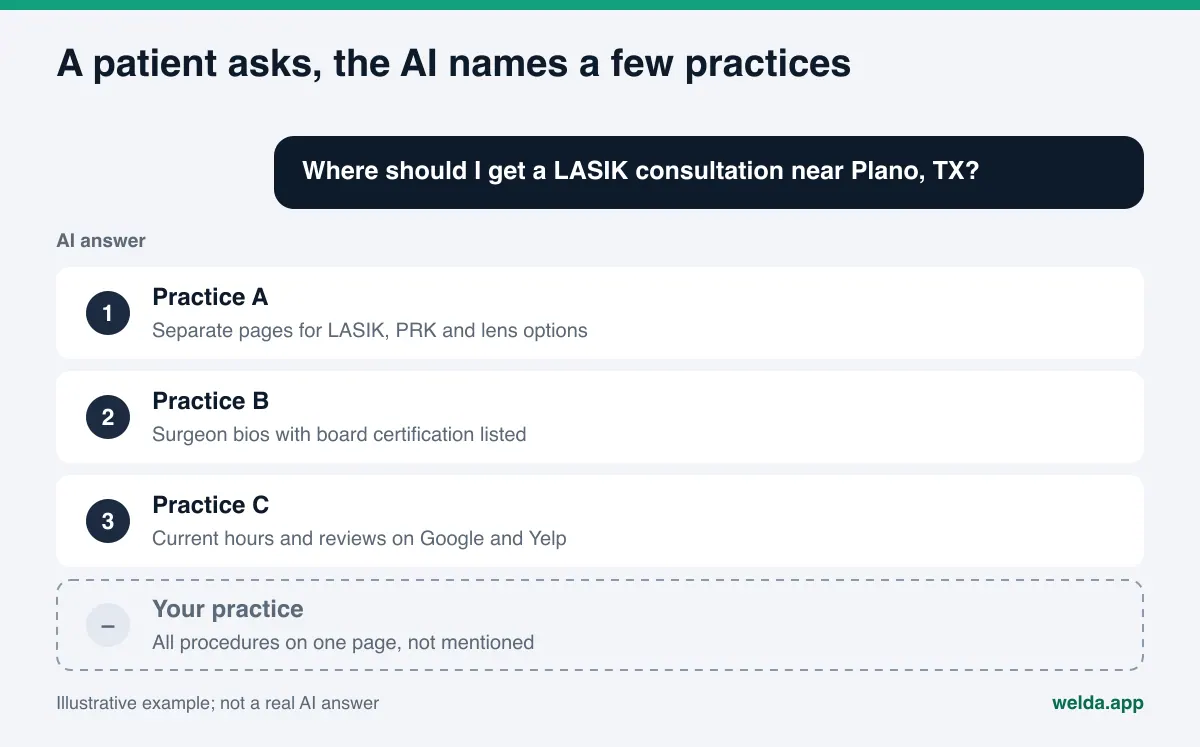
Why patients now ask AI about eye care
Vision correction is a considered decision. Someone tired of contacts reads about LASIK, PRK and lens-based options, wonders whether they qualify, compares costs and financing, and only then picks a practice. An adult child helping a parent with cloudy vision wants to know how cataract surgery works, how long recovery takes and which surgeons nearby do it. These steps used to be spread across many searches and review sites. With AI assistants they often happen in one conversation: the patient types their city, their situation and their insurance, and the assistant replies with a few practice names.
If your practice is not in that answer, it is not on the shortlist. On a classic results page, ranking sixth still earned some clicks. An AI answer usually names only a handful of options, and many patients choose from those. So AI search visibility is less a marketing preference and more a question of how new patients find you at all.
Eye care has a few traits that make this harder than for many local businesses:
- A wide range of procedures. LASIK, PRK, SMILE, implantable lenses, refractive lens exchange, cataract surgery, glaucoma care, retina care, keratoconus treatment, pediatric eye exams, dry eye care. Each one is a separate question with a separate answer. A single "Services" page rarely wins any of them.
- Candidacy drives the conversation. Most LASIK questions start with "Am I a candidate?" A page that explains what the consultation evaluates, without making the decision for the reader, is the natural answer.
- Different audiences. Refractive patients tend to be working adults; cataract patients are often older and research together with family; pediatric eye care is researched by parents. One website has to serve all three.
- Claims are regulated. Health advertising in the U.S. has to be truthful and substantiated, and the FDA and FTC both publish consumer guidance on LASIK that patients and AI systems can read alongside your pages.
What AI engines look for in AEO for eye clinics and LASIK centers
AI engines do not know your practice from experience. They search the web, read the pages they find, combine the facts and pick the options that best match the question. The first requirement is that your site can be read at all. ChatGPT's search feature uses a crawler called OAI-SearchBot, and OpenAI's crawler documentation states that sites opted out of OAI-SearchBot will not be shown in ChatGPT search answers. On Google, AI Overviews and AI Mode have no extra technical requirements: Google's AI features guide says a page needs to be indexed and eligible to show with a snippet, and that even this does not guarantee inclusion.
Once your site is readable, here is the information engines look for when they answer eye care questions:
| Information | Where it should live | What happens if it is missing |
|---|---|---|
| Which procedures you perform | A dedicated page for each major procedure | The engine knows you as "an eye doctor" but skips you for "cataract surgeon" |
| Surgeons and credentials | Doctor bios: training, board certification, focus areas | Trust signals stay weak and another practice gets named |
| Consultation process | On LASIK and cataract pages or a separate page | Nothing to cite when a patient asks "am I a candidate" |
| Name, address, phone, hours | Every page, Google Business Profile, Apple Maps, Yelp | Outdated or conflicting details end up in the answer |
| Insurance and payment | A clear page or FAQ section | You are left out of "does my plan cover it" questions |
| Reviews and third-party mentions | Google, Yelp, Healthgrades, local health directories | The engine has no second source to confirm you |
Every row is a piece of the answer the engine builds from your information. If a patient asks for "an eye doctor open Saturday near me", the engine looks for your hours. If it cannot find them, or your website and your Google listing disagree, it may leave you out. We cover this in more detail in our guide on how to keep business hours accurate for AI.
What patients ask AI about LASIK, cataracts and eye exams
The fastest way to build your question list is to ask your front desk. The questions they hear on the phone every week are very close to the questions patients now type into AI assistants. The diagram below sorts typical eye care questions into four groups. The examples are illustrative, written from the common topics of eye practices, not from a measurement.
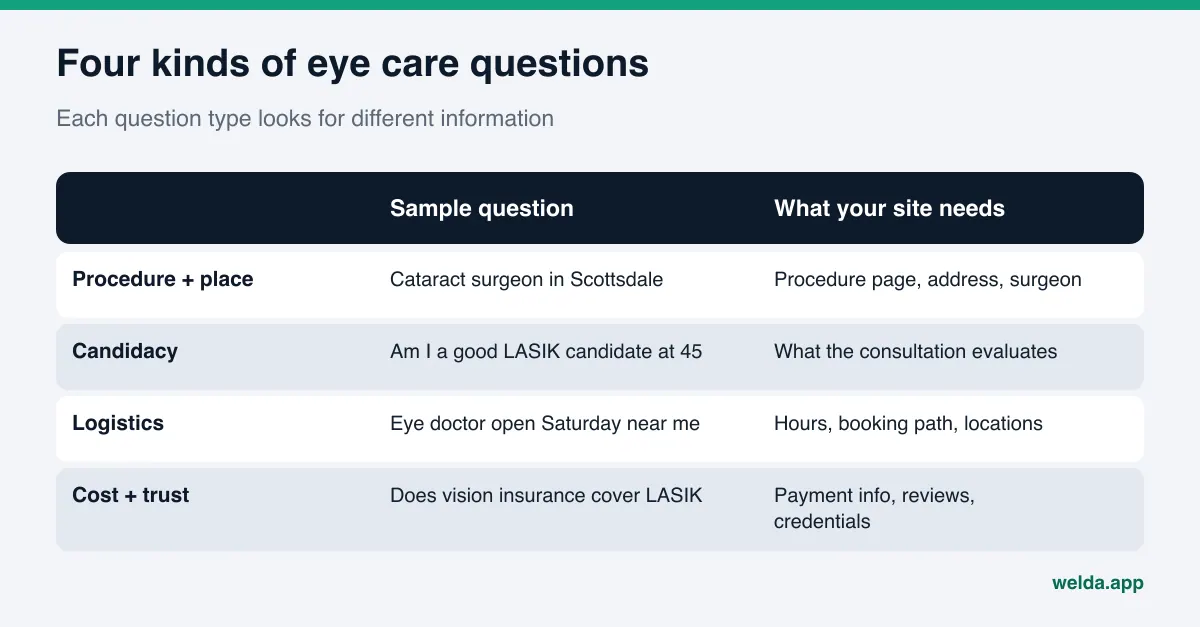
These four groups map directly to pages. Procedure and place questions need procedure pages. Candidacy questions need a clear explanation of the consultation. Logistics questions need hours, locations and a booking path. Cost and trust questions need payment information, reviews and credentials. On cost, keep in mind what the FTC tells consumers in its basics of LASIK eye surgery page: most insurance plans don't cover the surgery. Patients arrive with that in mind, so a calm, accurate page about payment options answers a real question.
If a competing practice keeps showing up where you do not, our guide to AI competitor analysis explains how to find which question types and which sources give them the edge.
Step by step: the work for an eye practice
The order below starts with the technical basics and moves to content and third-party sources. Order matters; adding pages to a site that crawlers cannot read does not help.
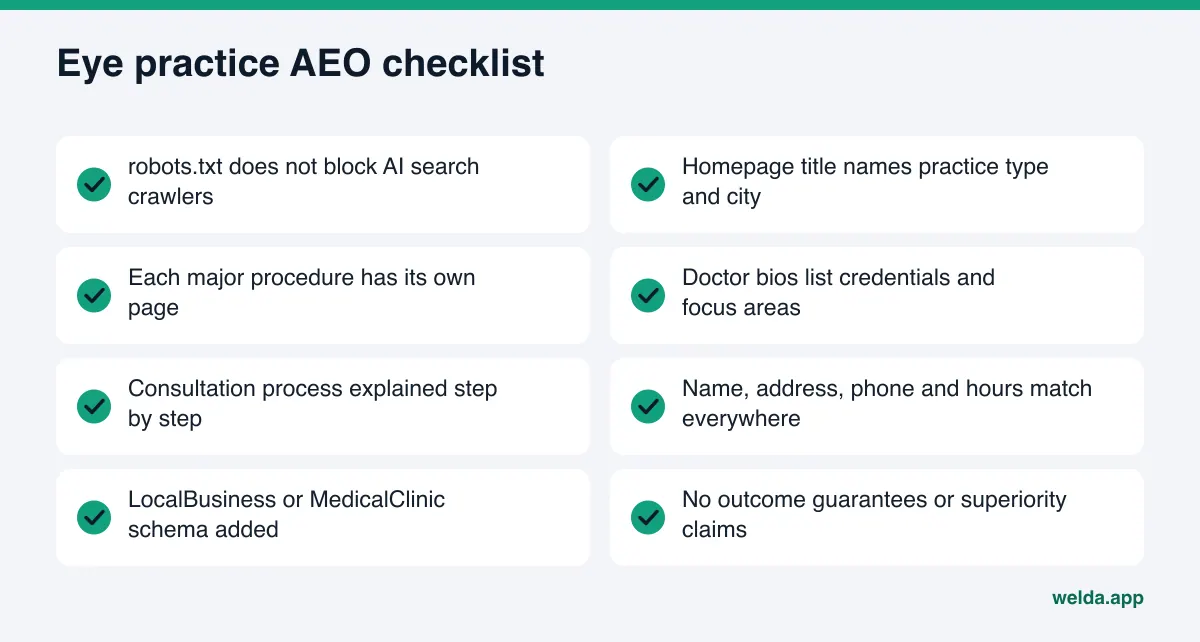
- Check robots.txt. Look for rules that block AI search crawlers. Web vendors sometimes block all bots for security reasons. If so, even excellent content stays invisible to AI engines.
- Tighten the homepage title and description. Name the practice type and city: "Eye Care and LASIK Center in Plano, TX" says more than a brand name alone. The description should list your main procedures in two sentences.
- Give each major procedure its own page. LASIK, PRK or other laser options, lens-based procedures, cataract surgery, glaucoma care, retina care and pediatric eye exams each deserve a page. Each page should explain what the procedure is, how candidacy is evaluated and what the process looks like from consultation to follow-up.
- Write proper doctor bios. List training, board certification, the procedures each doctor performs and the conditions they focus on. AI engines need to connect "cataract surgery" with a named surgeon at your practice.
- Explain the consultation. Describe how long it takes, which measurements are taken, when patients should stop wearing contact lenses before the exam and whether they should arrange a ride. Have your clinical team review every line.
- Make your listings match. Your name, address, phone and hours should read the same on your site, your Google Business Profile, Apple Maps, Yelp and Healthgrades. Add the same details to the page as structured data (schema).
- Answer real questions on each page. Add five or six short FAQs per procedure. Our guide to FAQ pages for AEO explains how to write them so engines can quote them.
- Review third-party sources. Are your categories, hours and photos current on Google? Is your directory profile accurate? Are there unanswered reviews on Yelp? AI engines use these sources to confirm what your site says.
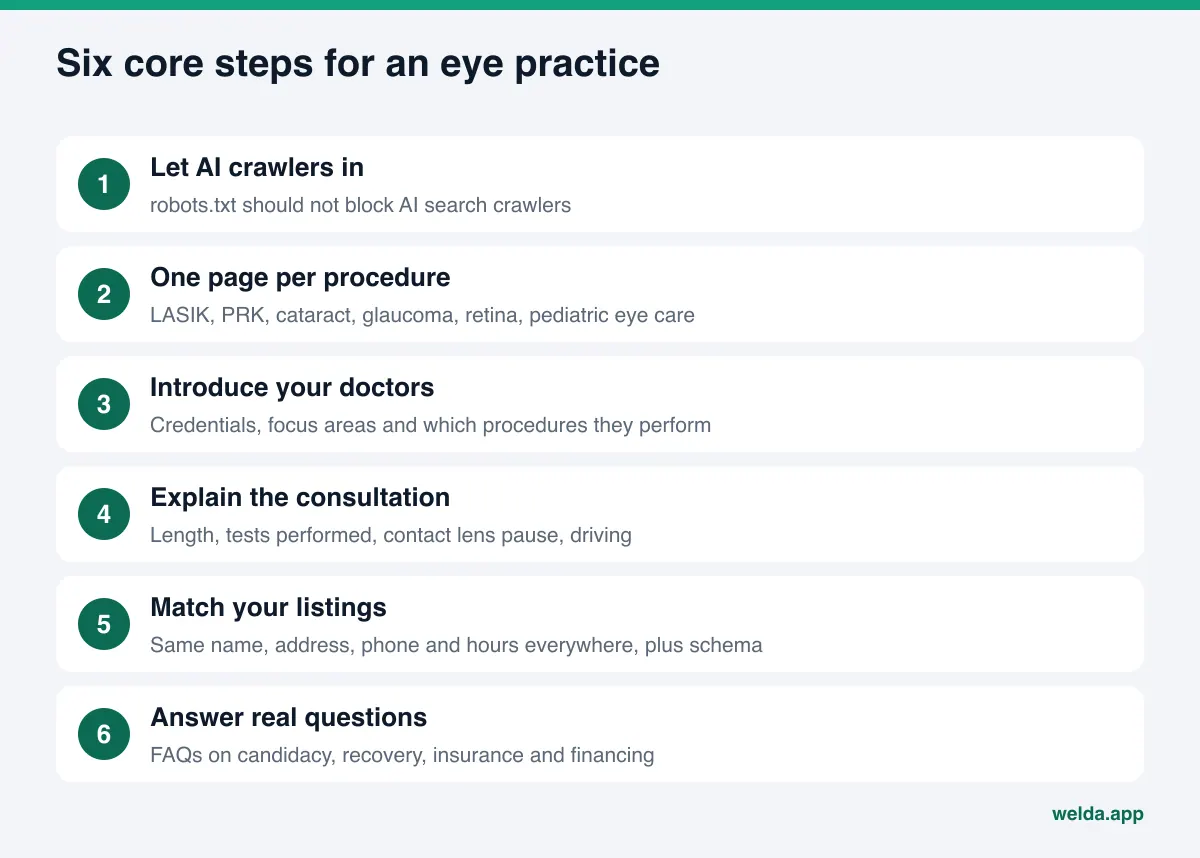
Most of these steps are done once and then maintained. Procedure pages take the most effort because each needs clinical review. The goal is not long pages but pages that answer the patient's question plainly. A cataract page is doing its job if it answers: what a cataract is, how surgery is performed, which exams come first, what happens on surgery day, how follow-up visits work, which lens options patients typically discuss with the surgeon, and which insurance plans the practice works with.
Writing LASIK and cataract content that stays within the rules
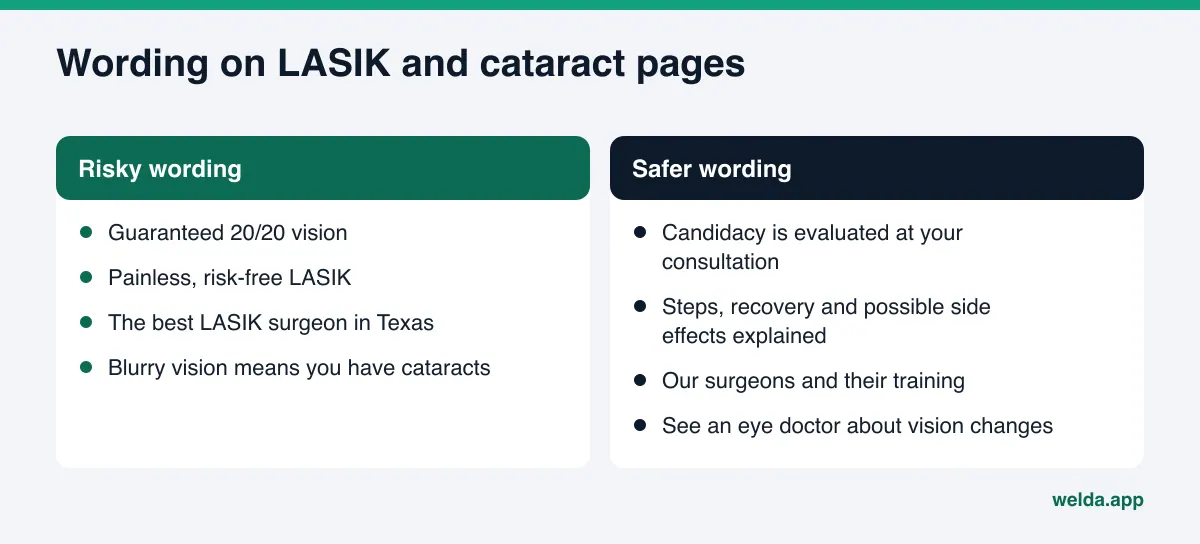
Most content problems on eye care sites fall into two groups: outcome promises and superiority claims. "Guaranteed 20/20", "painless and risk-free", "the best LASIK surgeon in the state" are the kind of claims that draw scrutiny under truth-in-advertising rules. They are also weak signals for AI engines, which look for facts they can verify, not adjectives.
A practical rule: describe what you do, do not promise the outcome. Explain that candidacy is evaluated at the consultation, describe the steps of the procedure, list possible side effects and describe the follow-up schedule. The FDA's LASIK surgery checklist is a useful reference point here: it reminds patients about possible glare, halos, difficulty with night driving and dry eye. A practice page that discusses these topics openly matches what patients have already read, and it reads as more credible. On symptom pages, avoid diagnosis: instead of "blurry vision means you have cataracts", say "see an eye doctor about changes in your vision".
For a broader look at health claims and AI-ready content, see our guide on compliant AEO content for healthcare practices. Nothing here is legal advice; review your content with your own counsel.
How to measure AEO for eye clinics and LASIK centers
After fixing your site, you need to know whether it is working. Asking ChatGPT one question once is misleading, because the same question can get a different answer an hour later. A more reliable measurement asks a list of patient questions across several engines, more than once each.
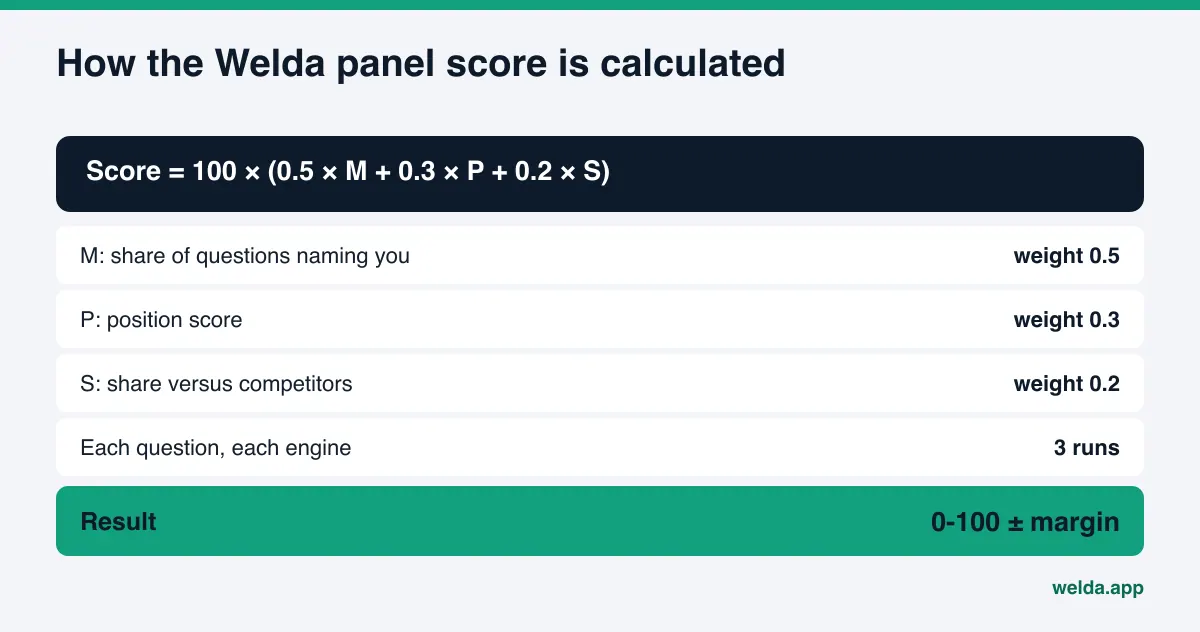
The Welda panel score follows that logic, and the formula is open: 100 × (0.5 × share of questions where your name appears + 0.3 × position score + 0.2 × share versus competitors). Each question is asked three times in ChatGPT, Gemini, Perplexity and Google AI, and the spread across those three runs produces a ± margin. That margin helps you tell whether a small move in the score is real or just normal variation in AI answers.
When you build a question list for an eye practice, combine procedures and places. For example, five procedures (LASIK, cataract, glaucoma, retina, pediatric) across three cities or neighborhoods you serve already give you fifteen core questions, before you add hours, insurance and candidacy questions. This is an example of how to build the list, not a recommended number. Our guide on how to read your AI visibility report walks through what each part of a report means.
How Welda handles AI visibility for an eye practice
Welda is software that measures where a business appears in AI answers and fills the gaps on the business's behalf. Here is the honest status: the Welda panel is in early access and is opening first in Turkey. Regular four-engine measurement is being added during early access, and sample panel screens are shown with representative data. What anyone can use today, in English, is the free AI visibility analysis. Below are the three parts that matter most for an eye practice.
The free analysis: what your site tells AI today
The free analysis reads your homepage and a few inner pages, such as services, pricing, about and contact, the way Google and AI systems do. For an eye practice, it shows whether AI crawlers can access the site, whether your title and description name your practice type and city, whether business details are marked up as schema, whether your address and phone are consistent, whether your map and social profiles link back to the site, whether you have an FAQ section, whether reviews and trust signals are visible, whether procedures are described clearly, and how fast the page loads.
You get a score out of 100 with technical and content parts shown separately. Each issue comes with what was found, why it matters and how to fix it. For the homepage you get ready-to-use text suggestions: title, description, main heading, intro paragraph and FAQs. A simulation shows how much each fix would move the score, so a practice can decide whether to start with schema, with the procedure description or with hours. There is a competitor comparison, a fix package with schema code you can add to the site, a PDF and a shareable score card. The analysis also asks five patient questions to an AI assistant that can search the web and checks whether your practice name appears. That is a one-time snapshot, not ongoing tracking. Each site gets one free analysis; email and phone are verified, and the results link arrives by email and stays open for 14 days. The analysis does not measure rankings and does not promise any.
The question view: which procedures name you
In the panel, the questions screen lists each patient question and shows, engine by engine, whether your practice was named and in what position. For an eye practice this view is often uneven: you might be named for LASIK questions in a couple of engines and not at all for cataract questions. That tells you which procedure page to work on first. The competitors screen then shows which topic a rival wins and which source the engine cited, and the sources screen shows the sites AI draws on and where you are missing.
Prepared content, your approval
When Welda finds a gap, it turns it into a task: no cataract page, doctor bios without focus areas, no consultation explanation, hours on Google that differ from the site. Welda drafts the content, profile text and review replies. It does not invent what it does not know. Details like which surgeon performs which procedure, accepted insurance plans or the lens options you offer are left blank and asked of you. There is no automatic publishing for healthcare businesses; every piece of content goes to an approval queue, and patient data is never sent to AI. A compliance check flags patterns like pricing, guarantees, superiority claims and diagnostic suggestions before anything goes live. It is not legal advice and has not been reviewed by legal counsel. Content always lives on your own website; Welda does not host it. On WordPress, Welda connects through a separate Editor user and an application password, with no code to install, and opens drafts on your site. On other platforms you get a ready-made package to apply by hand.
Limits: what Welda does not do
Knowing the limits up front keeps expectations realistic.
- No ranking guarantee. Welda does not promise that you will show up in ChatGPT or hold a specific position. No software controls what AI engines say.
- No invented facts. Surgeon details, procedure names, technology and insurance information come from you. A blank field stays blank until you fill it.
- No unapproved health content. An eye practice is a healthcare business, so every piece goes through approval.
- No fake reviews. Welda can draft replies to real patient reviews; posting them is your call. It never generates reviews.
- Some work stays with you. Handling negative reviews, managing directory accounts such as Healthgrades or Yelp, and press work remain with the practice. Welda lists them as manual tasks.
- Results take time. New content usually takes weeks to show up in AI answers. Expect patience between one measurement and the next.
Decision checklist: is your eye practice ready?
Use this list to judge where your site stands today. Answer yes or no to each item. Every "no" is a task for the top of your list.
Alongside the checklist, this table helps you decide what to do first:
| Situation | First move |
|---|---|
| Site blocks crawlers or loads slowly | Technical fix: robots.txt and page speed |
| Site is open but every procedure sits on one page | Separate LASIK and cataract pages, then the rest |
| Procedure pages exist but surgeons are vague | Doctor bios, linked from each procedure page |
| Content is solid but listings disagree | Align Google Business Profile, Apple Maps, Yelp and directories |
| Everything is in place but a competitor leads | Measure question by question and study the sources they win from |
Frequently asked questions
Is AEO for eye clinics different from regular SEO?
The foundations overlap: a readable site, clear titles, accurate business details. The difference is that AI engines build an answer from several sources instead of listing one page. Your procedure pages, surgeon bios and third-party listings need to confirm each other.
Do I really need separate LASIK and cataract pages?
Yes, in most cases. The two procedures have different patients, questions and processes. On a shared page, the engine may see you as a weak match for both. Separate pages answer each question directly.
Should I publish LASIK prices on my site?
That is a business and compliance decision for your practice and your counsel. If you do, make sure any price is accurate and complete. Welda's compliance check flags price patterns before publishing so you can review them.
Will Welda publish content for my practice automatically?
No. For healthcare businesses every item goes to an approval queue. On WordPress, approved drafts are published on your site; on other platforms you apply the package yourself.
Does the free analysis work for U.S. practices?
Yes. The free analysis works in English and reads any public website. The full panel is in early access and is opening first in Turkey.
How soon will I see changes?
New content usually takes weeks to be reflected in AI answers. Measure on a regular schedule and read small changes together with the margin of error.
Your next step
AEO for eye clinics and LASIK centers starts with a few well-built pages and consistent details, then continues with regular measurement. First see how your site reads today: what is missing, which fix moves the score most and where competitors are ahead. Run the free AI visibility analysis; after email and phone verification, your results link arrives by email and stays open for 14 days. If you want to talk about the panel, pricing is discussed in an early access conversation.