What does AEO for law firms actually involve? When ChatGPT, Gemini, Perplexity or Google's AI Overviews recommend a lawyer, they lean on clear facts they can find on your website and in the places that mention your firm: which practice areas you handle, where you are, who your attorneys are and how you explain the legal process. Publishing that information accurately, consistently and within your state's advertising rules makes it more likely your firm is named in those answers. No one can guarantee a specific position.
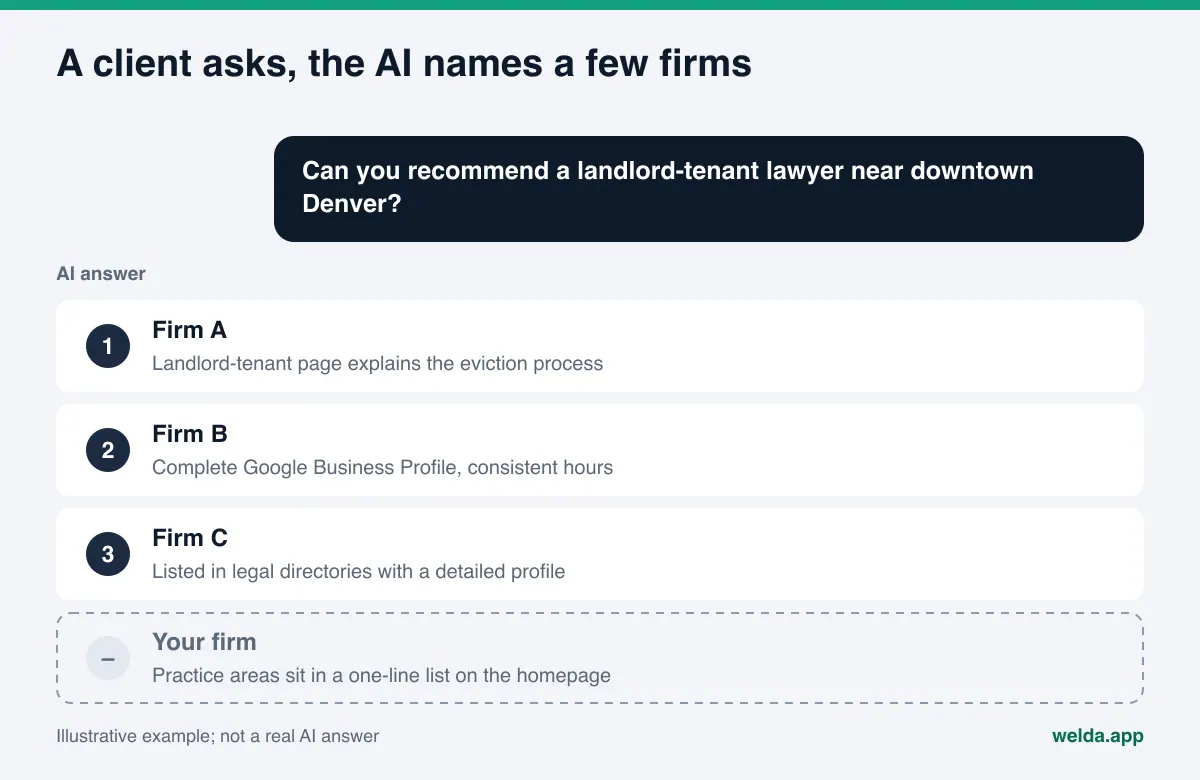
This guide is for solo attorneys, small and mid-sized firms, and the marketing or operations people who run a firm's website. The question is simple. When someone types "Can you recommend a landlord-tenant lawyer near downtown Denver?" or "I need a probate attorney in Columbus, who should I call?" into an AI assistant, does your firm come up? If not, why not, and what can you fix without stretching the professional conduct rules? We cover the problem, the steps, how Welda does this work and what it does not do. If you want to see where your site stands today, start with the free site analysis.
Why AEO matters for law firms now
People rarely plan to need a lawyer. A landlord files for eviction, an employee is let go and wonders about unpaid overtime, siblings disagree over an estate, or a small business owner cannot collect on an invoice. In the past that person would ask a friend, search for "lawyer near me" and click through a few firm websites. Today a growing part of that research happens in a single conversation. The person describes the problem, the city and the urgency in a few sentences, and the assistant replies with a general explanation and a short list of firms.
A firm that is not named in that answer does not make the shortlist. In a classic results page, ranking eighth still offered a chance at a click. An AI answer usually names a handful of firms, and the reader tends to choose among them. Answer engine optimization, or AEO, is the work of making sure your firm is one of the names an assistant can confidently mention. You may also see it called GEO (generative engine optimization); in the US, AEO and "AI search visibility" are the more common terms.
Law firms face a few conditions that most local businesses do not:
- Advertising is regulated. A pizza place can call itself the best in town. A law firm cannot write the same kind of claim without risk. Visibility has to be built on accurate, verifiable information, not on bold marketing copy.
- Questions are practice-specific. Nobody asks for "a lawyer" in general. They ask about family law, landlord-tenant disputes, employment claims, probate, criminal defense, personal injury or business disputes. If the assistant cannot read that you handle a given area, it cannot recommend you for it.
- Trust decides the click. The reader is making a decision about money, a job, a family or their freedom. Who the attorney is, where they are admitted and how long they have practiced are trust signals for people and for AI systems alike.
- Location and jurisdiction matter. Many questions include a city, county or courthouse. If your address and the counties you serve are missing, local questions are hard to win.
A firm whose website offers one "About us" paragraph and a single line listing practice areas gives an AI assistant very little to work with. The fix is not more advertising. It is more information.
Do the lawyer advertising rules allow AEO?
This is usually the first question attorneys ask, and it is a fair one. The ABA Model Rule 7.1 prohibits false or misleading communications about a lawyer or the lawyer's services, and the comments explain that even truthful statements can mislead, for example a report of past results that suggests the same outcome for other clients. Each state adopts its own version of the rules, and some add requirements on testimonials, disclaimers or claims of specialization. Your state bar's rules are the ones that apply.
AEO, done properly, is not a way around those rules. AI assistants draw far more on concrete, checkable facts than on praise: the firm's name, address, attorneys, practice areas, how a type of case generally proceeds and how to schedule a consultation. That is the kind of information the rules are designed to allow. The more inflated the marketing language, the higher the compliance risk and the less useful the page becomes to an assistant looking for facts.
A plain caveat: this article is not legal advice, and it is not ethics guidance. Your state bar and its ethics opinions decide what counts as misleading. We only describe how AI answers are assembled and how the underlying information can be written in an informative way. If you are unsure about a phrase, check your state's rules before you publish.
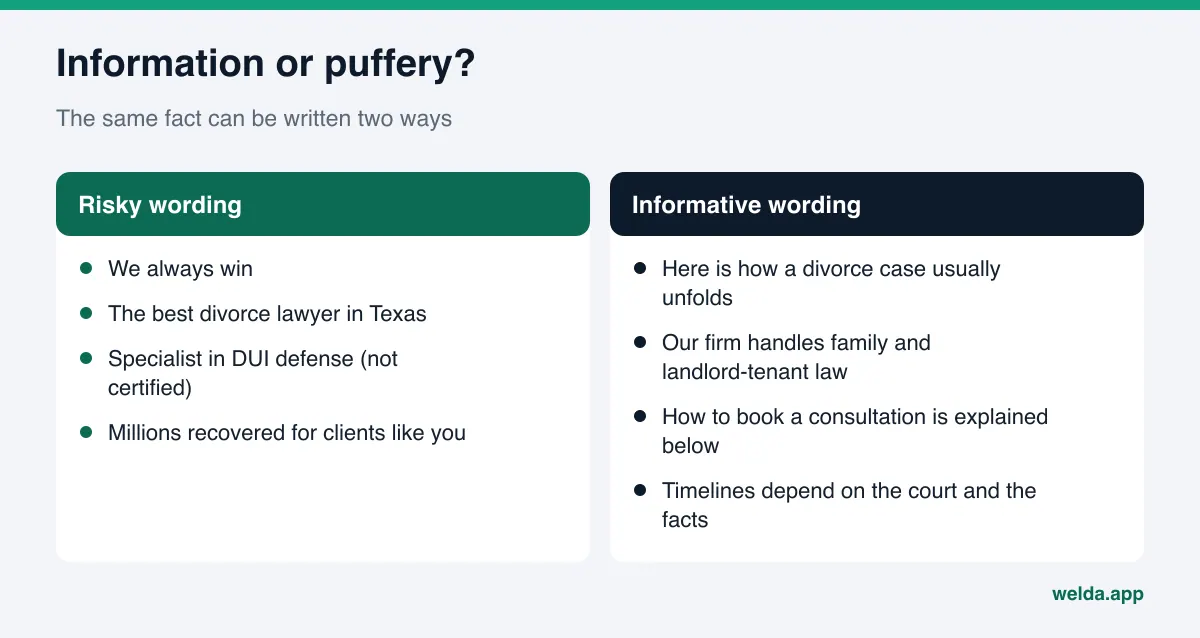
In practice the line often comes down to what a sentence promises. "We always win" is a promise about results. "A contested divorce usually moves through filing, discovery, mediation and, if needed, trial; timing depends on the court and the facts" is information. The second sentence is closer to the rules, and it is also exactly the kind of sentence an assistant can use when someone asks how long a divorce takes.
Which facts do AI assistants use to recommend a law firm?
When an assistant builds a list of firms, it draws on two kinds of sources. The first is your own website. The second is what other sites say about you: your Google Business Profile and Google Maps listing, legal directories, state bar listings, local news, forums and review sites. Google's documentation for site owners on AI features explains that AI Overviews and AI Mode have no extra technical requirements beyond normal Search: a page needs to be indexed and eligible to show a snippet. The core job is to make your pages readable and clear.
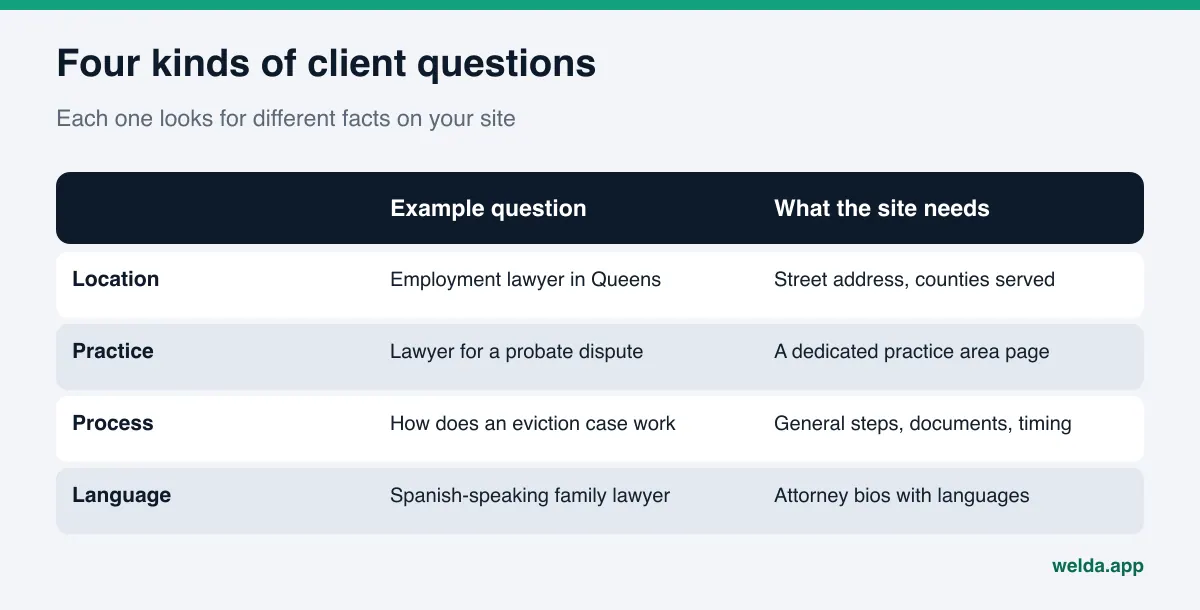
It helps to group client questions into types. Each type looks for different facts on your site:
| Question type | Example | What the assistant looks for | Where it should live on your site |
|---|---|---|---|
| Location | "Employment lawyer in Queens" | Street address, city, counties and courts served | Contact page, footer, structured data |
| Practice area | "Lawyer for a probate dispute" | A page that clearly describes the practice area | One page per practice area |
| Process | "How does an eviction case work in Colorado" | General stages, documents, what affects timing | Inside the practice page, FAQ section |
| Person and language | "Spanish-speaking family lawyer" | Attorney name, bar admissions, languages | Attorney bio pages |
| Consultation | "What happens in a first meeting with a lawyer" | How to book, office hours, virtual options | Contact page, FAQ section |
Try filling this table in for your own firm. Every row where you write "not on our site" is a likely reason you are missing from that kind of answer. If you want a more detailed method for finding the real questions people ask, see our guide on how to find the questions customers ask AI.
AEO for law firms, step by step
Most of the steps below can be done by any firm with a website and a Google Business Profile. Order matters: open the technical door first, then write the content, then tidy up the outside sources.
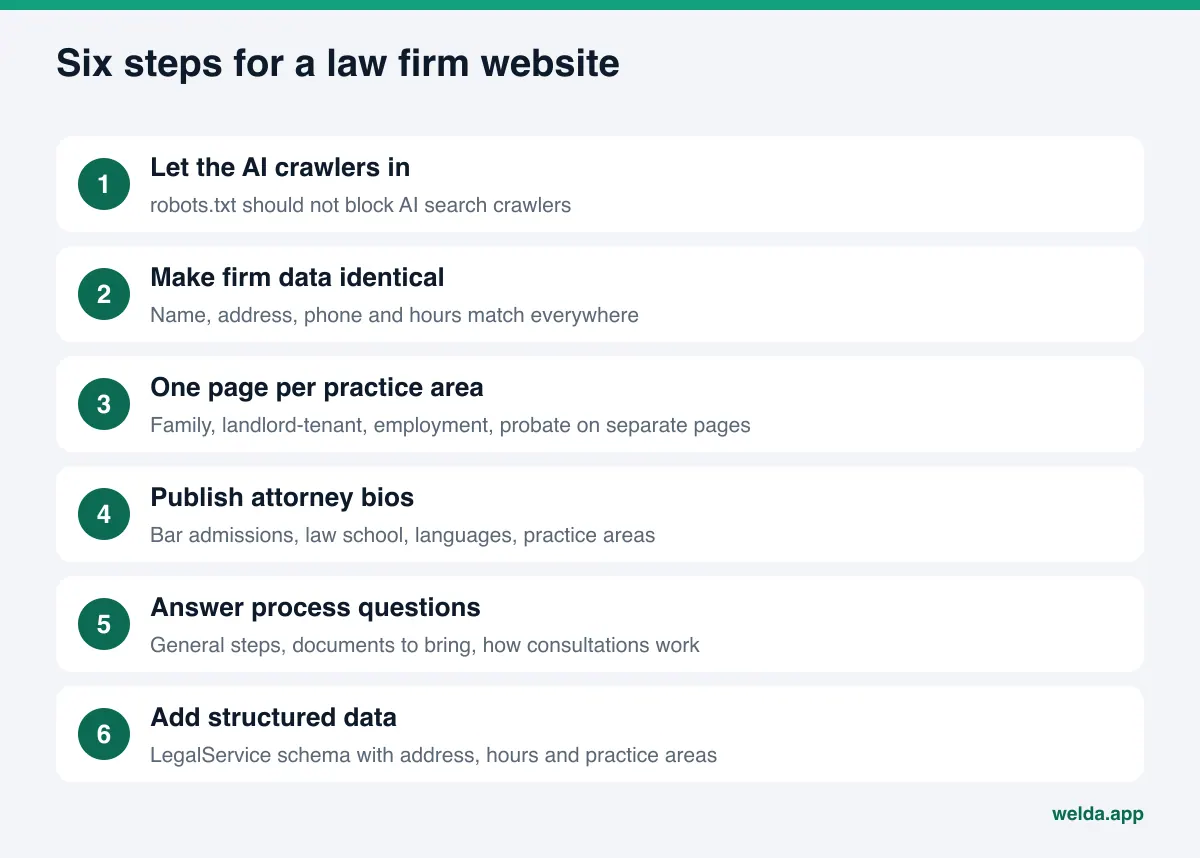
- Make sure AI crawlers can reach your site. If your
robots.txtfile blocks search and answer engine crawlers, even a great page will not be read. OpenAI's crawler documentation describes OAI-SearchBot, which it uses for ChatGPT search results, separately from its other bots. Some website templates and security plugins block these crawlers without anyone noticing, so it is worth checking once. - Make your firm data identical everywhere. Firm name, address, phone number and hours should match exactly on your site, your Google Business Profile, your state bar listing and legal directories. If one place says "Smith & Lee LLP", another "Smith Lee Law" and a third "Smith and Lee Attorneys", an assistant may struggle to tell they are one firm. If you moved, the old address should not survive anywhere.
- Give each practice area its own page. A single line reading "family law, criminal defense, employment, business litigation" is not enough. Each area deserves a page that explains which kinds of matters you take, how the process generally works and what a client should bring to a first meeting.
- Publish attorney bios. For each attorney: name, state bar admissions, law school, year admitted, languages spoken and practice areas. These are verifiable facts, not self-awarded titles. Be careful with words like "specialist" or "expert"; many states restrict them unless the lawyer holds a recognized certification. For more on this, see our article on about page trust signals for AI.
- Answer process questions as general information. People often start with a process question: "How long does probate take in Ohio?", "Do I need a lawyer for small claims court?" Clear, careful, general answers on your practice pages give an assistant something to cite. End each answer by noting that advice on a specific situation requires a consultation.
- Add structured data. Schema markup gives machines the firm type, address, hours and contact details in a predictable format. The fitting type for a law firm is LegalService, which schema.org describes as a business that provides legally oriented services, advice and representation.
- Keep your Google Business Profile current. Category, address, hours and description should match your site. In the description, list practice areas and how consultations work rather than results or superlatives.
- Reply to reviews with care. Replying is a trust signal, but confidentiality duties still apply. A reply should never confirm that the reviewer was a client, mention case details or argue the facts. We cover this in more depth in our guide to review responses for AI visibility.
How to write a practice area page an AI can use
Practice area pages take the most effort and make the biggest difference. A good one explains how a matter typically unfolds, says what your firm does in that area and promises no outcome. Here is a skeleton for a landlord-tenant page:
- Opening: Which matters the firm handles. For example, evictions, security deposit disputes, lease disputes and habitability claims. Two or three sentences.
- Process: The general stages of a case in your state, such as notice, filing, hearing and judgment, with references to the relevant statute where helpful.
- Documents: What a client should bring: the lease, notices, payment records, photos and messages.
- What affects time and cost: Without numbers or promises, the factors that drive timing and fees, such as the court's calendar, whether the other side contests and whether settlement is possible.
- FAQ: Four or five questions people actually ask about this area, with general answers.
- Consultation: How to book, whether virtual meetings are available and which counties you serve.
That structure tells readers and AI systems the same thing: this firm handles landlord-tenant matters in this area, understands the process and explains it openly. Nothing is exaggerated, yet everything an assistant needs to name you for "landlord-tenant lawyer in Denver" is on the page.
A common mistake is to fill practice pages with statute text alone. Citing the law helps, but the reader's real question is not "what does the statute say" but "what happens in my situation, and who should I call." A page that explains the general process and says case-specific advice comes in a consultation answers both questions honestly.
Where AI assistants read about your firm
Fixing your site is half the job. Assistants also look at what other sites say about your firm and may cite those sources in their answers. For US law firms, common sources include:
- Google Business Profile and Google Maps: Address, hours, reviews and category. One of the strongest sources for local questions.
- State bar directories: Many bars publish a lawyer lookup with admission status. Your name and details on your site should line up with that record.
- Legal directories: Sites such as Avvo, Justia, FindLaw and Martindale-Hubbard list attorneys by practice area and city. If you have profiles there, keep them accurate and consistent.
- Review sites: Yelp and the BBB can surface in answers about local firms. You cannot edit what is written there, but you should know what it says.
- Local news, bar publications and articles: Bylined articles and interviews connect an attorney's name to a specific practice area.
Which source matters most depends on the city and the practice area. We explain the general mechanics in our guide on how to get cited by AI.
How Welda handles AEO for a law firm
Welda is software that measures where a business appears in AI answers and prepares the missing pieces on the business's behalf. For a law firm, three parts matter most: question tracking, the compliance check and the to-do list.
Question tracking: which practice areas are you missing? In the Welda panel, the questions prospective clients are likely to ask are put to ChatGPT, Gemini, Perplexity and Google AI three times each. For a firm, those questions are built around practice areas and locations, such as "landlord-tenant lawyer in Denver," "probate attorney near Columbus" or "how does an eviction case work." The questions screen shows, question by question, which engines name your firm and in what position. If you appear for family law questions but never for landlord-tenant questions, you know the problem sits on the landlord-tenant page. The decision left to you is where to invest first.
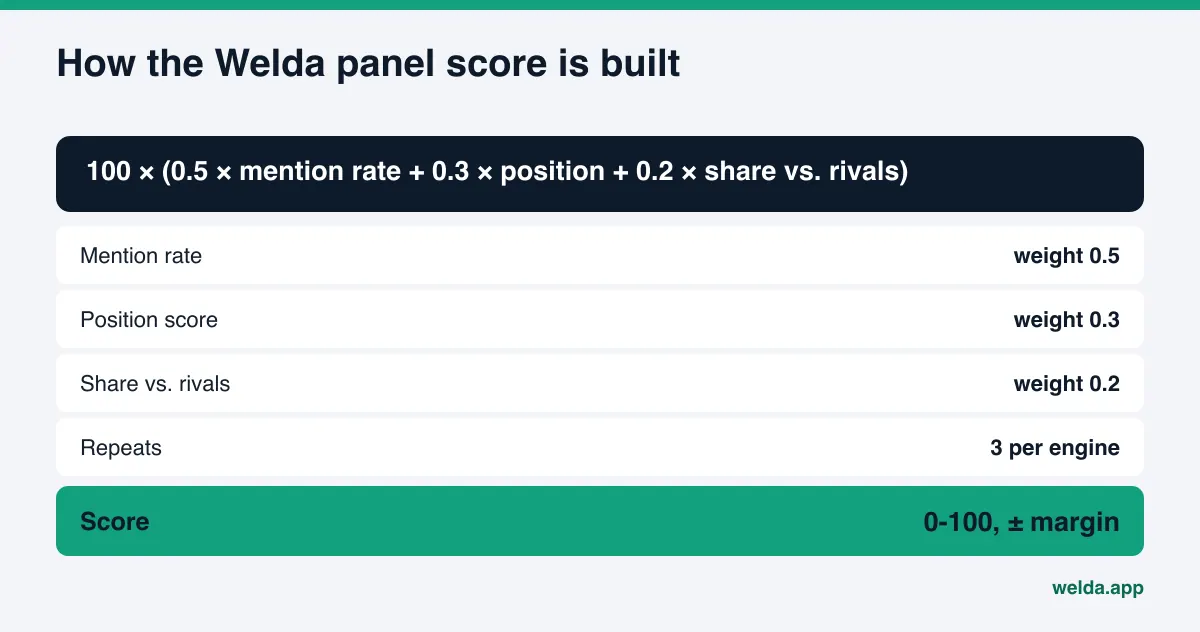
The score behind that screen uses a published formula, shown above. Because each question runs three times per engine, the panel also reports a margin of error, so a small move from one week to the next is not mistaken for progress.
Compliance check: risky phrases are flagged before anything goes live. Every text Welda prepares, and text you add yourself, passes a check before publication. Patterns such as prices, guarantees, promises about results and superiority claims are flagged. On a law firm site, a line like "we always win" or "the most experienced firm in the city" would be flagged, with a more informative alternative suggested next to it. This check is not legal advice and has not been reviewed by legal counsel. The final call belongs to the person who knows the professional conduct rules best: you.
To-do list: what Welda prepares and what stays with you. The to-do list shows three kinds of work. First, information Welda needs from you. Welda does not invent facts; if your site does not say where each attorney is admitted, which counties you serve or whether consultations can be held by video, it asks, and then applies your answer across every draft. Second, content waiting for approval: practice page drafts, FAQs, profile descriptions and review replies. Third, manual tasks, such as updating a directory listing that cannot be connected. Ready-to-use text sits next to each one.
If your site runs on WordPress, Welda connects through a separate Editor user and an application password you create, with no code to install. A new practice page opens on your site as a draft and goes live only after you approve it. On other platforms, Welda provides a ready package and you or your web person apply it. Your content always lives on your own website.
The rest of the panel, including competitor insights, the sources AI draws on, before and after comparisons and a one-page monthly report, supports these three parts.
Where things stand today: the Welda panel is in early access and is opening first in Turkey. Regular four-engine tracking is being added during early access, and sample screens in the panel use representative data. The part anyone can use today, in English, is the free site analysis. Pricing is discussed in the early access conversation.
What the free site analysis checks on a law firm website
Before any tracking, the free analysis is a solid first look. It reads your homepage and a few inner pages, such as practice areas, about and contact, the way Google and AI systems do. For a law firm it answers questions like these:
| What the analysis checks | What it means for a law firm |
|---|---|
| AI crawler access (robots.txt) | Can assistants read your firm's site at all |
| Page title, description and main heading | Are firm name, city and practice areas clear at a glance |
| Business structured data (schema) | Can machines read the firm, address and hours |
| Address, phone and location details | Is contact information clear and consistent |
| Linked social and map profiles | Is your Google Business Profile connected to the site |
| FAQ section | Are common process questions answered |
| Clearly described services | Are practice areas distinct and understandable |
| Reviews, trust signals, page speed | Are trust details and technical basics in place |
You get a score out of 100, split into technical and content, plus what was found for each gap, why it matters and how to fix it. You also get suggested homepage copy (title, description, main heading, intro paragraph and FAQs), a simulation of how much each fix would raise the score, a competitor comparison and a ready fix package that includes business schema code. The analysis also asks an AI assistant with web search 5 questions a client might ask and checks whether your firm is named; that is a one-time measurement. Each site can run the analysis once for free, and the results link arrives by email and stays open for 14 days.
Limits: what Welda does not do
In a profession with strict rules, it helps to know the limits up front:
- No guarantees. Welda does not guarantee rankings or that you will "show up in ChatGPT." AI answers vary; the same question can get a different answer on a different day.
- It does not make things up. If attorney admissions, education or practice areas are missing from your site, Welda asks rather than guesses.
- Nothing sensitive is published without approval. Approval always stays with the firm. On a law firm site, we recommend reading every text before it goes live.
- No fake reviews. Writing, buying or gating reviews is not part of Welda's work. See our article on fake review rules and AI visibility for why that matters.
- Not legal advice. The compliance check flags risky patterns. It does not decide whether a text complies with your state's rules.
- Some work stays with the firm. Handling negative reviews, managing directory accounts and press or article outreach are the firm's job. Welda can draft text, but it does not run those accounts for you.
- It takes time. New content usually takes weeks to show up in AI answers. Seeing no change in the first week is normal.
On client information, to be clear: Welda works with your firm's public information. Case files, client details and correspondence are not part of this work and should not be shared.
Decision guide and checklist for your firm
Every firm starts from a different place. Use the drawing below to pick a first step, then the checklist to see what is still open.
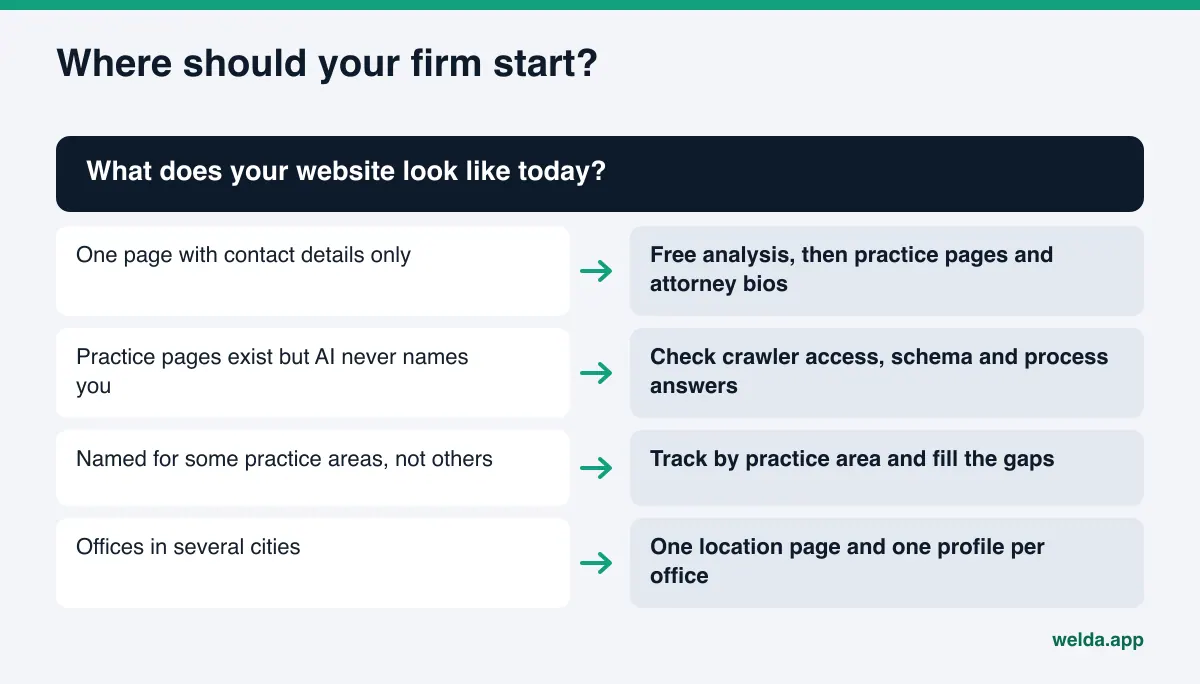
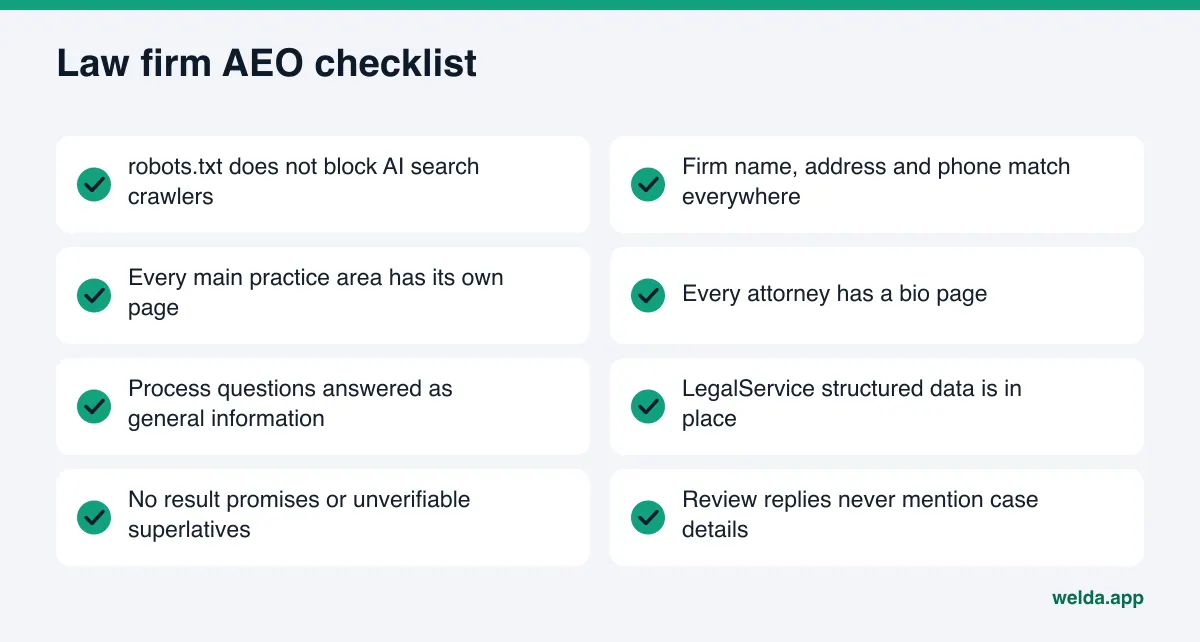
If you answer "no" to more than three items, fix the foundation first; the fix package from the free analysis is a reasonable starting point. If the foundation is solid and your real question is "which practice areas, which engines and how do we compare to other firms," you need regular tracking.
Frequently asked questions
Is AEO allowed under lawyer advertising rules?
AEO, done properly, means publishing accurate, verifiable information about your firm. ABA Model Rule 7.1 and your state's version prohibit false or misleading communications; your state bar decides where the line falls. Content that explains process and avoids result promises and superlatives sits closer to that line. This is not legal advice.
How long does it take for a law firm to show up in ChatGPT?
New content usually takes weeks to be reflected in AI answers. Timing depends on how often your site is crawled and how widely your firm is mentioned elsewhere. No exact timeline or result can be promised.
Do I really need a separate page for each practice area?
Client questions are practice-specific. If an assistant cannot clearly read that you handle probate, it cannot recommend you for a probate question. A one-line list does not carry that information; a short, clear page per main area does.
How should attorneys reply to online reviews?
Keep replies short, polite and general. Do not confirm the reviewer was a client and do not mention case details, the other party or the outcome. Confidentiality duties apply to review replies too, including replies to negative reviews.
Does Welda publish content to my site automatically?
On WordPress, Welda connects through a separate Editor user and opens content as a draft; nothing goes live until you approve it. On other platforms it provides a ready package that you apply yourself. Content always stays on your own site.
Is the Welda panel available to US law firms?
The panel is in early access and is opening first in Turkey. The free site analysis works in English today and is the best place to start. Questions in the panel can be tracked in English as well as Turkish.
Next step: see where your firm stands
AEO for law firms is not about louder marketing. It is about explaining clearly and consistently who your firm is, where it is and which matters it handles. That work does not have to conflict with the professional conduct rules; informative writing is closer to both the rules and the facts AI assistants look for. To see where to begin, run the free site analysis: you will see whether crawlers can reach your site, whether your firm details are readable and which fix should come first.