Why does AEO matter for home care agencies now? When a parent needs help at home, many adult children now start by asking an AI assistant which agencies serve their town. The answer usually names two to five agencies, and the family calls those. AEO for home care agencies is the work of making sure your agency is one of the names, described accurately, and this guide shows how to do it and how Welda handles it.
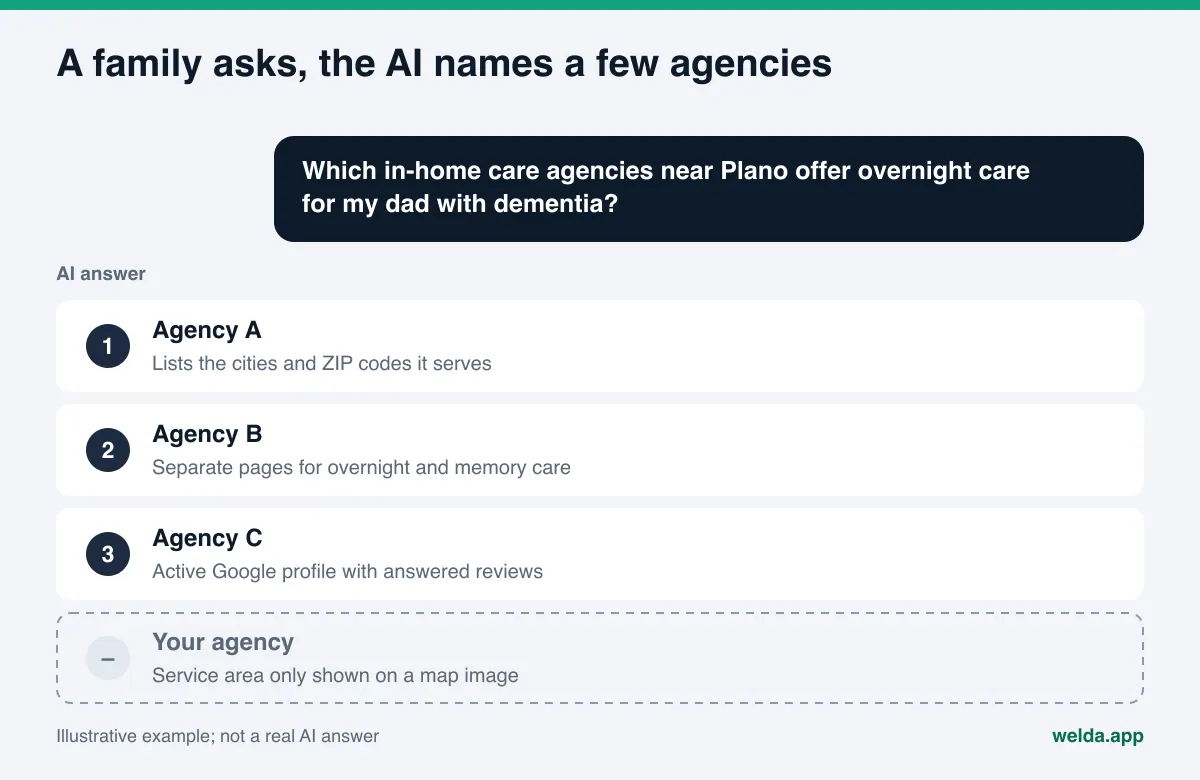
Home care decisions tend to happen fast. A hospital discharge, a fall or a new diagnosis leaves a family with a few days to arrange help. The person searching is often not the one who needs care but a son or daughter, sometimes in another state, typing questions into ChatGPT, Gemini, Perplexity or Google's AI Overviews late in the evening. They read a short list and pick up the phone. If you want to see how your site reads to these systems today, run the free AI visibility analysis; it reads your pages the way Google and AI assistants do and lists what is missing.
What is AEO for home care agencies?
AEO (answer engine optimization) is the practice of making your business easy for AI assistants to understand, trust and recommend. You will also see it called AI search visibility, or GEO (generative engine optimization), which means the same thing. In a classic search, a family sees ten links and opens a few. In an AI answer, they often see a handful of agency names, each with a one-line reason. If you are not on that short list, there is rarely a second look.
Three things make this sharper for home care than for most local services:
- It is local down to the ZIP code. Families ask about a specific city or suburb. If an AI assistant cannot read from your site that you serve that area, it will not recommend you there.
- The service comes in many forms. Personal care, companion care, live-in care, overnight care, respite care, memory care and post-hospital support all turn into different questions. A single "Our Services" paragraph rarely covers them.
- Trust decides everything. The family is letting a stranger into a parent's home. AI answers reflect that by leaning on reviews, caregiver screening details and how openly an agency explains its process.
One more distinction matters in the US. Families often mix up non-medical home care (help with daily living, companionship) and Medicare-certified home health (skilled nursing and therapy ordered by a physician). AI assistants try to separate them. If your site is unclear about which one you provide, you can end up in the wrong answers or in none.
What do families ask AI assistants about home care?
Home care questions fall into a few groups. The examples below were written for this article; they are not measurement results. They are a useful way to check whether your site holds the information each question needs.
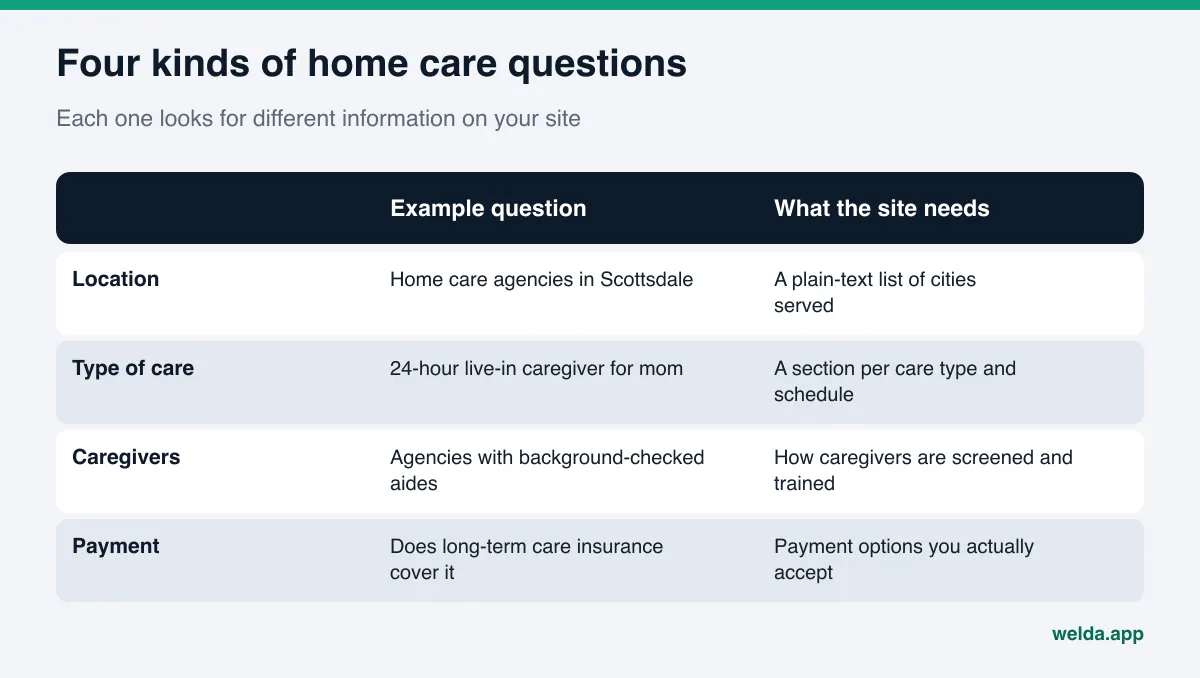
| Question group | Example question | What the AI looks for |
|---|---|---|
| Location | What are the best-reviewed home care agencies in Scottsdale? | A text list of cities and ZIP codes served, address, phone |
| Type of care | Who offers 24-hour live-in care for someone with Alzheimer's? | A clear description of live-in and memory care, if you provide them |
| Caregivers | Which agencies run background checks on their aides? | How caregivers are screened, trained and matched |
| Payment | Does long-term care insurance pay for in-home care? | The payment options you actually accept, stated plainly |
| Timing | Can a home care agency start this weekend? | Days and hours, typical start time, after-hours contact |
Notice that none of these questions contains an agency name. The family does not know you yet; they describe a need. The AI then picks agencies whose pages and listings describe that need clearly. If the words "overnight care" never appear on your site, it is hard for an assistant to name you for that question, even if you provide it every week.
There are also comparison questions: "home care or assisted living", "hourly caregiver or live-in". Here the AI usually explains the difference first and then names examples. An agency that explains the trade-offs on its own site, calmly and honestly, has a better chance of being both the source of the explanation and one of the names.
AEO for home care agencies, step by step
These steps build on each other. Do them roughly in this order.
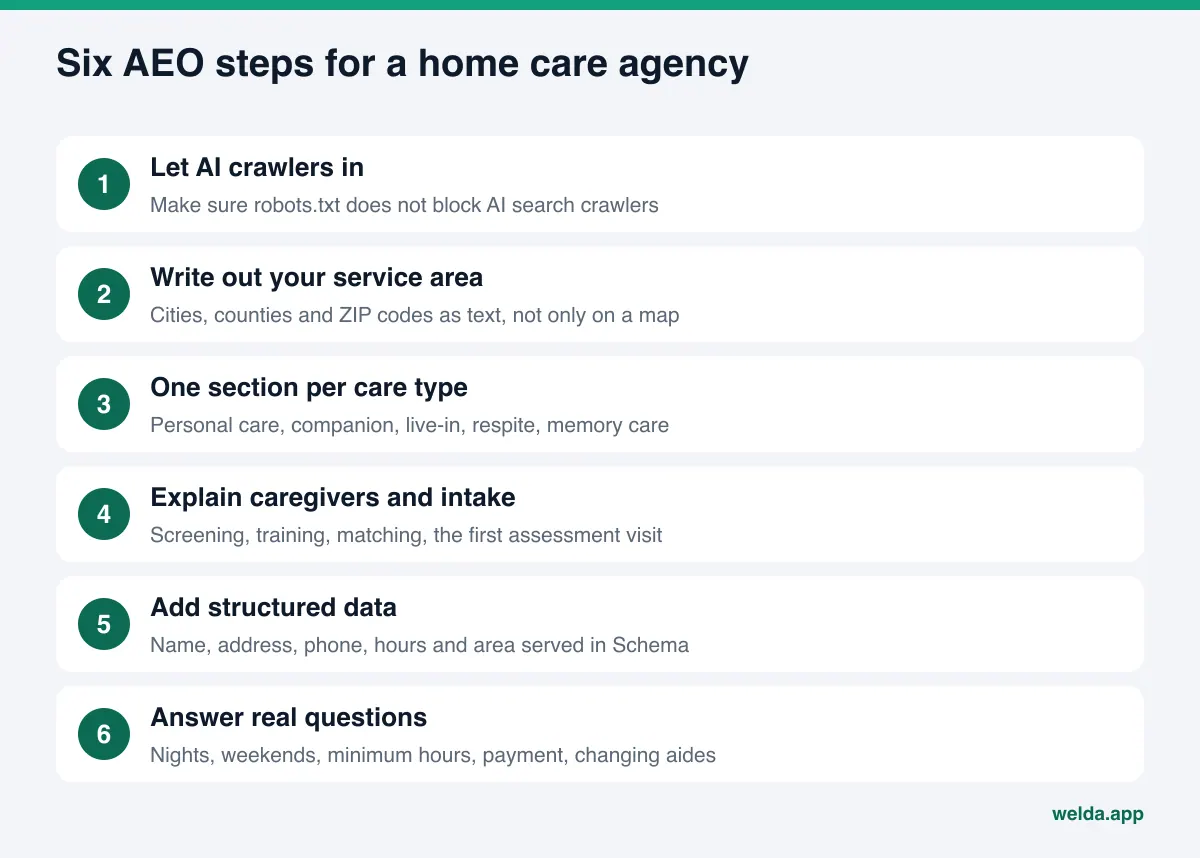
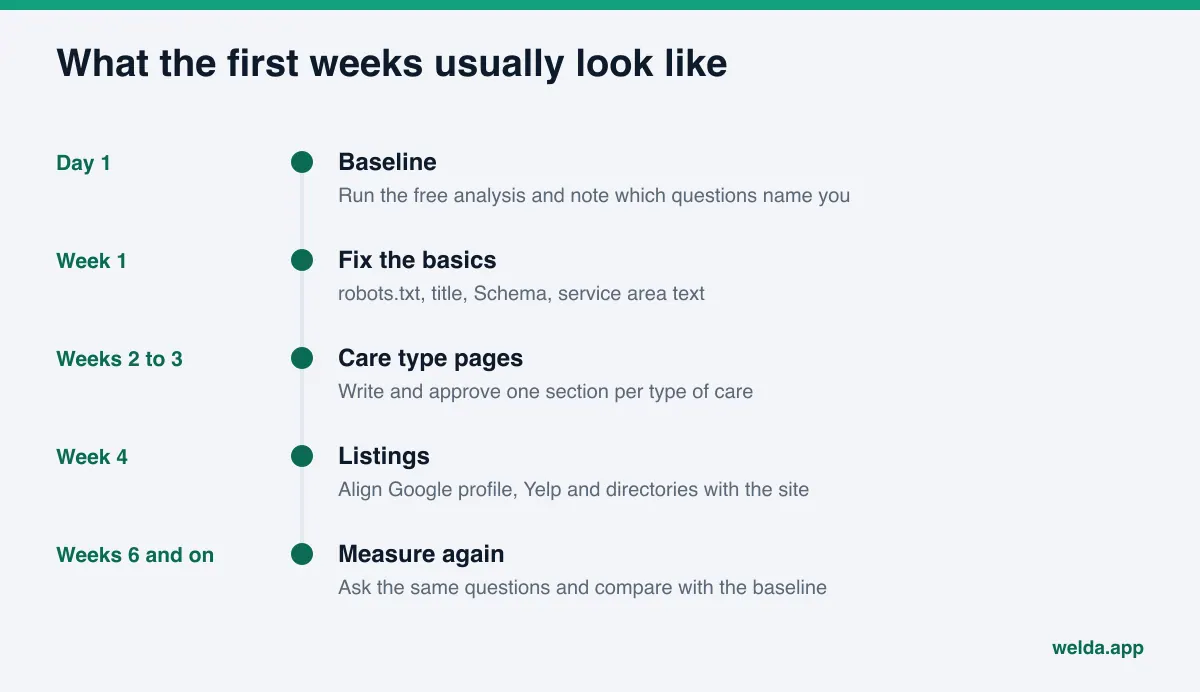
- Check that AI crawlers can reach your site. If your robots.txt blocks AI search crawlers, nothing you write will reach the answers. Some security plugins and hosting defaults block them without anyone noticing. Our guide on robots.txt for AI crawlers walks through the check.
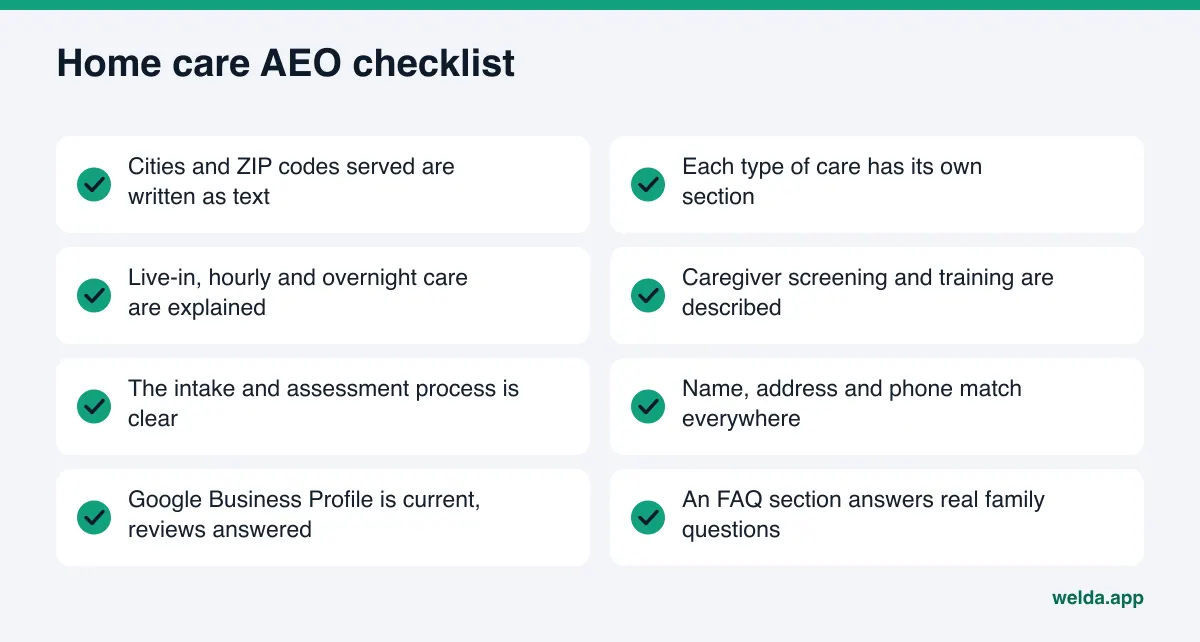
- Write out your service area in text. List the cities, counties and, if useful, ZIP codes you cover. A map embed is fine as an extra, but AI systems often cannot read what is drawn inside an image. A sentence like "We serve Plano, Frisco, Allen, McKinney and Richardson" is the single most useful line on many home care sites.
- Give each type of care its own section. Personal care, companion care, live-in care, overnight care, respite care, memory care and transitional care after a hospital stay each deserve a heading. For each one, say who it suits, what a typical day looks like and what the family needs to prepare.
- Explain caregivers and intake. Who comes to the home? How are caregivers screened and trained? How does matching work, and what happens if the family wants a different caregiver? Only describe what you really do. If something varies by case, say that.
- Add structured data. Mark up your business name, address, phone, hours and area served with Schema so machines do not have to guess. The markup must match the visible text exactly.
- Answer the questions families actually ask. Nights and weekends, minimum hours per visit, how quickly care can start, payment options, what happens in an emergency, how the family stays informed. Start every answer with one sentence that works on its own. Our piece on answer-first content explains why that first sentence matters so much.
- Align your listings. Your Google Business Profile, Yelp page, BBB listing and senior care directories should show the same name, phone, hours and service area as your site. Conflicting details make an AI less likely to name you at all.
How to write service area and care type pages
The most common gap on home care sites is a vague line such as "serving the greater metro area". It is unclear to a family and unclear to an AI. Even if you really do cover a wide region, listing the cities is both more honest and more useful. Do not list towns you do not serve. If an assistant sends a family to you and you have to turn them away, you lose time and trust.
On each care type section, answer four questions:
- Who is it for? For example, "older adults who are no longer safe alone overnight" or "adults recovering from surgery who need help for a few weeks".
- What does the caregiver do, and not do? Bathing, dressing, meals, light housekeeping, mobility, medication reminders, companionship. If any skilled tasks are involved, state who performs them and under what arrangement.
- How is it scheduled? Hourly visits, minimum shift length, overnight shifts, live-in arrangements, what happens on a caregiver's day off.
- How does it start? The first call, the in-home or video assessment, the care plan, the service agreement, the first day.
A page that answers these questions in short, plain sentences is the kind of page AI assistants quote. Put a one-sentence answer at the top of each section rather than opening with company history. The same structure works for other care providers; our guide on how physical therapy clinics get recommended by ChatGPT uses it for treatment pages.
Example: the outline of a live-in care section
Rules are easier to apply when you see them on a single section. Here is an outline for a live-in care section on an example agency's site. The cities are placeholders; use your own facts.
- One-sentence answer: "We provide live-in caregivers for older adults and people recovering from illness in Plano, Frisco and Allen."
- Who it suits: People who need support through the night or should not be left alone, and families who cannot be there during the day.
- What the caregiver does: Personal care, help with meals, moving around the home, medication reminders, companionship. Anything beyond that is stated separately.
- How the schedule works: Rest periods, days off, who covers those days, how the family requests a change of caregiver.
- How to start: Phone call, assessment visit, written care plan, service agreement, start date.
- Section FAQ: "Where does the caregiver sleep?", "How are we told if something happens at night?", "How do we end the agreement?"
Each item maps to a question a real family asks, and none of them promises an outcome. From a section like this, an AI can produce an accurate summary: live-in care, these cities, this way of working. Repeat the pattern for hourly, overnight, respite and transitional care.
Trust signals and compliant wording
Reviews carry a lot of weight in home care. AI answers draw on Google reviews, Yelp, BBB and senior care directories such as Caring.com, along with public forum discussions. Fake reviews are not a shortcut. The FTC's rule on consumer reviews and testimonials (16 CFR Part 465, published in August 2024) prohibits fake reviews, including AI-generated ones, and requires disclosure when testimonials come from company insiders. What works is asking real clients and families for reviews, replying to every review calmly (including negative ones) and never repeating health details in a reply.
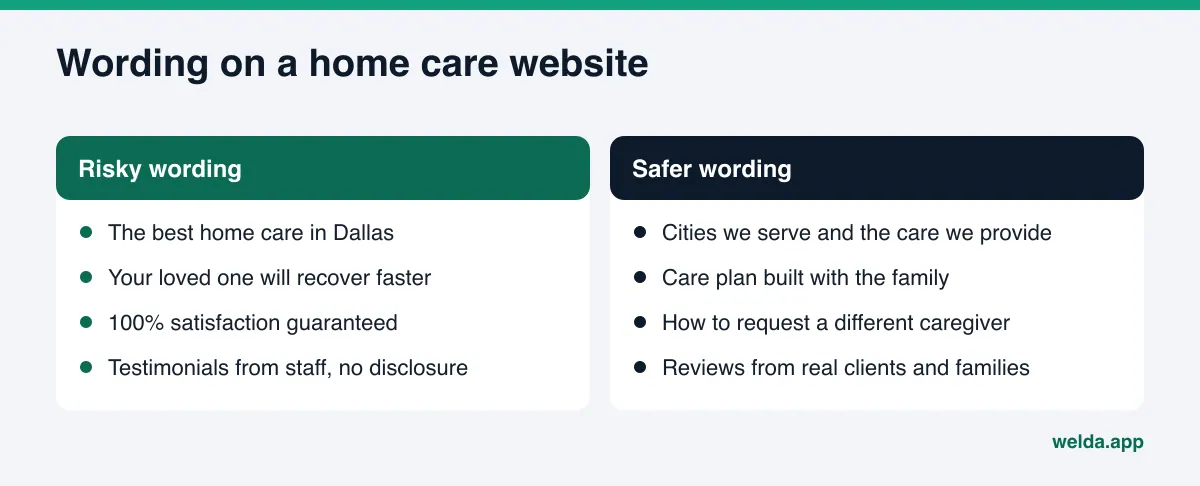
Wording matters too. Avoid "the best", "number one", promises about recovery, "guaranteed" satisfaction and testimonials that hide a relationship. State licensing, advertising rules and privacy obligations for home care differ by state and by service type, so confirm your framework with your own counsel. This article is not legal advice.
If you are also a Medicare-certified home health agency, families and AI assistants may look at Medicare's Care Compare. CMS publishes a quality of patient care star rating for home health agencies there. You cannot write that rating yourself, but you can make sure your site describes your services consistently with how you are listed.
How Welda does this work
Welda is software that measures where a business shows up in AI answers and fills the gaps on the business's behalf. For a home care agency, two parts matter most: question tracking and the to-do list.
Question tracking: where you appear and where you do not. In the Welda dashboard, the questions families would ask (location, care type, caregivers, payment) are asked three times each in ChatGPT, Gemini, Perplexity and Google AI. The questions screen shows one row per question and, for each engine, whether your agency is named and in what position. A typical home care pattern looks like this: you show up for a general "home care agency near me" question in one or two engines, but not for "overnight care" or for a specific suburb. That tells you which page is missing. The three repeats exist because AI answers vary from run to run; the margin of error next to the score comes from that variation. The competitors and sources screens add the other half: which agency wins a question and which site the AI reads to recommend it.
The to-do list: what we do not know, we ask. Welda reads your site and leaves unknown facts blank. If your service area, live-in availability, caregiver screening or weekend hours are not on the site, Welda does not guess; it asks you in a "details we need from you" section. Your answer then flows into every draft it prepares.
Drafts (care type sections, FAQ answers, Google Business Profile text, review replies) go into an approval queue. In healthcare-related sectors, nothing is published automatically; every piece waits for your approval. The compliance check flags patterns such as prices, guarantees, superiority claims and diagnostic suggestions before anything goes live. It is a warning layer, not legal advice, and it has not been reviewed by legal counsel. Client and patient data is never sent to AI.
If your site runs on WordPress, Welda connects through a separate Editor user and an application password, with no code to install; drafts open on your site and go live once approved. Content always stays on your own site. On other platforms, Welda gives you a ready-to-apply package. A one-page monthly report and a before-and-after view show what changed.
Where things stand today: the Welda dashboard is in early access and opening first in Turkey. Regular four-engine measurement is being added during early access, and the sample dashboard screens use representative data. The part anyone can use today is the free site analysis, which works in English. Pricing is discussed in the early access conversation.
Limits: what Welda does not do
- No guarantees. Welda does not guarantee rankings or placement in ChatGPT. AI answers draw on many sources, and no one controls them alone.
- No invented facts. If your service area or caregiver process is not on the site, Welda asks instead of writing something plausible.
- No unapproved publishing. In healthcare-related sectors, every piece of content waits for your approval.
- No fake reviews. Welda drafts replies to reviews. It does not write or solicit fake ones.
- Some work stays with you. Handling negative reviews, managing directory accounts and press outreach remain the agency's job. Welda lists them on the to-do list but does not open accounts for you.
- It takes time. New content usually takes weeks to show up in AI answers.
The free analysis has limits too. It is a one-time check and does not measure rankings. It asks five questions customers might ask to an AI assistant that can search the web and checks whether your agency is named in the answers. That gives you a starting snapshot; ongoing tracking is what the dashboard is for.
Decision checklist: who should do this, and how?
You can do this work in-house or with software. Before deciding, check where your site stands today:
| Your situation | Sensible first step |
|---|---|
| Service area and care types are not written anywhere on the site | Add those two things in plain text first; technical work comes after |
| The information is there, but AI answers never name you | Run the free analysis to check robots.txt, Schema, titles and other technical blockers |
| One competitor keeps getting named | Find out which source the AI reads for that competitor; often it is a directory or a review profile |
| Nobody on staff has time to write and track content | Let software prepare drafts while you keep approval |
| You are unsure about advertising or privacy rules in your state | Agree on a written framework with counsel and check all content against it |
Whatever you choose, measure before you fix. Content written without knowing which questions you miss tends to repeat topics where you already show up. If you are comparing agencies or vendors, our article on AEO for fertility clinics shows how the same approach adapts to another sensitive healthcare field.
Frequently asked questions
Can a home care agency pay to appear in ChatGPT answers?
The list of agencies in an AI answer is not an ad slot. The way onto that list is describing your services clearly, accurately and consistently on your site and in your listings.
How should we list our service area?
Write the cities, counties or ZIP codes you serve as plain text. Keep a map if you like, but do not rely on it as the only source. Do not list areas you do not serve.
Do we need a separate page for each type of care?
Not necessarily, but each type of care needs its own heading and description. Live-in, hourly, respite and memory care match different questions, and a service mentioned only in passing rarely gets named.
What if a review mentions a client's health condition?
Do not repeat it in your reply and do not add details. Thank the reviewer and offer to continue the conversation privately by phone.
Does Welda publish content on our site by itself?
Not in healthcare-related sectors. Welda drafts content, runs the compliance check and sends it for your approval. Nothing goes live without it, and content always stays on your site.
Is the Welda dashboard available for US agencies?
The dashboard is in early access and opening first in Turkey. The free site analysis works in English today and is the best place to start.
How long until we see a change?
New content usually takes weeks to show up in AI answers. That is why a baseline measurement, repeated later with the same questions, matters.
AEO for home care agencies comes down to answering a family's questions honestly on your own site: where you go, what you do and how care starts. To see how your site answers those questions today, run the free AI visibility analysis. You will get a score, a list of gaps with fixes, and ready-to-use text suggestions for your homepage.