How does AEO for fertility clinics work? AI assistants recommend a fertility clinic based on clear, consistent, verifiable information they can find on your website and on the sources that mention you: which treatments you offer, who your physicians are, how the process works, and where patients can reach you. When that information is written in a calm, factual tone instead of marketing copy, your clinic becomes easier to cite in AI answers. No one can promise a specific position.
This article is for reproductive endocrinologists who own or run a practice, marketing leads at multi-location fertility networks, and the people who manage the website of an IVF program inside a hospital system. The question is simple: when someone asks ChatGPT, Gemini, Perplexity, or Google's AI Overviews "Which IVF clinics near Denver should I look at?", does your clinic's name come up? If it does not, why not, and what should you fix first without stepping into misleading health claims? Below we cover the problem, the steps, how Welda handles this work, and what Welda does not do. If you want to see where your site stands today, start with the free site analysis.
Why answer engines matter for fertility clinics now
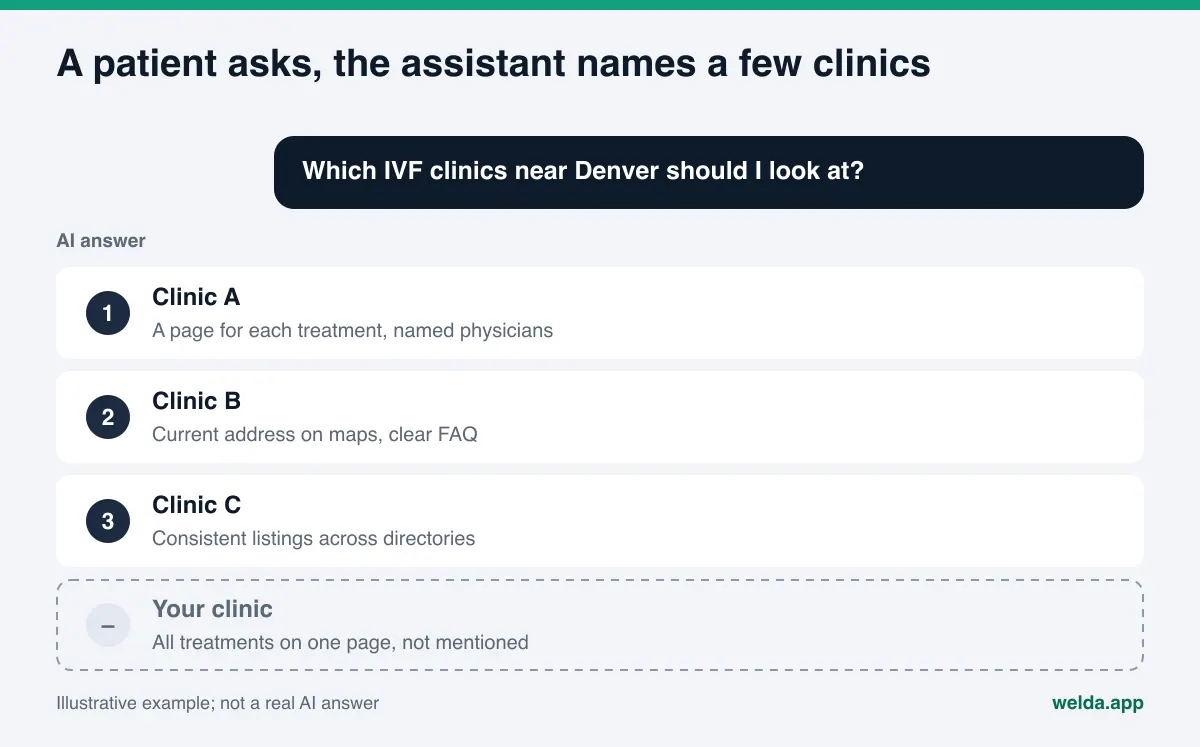
Choosing a fertility clinic is a long, careful decision. Patients read for months, compare clinics, ask their OB-GYN, and look for people who have been through the same thing. A growing part of that research now happens inside AI assistants. In a single conversation, a patient can ask how an IVF cycle works, what to expect at the first consultation, and which clinics near them offer egg freezing on weekends. The assistant replies with a short list of names, sometimes with links to the clinics' own pages.
A clinic that is missing from that answer never makes the shortlist. In a classic search results page, sitting in seventh place still earned some clicks. In an AI answer, only a handful of names appear. That is why answer engine optimization (AEO), the work of making your clinic easy for AI systems to understand and cite, belongs on the same list as your Google Business Profile and your referral relationships. You may also see it called GEO, short for generative engine optimization; in practice the two terms describe the same work.
Fertility care has a few traits that make AI search visibility different from other specialties:
- The decision is emotional and high-stakes. Patients look for trust signals. AI systems look for them too: named physicians, a clear explanation of the process, consistent contact details, and what third parties say about you.
- The questions are layered. IVF, IUI, egg freezing, embryo freezing, genetic testing of embryos, male factor evaluation, donor programs, LGBTQ+ family building, and insurance or financing each draw separate questions.
- Success rates are public and standardized. Under the Fertility Clinic Success Rate and Certification Act of 1992, clinics that perform assisted reproductive technology report data to the CDC's National ART Surveillance System, which publishes clinic-specific success rates. AI assistants can find that data on their own, so your site does not need to compete with it.
- Health claims are regulated. Advertising for health services falls under FTC rules on truthful, substantiated claims, which shapes the language you can use.
Why fertility clinics go missing from AI answers
When a clinic does not appear in AI answers, the reason is rarely the quality of care. It is usually how readable the website is. An AI system cannot judge your embryology lab; it can only read what is written. These are the problems we see most often on fertility clinic websites:
- Everything on one page. IVF, IUI, ICSI, egg freezing, embryo testing, and male infertility share a single "Services" page with a sentence each. An assistant asked "Which clinics in Austin offer egg freezing?" cannot pull a clear answer from that page.
- Physicians are hard to find. Names, board certifications, and focus areas appear only inside images or a slider. Text inside an image often does not exist for a crawler.
- Location data conflicts. The address on the site, the Google Business Profile, and listings on Healthgrades or Yelp do not match. A satellite office closed, but its listing is still live.
- No structured data. The site never tells machines, in schema markup, that it is a medical organization with a specific address, phone number, and hours.
- No FAQ section. The practical questions patients ask before booking a consultation go unanswered.
- Crawlers are blocked. A robots.txt rule or a security setting keeps AI search crawlers out of the site entirely.
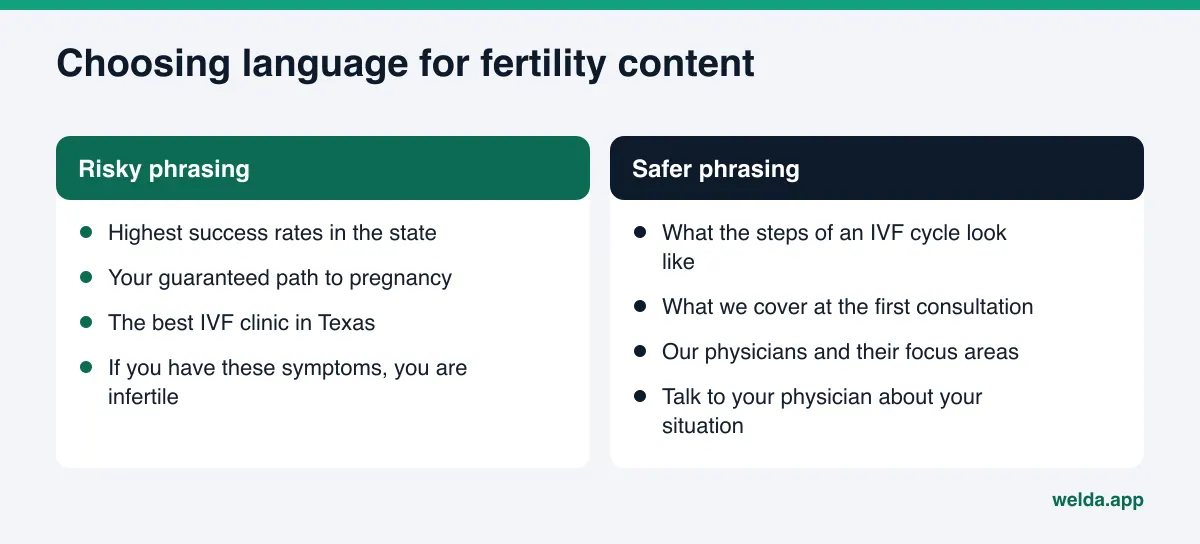
- The copy reads like an ad. Phrases like "highest success rates in the state" invite regulatory risk and give an assistant nothing neutral to quote.
Most of these problems are editorial, not technical. You do not need a new website. You need the right facts on the right page in the right tone. OB-GYN practices face a similar picture; our guide to AEO for OB-GYN practices covers that side in detail.
What patients ask AI about fertility clinics
You cannot know which page is missing until you know which questions you are missing from. The table below groups fertility questions by type. The questions are examples written for this article, not data from a study. The point is to show what each question type looks for on your site.
| Question type | Example question | What the site needs |
|---|---|---|
| Clinic and location | Which IVF clinics near Denver should I look at? | Clear address, neighborhood, Google Business Profile |
| Treatment | Where can I freeze my eggs in Austin? | A dedicated page for that treatment |
| Process | What happens at a first fertility consultation? | First visit page, FAQ |
| Team | Fertility clinic with a male infertility specialist near me | Physician pages with focus areas |
| Coverage and cost | Fertility clinics that accept my insurance plan | Insurance and financing page |
| Family building | LGBTQ+ friendly fertility clinic in Chicago | Page describing the programs you offer |
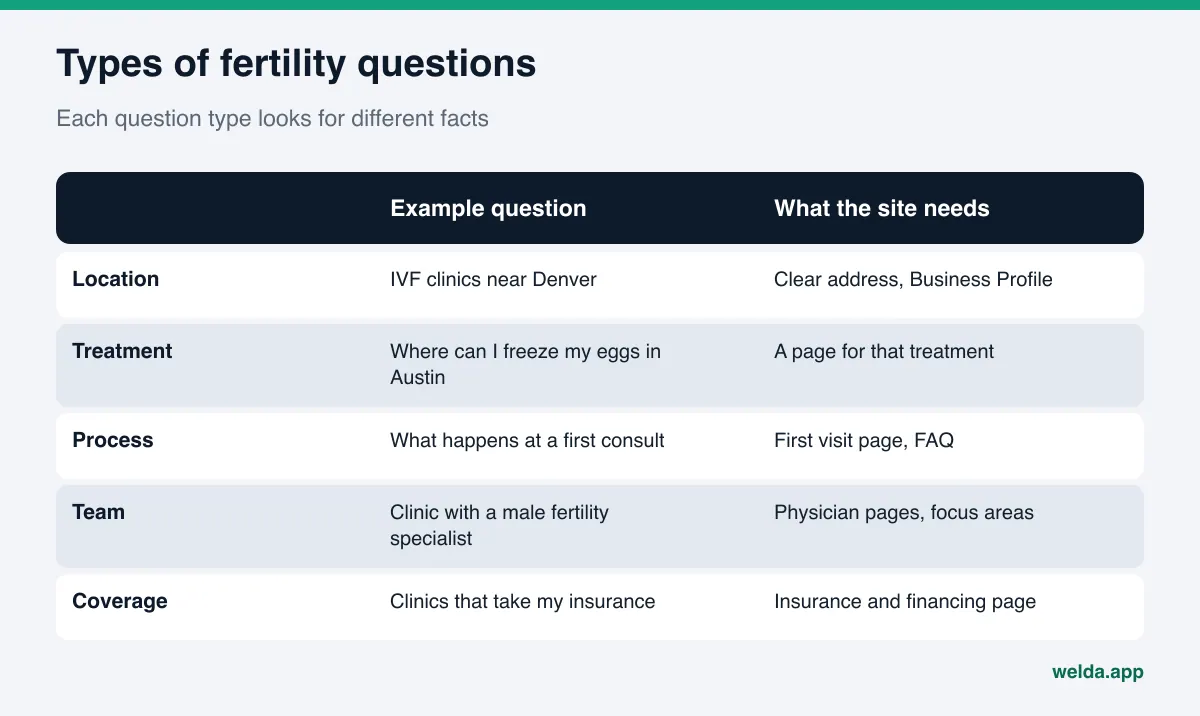
Every row in the table maps to a page or a paragraph. If you are absent from egg freezing questions, you probably have no page that explains egg freezing clearly. If you are absent from insurance questions, you have not written down which plans you work with or how financing works at your clinic.
AEO for fertility clinics: a step-by-step plan
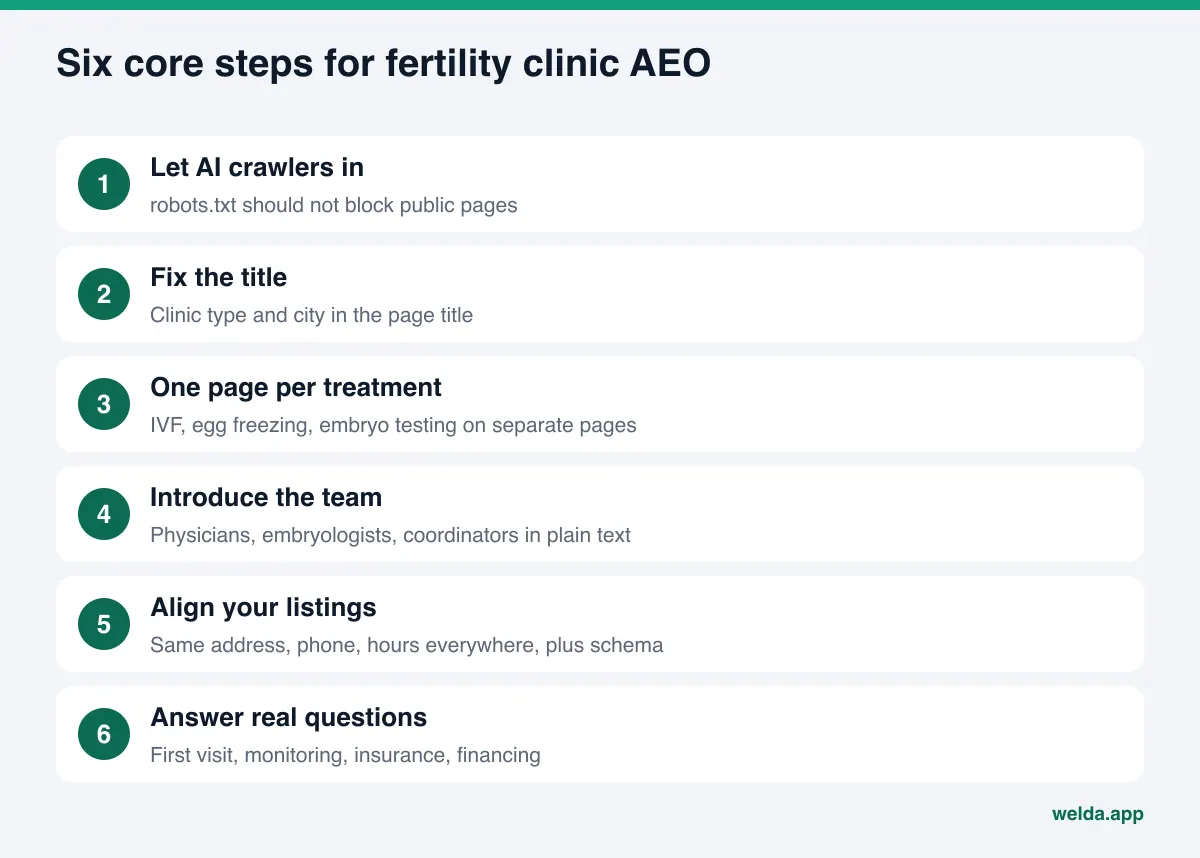
Order matters. If crawlers cannot read the site, writing new pages does nothing. If your listings conflict, adding pages adds confusion.
1. Make sure AI crawlers can reach your public pages
Open your robots.txt file and check that AI search crawlers are not blocked. Some security plugins and hosting setups block them without telling you. Your patient portal, scheduling system, and anything with personal data should stay closed. What needs to be open are your public, informational pages.
2. Fix the title, meta description, and main heading
Your home page title should state what you are and where: "Fertility Clinic in Denver, CO" works better than a tagline. The meta description should explain what you do in two sentences. The main heading should describe the clinic, not sell it.
3. Give each treatment its own calm, factual page
IVF, IUI, egg freezing, embryo freezing, embryo genetic testing, male factor evaluation, and donor or gestational carrier programs should each have a page. On each page, explain what the treatment is, who it is generally considered for (in general terms, not personal advice), what the steps look like, what happens at the first visit, and which physicians focus on it. Leave out outcome promises and comparisons with other clinics. If you mention success rates at all, point patients to the CDC's published data rather than writing your own claims.
4. Introduce your team in plain text
Write each physician's name, credentials, focus areas, and role as plain text. Introduce embryologists, nurse coordinators, and financial counselors too. Patients want to know who they will talk to, and assistants pick up on that.
5. Make your name, address, and phone consistent everywhere
The details on your site should match your Google Business Profile, Apple Maps, Healthgrades, Yelp, and any insurer directories. Add the same details as schema markup on your site, and link your social and map profiles from the site.
6. Answer the questions patients actually ask
What should I bring to the first consultation? Do you offer weekend monitoring? Do you work with my insurance? Is there financing? Do you see patients from out of state? Keep answers short, general, and free of personalized medical advice.
7. Treat reviews carefully
Reviews are one of the sources AI systems read. In fertility care, any reply to a review must avoid confirming that the reviewer is a patient or mentioning anything about their treatment. Fake reviews are unacceptable, and Welda does not write them.
Health claims and the FTC: why tone shapes AI visibility
The FTC's Health Products Compliance Guidance explains that health benefit claims need competent and reliable scientific evidence, and that patient testimonials do not replace that evidence. It also says testimonials that show better results than most people can expect need a clear disclosure of typical results. For a fertility clinic, that means patient stories and "success" language need careful review before they go anywhere public.
This connects directly to AI search visibility. An assistant is more likely to quote a clear description of your process, your team, and your location than a slogan. Neutral, specific copy is safer from a compliance standpoint and more useful to an answer engine. This section is not legal advice; review your website copy with your own counsel. For a structured way to do that review, see our guide to a content approval workflow for AEO.
How Welda handles AEO for a fertility clinic
Welda is software that measures where a business appears in AI answers and prepares the fixes on the business's behalf. For a fertility clinic, three parts matter most: question-by-question measurement, an approval queue built for healthcare, and a compliance check before anything is published.
Measurement by treatment, not just by clinic name
In the Welda dashboard, the questions your patients are likely to ask are sent to ChatGPT, Gemini, Perplexity, and Google AI three times each. The questions view shows, for every question, which engines mention your clinic and in what position. For a fertility practice, the value is that visibility breaks down by treatment. If your clinic shows up for "IVF clinic near me" questions but never for egg freezing questions, the problem is not your reputation. It is the missing egg freezing page.
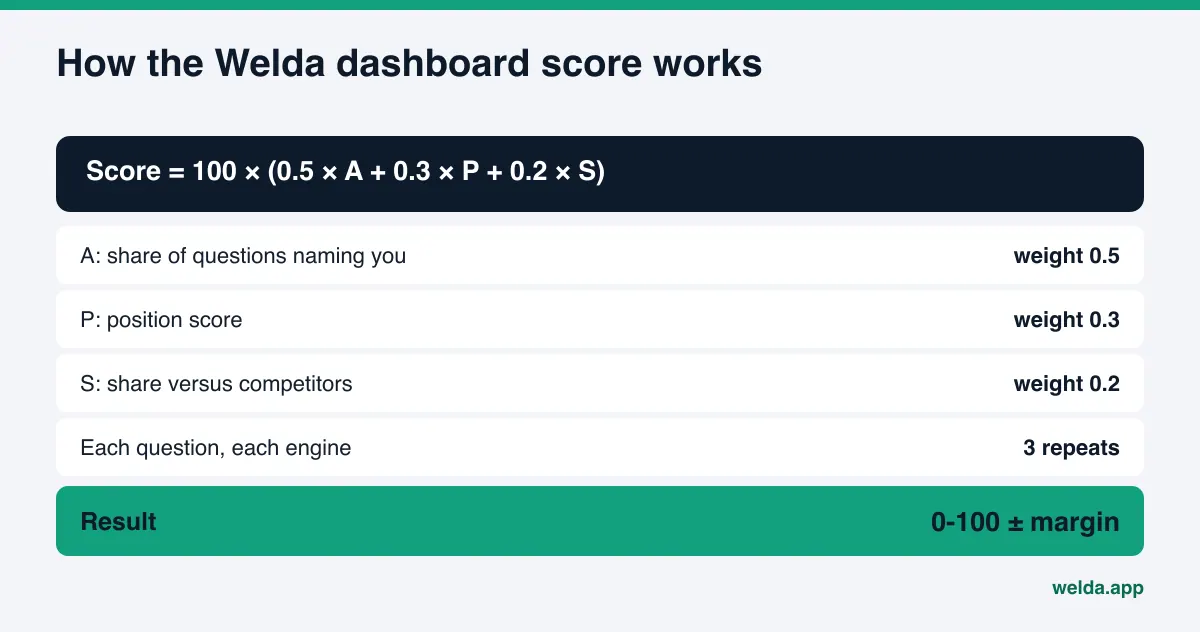
The score uses an open formula: the share of questions where your name appears, a position score, and your share relative to competitors. The spread across the three repeats gives a margin of error, so you can tell a real change from noise. The competitors view shows which topic and which source a competing clinic is winning on, and the sources view lists the sites AI systems draw from, so an outdated directory listing shows up there.
In healthcare, every draft waits for your approval
Welda drafts page copy, profile descriptions, and review replies. In healthcare there is no automatic publishing: every piece of content lands in an approval queue. A physician or practice manager reads it, edits it, and approves or rejects it. Welda does not invent facts. If it cannot confirm from your site whether you offer weekend monitoring, it leaves that blank and asks you. Patient data is never sent to AI; Welda works only with what is already public on your site and profiles.
Before publishing, each draft passes a compliance check that flags patterns like pricing, guarantees, superiority claims, and diagnostic suggestions. On a fertility site, that means phrases like "guaranteed pregnancy" or "best IVF clinic in Texas" are flagged before they go live. This check is not legal advice and has not been reviewed by legal counsel; your own legal and clinical review has the final word.
If your site runs on WordPress, Welda connects through a separate Editor user and an application password, with no code to install, and approved content opens on your site as a draft first. On other platforms, Welda gives you a ready-made package and your team applies it. Content always lives on your own site.
Where the product is today
The Welda dashboard is in early access and opening in stages, starting with businesses in Turkey. Regular four-engine measurement is being added during early access, and dashboard screens are shown with sample data. What anyone can use today is the free site analysis, which works in English. Pricing is discussed in an early access call.
What the free site analysis tells a fertility clinic
You can check your site before the dashboard reaches you. The free analysis reads your home page and several inner pages (services, pricing, about, contact) the way Google and AI systems would. Here is what its checks mean for a fertility clinic.
| What the analysis checks | What it means for a fertility clinic |
|---|---|
| AI crawler access (robots.txt) | Can AI systems read your treatment pages at all |
| Title, description, main heading | Is it clear at a glance that you are a fertility clinic, and where |
| Business information (schema) | Is the clinic defined as a medical organization |
| Address, phone, location | Does the site match your map and directory listings |
| FAQ section | Are first-visit and process questions answered |
| Clearly described services | Is each treatment explained on its own |
| Reviews and trust signals | Are your team, credentials, and profiles visible |
You get a score out of 100 (technical and content scored separately), and for each gap you see what was found, why it matters, and how to fix it. The report also includes ready-to-use copy for your home page title, description, main heading, intro paragraph, and FAQ, a simulation showing how much each fix could raise your score, a competitor comparison, and a fix package with schema code ready to add to your site. The analysis also asks a web-enabled AI assistant 5 questions your patients might ask and checks whether your clinic is named in the answers. That is a one-time snapshot. The analysis is free once per site; your email and phone are verified, and the results link arrives by email and stays open for 14 days.
Limits: what Welda does not do
In a field as sensitive as fertility care, knowing what is not done matters as much as knowing what is.
- No ranking guarantee. Welda does not promise placement in ChatGPT or any other assistant. AI answers vary, which is why measurement uses three repeats and a margin of error.
- No invented facts. If your treatments, insurance plans, or hours are not on your site, Welda asks you.
- No unapproved health content. In healthcare, every piece of content goes through approval.
- No fake reviews. Asking for reviews, responding to negative ones, and managing directory accounts stay with your clinic.
- No PR work. Media coverage is your clinic's own work.
- No legal advice. The compliance check flags risky patterns; it does not issue rulings.
Timing matters too. New content usually takes weeks to show up in AI answers, and there is no shortcut. Our article on how long AEO takes explains what to expect. If an assistant is stating something wrong about your clinic, such as an old address or a program you no longer offer, see what to do when ChatGPT has wrong information about your business.
A checklist for fertility clinic AI visibility
Open your website and go through this list. Every item you cannot check off is next month's work.
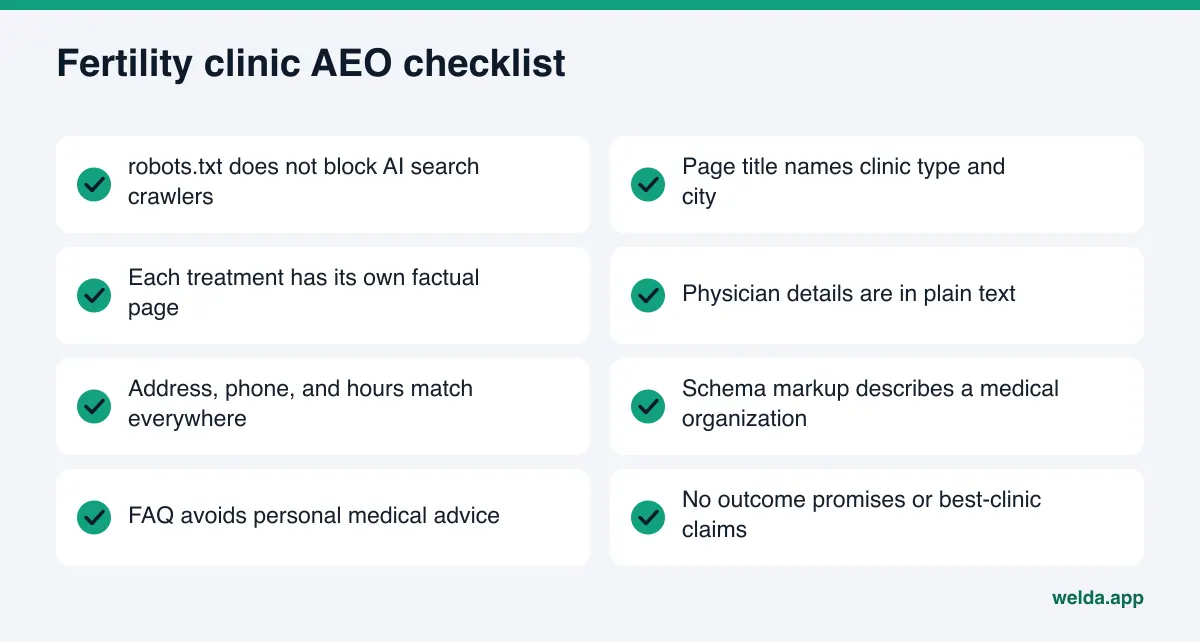
- robots.txt does not block AI search crawlers from public pages.
- The home page title names the clinic type and city.
- Each treatment has its own page written in a factual tone.
- Physician and team details are in plain text.
- Name, address, phone, and hours match across the site, maps, and directories.
- Schema markup describes the clinic as a medical organization.
- The FAQ answers practical questions without personal medical advice.
- The copy contains no outcome promises or "best clinic" claims.
- Any success rate mention points to the CDC's published data.
- Every new page is reviewed by a physician and counsel before it goes live.
When you decide who will do this work, ask three more questions. Is there someone at the clinic who can write this copy and get physician sign-off? Is there a way to measure, on a regular schedule, which questions you are missing from? Is there a review step before anything goes live? Your answers show whether you can run AEO in-house or want software to support it.
Frequently asked questions
Can a fertility clinic publish content for AEO without running into advertising rules?
Factual, informational content about who you are, what you offer, and how the process works is different from promotional claims. Health claims still need to be truthful and substantiated under FTC rules. Review your copy with your own counsel; this article is not legal advice.
Will posting our success rates make AI recommend us more often?
We do not recommend building a strategy on that. The CDC already publishes standardized clinic-level data. Assistants are more likely to cite verifiable facts like your process, team, and location.
Does Welda see patient information?
No. Welda works with what is already public on your website and profiles. Patient data is never sent to AI.
Will anything be published without our approval?
No. In healthcare there is no automatic publishing. Every draft goes to an approval queue, and even with a WordPress connection it opens as a draft first.
Is Welda available for US fertility clinics today?
The free site analysis works in English and is available today. The full dashboard is in early access and opening first in Turkey.
How long until we see results?
New content usually takes weeks to show up in AI answers. Nobody can promise a specific timeline or position.
First step: check your clinic's site for free
AEO for fertility clinics starts with putting the right facts on the right pages, in a tone that informs rather than sells. To see what is missing on your site, run the free site analysis. The results link arrives by email with your score, the list of gaps, and ready-to-use copy for your first fixes. If you want ongoing measurement and approved content drafts, we are also happy to talk about early access.