Why doesn't ChatGPT or Google's AI recommend my burger restaurant, and what can I do about it? AI assistants recommend burger joints based on what they can read clearly on your website, your Google Business Profile, and review sites like Yelp and Tripadvisor. If your patty style, menu, hours, takeout options, and plant-based or gluten-free choices aren't written out and consistent, your name gets left out of the answer or shows up with the wrong details. This guide walks through AEO for burger restaurants step by step and explains which parts of the work Welda does for you.
What is AEO for burger restaurants, and why does it matter now?
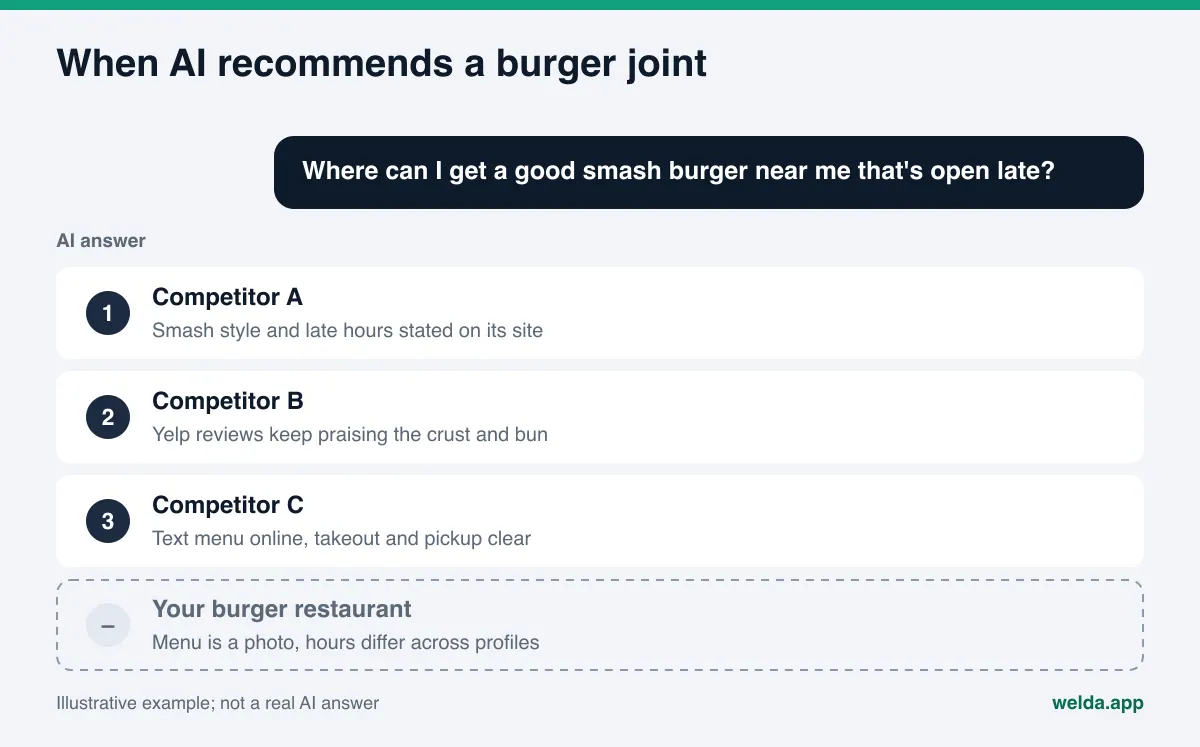
AEO, short for answer engine optimization, is the work of getting your business named in AI-generated answers: ChatGPT, Gemini, Perplexity, and Google's AI Overviews and AI Mode. You will also see it called AI search visibility, or GEO (generative engine optimization), which means the same thing. In a classic search, a diner sees a page of links and a map pack and picks for themselves. In an AI answer, they often see a short list of three or four places. If you are not on that list, the decision gets made without you.
Burger restaurants feel this shift sharply because burger questions are specific and in the moment. People don't ask "where should I eat." They ask "best smash burger near me that's open late," "burger place with a really good veggie burger," or "kid-friendly burger joint with seating, not just counter service." To answer, the AI looks for a place that has stated those details somewhere it can read. If you haven't, the competitor who has gets the mention. If that already sounds familiar, our piece on competitors showing up when AI is asked about your brand covers the pattern in more depth.
Burger menus and hours also change often. A seasonal burger comes on, a sauce goes away, weekend hours run later, a second location opens. If the menu only lives in an Instagram post or a photo, AI either can't read it or repeats an old version. A customer who shows up to a locked door because of wrong hours writes about it on Yelp, and that review becomes a source for the next AI answer.
The fastest way to see where you stand is to measure your site as it is today. Welda's free site analysis reads your homepage and a few inner pages the way Google and AI systems do, then lists each gap.
What do diners ask AI about burger restaurants?
Burger questions fall into a handful of patterns, and each pattern leans on a different fact. The questions below are examples we wrote to show the pattern, not results from a study. Once you see which fact feeds which question, it becomes obvious what to write and where.
| Question pattern | Example question | What the answer relies on |
|---|---|---|
| Location and hours | "Burger place open right now near me?" | Address, map pin, current hours, holiday hours |
| Burger style | "Where can I get a real smash burger in Austin?" | Patty style, bun and cooking method stated on your site, wording in reviews |
| Dietary needs | "Burger joint with a good plant-based burger?" | Options written in a text menu, gluten-free bun availability |
| Service type | "Quick burger pickup or drive-thru on my way home?" | Takeout, curbside, drive-thru, dine-in, ordering links |
| Who it suits | "Family-friendly burger restaurant with a kids menu?" | Kids menu, seating, high chairs, written plainly |
| Value | "Best burger and fries combo under fifteen dollars?" | Current menu prices and combo descriptions on your site |
The point of the table: every pattern rests on a specific fact. Whichever fact is missing from your site, that whole group of questions gets harder to win.
Where does AI learn about a burger restaurant?
Answer engines don't rely on one source. They read your website, your Google Business Profile, reviews on Yelp, Tripadvisor and Google, delivery app listings, local "best burgers in town" roundups from city magazines and food blogs, and discussion threads. When these sources agree, AI is more comfortable naming you. When they conflict, it skips you or repeats the wrong detail.
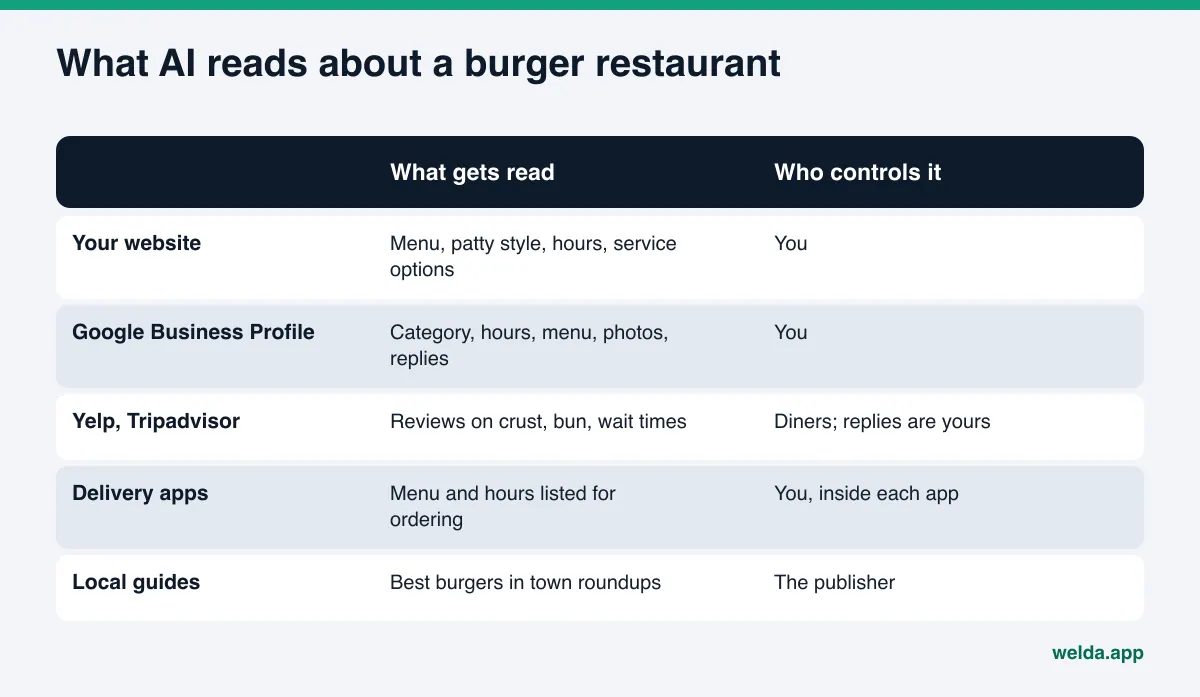
Your website and Google Business Profile are fully in your hands. Reviews are written by diners, but the replies are yours, and steady, specific replies are part of what gets read. You have no direct say over local guides. So the most efficient order is: make the two sources you control complete, then work on review replies, then keep delivery app listings in sync.
Delivery and takeout deserve their own attention for burger restaurants, since many orders never involve a table. We cover how delivery listings feed AI answers in AEO for takeout and delivery restaurants.
AEO for burger restaurants: the steps, in order
The steps start with work that needs no technical skill. Most of it fits into one week. Order matters: first AI has to be able to reach your site, then what it reads has to be accurate and clear.
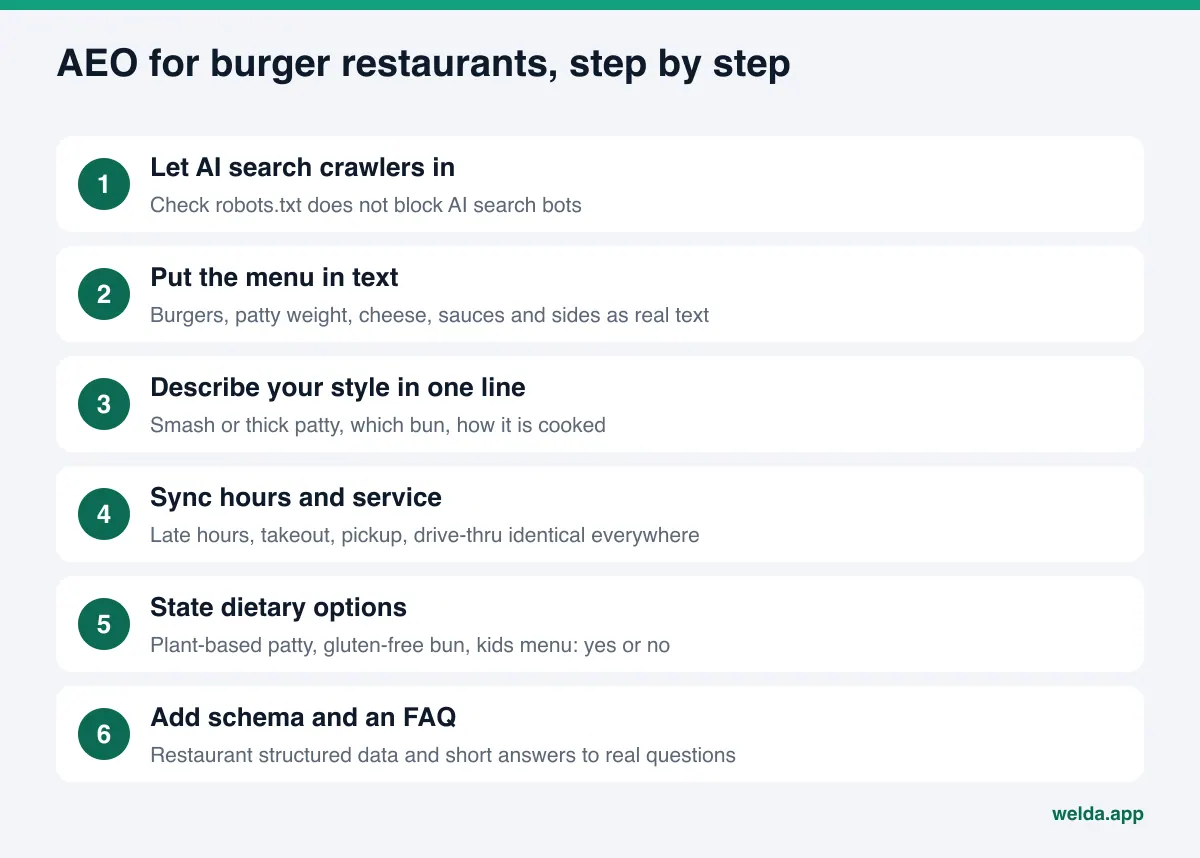
- Let AI search crawlers in. If your robots.txt blocks AI search bots, no fix on your site will reach the answers. OpenAI, for example, documents that its OAI-SearchBot is used to surface websites in ChatGPT's search features, and that sites which opt out of it won't appear in ChatGPT search answers. Our guide to robots.txt for AI crawlers explains the details.
- Put the menu in text. List each burger with patty weight, cheese, sauces and bun, plus sides and shakes, as real text on a page. A photo or PDF menu can stay as an extra, but it shouldn't be the only source. AI does not always read text inside images.
- Describe your style in one line. Something like "thin, crispy-edged smash patties on a potato roll" or "half-pound patties cooked to order on a brioche bun." Put that line on the homepage, right under the main heading. The closer your wording is to how people phrase the question, the easier the match.
- Sync hours and service. Weekday, weekend and late-night hours; takeout, curbside, drive-thru and dine-in. Make them identical on your site, your Google Business Profile, Yelp and every delivery app. Enter holiday hours ahead of time.
- State dietary options. Plant-based patty, gluten-free bun, lettuce wrap, kids menu, allergen information: write down what you offer. If you don't offer something, saying so helps too. AI won't recommend you for the wrong question, and guests won't arrive expecting something you don't have.
- Add schema and an FAQ. Add Restaurant structured data (schema) to your site. schema.org defines properties for this type such as servesCuisine, hasMenu, acceptsReservations, opening hours and priceRange. Next to it, write short answers to five or six questions guests really ask.
- Reply to reviews. Especially on recurring themes like wait times, doneness, or soggy fries in delivery orders. Keep replies short and concrete. Never buy or solicit fake reviews.
Which pages and sentences should a burger restaurant website have?
AI makes the most use of sentences that are short, plain and directly answer a question. For a burger restaurant, a few accurate pages beat many scattered ones. We explain this writing style in answer-first content.
- Homepage: A main heading that says what you are and where ("Smash burgers in East Austin," for example). Under it, your one-line style description, hours, address and service options.
- Menu page: Each burger with patty, cheese, sauce and bun; sides and drinks; plant-based and gluten-free items clearly marked.
- About page: How long you've been open, how you make the patties, where the beef comes from. Only facts you can stand behind.
- Location and contact: Address, map, phone, parking, nearby transit, and a separate block for each location.
- FAQ: Real questions such as "Do you offer takeout?", "How late are you open?", "Do you have a veggie burger?", "Do I need a reservation?"
Be careful with claims. Listing current prices helps diners, but "best burger in town" or "cheapest in the city" are claims you can't prove, and they don't make AI trust you more. If you use price language in your copy, our piece on pricing claims in AI-ready content is worth a read. Specific, checkable facts work better every time.
Example: a burger restaurant homepage, before and after
The scenario below is an example and does not describe a real business. An example neighborhood burger spot has a homepage like this: the page title is just the business name, the main heading says "Taste the difference," and below it sits a large burger photo and a link to Instagram. The menu is a single photo. Hours appear in small type at the bottom of the page and don't match the Google Business Profile.
An AI reading that page can guess it's a burger place from the photo, but it can't say with confidence what the patty style is, whether it's open late, whether there's a veggie option, or what neighborhood it's in. For "smash burger near me open late," that page is unlikely to come up.
| Element | Before | After (example copy) |
|---|---|---|
| Page title | Business name only | Business name, smash burgers, neighborhood |
| Main heading | "Taste the difference" | "Smash burgers in the heart of the neighborhood, open late" |
| Intro paragraph | None | Patty style, bun, veggie option, takeout and pickup in two sentences |
| Hours | Small print at the bottom, conflicting | Near the top, same as profiles, weekends listed separately |
| Menu | One photo | Text menu, photo as an extra |
| FAQ | None | Takeout, late hours, veggie burger, reservations |
None of these changes break the design; most of them are a few added sentences. What matters is that every statement is true. Don't write "veggie burger" if you don't have one, and don't say "late night" if you close at nine. Welda's free analysis suggests ready-made homepage copy for exactly these fields, and you choose what is accurate.
How Welda handles AEO for burger restaurants
Welda is software that measures where a business appears in AI answers and fills in the gaps on the business's behalf. It comes in two parts: the free site analysis anyone can use today, and the Welda dashboard, which is in early access.
What the free site analysis shows
The analysis works in English and reads your homepage and a few inner pages (menu or services, pricing, about, contact) the way Google and AI systems do. It checks whether AI bots can reach your site through robots.txt, your page title and description, main heading, business information (schema), address, phone and location details, whether your social and map profiles are linked from the site, an FAQ section, reviews and trust signals, how clearly you describe what you sell, and page speed.
You get a score out of 100, with technical and content scored separately. Each gap comes with what was found, why it matters and how to fix it. You get ready-made copy for your homepage title, description, main heading, intro paragraph and FAQ; a simulation of how much each fix would raise the score; a competitor comparison; a fix package to add to your site, including business information (schema) code; and a PDF plus a shareable score card.
The analysis also puts 5 questions a customer might ask to an AI assistant that can search the web, and checks whether your burger restaurant's name appears in the answers. That is a one-time measurement. The analysis is free once per site. Your email and phone are verified, the results link arrives by email and stays open for 14 days. It does not measure rankings and does not guarantee them.
What the Welda dashboard does
The dashboard is in early access and opening in stages, starting with businesses in Turkey. Regular measurement across all four engines is being added during early access, and the sample screens in the dashboard use representative data. In measurement, the questions your customers would ask are put to ChatGPT, Gemini, Perplexity and Google AI three times each. You see which questions name you, where in the answer you're mentioned, and where competitors are ahead. Questions can be run in English or Turkish.
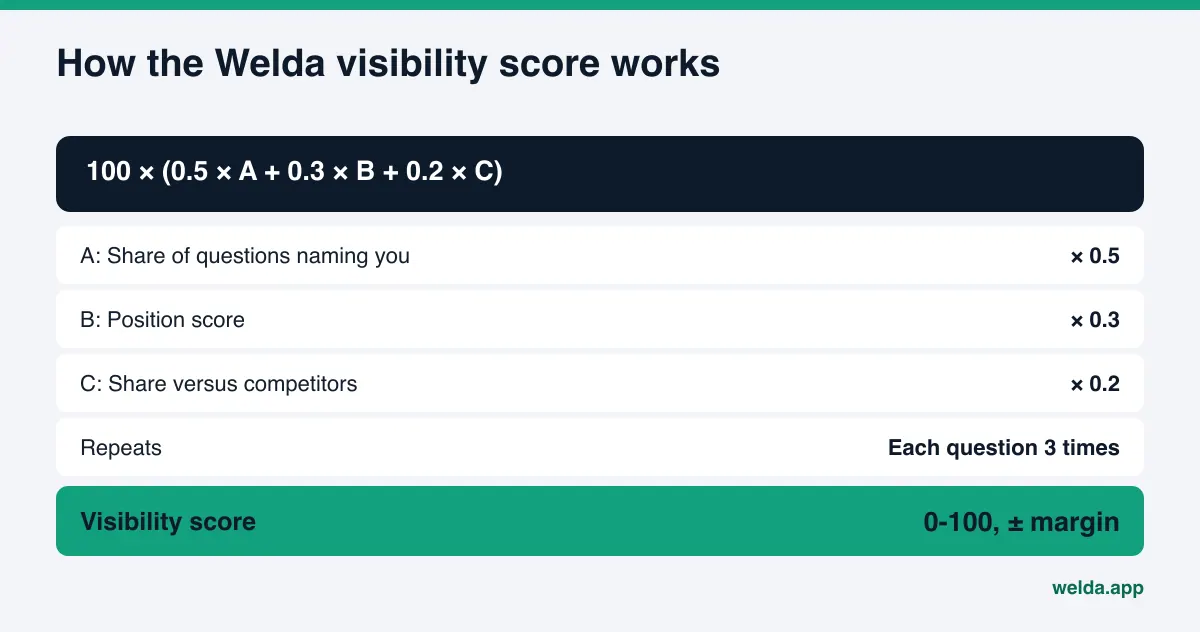
The score formula is open: 100 × (0.5 × share of questions that name you + 0.3 × position score + 0.2 × share versus competitors). The spread across the three repeats produces a ± margin of error. AI answers vary from run to run, and the score says so instead of hiding it.
The dashboard home shows your score, a one-sentence summary and what comes next. The to-do list gathers missing information, content waiting for approval and manual tasks, each with ready-made copy. The questions screen shows, question by question, whether you're named. The competitors screen shows which topic and which source a competitor is winning on. The sources screen lists the sites AI draws from and where you're missing. Other screens cover ready-to-publish pages, a compliance check, incoming leads, a before-and-after comparison and a one-page monthly PDF report.
How fixes happen and what stays with you
Welda drafts the content, profile text and review replies; you keep publishing approval. For a burger restaurant, that might mean menu page copy, your style line, FAQ answers, a Google Business Profile description and reply drafts for recurring review themes. Content always lives on your own website; Welda does not host content.
On WordPress sites, Welda connects through a separate Editor user and an application password you create, with no code to install. Content opens on your site as a draft and goes live once you approve it. On other platforms, Welda gives you a ready-made package to apply by hand. Google Business Profile, Instagram and Facebook can be connected; if they aren't, the task is listed as manual.
The compliance check flags patterns like price claims, guarantees and superiority claims before publishing, so "best burger in town" gets surfaced for you to review. It is not legal advice and has not been reviewed by legal counsel. Pricing is not published; it is discussed in an early access call. What anyone can use today is the free site analysis.
What Welda does not do, and the limits of AEO
Honest AEO means setting the right expectations. Knowing what Welda won't do makes the decision easier.
- Welda does not guarantee rankings or "showing up in ChatGPT." Answer engines make their own calls; no one can guarantee them.
- It doesn't write what it doesn't know. If it can't find your patty weight, beef source or what's in your veggie burger, it asks you instead of making it up.
- It doesn't publish sensitive content without your approval.
- It doesn't create fake reviews. In the US, the FTC's final rule on fake reviews and testimonials bans buying or selling fake reviews and offering incentives conditioned on a positive or negative review. This is general information, not legal advice.
- Resolving negative reviews, setting up directory listings and press outreach stay with you. Welda can draft text for them but doesn't run them for you.
- New content usually takes weeks to show up in AI answers.
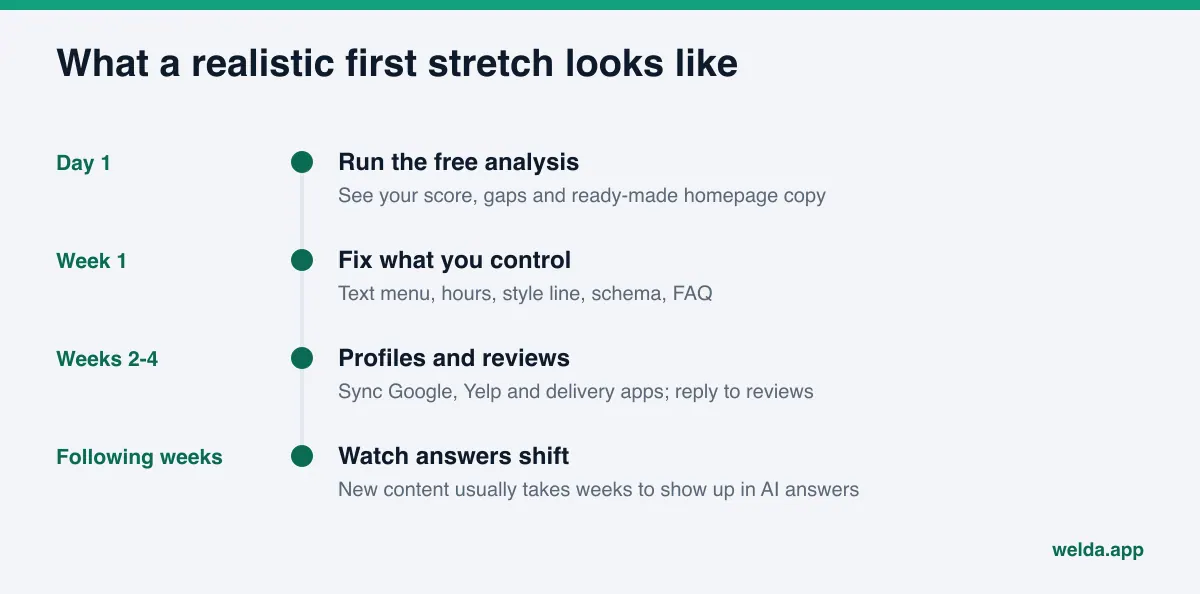
One limit sits on your side: when AI recommends you, the guest needs to find what they were promised. If your site says "open until 2 a.m." and you close at eleven, the visibility you earned turns into a bad review quickly.
Decision guide and checklist for burger restaurants
Use this table to pick your first move based on where your burger restaurant is today.
| Your situation | First move | Why |
|---|---|---|
| No website, only Instagram | A simple site and a complete Google Business Profile | AI needs one reliable primary source |
| Site exists, menu is a photo | Turn the menu into text, add schema | The menu is the most common missing fact |
| Site and profile are complete, still not named | Measure which questions name which competitors | The gap may be in sources or question topics, not your facts |
| Several locations | A page and a profile for each location | Neighborhood questions are answered location by location |
| Heavy delivery and pickup | Sync every delivery listing with your site | Conflicting hours or menus push you out of answers |
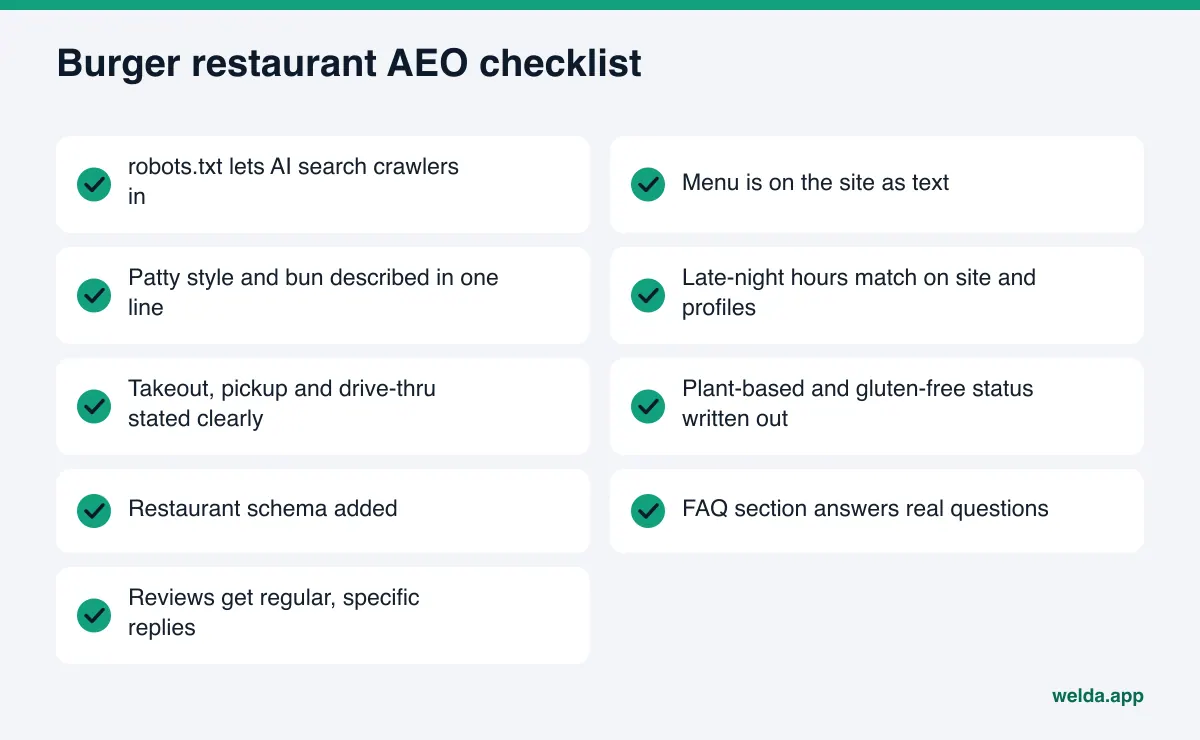
Reviewing the checklist once a week is enough. When the menu or hours change, update your site and every profile the same day.
Frequently asked questions
Is AEO for a burger restaurant different from regular SEO?
The foundation is shared: a crawlable site, clear headings, accurate business information. The difference is that AI writes a short answer instead of showing a list, so plainly written facts about your menu, style and hours matter even more.
My menu is on Instagram. Isn't that enough?
Instagram is a useful source but shouldn't be the only one. Text inside images isn't always read, and posts go stale. A text menu on your site makes current information easy for AI to find.
Do delivery app listings affect AI answers?
AI reads many sources together, and delivery listings can be among them. What matters most is that menus and hours there match your website. Conflicting details can push you out of the answer.
How long until I see results?
New content usually takes weeks to show up in AI answers. No one can promise a fixed timeline or outcome. Regular measurement lets you see the change over time.
Can US burger restaurants use the Welda dashboard today?
The dashboard is in early access and opening first in Turkey. The free site analysis works in English and is available to anyone today.
Will Welda write reviews for me?
No. Welda does not create fake reviews. It can draft replies to reviews you receive; publishing them stays your decision.
See where your burger restaurant stands today
Getting named in AI answers starts with a handful of facts about your burger restaurant written clearly, accurately and the same way everywhere. Measuring what's missing is faster than guessing. Run the free site analysis; the results link arrives by email with your score, your gaps and ready-made copy for your homepage in one report.