How do optometrists and eyewear stores get recommended by ChatGPT? ChatGPT and other AI assistants recommend an eye care practice or optical shop based on clear information they can find on your website and on the sites that talk about you: which services you offer (eye exams, contact lens fittings, progressive lenses, kids' frames, repairs), which vision plans you accept, where you are, when you are open, and what patients say about you. When that information is clear, consistent, and readable, your chances of being named go up. Nobody can guarantee a specific position.
This guide is for owners of independent optometry practices and eyewear stores, managers of multi-location optical groups, and the people who run their websites. The question is simple: when someone asks "Who's a good optometrist near me that takes VSP?" or "Where can I get progressive lenses made in Austin?", does ChatGPT, Gemini, Perplexity, or Google's AI Overviews mention your name? If not, why not, and what should you fix first? Below we cover the problem, the steps, how Welda handles this work, and what it does not do. If you want to see where your site stands today, start with the free site analysis.
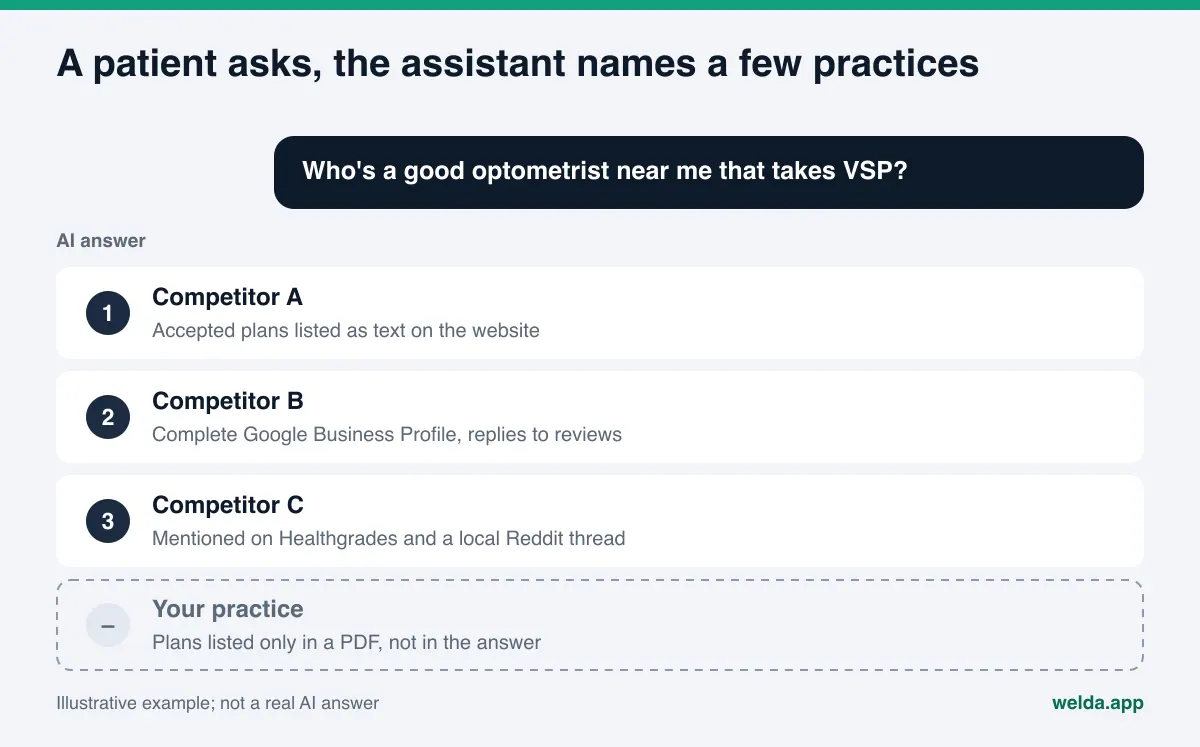
Why AI answers now matter for optometrists and eyewear stores
Eye care decisions usually start with a trigger. A new prescription, a broken pair the night before a trip, a child squinting at the whiteboard, an annual exam the insurance plan covers. A few years ago, that person would type "optometrist near me" into a search box, scan the map pack, and click through a few websites. Today, more of that research happens inside a single conversation with an AI assistant. The patient writes their neighborhood, their vision plan, their deadline, and what they need, all in one sentence, and the assistant answers with a short list of names.
If your practice is not in that short list, you are not in the consideration set at all. On a classic results page, being in position seven still gave you a shot at a click. In an AI answer, there are usually only a few names, and people tend to choose among them. That is what answer engine optimization (AEO) is about: making sure the answer engines that patients now use can find, understand, and cite your practice. You will also see this called AI search visibility or, less often in the US, GEO (generative engine optimization). They describe the same work.
Optical businesses have a few traits that make this harder than for a typical retail shop:
- Product and clinical service are mixed. A patient may need a comprehensive eye exam from an optometrist, a contact lens fitting, and then frames and lenses from an optician. Assistants need to read which of these you actually offer, and at which location.
- Insurance questions dominate. "Takes VSP", "in network with EyeMed", "accepts FSA or HSA cards". If your accepted plans live only in a PDF or a phone conversation, the assistant cannot use them.
- Trust is personal. Glasses are made for one person. A bad measurement affects daily life. Patients look at reviews, credentials, and how long a practice has been around.
- Regulation shapes the patient journey. In the US, the FTC's Eyeglass Rule and Contact Lens Rule give patients the right to a copy of their prescription, whether they ask for it or not. Patients increasingly ask assistants whether they can bring an outside prescription to a store. Being clear about this on your site helps. This is not legal advice; check the rules for your practice with your own counsel.
What patients ask AI about eye exams and eyewear
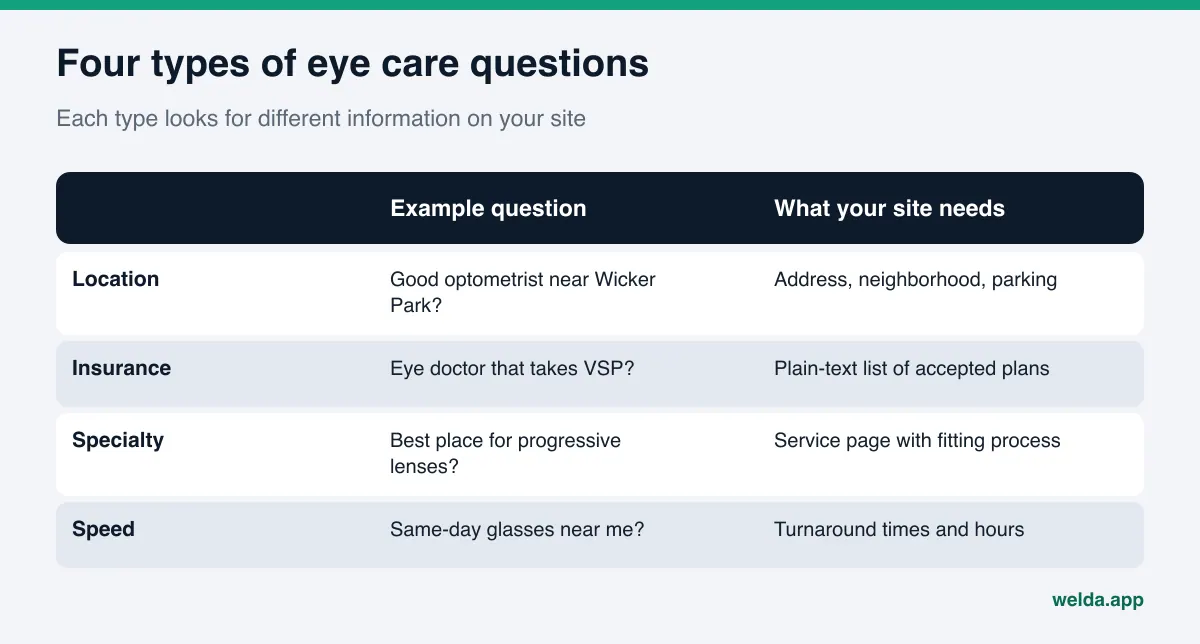
Questions to AI assistants about eye care fall into a few clear types. The table below shows example questions and the information each one looks for on your site. The questions are illustrations; your own list should come from the words your patients actually use at the front desk and on the phone.
| Question type | Example question | What your site needs |
|---|---|---|
| Location | Good optometrist near Wicker Park? | Full address, neighborhood name, parking and transit info |
| Insurance | Eye doctor that takes VSP in Plano? | A plain-text list of accepted vision and medical plans, FSA/HSA note |
| Exam type | Where can I get a contact lens exam this week? | Service page per exam type, booking options, how far out you book |
| Specialty lenses | Best place for progressive lenses in Denver? | Progressive lens page with fitting process and adaptation support |
| Kids | Pediatric eye exam and kids' glasses near me? | Pediatric page, minimum age, frame durability, replacement policy |
| Speed | Same-day glasses in Phoenix? | Turnaround times, in-house lab or not, hours including weekends |
| Outside prescription | Can I buy glasses with a prescription from another doctor? | Clear policy on outside prescriptions and what to bring |
When practices fill this out for themselves, two things usually show up. First, many services are never written down on the site: the staff knows them, patients find out in the store. Second, the information that is written down conflicts across platforms: one set of hours on Google Business Profile, another on the website, a third on Yelp, and a phone number that changed two years ago on the BBB listing. Assistants that see conflicting facts either skip the business or repeat the wrong detail.
Where AI assistants look before recommending an eye care practice
An AI answer draws on two pools: your own website and third-party sites that describe you. For US eye care, the second pool is typically Google Business Profile and its reviews, Yelp, Healthgrades and similar doctor directories, the BBB, local news and neighborhood blogs, Reddit threads where people trade recommendations, insurer provider directories, and frame or lens brands' store locators.
There is a prerequisite for the first pool: AI search crawlers have to be able to read your site. OpenAI documents that its OAI-SearchBot crawler is used to surface websites in ChatGPT search, and sites that block it will not show up in ChatGPT search answers. Some website builders, security plugins, and hosting firewalls block these crawlers without anyone noticing. Google, for its part, says in its documentation on AI features that there are no additional requirements or special optimizations needed to appear in AI Overviews or AI Mode beyond the usual search fundamentals. A crawlable, well-structured site with plain facts serves both.
Then the assistant matches your text against the question. If the word "progressive" never appears on your site, it is hard for the assistant to name you for a progressive lens question, no matter how skilled your opticians are. Putting information inside an image, such as a banner listing accepted plans, does not help much either. Assistants trust readable text.
How optometrists and eyewear stores get recommended by ChatGPT: the AEO work step by step
The steps below follow an order on purpose. If crawlers cannot reach the site, new service pages will not help. If your basic facts conflict, new reviews only go so far.
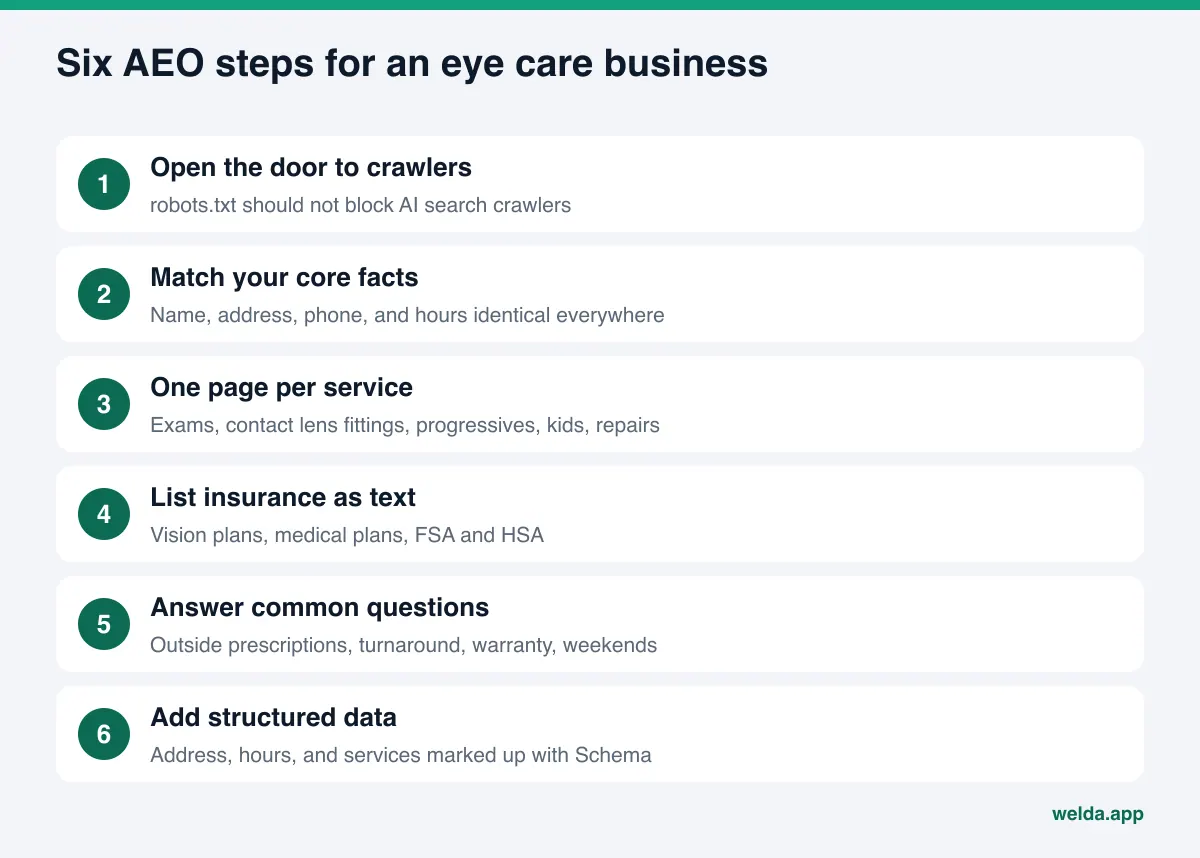
- Check crawler access. Look at your robots.txt file for lines that block AI search crawlers. Ask your web host or developer whether a firewall or security plugin filters bot traffic.
- Make your core facts match everywhere. Practice name, street address, phone, booking link, and hours should be identical on your site, Google Business Profile, Yelp, Healthgrades, and the BBB. For multiple locations, give each location its own page.
- Write one page per main service. Comprehensive eye exams, contact lens exams and fittings, pediatric exams, progressive and multifocal lenses, sports or safety eyewear, repairs and adjustments. Each page should say what the service is, who it is for, what happens during the visit, how long it takes, what to bring, and how to book.
- Publish your insurance list as text. List accepted vision plans and medical plans, mention FSA and HSA if you accept them, and say what patients should do if their plan is not listed. Keep it current.
- Name your brands and your range. Write which frame and lens brands you carry, describe the range in words (budget-friendly through designer), and explain how to check stock.
- Answer the common questions. Outside prescriptions, turnaround times, warranty and remakes, weekend hours, parking, walk-ins versus appointments, and what a contact lens fitting includes.
- Add structured data. Schema markup gives machines your address, hours, and services in a direct format. Schema.org defines an Optician type, a subtype of MedicalBusiness, that fits optical shops; check with your developer which type best describes your practice.
We explain how to write pages an assistant can quote in our guide to service pages AI can quote. The role reviews play in AI answers is covered in reviews and AI recommendations.
How to write eye care pages without overclaiming
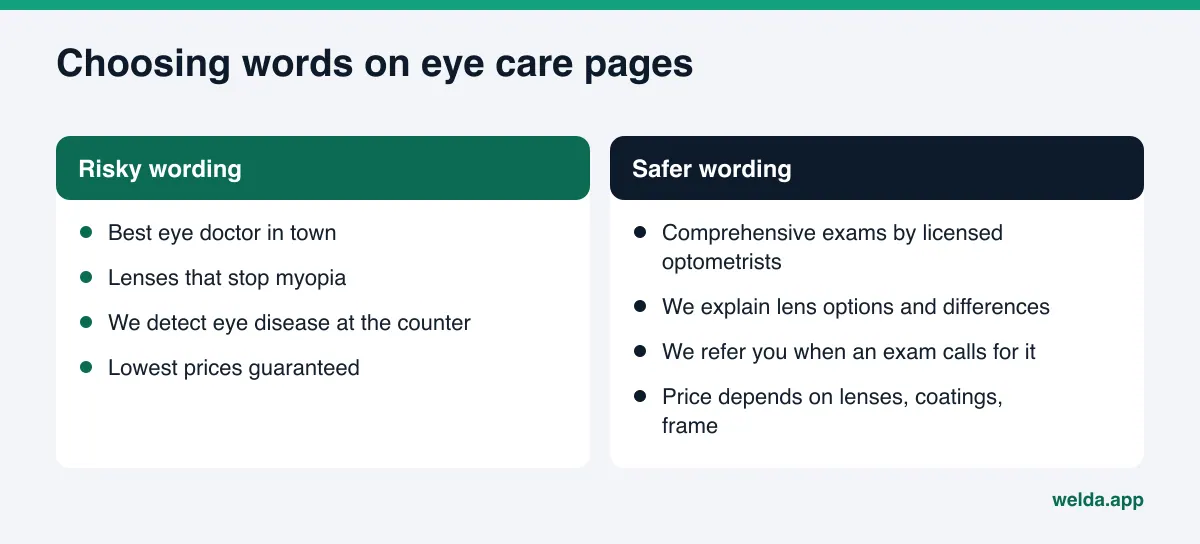
Eye care sits close to health care, so two traps come up often. The first is superlatives: "the best eye doctor in town", "lowest prices guaranteed". These carry no information an assistant can use, and in a regulated, health-adjacent field they can create problems under advertising rules. The second is outcome or treatment claims written by the retail side: "lenses that stop myopia", "we detect eye disease". Exams and diagnosis belong to licensed optometrists and ophthalmologists; the copy should describe what each role at your practice actually does.
Here is a skeleton for a progressive lens page. Fill it in with your own facts:
- Opening paragraph: what progressive lenses are, in one or two sentences, with your practice name and neighborhood in the same paragraph.
- Who they are for: people switching between reading glasses and distance glasses, patients with a progressive prescription.
- The process: prescription, frame selection, measurements taken with the chosen frame, ordering, fitting, adjustment at pickup, with realistic times.
- Adapting: what patients may notice in the first days and how you help if they struggle.
- Practical details: appointment or walk-in, hours, accepted plans for lenses, how to reach you.
- Three or four FAQs specific to this service.
There is almost no marketing language in that skeleton, and yet it contains everything an assistant needs to answer "where should I get progressive lenses?" The same structure works for contact lens fittings, kids' glasses, and repairs.
How Welda handles AI visibility for eye care businesses
Welda is software that measures where a business shows up in AI answers and prepares the fixes on the business's behalf. For an optometry practice or eyewear store, three parts do most of the work: question tracking, source and competitor views, and a to-do list with ready-made drafts.
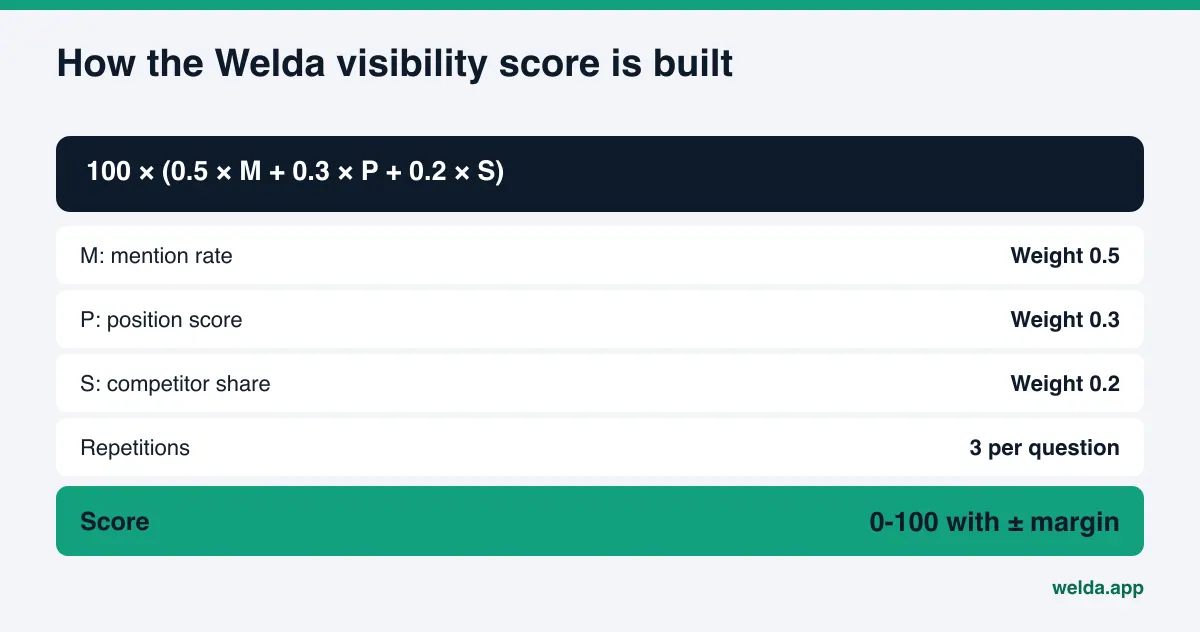
Question tracking. In the Welda panel, the questions your patients are likely to ask are sent to ChatGPT, Gemini, Perplexity, and Google AI three times each. For every question you can see which engine named you and in what position. For an optical business, this shows which question type from the table above is the weak spot. Say an example practice gets named for "optometrist in Wicker Park" but never for "progressive lenses" or "takes VSP". The issue is not general awareness; it is that those two topics are not described on the site. That tells you which page to write first. The score behind it is open: 100 × (0.5 × share of questions where you are named + 0.3 × position score + 0.2 × share against competitors), with a ± margin of error derived from the three repetitions.
Sources and competitors. The sources view lists the sites the engines lean on when answering, and your status on each: present, incomplete, or missing. For eye care this is usually map profiles, review sites, doctor directories, and forums. The competitor view shows which question cluster a competitor wins and which source is driving it. For example, "Competitor A" leads on pediatric questions, and the citations trace back to a parenting thread on a local forum. That is not a reason to copy Competitor A; it shows you where you are absent. We walk through the method in citation gap analysis.
To-dos and drafts. Measurement turns into one to-do list. Welda drafts the missing service page, the FAQ section, or the Google Business Profile description, and suggests replies to reviews. It does not invent facts: it asks you for your turnaround times, accepted plans, and brands. A compliance check flags patterns such as pricing claims, guarantees, superiority claims, and diagnostic suggestions before anything goes live. That check is not legal advice and has not been reviewed by legal counsel. Publishing approval always stays with you.
On WordPress sites, Welda connects through a separate Editor user and an application password, without installing code; content opens on your site as a draft and goes live when you approve it. On other platforms, Welda hands you a ready-made package to apply yourself. Google Business Profile, Instagram, and Facebook can be connected; if they are not, the task appears as a manual item. Your content always lives on your own site.
To be clear about where Welda stands: the panel is in early access and is opening in stages, first with businesses in Turkey. Regular four-engine measurement is being added during early access, and the panel screens shown in demos use representative data. Question language can be set to English or Turkish. What anyone can use today, in English, is the free site analysis. It reads your homepage and a few inner pages, checks crawler access, structured data, address and hours, FAQ content, and how clearly services are described, and gives you a score out of 100, a fix for each gap, and a ready-to-install fix package. It also asks an AI assistant with web search five questions your customers might ask, once, and checks whether your name appears. Pricing is discussed in an early access conversation.
Notes for multi-location optical groups
Optical groups with several locations often list every office on one "Locations" page with a line or two each. When an assistant answers "eye doctor in Cherry Creek", it needs a page that clearly belongs to that office: address, phone, hours, the optometrists who see patients there, which services that office offers (not every location may do specialty contact lens fittings or have an in-house lab), and parking. Mirror that structure in a separate Google Business Profile listing for each location.
Groups also tend to copy promotional language from the main site to every location page. A "buy one, get one" headline is short-lived information for an assistant. What lasts is a clear description of the location and its services. We cover the measurement side in multi-location AEO.
Limits: what Welda does not do
- No ranking guarantees. No tool can promise you will be "first in ChatGPT". Answers vary from question to question and day to day, which is why Welda asks each question three times and shows a margin of error. Our post on why AI answers change every time explains the variance.
- No made-up facts. If Welda does not know your turnaround time, your accepted plans, or your doctors' credentials, it asks you.
- No fake reviews. Reviews come from your real patients. Welda only suggests replies to existing ones.
- No unapproved sensitive content. Anything touching on eye health goes through your approval first.
- Not everything is automated. Handling a negative review or a complaint, creating directory accounts, and earning press coverage stay with the business. Welda lists them and describes what needs doing.
Timing matters too. New content usually takes weeks to show up in AI answers. Fixing access and consistency is faster to do, but the effect on answers still takes time.
Checklist and decision guide
Use the decision guide below to set priorities: access first, consistency second, content third, third-party sources last.
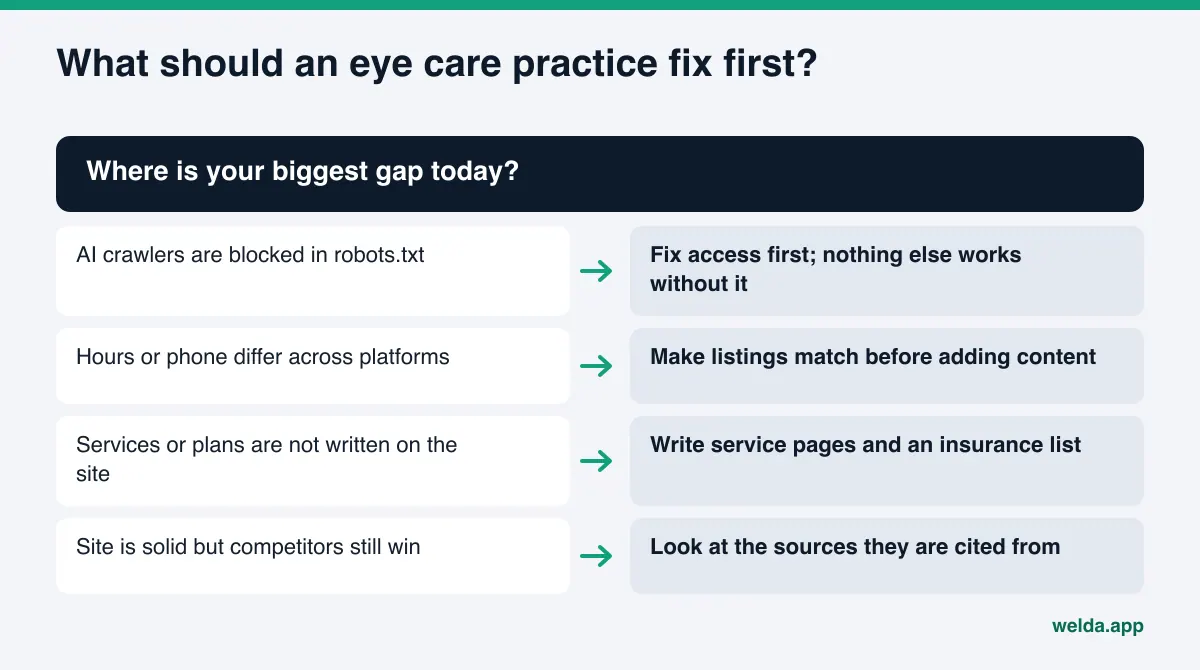
Then work through this quick audit with your website and Google Business Profile open. Every "no" is a task.
- robots.txt does not block AI search crawlers
- Name, address, phone, and hours match on every platform
- Each main service has its own page
- Accepted vision plans and FSA/HSA are listed in plain text
- Outside prescription policy is written down
- Brands and price range are described in words
- Each location has its own page and profile
- No superlatives, guarantees, or diagnostic claims in copy
One more decision: which service to start with. Consultative services such as progressive lenses, contact lens fittings, and pediatric exams generate the most questions before a patient commits. Starting your first service page there usually makes sense.
Frequently asked questions
My practice shows up on Google Maps but not in ChatGPT. Why?
Map results lean heavily on location and profile data. Assistants like ChatGPT look for text that matches the question. If "progressive lenses" or "takes VSP" is not written on your site, the assistant struggles to connect you to those questions. Blocked AI crawlers are another common cause.
Should we list every insurance plan we accept?
Yes, in plain text, and keep it current. Insurance is one of the most frequent filters in eye care questions. Say what patients should do if their plan is not on the list.
Should we publish prices?
Patients ask about price, and assistants can repeat price information. If you publish numbers, you need to keep them current. If you cannot, describe the range and what changes it (lens type, coatings, frame).
Is AEO different from local SEO for an optometrist?
They overlap: consistent listings, a crawlable site, and good reviews help both. AEO adds a focus on whether answer engines name you in full-sentence questions, and on the specific sources they cite.
How long until we see results?
New content usually takes weeks to be reflected in AI answers. Nobody can guarantee a timeline or a position.
Can I use Welda today from the US?
The free site analysis works in English and is free once per site. The full panel is in early access and is opening first in Turkey. Pricing is discussed in an early access conversation.
Next step: see where your practice stands
Instead of guessing why your practice is missing from AI answers, measure it. The free analysis shows whether crawlers can reach your site, whether your address and hours are read correctly, how clearly your services are described, and whether your name appears for five sample questions. The results link arrives by email and stays open for 14 days. It does not measure rankings or promise them; it tells you what is missing and how to fix it. Start with the free site analysis.