How do architects and interior designers get recommended by ChatGPT? AI assistants recommend the firms they can describe with confidence: what services you offer, where you work, what kinds of projects you take on, who on your team is licensed, and what other sources say about you. If your portfolio is mostly photos with little written context, the assistant has nothing to quote and names another firm. The work is turning your portfolio into readable text and keeping that information consistent everywhere you appear.
This guide is for architecture firms, interior design studios, solo practitioners, and small design-build teams in the US. It covers how clients phrase their questions to AI assistants, what your website and profiles need to say so you show up in the answer, and which part of the work Welda takes on. This practice is usually called AEO, short for answer engine optimization; you may also see it called GEO, generative engine optimization. If you want to see what your site tells AI assistants today, run the free site analysis first; the steps below are easier to follow with that report next to you.
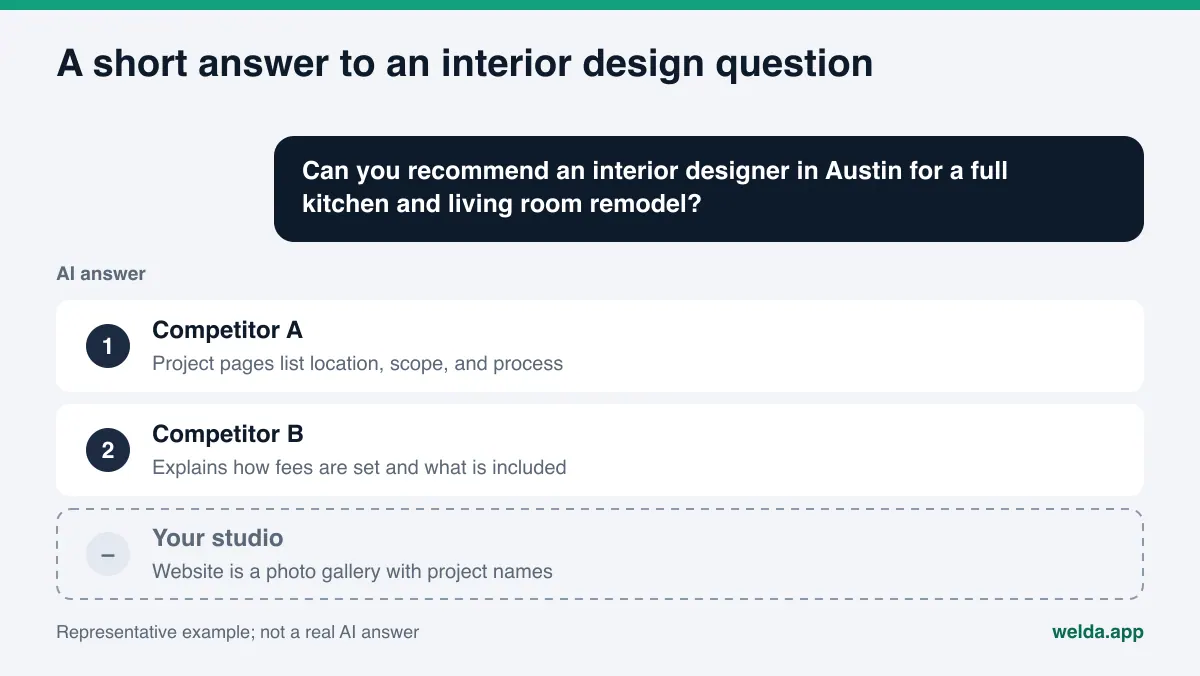
How clients search for an architect or interior designer now
Hiring an architect or interior designer is a decision most people make only a few times in their lives. They have bought a house, they want to open up a 1960s ranch, they are moving their office, or they are opening a restaurant. They often do not know where to start. A few years ago they asked friends, searched Google, and clicked through portfolios. Today a growing share of them type a long, specific question into an AI assistant: "Can you recommend an interior designer in Austin for a full kitchen and living room remodel? Mid-range budget."
The answer is not ten pages of links. The assistant names two or three firms and gives a sentence on why each fits. A firm that is not on that short list never reaches the comparison stage. Google says its AI Overviews and AI Mode also link out to web pages as part of the answer, and that the same content quality and technical basics apply (Google Search Central, AI features). In other words, AI search visibility is earned by pages that answer the question clearly.
Architecture and interior design have a particular problem here: the industry presents itself visually. Firm websites are built around large images, short project titles, and very little copy. That works for a human eye. A good photo explains a kitchen in a second. AI assistants, though, build their answers mostly from text. One sentence such as "Full gut renovation of a 1962 ranch house in Allandale, Austin, including a kitchen relocation; interior design and construction administration" says more to an assistant than twelve photos of the same project.
The second problem is trust. A client hiring an architect is starting a long, expensive project that is hard to undo. They worry about budget overruns, delays, permits, and quality on site. When an assistant chooses which firms to name, it leans toward the ones it can describe on exactly those points: a clear process, a defined scope, responsive replies to reviews, and stated credentials.
What clients actually ask AI assistants
The questions clients ask fall into a few recognizable types. The examples below are illustrations of those types, not survey data.
- Location and job: "I need someone to design a small office build-out in downtown Denver."
- Project type: "Which architects in the Hudson Valley design modern single-family homes?"
- Process: "What happens in the first meeting with an interior designer?"
- Fees: "Do interior designers charge hourly, a flat fee, or a percentage?"
- Scope: "Is there a firm that does both the design and manages the contractor?"
- Credentials: "For a remodel, do I need a licensed architect, an interior designer, or a decorator?"
Five needs show up across these questions: place, project type, scope, process, and trust. When an assistant finds information that covers those needs in a clear source, it can recommend a firm. The table below shows which information covers each need and where it should live.
| Client's need | What the assistant looks for | Where it should live |
|---|---|---|
| Place | Office address and the cities or counties you serve | Contact page, service pages, Google Business Profile |
| Project type | Residential, workplace, retail, hospitality, multifamily | Service pages and project pages |
| Scope | Design only, design plus construction administration, consulting | One page per service |
| Process | Steps from first call to completion and typical order | Process page and FAQ |
| Fees | How fees are structured and what the first consultation includes | FAQ or a short fees section |
| Trust | Licenses, team, reviews, and written project descriptions | About page, review platforms, project pages |
What AI assistants check before recommending architects and interior designers
An assistant does not rely on one source. It reads your website, your Google Business Profile, directories, design platforms such as Houzz, review sites such as Yelp, and any articles that mention you. When those sources agree, it can describe you with confidence. When they disagree, or when none of them says clearly what you do, leaving you out is the safer choice for the assistant.
Three issues come up again and again on architecture and design websites:
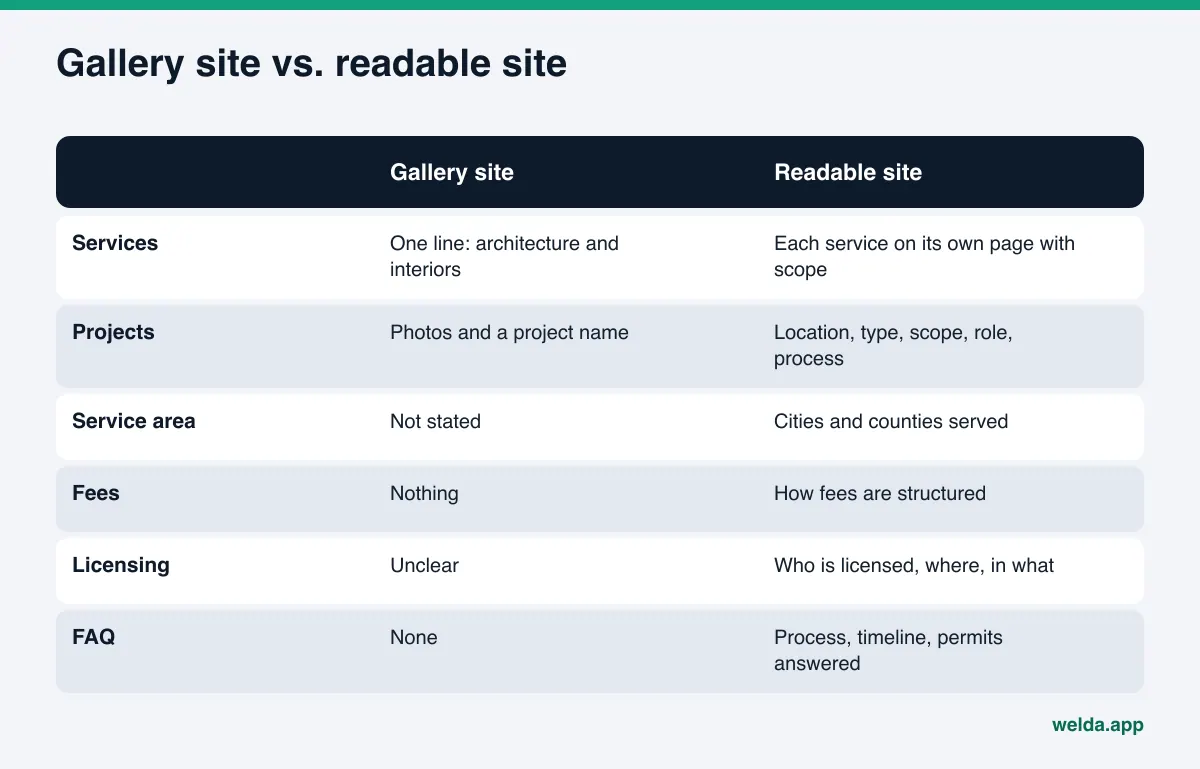
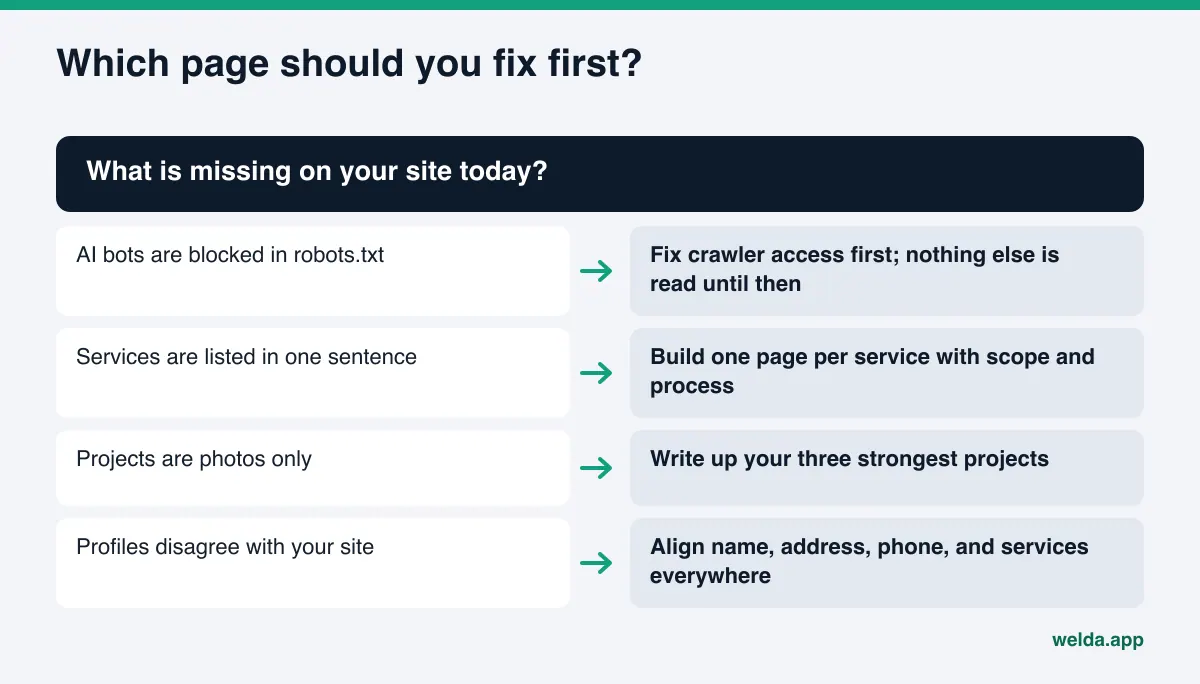
- Services in one sentence. "We offer architecture and interior design" does not answer "interior designer for a kitchen remodel" or "architect for a restaurant build-out." Each service needs its own page.
- Projects as photo sets. A project page has a title and a dozen images, but no location, building type, or description of what the firm did. Alt text is often empty.
- Unclear credentials. The site says "our design team" but never says who is a licensed architect and who is an interior designer. Clients ask about that distinction, and assistants look for a clear answer.
There can be a technical block, too. If your robots.txt file blocks AI crawlers, your content is not read no matter how good it is. OpenAI says ChatGPT search uses a crawler called OAI-SearchBot, and that sites which block it will not appear in ChatGPT search answers (OpenAI crawler documentation). We walk through the check in our post on whether AI bots are crawling your website.
How architects and interior designers get recommended by ChatGPT: step by step
These steps are not a one-weekend list, but the order matters. First you clarify what you do, then you add the written proof, then you align outside sources and measure.
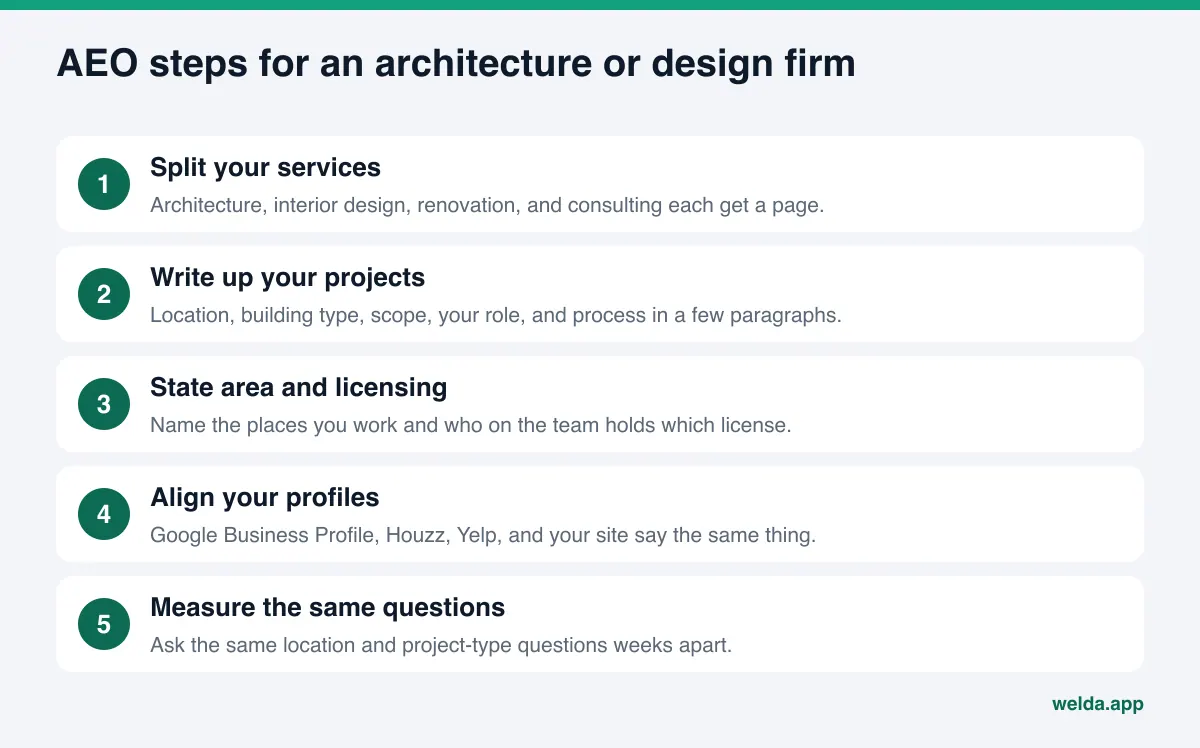
1. Give each service its own page
Do not bundle architecture, interior design, renovation, commercial build-outs, design-build, and consulting on one page. Give each a page and answer: who it is for, what it includes, what it does not include, how the process works, and what the client receives at each stage. If you only do interiors, say so. Do not list work you do not do. An assistant would rather recommend you for the right question than the wrong one.
2. Write up your projects
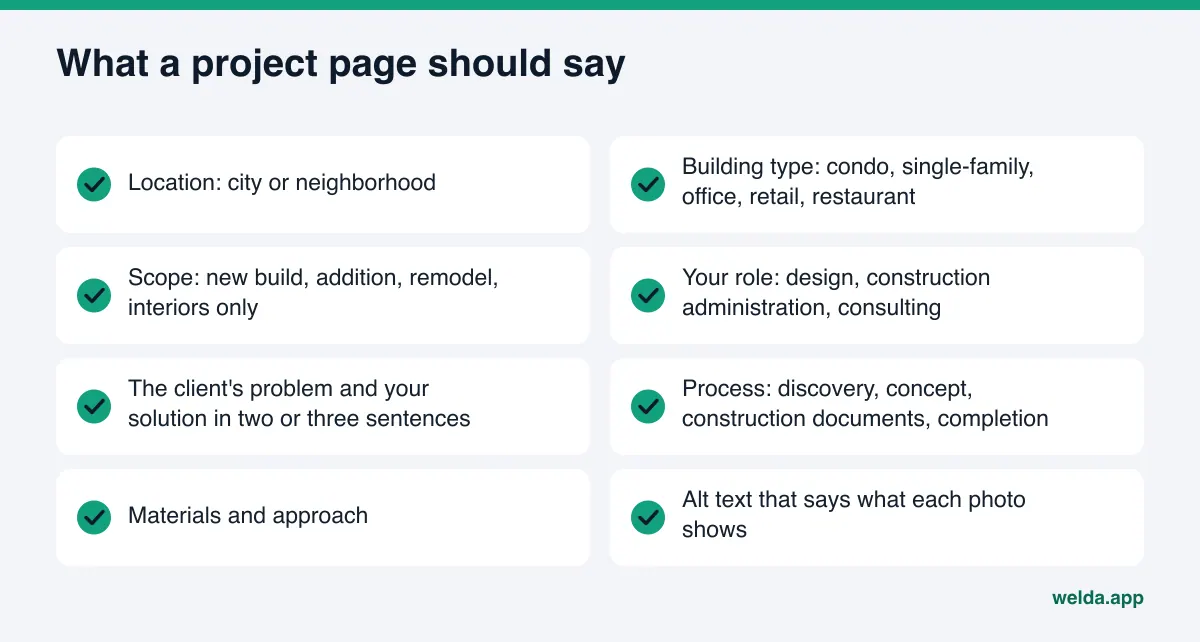
Your portfolio is your strongest evidence, but it only counts if the assistant can read it. Add a few paragraphs to each project page: location, building type, the client's goal, your role, how the process went, and the materials and approach you chose. Write alt text that says what each photo shows. Get client consent before naming the client or the exact address; for most projects the neighborhood and building type are enough.
3. State your service area and office location
Many questions include a place. Write your office address, the cities or counties you take projects in, and whether you work remotely. If you work out of state, show it with example projects. Name, address, and phone number should match on your site, your Google Business Profile, Yelp, Houzz, and any professional directory listing.
4. Spell out licensing, team, and process
On your about page, list the people on your team and their credentials: who is a licensed architect and in which states, who is a registered or certified interior designer where your state has such a registration, who handles construction administration. In the US, the title "architect" is restricted by state law. New York, for example, states that any use of the title "Architect" in the state requires a New York license (New York State Education Department, architecture requirements). Interior design regulation varies a lot from state to state. Stating your credentials accurately gives the assistant a basis for answering "architect or interior designer?" This is not legal advice; check your state board for the rules that apply to you.
5. Answer the questions clients ask in the first meeting
Put the answers on your site: how long a typical project takes, how fees are structured, whether the first consultation is paid, how you handle permits, whether you manage the contractor, whether you take remote projects. You do not have to publish numbers. Explaining how your fees are set already gives the assistant something reliable to say.
6. Align your outside profiles
Choose the right primary category on your Google Business Profile and write the description in the same language as your site. Review your Houzz, Yelp, and directory profiles, and any listing with a professional association. An old address, a dead phone number, or a different spelling of your firm name makes the assistant hesitate. Reply to reviews in a calm, specific tone, and never solicit fake ones; the FTC's rule on fake reviews and testimonials applies to every business (FTC announcement).
7. Measure the same questions over time
After you make changes, pick the questions clients would ask and repeat them, worded the same way, weeks apart. A single query is misleading; AI answers can change even for the same question. Measurement needs fixed questions and repeated runs.
How to write a project page: a worked example
The example below is not from a real firm. It shows how a project page can be written. Say an example interior design studio renovated a 1962 ranch house in Austin.
On a gallery site, this project appears as "Allandale Residence" and twelve photos. An assistant can read only the project name.
On a readable site, the same project is described like this: "Full renovation of a 1962 ranch house in the Allandale neighborhood of Austin. The owners wanted to open the closed kitchen to the living area and add storage without an addition. The studio produced the interior design and construction documents, coordinated with a structural engineer to confirm the wall could be removed, and handled construction administration through completion. The work moved through four phases: discovery, concept, construction documents, and build." Below it sit the photos, each with a short caption of what it shows.
The second version answers every need in the client's question: place (Allandale, Austin), project type (single-family renovation), scope (design plus construction administration), process (four phases), and trust (structural review, on-site follow-through). When someone asks "interior designer in Austin who handles full home renovations," the assistant can use this page as a source.
The same principle applies to builders and remodelers, and the two kinds of firms benefit from being described separately. We cover the contractor side in AI search optimization for home remodeling contractors, and another service trade in how plumbers get recommended by ChatGPT.
How Welda does this work
Welda is software that measures where a business shows up in AI answers and fills in the gaps on the business's behalf. For an architecture or design firm, three parts of it matter most: seeing what your site says today, measuring whether your name comes up in client questions, and drafting the written information that is missing.
Starting with the free site analysis. The analysis reads your home page and a few inner pages such as services, about, and contact. It works in English. On architecture sites, the most common findings are vague service descriptions, no FAQ section, and missing business schema markup. For each gap you see what was found, why it matters, and how to fix it, plus suggested copy for your home page title, description, and intro paragraph. The analysis also asks five questions a client might ask to an AI assistant that can search the web, and checks whether your firm's name appears in the answers. That is a one-time measurement, and anyone can run it today.
Question-by-question measurement in the panel. The Welda panel is in early access and is opening first in Turkey. Inside it, a firm's questions, for example "interior designer in Austin for a whole-home renovation" or "architect for a restaurant build-out in Denver," are asked to ChatGPT, Gemini, Perplexity, and Google AI three times each. Questions can be run in English. The questions view shows, for each question and each engine, whether your firm was named and in what position. That lets you reach conclusions such as "we appear for residential questions but not for commercial ones" and decide which service page to work on next. Regular four-engine measurement is being added during early access, and the sample screens in the panel use representative data.
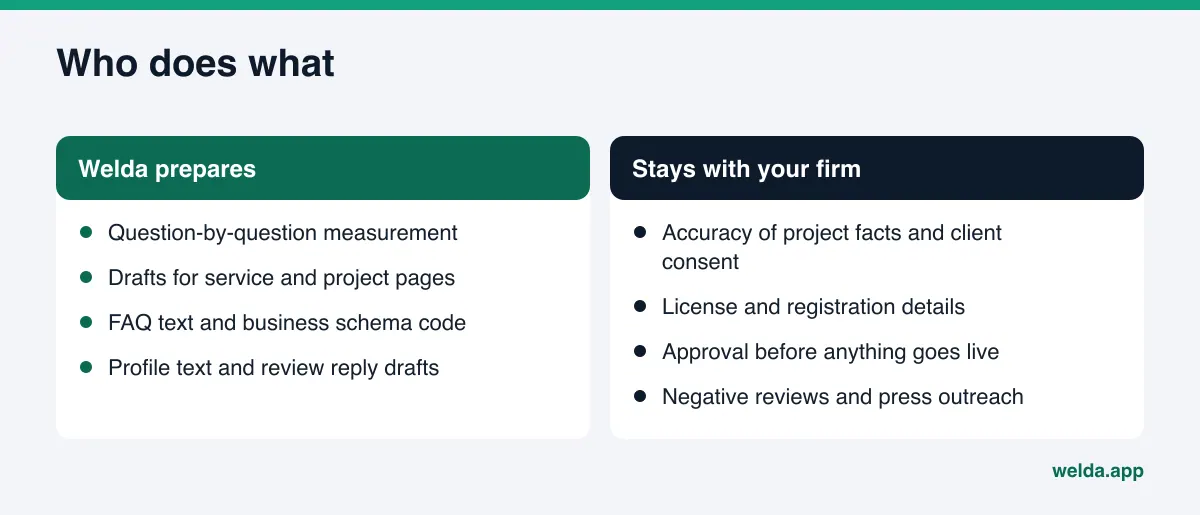
Sources and ready-to-use copy. The sources view shows which sites the assistants lean on and where you are missing. For a design firm, that might reveal an incomplete Google Business Profile or no presence on a platform the answers keep citing. In the to-do list, Welda places a draft next to each gap: a service page draft, a project write-up outline, FAQ answers, profile text. Because only you know the project facts, Welda does not invent them; it asks you. On WordPress sites, Welda connects through a separate Editor user and an application password, and content opens as a draft on your site until you approve it. On other platforms, Welda gives you a ready package and the change is made by hand.
The panel also shows where competitors are ahead and which source they win from, a before-and-after comparison, and a one-page monthly report. We explain how the measurement turns into a share figure in AI share of voice.
Limits, and what Welda does not do
Honesty matters here. No software or agency can guarantee that a firm will be recommended by ChatGPT. AI answers vary by engine, by question, and over time. Welda does not guarantee rankings or placement.
- It does not make things up. Project locations, scope, your role, licenses, and process come from you. Welda does not fill a blank with a guess.
- It does not publish without approval. Content always lives on your own site, and the decision to publish stays with you. Welda does not host content.
- It does not write fake reviews. It drafts replies to reviews, but it never writes or solicits reviews.
- Some work stays with you. Talking to an unhappy client, setting up directory accounts, and getting featured in design publications are your firm's work.
- It takes time. New content usually takes weeks to show up in AI answers.
Before publishing, a compliance check flags patterns such as price claims, guarantees, and superiority claims. It is a prompt to look again, not legal advice, and it has not been reviewed by legal counsel.
Checklist for architecture and interior design firms
Compare the table with your own site. Every "no" is a piece of information the assistant is missing when it tries to describe you.
| Check | How to tell | Priority |
|---|---|---|
| Can AI crawlers reach the site | robots.txt does not block OAI-SearchBot and similar crawlers | High |
| Does each service have a page | Architecture, interiors, renovation each described separately | High |
| Do project pages have written text | Location, type, scope, role, and process in at least a paragraph | High |
| Is the service area clear | Cities or counties served appear on the page | High |
| Are licenses and team stated | About page lists people, credentials, and states | Medium |
| Is there an FAQ | Process, timeline, fee structure, and permits answered | Medium |
| Is there business schema | Name, address, phone, and area served marked up | Medium |
| Do outside profiles match | Google Business Profile, Houzz, Yelp, and site agree | Medium |
| Are reviews answered | Recent reviews have calm, specific replies | Low |
Frequently asked questions
Aren't my portfolio photos enough for AI assistants?
Usually not. Assistants build answers mostly from text. If your photos are not accompanied by the project's location, type, scope, and your role, your portfolio may never reach the answer. Fill in the alt text too.
Do I need to name the client or the address on a project page?
No. For most projects the neighborhood or city and the building type are enough. Get the client's consent before publishing a name, an exact address, or anything identifying.
Will the assistant skip me if I don't publish fees?
Publishing numbers is not required. Explaining how fees are structured, what the first consultation includes, and how site visits work gives the assistant a reliable answer to the fee question.
We do both architecture and interiors. Can one page cover it?
Separate pages work better. Client questions usually target one kind of work, and a dedicated page answers that question directly.
How long until changes show up in ChatGPT answers?
There is no fixed timeline. New content usually takes weeks to show up. That is why you should measure the same questions, worded the same way, weeks apart.
Can US firms use the Welda panel today?
The panel is in early access and is opening first in Turkey. What anyone can use today is the free site analysis, which works in English. Pricing is discussed in the early access conversation.
Where to start
For an architecture or design firm, the first step is rarely producing something new. It is writing down the work you have already done. Your projects are the proof; what is missing is a version the assistant can read. See what your site says today, then write your service pages and your three strongest project write-ups, then align your outside profiles.
To see what your site tells AI assistants, which information is missing, and which fix would make the biggest difference, run the free site analysis. The results arrive by email and stay available for 14 days.