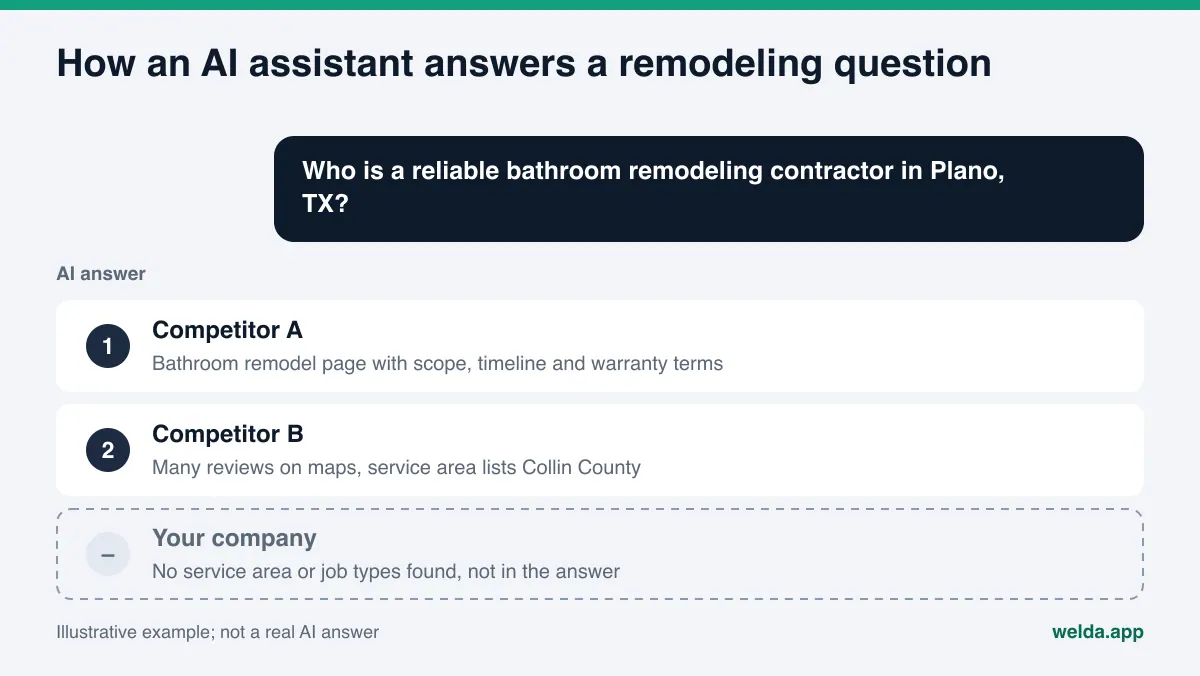
What does AI search optimization for home remodeling contractors actually do? Homeowners now ask ChatGPT, Gemini, Perplexity or Google's AI Mode things like "Who is a reliable bathroom remodeling contractor in Plano?" and get back a short list of names. AI search optimization for home remodeling contractors, usually called AEO (answer engine optimization), is the work of making your website, your Business Profile and your job information easy for those assistants to read, trust and repeat. This guide explains what a remodeler should publish, what to measure, and which part of the work Welda takes on.
What is AEO for remodelers, and why does it matter now?
AEO stands for answer engine optimization: getting your business named inside the answers that AI assistants give. You will also see the terms "AI search visibility" or "AI visibility," and some people call the same work GEO (generative engine optimization). They describe one goal. In this article we use AEO.
In a classic search, a homeowner sees ten links, opens a few contractor sites, looks at project photos and calls two or three companies. In an AI answer, they often see three or four names, each with a one-line reason. The estimate requests go to that short list. If you are not on it, you are not part of the comparison at all.
Remodelers feel this shift more than many local businesses, for three reasons:
- The job is big and the decision is heavy. A kitchen or a basement finish is something the family will live with for years. People ask long, specific questions before they pick anyone: timeline, permits, dust, whether they can stay in the house, what happens if something leaks a year later. A contractor whose site answers none of these is not a candidate for the answer.
- Trust comes before price. Questions like "remodeler who won't disappear halfway through the job" or "how do I check a contractor is licensed" are common. AI assistants answer them using what the contractor publishes and what other people write about the contractor.
- The work happens at the customer's home. You do not receive customers at a storefront; you drive to them. For an assistant to answer "does this company work in my town," your service area has to be written out clearly. We cover this pattern in general in our article on "near me" searches in AI.
The quickest way to see where you stand is Welda's free website analysis. It reads your homepage and a few key pages (services, pricing, about, contact) the way Google and AI systems read them, and lists every gap with a suggested fix. The free analysis works in English.
Which remodeling questions do homeowners ask AI?
Remodeling questions are rarely as short as "good contractor near me." The table groups the question types a remodeling contractor's website should be ready for. The example questions were written for this article; they are not survey or measurement results.
| Question type | Example question | Where the answer should live on your site |
|---|---|---|
| Job type and town | "Kitchen remodeling contractor in Naperville that also does cabinets" | One page per job type, plus a service area list |
| Scope | "What does a full bathroom remodel include" | Scope list: demo, plumbing, waterproofing, tile, fixtures, cleanup |
| Timeline | "How long does a basement finish take" | Process steps and the factors that change the timeline |
| Permits | "Do remodelers pull the permits or do I" | Process page explaining who handles permits |
| Trust | "Licensed and insured remodeler with a workmanship warranty" | About page with license details and warranty terms |
| Living through it | "Can we stay home during a kitchen remodel" | FAQ section |
| Estimate | "Remodeler who gives a written, itemized estimate" | Estimate page: how the visit works, what the estimate shows |
There is a pattern in the table. Every piece of the answer is something you normally explain during the in-home estimate or on the phone. An AI assistant does not sit in on the estimate. Information that is not written down does not make it into the answer.
Licensing and permit rules differ by state, county and city. Write down what your company actually does (for example, "we pull all building permits for the jobs we take on" or your license number if you hold one), but do not state the law for the reader. This article is not legal advice.
Which sources does AI use to learn about a remodeling contractor?
When an AI assistant searches the web to build an answer, it reads several sources together. For a remodeler, some of those sources are in your hands. Others belong to customers and platforms: Google Business Profile, Yelp, Angi, Houzz, the BBB and local forums or neighborhood groups that are publicly visible.
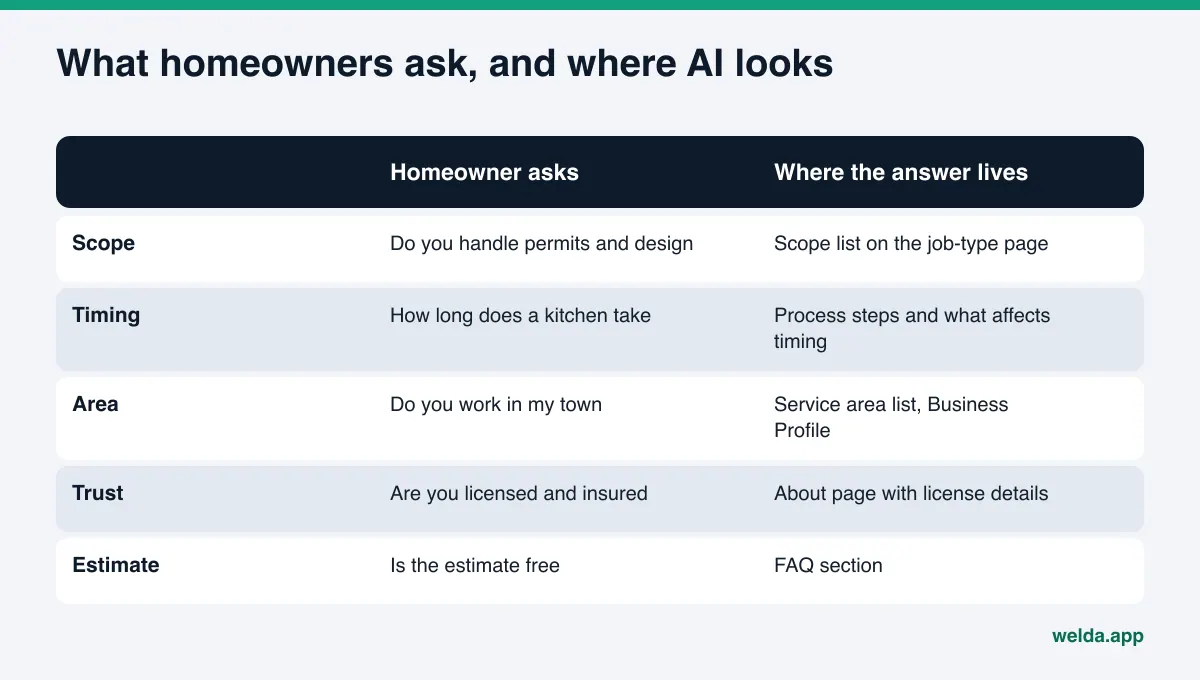
In practice, four rules stand out:
- Your own website is the primary source. You are the one who can state your job types, service area, process and warranty correctly. If that information is not on your site, the assistant tries to piece it together from other sites, or leaves you out.
- Your Google Business Profile carries a lot of weight. For businesses that do not serve customers at their address, Google asks you to remove the address from the profile and define a service area by city or ZIP code instead, as explained on the Google Business Profile help page on service areas. The towns in your profile should match the towns on your website.
- Your facts must match everywhere. If your site shows one phone number, Yelp shows an old one and your Angi listing uses a former company name, the assistant cannot tell which is right. Conflicting facts can lead to a wrong answer or to no mention at all. We walk through that problem in what to do when ChatGPT has wrong information about your business.
- Reviews and complaints are sources too. A BBB complaint or a long Yelp review can feed the answer to "is this contractor reliable." Your calm, specific reply is read as well. Review rules matter here: the FTC's final rule on fake reviews, announced in August 2024, bans fake and AI-generated reviews, undisclosed insider reviews and review suppression through threats. This is a summary, not legal advice.
AI search optimization for home remodeling contractors, step by step
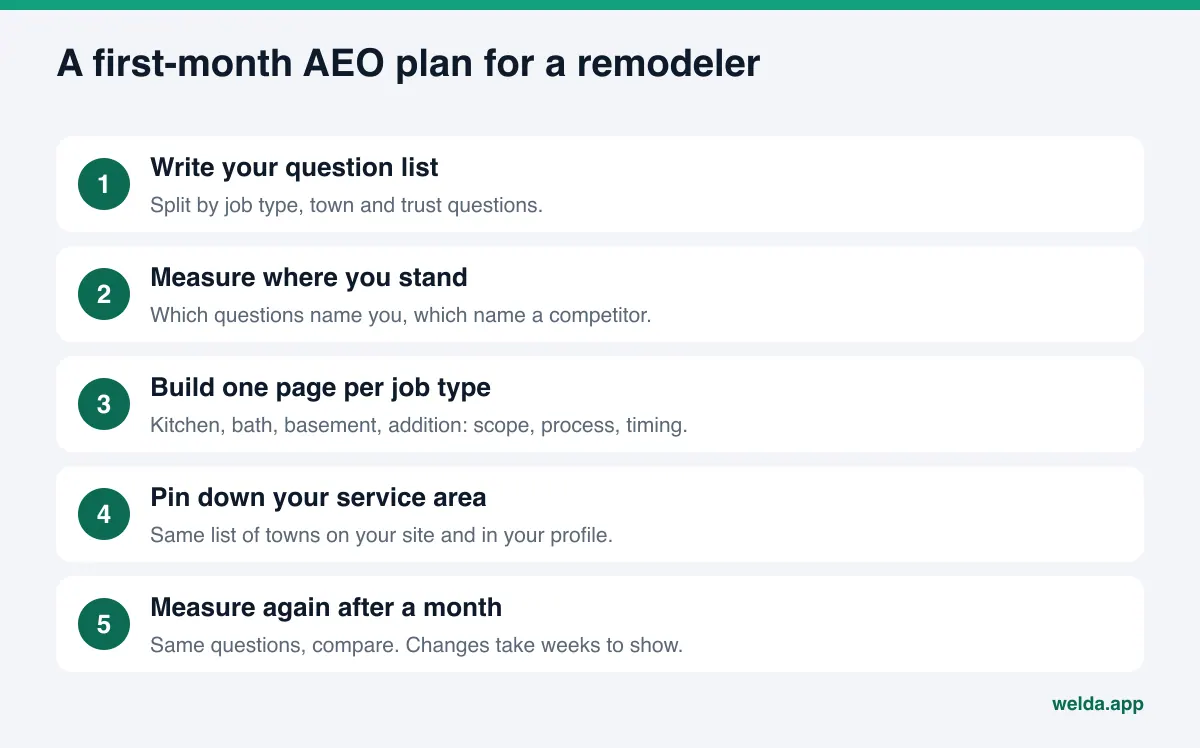
The steps below are ordered for a small or mid-sized remodeling company that does the work with its own team. The first three usually take a day or two. The real effort goes into the job-type pages.
- Check that AI crawlers can reach your site. Your robots.txt file may block the crawlers that AI assistants use without anyone noticing, for example after a theme, plugin or hosting change. The free analysis checks it first.
- Say what you do in one paragraph. The top of your homepage should answer three questions: which jobs you take on, which towns you serve and how you deliver the work. "Quality remodeling at a fair price" is not an answer. "Kitchen, bathroom and basement remodeling across Collin and Denton counties, with an in-home estimate, a written itemized proposal and a final walkthrough" is an answer.
- Add business information as structured data. Schema markup helps an assistant read your company name, phone, service area and services without guessing. For a service-area business, fill in the area field as well.
- Build a page for each job type. Kitchen remodeling, bathroom remodeling, basement finishing, additions, flooring, whole-home renovation. Each page should cover scope, the typical process, what stretches the timeline, what you look at during the estimate and five or six common questions. You do not need to publish prices. Explaining what drives the price already answers a trust question.
- Write your service area as plain text. Do not bury your towns inside a map image. List them in text and use the same list in your Business Profile.
- Make trust information visible. License details if you hold a license, insurance, workmanship warranty terms, how long you have been in business, how crews and subcontractors are organized, how contracts and change orders work. Do not write a promise you cannot keep; an assistant may repeat it word for word.
- Set up a review habit. Ask for a review after the final walkthrough and reply to every review with a short, specific answer. Never buy reviews or write them yourself.
- Measure again after a month with the same questions. New content usually takes weeks to show up in AI answers. Our article on how long AEO takes helps set realistic expectations.
How to build a job-type page
Take a bathroom remodeling page as an example. The main heading names the job and the area: "Bathroom remodeling in Plano, Frisco and McKinney." The opening paragraph says in two sentences what the job covers. A scope list follows: demolition and haul-away, supply and drain lines, waterproofing, tile, vanity and fixtures, glass, final cleanup. Then the process: estimate visit, written proposal, selections, permits where needed, build, final walkthrough. A separate paragraph covers what changes the timeline: room size, whether plumbing is moved, whether special-order tile is on hand. At the bottom sits a short FAQ: "Can we use the house during the remodel?", "Can I supply my own fixtures?", "What happens if a leak shows up after the job?" This structure lets an assistant answer "what does a bathroom remodel include" straight from your page.
Project galleries help, but they are not enough by themselves. An assistant understands a photo only as well as the text around it. Put two lines next to every before-and-after: the town, the job, what changed.
How Welda handles AEO for a remodeling contractor
The part of Welda anyone can use today is the free website analysis, which runs in English and German. For a remodeler, its main value is showing how clearly your job types and service area are written on your site. It reads your homepage and a few inner pages and gives a score out of 100, with technical and content scores reported separately. Each gap comes with what was found, why it matters and how to fix it. A finding like "services page lists every job type in one mixed paragraph" or "no service area in the page text" points straight at your first task.
The analysis also asks five questions a customer might ask to an AI assistant that can search the web, and checks whether your company name appears in the answers. It is a one-time measurement, a snapshot of where you start. The results include suggested homepage text (title, description, main heading, intro paragraph, FAQ), a simulation showing how much each fix would raise your score, a competitor comparison, and a ready-to-install fix package that includes the business information code. You can download it as a PDF and share a score card.
The dashboard: measuring by job type
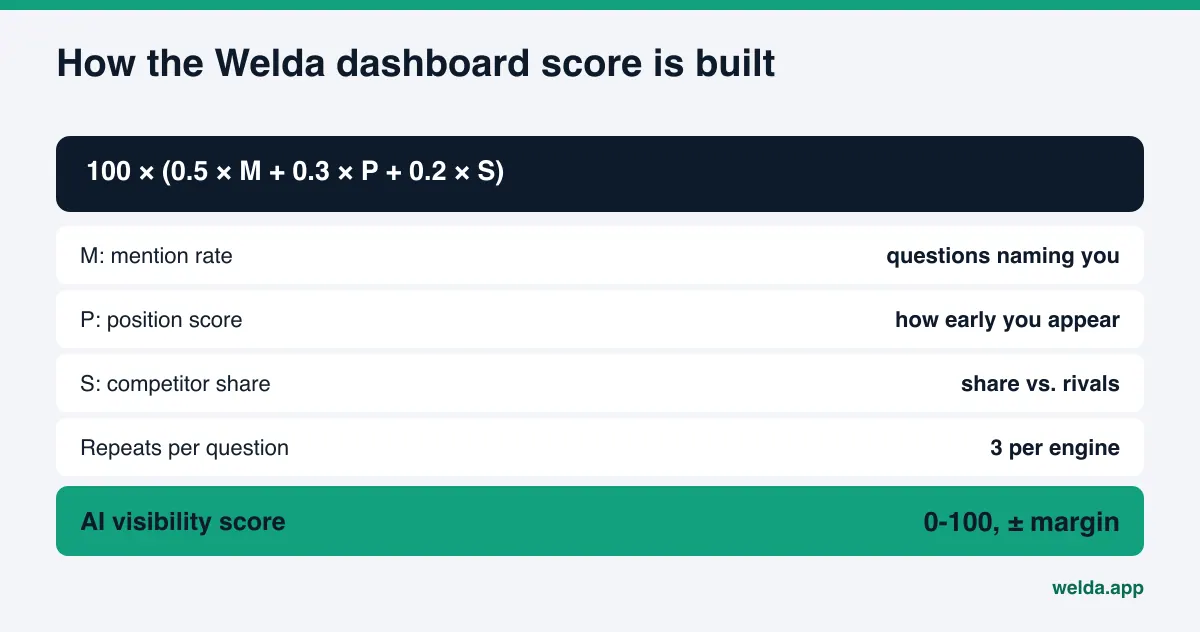
The full Welda dashboard is in early access and is opening first in Turkey. Regular measurement across all four engines is being added during early access, and the example screens use representative data. In the dashboard, the questions your customers would ask are put to ChatGPT, Gemini, Perplexity and Google AI three times each. You see which questions name you, where in the answer you appear, and where competitors are ahead.
For a remodeler, the competitor view is usually the most useful. Questions group naturally by job type: kitchen, bath, basement, additions. In an example scenario, Competitor A leads on bathroom questions and is cited from its Houzz profile, while you show up on kitchen questions from your own site. The decision is plain: write a detailed bathroom page and bring your Houzz profile in line with your site. A sources view lists the sites the assistants draw on and where you are missing.
The to-do list: it asks what it does not know
Everything the measurement surfaces lands on one to-do list. Welda drafts content, profile text and review replies; the approval to publish stays with you. If Welda does not know your warranty terms, the towns you serve or whether your estimate is free, it does not invent them. It leaves the field empty and asks you. Your answer then flows into every draft.
On WordPress sites, Welda connects through a separate Editor user and an application password you create for it, with no code to install. A drafted job-type page opens on your site as a draft and goes live when you approve it. Your content always stays on your own site; Welda does not host it. For other systems, Welda hands you a ready package and you apply it yourself. If your Business Profile is not connected, the profile text shows up as a manual task with the text ready to paste. Pricing is discussed in the early access conversation.
Limits: what Welda does not do
A remodeler should know the limits before starting. Stating them plainly is the shortest way to set the right expectations.
- No guarantees. Welda does not guarantee rankings or that you will appear in ChatGPT. AI answers vary; the same question can get a different answer on a different day. That is why the dashboard asks each question three times and shows a margin of error next to the score.
- It does not make things up. Warranty length, crew size and the towns you serve are things Welda asks you. It does not put a promise into your text that your company has not made.
- No fake reviews. Reviews must come from real customers. Welda only drafts replies to the reviews you receive.
- Some work stays with you. Handling negative reviews, opening and managing directory and marketplace accounts, and press outreach remain your job. Welda can give you ready text for them, but it does not log into those accounts for you.
- Results take time. A new job-type page usually takes weeks to show up in AI answers. Seeing no change in the first week is normal.
AEO checklist and decision guide for remodeling contractors
Open your website and go through the list below item by item. A simple "yes" or "no" for each is enough.
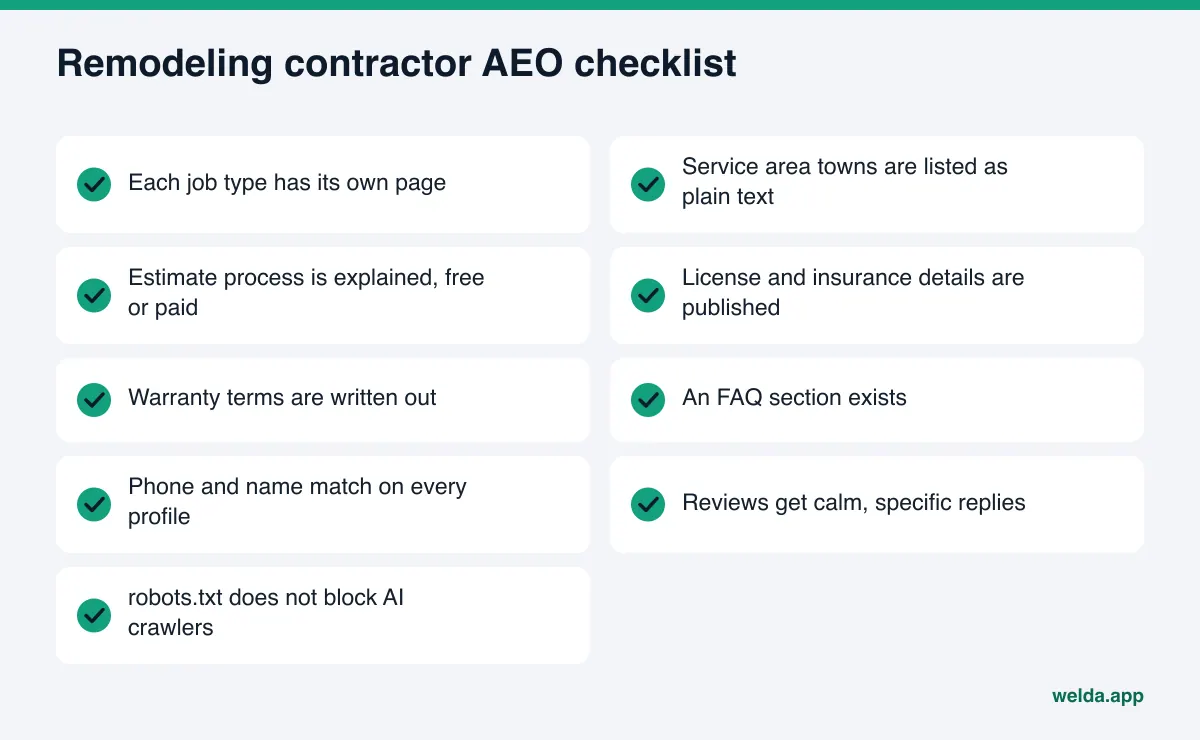
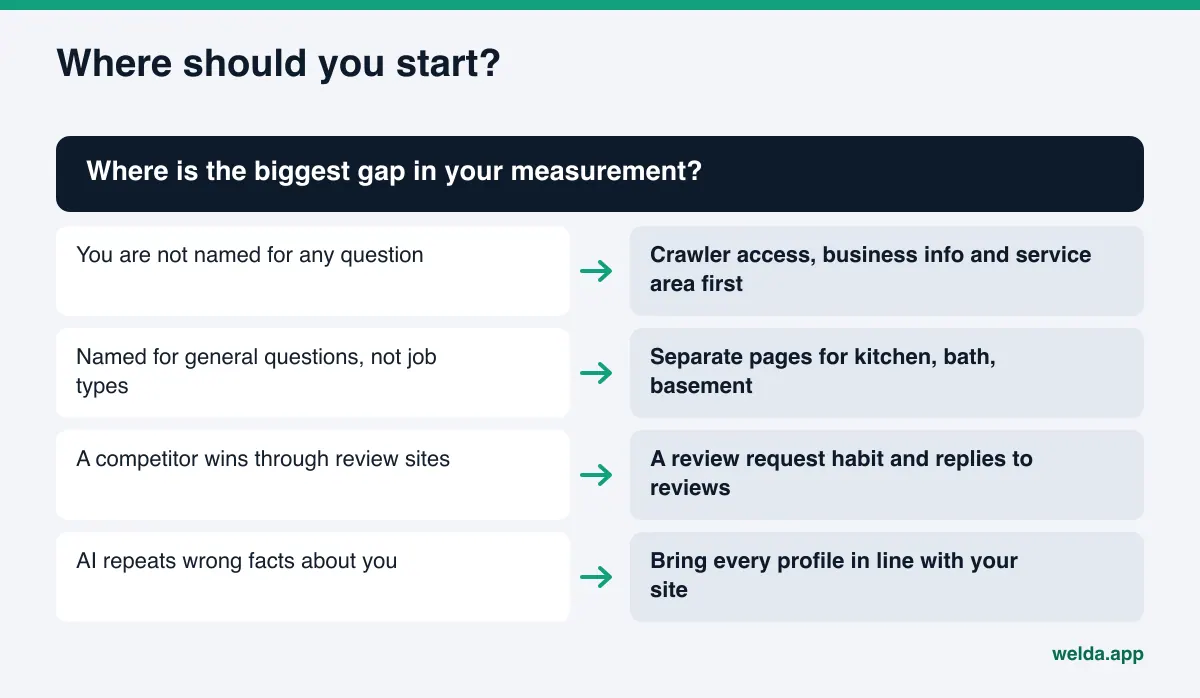
The list may look long, but the items do not carry equal weight. Your measurement decides where to begin. The chart below sums up the four most common situations and the first step for each.
A table also helps when deciding who does what. It depends on how much time you have and how comfortable your team is with writing.
| Task | Doing it yourself | With Welda |
|---|---|---|
| Seeing where you stand | You ask the questions yourself and take notes | The free analysis lists gaps and runs a five-question test |
| Job-type pages | You write each page from scratch | A draft is prepared; you fill in facts and approve |
| Profile text | You edit each profile separately | Ready text arrives; you paste it if the profile is not connected |
| Competitor tracking | You check by hand now and then | Competitor and source views in the dashboard (early access) |
| Review replies | You write every reply | A reply draft is prepared; you approve it |
Other home-related businesses face a similar set of choices. For a close comparison, see AI search optimization for real estate agents.
Frequently asked questions
Does AEO replace SEO for a remodeling company?
No. Both rest on the same foundation: a clearly written site that crawlers can read. AEO looks at how that foundation is read and repeated inside AI answers. You do not need to drop SEO.
If I do not publish prices, will AI skip me?
Published prices are not required. Explaining what drives the price, how the estimate visit works and what the written proposal shows answers both the price question and the trust question.
I mostly get work through referrals. Does this still matter?
Referred customers often look you up before they call. More and more of that checking happens by asking an assistant about you. A clear site and a consistent Business Profile help the referral hold up.
Should I create a page for every town I serve?
Thin pages that only swap the town name do not help. Start with job-type pages and list your service area in plain text. If you do a lot of work in one town, a page with real local detail can make sense later.
What does the free analysis need from me?
You enter your site address and verify your email and phone. The results link arrives by email and stays open for 14 days. The analysis is free once per site and does not measure rankings.
Can I use the Welda dashboard now?
The dashboard is in early access and is opening first in Turkey. The free website analysis is the part anyone can use today, in English and German. Pricing is discussed in the early access conversation.
Can a bad review end up in an AI answer?
It can, because review and complaint sites are sources. A calm, specific reply usually tells both the next customer and the assistant more than a fight over removal. That work stays with you; Welda can draft the reply.
Where to start today
AI search optimization for home remodeling contractors can look like a big project, but the first step is small: see what an AI assistant can read from your site today. Are your job types, service area and process written down, or do they live only in what you say during the estimate? The quickest way to find out is to run Welda's free website analysis. It shows which gap to close first, with ready-to-use text.