Do attorney advertising rules apply to AEO? Yes. Attorney advertising rules and AEO meet wherever your firm's own words end up in an AI answer: your website, your directory profiles, your bios. AEO (answer engine optimization) for a law firm should mean keeping those words accurate, verifiable and free of claims your state bar would treat as misleading, then measuring how ChatGPT, Gemini, Perplexity and Google AI describe you.
This guide is for the managing partner, the solo practitioner who handles marketing between hearings, and the marketing director at a mid-size firm. US lawyers have been allowed to advertise since the Supreme Court's decision in Bates v. State Bar of Arizona (1977), and most firms already have a website, a Google Business Profile and listings on Avvo, Justia or Martindale-Hubbell. What is new is that a growing number of prospective clients now type their question into an AI assistant instead of a search box: "best DUI lawyer near me," "do I need a lawyer for a landlord dispute in Austin," "which firms handle Social Security disability appeals." The assistant answers in a few sentences, names a few firms and gives a reason for each. Those reasons are where professional conduct rules start to matter.
A note before we start: this article is not legal advice. The rules below are summarized from official sources. Your state's version of the rules, and your bar's ethics opinions, are what govern your firm.
What the attorney advertising rules actually say
Most states base their lawyer advertising rules on the ABA Model Rules of Professional Conduct, Rules 7.1 through 7.3, though wording varies by state. The core of the system is Rule 7.1: a lawyer shall not make a false or misleading communication about the lawyer or the lawyer's services. A communication is misleading if it contains a material misrepresentation of fact or law, or leaves out a fact needed to keep the statement as a whole from being materially misleading. The Model Rules were streamlined in 2018, and many states have since adopted the revised structure.
California is a useful example of how a state version reads. Its Chapter 7 rules on information about legal services prohibit false or misleading communications, set conditions for advertising, restrict solicitation, and, in Rule 7.4, say a lawyer shall not state that they are a certified specialist in a field unless they are currently certified and the certifying organization is clearly identified. Other states have their own versions, and some add requirements such as disclaimers on past results or testimonials.
For AEO purposes, four parts of these rules matter most:
- Misleading statements: Truthful statements can still mislead if they create unjustified expectations. Results language on a website, such as "we win," can travel straight into an AI summary.
- Specialist claims: "Specialist" and "certified" are regulated words in many states. Saying you "focus on" or "practice in" an area is generally treated differently from claiming certification.
- Comparisons: "Best," "top-rated" or "leading" invite questions about whether the claim can be backed up.
- Testimonials and past results: Some states require a disclaimer, and both can create expectations a new client's matter may not meet.
Generative AI adds a second layer. In July 2024 the ABA issued Formal Opinion 512 on generative AI tools, which applies existing duties such as competence, confidentiality and supervision to lawyers' use of AI. If AI tools help write your website copy, the lawyer remains responsible for what is published.
Why attorney advertising rules and AEO are the same conversation
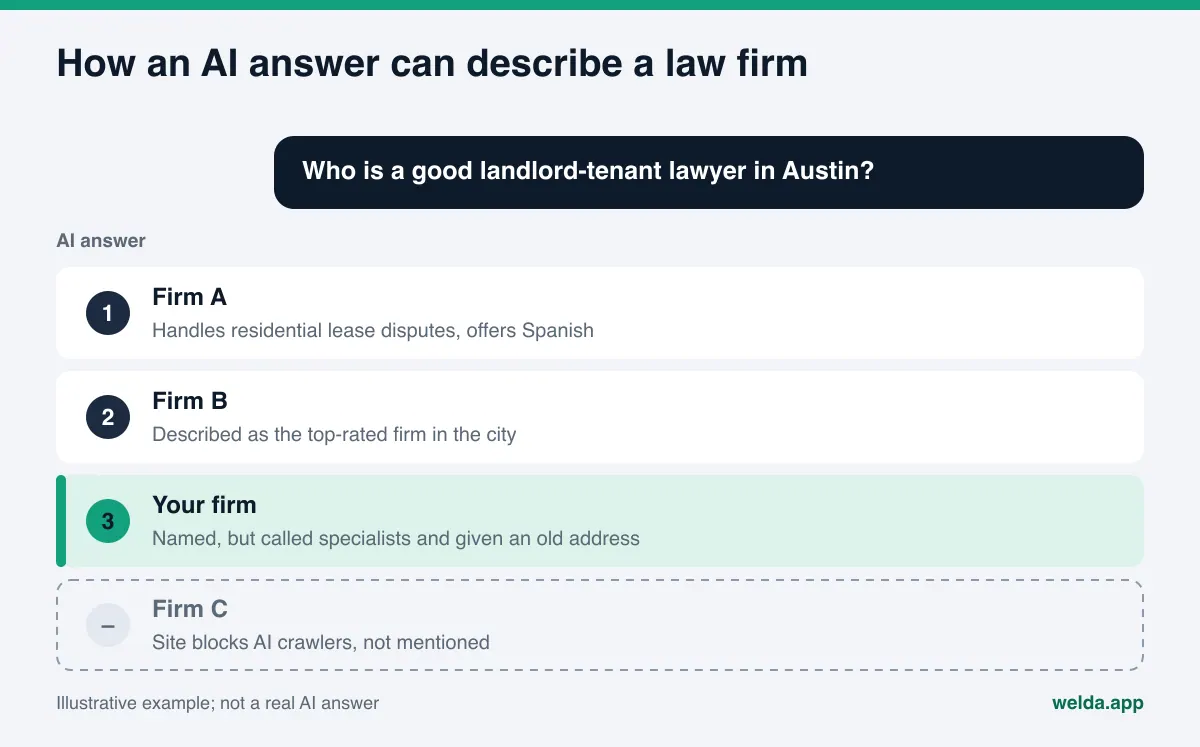
AI answer engines build their answers from what they can read on the open web: your site, your directory profiles, bar listings, news coverage, forums and review sites like Yelp, Google reviews and BBB. When an assistant writes "Firm A is known for aggressive representation and has won millions for clients," it is usually paraphrasing something someone published. Often that someone is the firm.
That creates a specific risk for law firms. A claim that would get a second look from your bar's ethics counsel if you ran it as a billboard can quietly reappear as a reason an AI assistant recommends you. The assistant did not invent it. It summarized your homepage. And the prospective client reads it as something your firm says about itself.
Typical problems a firm can find when it checks AI answers:
- Outdated facts: a former office address, a partner who left, a practice area you dropped.
- Inflated labels: "specialist," "top," "best," pulled from old copy or from third-party directory badges.
- Results language: verdict figures or "we win" phrasing repeated without the context or disclaimer your state requires.
- Not being named at all, even for questions that include your own firm name, because the assistant cannot find consistent information.
None of these are fixed by more marketing. All of them come down to the accuracy and consistency of what your firm publishes. You may also see this work called GEO, short for generative engine optimization; in the US, AEO is the more common label for the same thing. That is why AEO for law firms, done properly, looks a lot like a compliance review with a measurement step. The fastest way to see what an AI system reads on your site today is a free AI visibility analysis.
Attorney advertising rules and AEO: what is low risk and what needs review
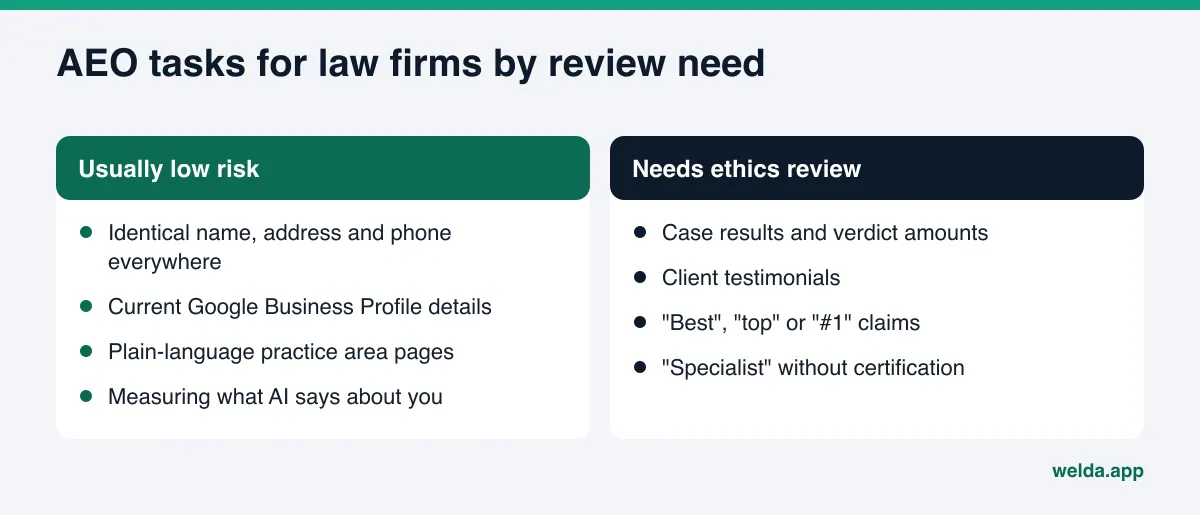
The table below sorts common AEO tasks by how much attention they usually need from an ethics perspective. It is a practical starting point, not a ruling. Your state's rules and your own judgment decide.
| AEO task | Usual risk level | What to watch |
|---|---|---|
| Making name, address and phone identical everywhere | Low | Use the firm name exactly as registered with the bar |
| Updating Google Business Profile hours and categories | Low | Keep the description factual |
| Allowing AI crawlers in robots.txt | Low | A technical choice; decide deliberately |
| Adding organization schema to the site | Low to medium | Schema text should match what the page says |
| Writing practice area pages in plain language | Medium | Avoid "specialist" unless certified under your state's rule |
| Publishing an FAQ that answers common legal questions | Medium | General information, not advice; no implied outcomes |
| Showcasing case results or client testimonials | Higher | Check your state's disclaimer and substantiation rules |
| Calling the firm "best" or "top" in your city | Higher | Comparative claims need to be verifiable |
Compared with many other countries, the US is permissive about lawyer advertising. So the question is rarely "may we do AEO at all." It is "are the words that AI will repeat about us ones we could defend in front of our bar."
Step by step: AEO for a law firm, inside the rules
These steps assume you want AI assistants to describe your firm accurately and to have enough clear information to name you when someone asks a relevant question. Each step keeps the lawyer in control of the words.
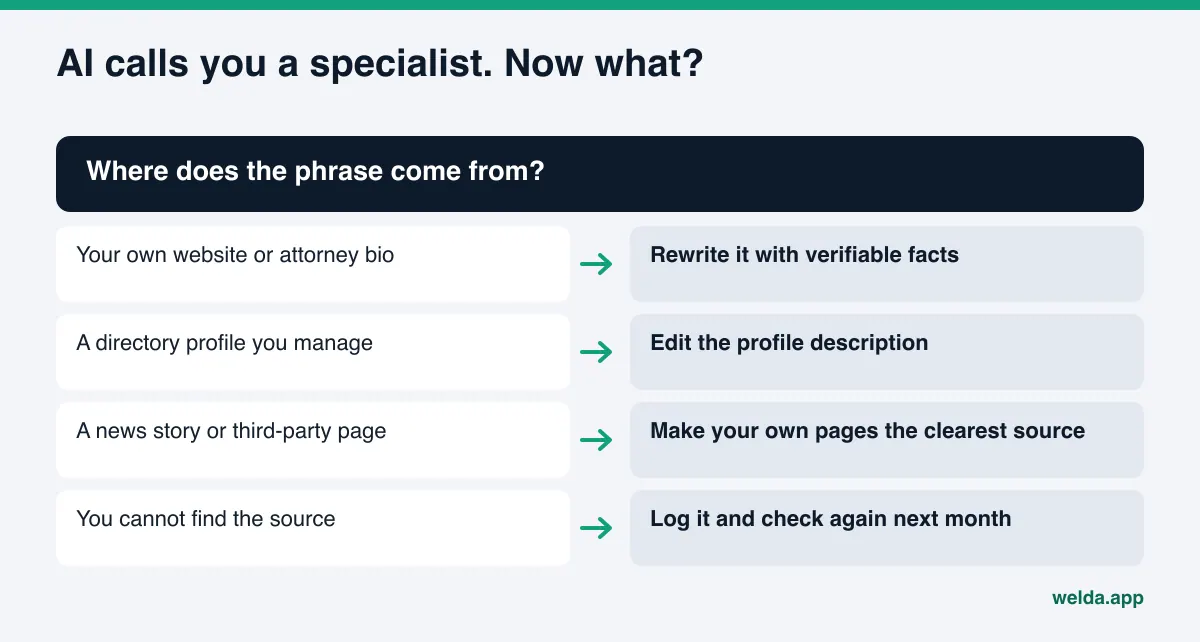
1. Build a question list
Write down the questions a prospective client would actually ask an AI assistant. Group them: questions with your firm or lawyer names ("where is [your firm] located," "is [lawyer name] licensed in Texas"), practice-area questions with a place ("estate planning attorney in Scottsdale"), and general questions ("do I need a lawyer for a small claims case"). Twenty to forty questions is enough to start. Your intake notes are the best source.
2. Read the answers, not just the names
Ask each question in several AI tools. For a law firm, the most important column is not "were we named." It is "what did the assistant say about us, and where did it get that." Note any adjective, result or credential the assistant attaches to your name. Ask more than once: the same question can produce different answers.
3. Clean up your own copy first
Go through your homepage, attorney bios and practice area pages. Look for superlatives, outcome promises, unqualified results and "specialist" language. Replace them with verifiable facts: bar admissions, years in practice if accurate, the types of matters you handle, languages spoken, office locations. This is the step most likely to change what AI says about you, because your site is often the most specific source available. Our article on best claims and advertising rules in AI content covers comparative language in more depth.
4. Make sure AI crawlers can read the clean version
If robots.txt blocks AI search crawlers, assistants rely on other sources to describe you, including older directory copy you no longer control. Blocking can be a valid choice; just make it on purpose.
5. Align directories and profiles
Google Business Profile, Avvo, Justia, Martindale-Hubbell, Yelp and your state bar's lawyer search are all places an assistant may read. Make the firm name, address, phone and practice areas consistent. Where a directory shows a badge or rating, be aware that an AI assistant may restate it as "top-rated." Whether that is a problem under your state's rules is a question for you, not for a software tool.
6. Handle testimonials and reviews with care
Reviews are one of the main sources AI uses to explain why it recommends a business. For lawyers, testimonials raise disclaimer and confidentiality questions, and incentivized or fake reviews are a problem in any industry. See fake reviews rules and AI visibility before you start any review request program.
7. Re-measure monthly
Changes on your site usually take weeks to show up in AI answers. Re-ask the same question list once a month and compare. That is the only honest way to know whether a change worked.
What if AI calls you a "specialist" you are not?
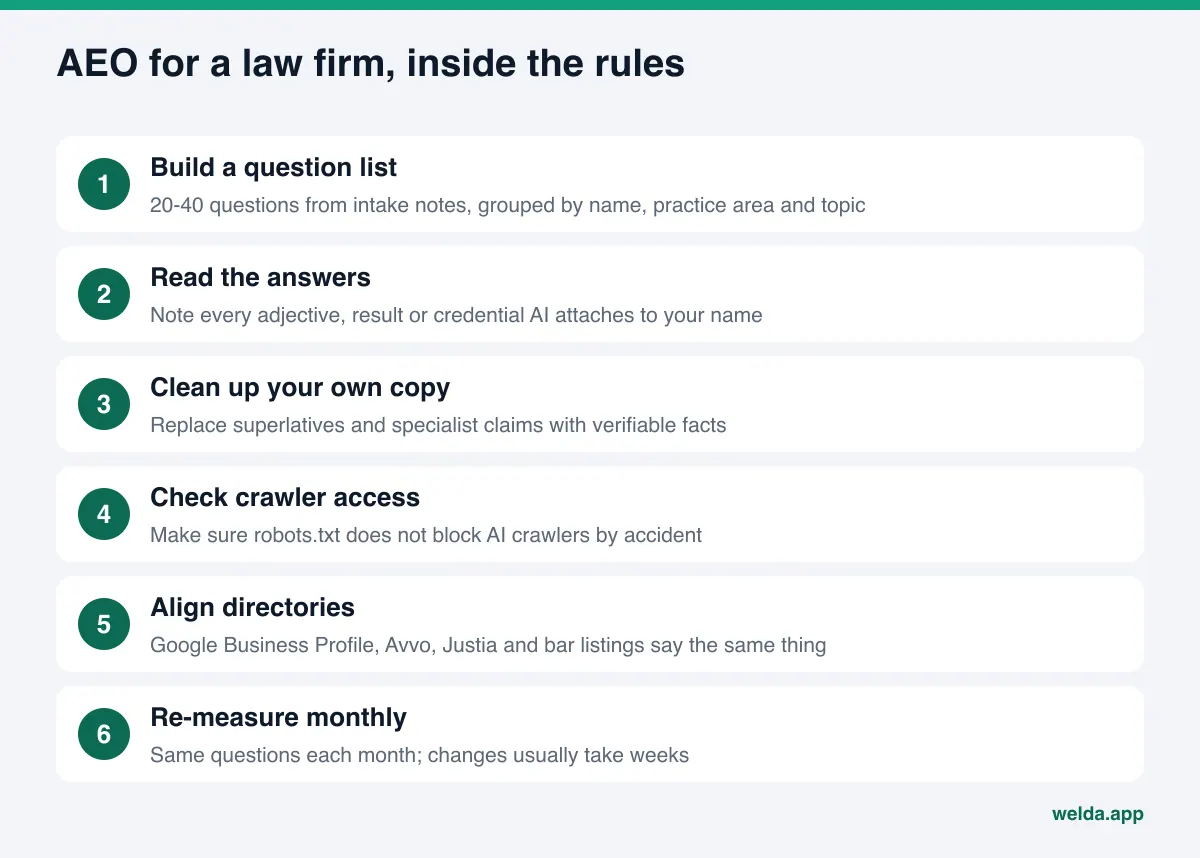
This is the attorney-specific version of a common AEO problem. An assistant answers "who handles medical malpractice in Denver" and describes your firm as "specialists in medical malpractice." You are not certified in that area, and your state limits who may use that word. You did not write the sentence. But a prospective client may read it as your claim.
Start by tracing the source. AI answers often cite or paraphrase specific pages. If the phrase comes from your own website or a bio you control, change it. If it comes from a directory profile you manage, edit the profile. If it comes from a news article or a third-party page you do not control, the most practical response is to make your own pages the clearest and most consistent description of what you do, so the assistant has a better source to draw on.
No one can directly edit what an AI model writes, and no tool, Welda included, can guarantee an AI answer will change. What you can control is the information that feeds it.
How Welda handles AEO for a law firm
Welda is software that measures where a business appears in AI answers and prepares the missing pieces on the business's behalf. For a law firm, the measuring and the pre-publication review are the most useful parts. Here is how they apply.
The free site analysis: what AI reads on your site today
The free analysis, which works in English, reads your homepage and a few inner pages such as about, services and contact the way Google and AI systems would. It checks whether AI crawlers can access the site, your page title and description, your main heading, whether organization schema is present, whether your address and phone are consistent, whether social and map profiles are linked, and page speed. You get a score out of 100, with technical and content scores shown separately, and an explanation for each gap. It also asks an AI assistant with web search five questions a client might ask and checks whether your firm is named in the answers. That test is a one-time snapshot.
One honest caveat for lawyers: the analysis applies the same checklist to every business. It may suggest adding reviews, trust signals, an FAQ or a sharper homepage headline. The technical findings, like crawler access, consistent contact details and schema, are usually safe to act on. The content suggestions need to pass through your state's advertising rules before anything goes live. That filter is yours.
Question tracking: what AI says about your firm, and why
In the Welda panel, you set the questions. Welda asks each one on ChatGPT, Gemini, Perplexity and Google AI three times and shows, question by question, whether your firm is named, where it appears in the answer, and which competitors appear ahead of you. For a firm, the answer detail is the part to read closely: the sentence the assistant used about you and the sources it cited. That is how you find the origin of a "specialist" label or an outdated address. Question language can be set to English or Turkish.
Drafts, a pre-publication check, and your approval
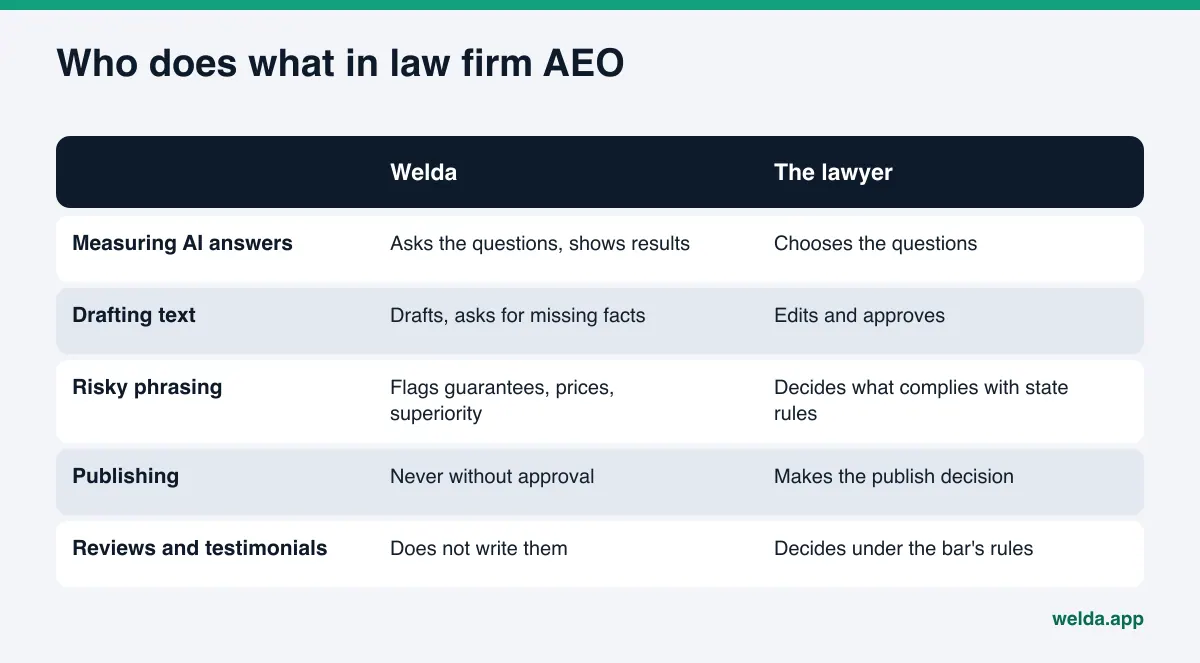
When Welda prepares text, such as a clearer practice area description or a profile summary, it does not fill in facts it does not have. It asks you for missing details instead. A built-in check flags patterns like price claims, guarantees and superiority claims before anything is published, so a line like "we always win" or "the best firm in town" gets flagged. Nothing goes live without your approval. Content stays on your own site; Welda does not host it.
The limit is important: that check is not legal advice and has not been reviewed by legal counsel. It does not know your state's specific rules or your bar's ethics opinions. Treat it as a first screen. A lawyer makes the final call. Our piece on the content approval workflow for AEO walks through how to set up that sign-off.
The rest of the panel, including competitor and source views and a monthly one-page report, fills in the picture but is secondary for most firms.
Limits: what Welda does not do
- It does not certify compliance. Welda flags risky patterns. Whether copy complies with your state's Rules of Professional Conduct is a lawyer's judgment.
- It does not guarantee rankings or AI mentions. No one can promise how an AI assistant will answer.
- It does not invent facts. Bar admissions, practice areas and credentials come from you.
- It does not publish without approval. Every piece of text waits for your sign-off.
- It does not write reviews or testimonials. No fake reviews, no client stories.
- Negative reviews, directory accounts and press stay with you.
Where the product stands today: the free site analysis works in English and German and is open to anyone. The Welda panel is in early access and is opening first in Türkiye. Regular four-engine measurement is being added during early access, and the sample panel screens use representative data. Pricing is discussed in the early access conversation. Client data should never go into any AEO tool; our article on data privacy and AEO tools covers what to ask a vendor.
Checklist before you publish anything AI will read
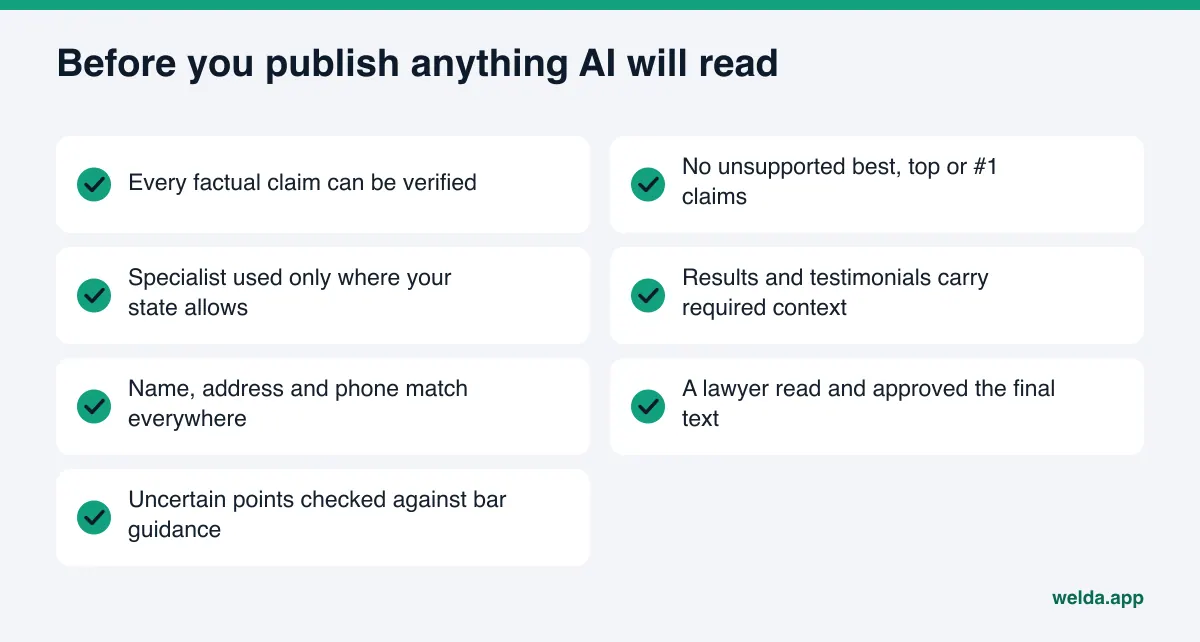
- Is every factual claim verifiable: admissions, years, office locations, languages?
- Have you removed "best," "top," "leading" or "#1" unless you can substantiate the comparison?
- Is "specialist" or "certified" used only where your state's rule allows it?
- Do any results or testimonials carry the disclaimer or context your state requires?
- Is the firm name, address and phone identical on your site and your main directories?
- Did a lawyer read and approve the final text?
- For anything uncertain, did you check your bar's ethics guidance?
Frequently asked questions
Is AEO allowed for law firms?
US lawyers may advertise, subject to their state's rules. AEO work that keeps your published information accurate and measures how AI describes you fits within that. Specific content still has to meet your state's rules on misleading statements, specialization and testimonials.
Am I responsible if an AI assistant exaggerates my credentials?
An AI-generated sentence is not your statement. But if the exaggeration comes from your own site or a profile you control, fixing the source is within your reach. This is not legal advice; check your state's guidance.
Should a law firm block AI crawlers?
That is a choice. Blocking means assistants rely more on third-party sources, which you control less. Many firms prefer to let crawlers read clean, accurate copy.
Can Welda write compliant attorney advertising copy?
Welda drafts text and flags patterns such as guarantees, price claims and superiority claims. It does not certify compliance with any state's rules, and its check is not legal advice. Every draft waits for your approval.
How long until changes show up in AI answers?
Usually weeks. Measure monthly with the same question list rather than checking daily.
Can US firms use Welda today?
The free site analysis works in English and is available now, once per site, with email and phone verification. The result link arrives by email and stays open for 14 days. The full panel is in early access and opening first in Türkiye.
See what AI reads about your firm
Attorney advertising rules do not stop AI assistants from talking about your firm. They do make it more important that what assistants repeat is something you could stand behind. Start with a free AI visibility analysis of your site: crawler access, consistent contact details, schema, and a five-question AI test showing whether your firm is named. Then run the findings through your state's rules and decide what to change.