What does AI visibility software for wedding planners actually do? It checks whether your business is named when couples ask ChatGPT, Gemini, Perplexity or Google's AI Overviews and AI Mode for a planner, shows which competitors get picked and why, and helps you fill the gaps. Answer engines favor the planner whose site clearly says what kind of weddings it plans, where, for how many guests, and whose details match everywhere.
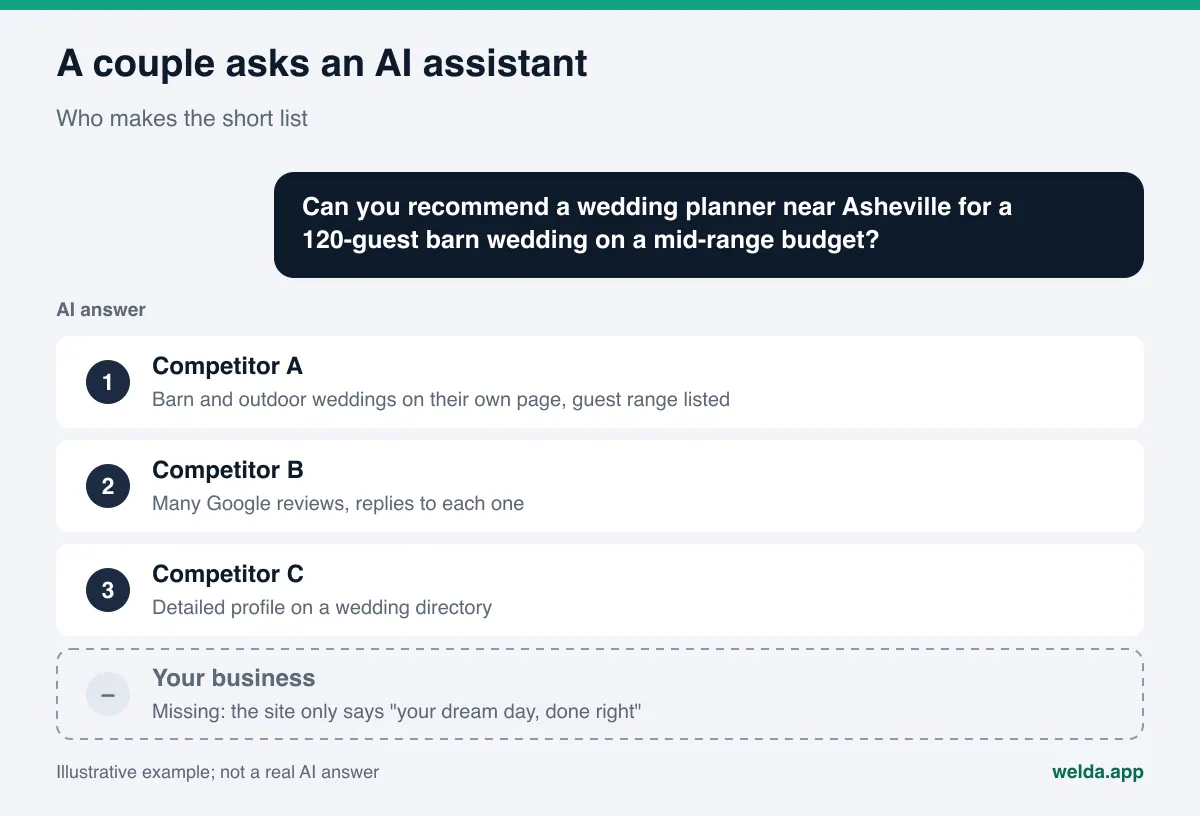
A lot of wedding planning now starts with a chat window. A newly engaged couple types "Can you recommend a wedding planner near Asheville for a 120-guest barn wedding on a mid-range budget" or "Do we need a full planner or just a day-of coordinator for a backyard wedding, and who do you suggest". The answer is a few sentences and usually two or three business names. If your business is not on that short list, the couple does not fill out your contact form, does not ask for a quote and does not book a consult. This guide covers what AI visibility software for wedding planners does, which work stays with the planner, and how Welda measures and closes the gaps. This discipline is usually called AEO (answer engine optimization); you may also see the term GEO, short for generative engine optimization, which means roughly the same thing. If you want to see your own starting point first, run the free site analysis; the result helps you put the steps below in the right order for your site.
Why AEO matters for wedding planners right now
A wedding is a high-stakes, once-in-a-lifetime purchase, and couples ask a lot of questions before they commit. Does this planner do the style we want? Will they travel to our venue? Will they take on a 60-guest wedding or only large ones? How do they price? How far ahead do we need to book? In classic search, the couple collected those answers by opening a dozen tabs. In an AI answer, the assistant does that collecting and returns a short summary. Whoever is named in the summary gets compared. Everyone else is invisible at the moment the couple is choosing.
That shift has three practical consequences for planners. First, a beautiful Instagram feed does not mean you will be named. An AI model has a hard time concluding "this planner does barn weddings" from photos alone; it relies on text it can read and cite. Second, questions are specific. Couples rarely ask for "the best wedding planner". They combine style, location, guest count and budget in one question. If your site only says "your dream day, done right", the model has nothing to match against "barn wedding, 120 guests, mid-range". Third, many planners work from a home office or a small studio and serve a region rather than a storefront. When there is no fixed location, your service area has to be written out clearly, or location-based questions skip you.
Google describes how its AI features draw on web content and what site owners can do in its documentation on AI features and your website. The short version: the basics of a crawlable, clearly written site still apply, and there is no special trick that bypasses them. The same logic applies to other local service businesses; our guide to AEO for local businesses covers the general picture.
What couples ask AI tools about wedding planners
It helps to sort wedding planner questions into five groups. The examples below were written for this guide as illustrations; every planner should adapt the list to their own region and service mix.
- Service-level questions: "Do I need a full-service planner or a day-of coordinator", "Who does partial planning in Charleston", "Elopement planner in Colorado". The model wants to read which service levels you actually offer.
- Location and venue questions: "Wedding planner for a vineyard wedding in Sonoma", "Planner who handles backyard weddings in the Austin area". If your service area and venue types are not written out, you will not appear here.
- Guest count and budget questions: "Planner for a small 40-person wedding", "How to find a wedding planner on a tight budget". Your guest range and what drives your pricing need to be on the site.
- Process questions: "How far in advance should we hire a wedding planner", "Does a planner coordinate the caterer", "What happens if it rains at an outdoor wedding". These map directly to an FAQ section.
- Trust questions: "How do I know a wedding planner is legit", "What should be in a wedding planner contract". The model often gives general advice here, but it can point to planners who explain their process and contract approach openly.
What answer engines look at before naming a planner
An AI answer is a summary of sources. The assistant finds pages related to the question and tries to build a consistent picture from them. For a wedding planner, that picture is made of these signals:
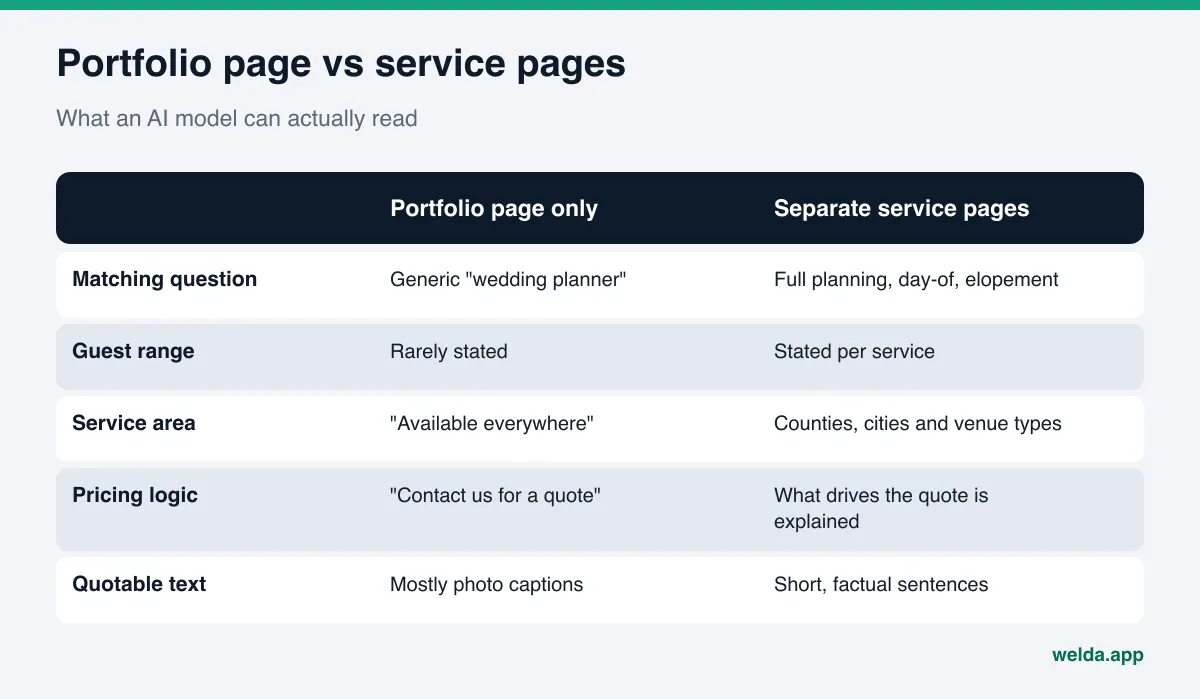
| Signal | What the model looks for | Common gap for planners |
|---|---|---|
| Service definition | Which service levels and wedding styles you offer | Everything on one page, mostly taglines |
| Service area | Cities, counties and venue types you cover | "Available nationwide" with no specifics |
| Guest range and scope | Size of events you take, what is included | Not stated, or only package names |
| Pricing logic | What drives the quote | "Contact us" and nothing else |
| Business info | Name, phone, service area consistent everywhere | Different phone numbers on Instagram, Google and site |
| Outside sources | Google reviews, Yelp, wedding directories, forums | Outdated directory profiles, unanswered reviews |
| FAQ | Short text that directly answers a couple's question | No FAQ, or one full of generic lines |
Each row is a small job. The problem is that for many planners, most of this information lives only in DMs, discovery calls and email threads. You know the answer when a couple asks, but the model cannot read your inbox. What it can read is your site, your Google Business Profile, and what other sites say about you: wedding directories such as The Knot or WeddingWire, Yelp, local wedding blogs and Reddit threads.
Instagram deserves its own note. Many planners tell their story almost entirely on Instagram. That works as a showcase for couples, but it can be a weak source for an answer engine: it is image-heavy, captions are short, and profiles are not always readable to crawlers. We cover this in detail in Instagram and AI search. The short version: whatever you say on Instagram should also be written on your site, and the two should link to each other.
Step by step: AEO for a wedding planning business
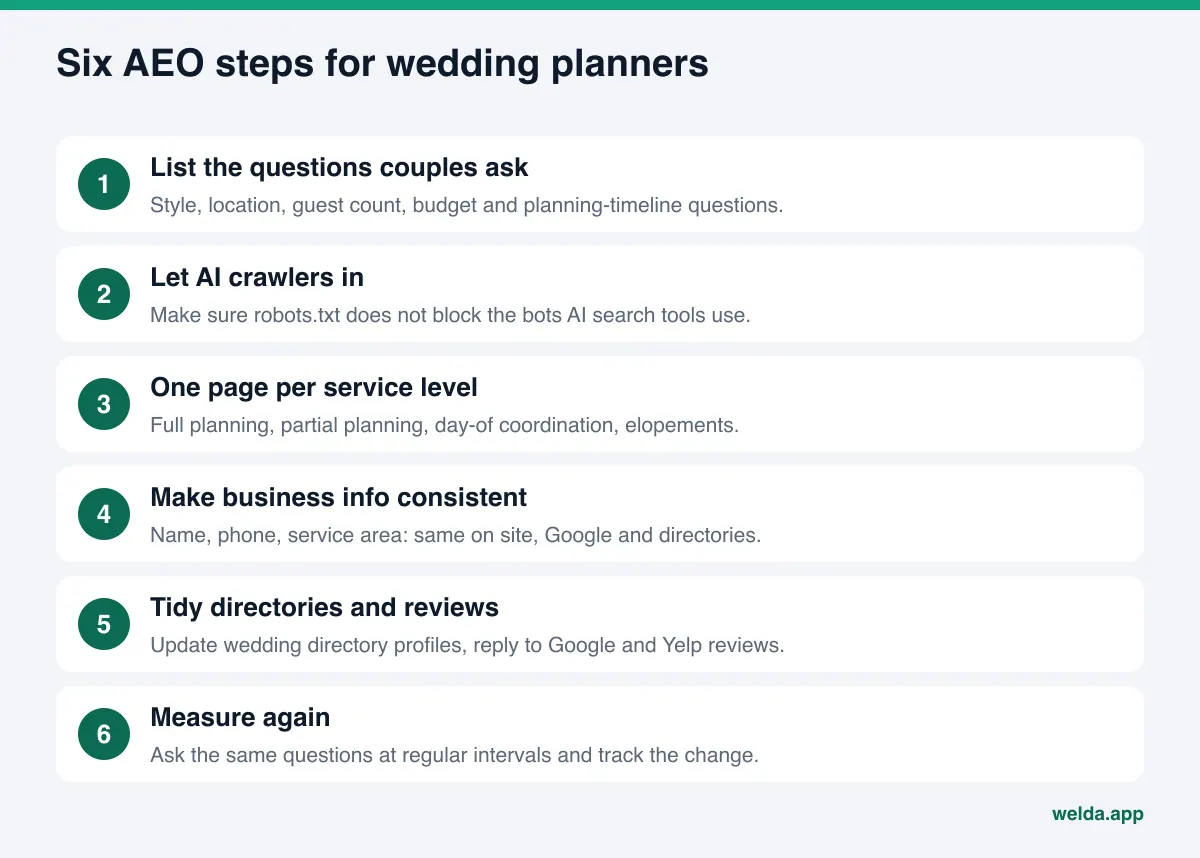
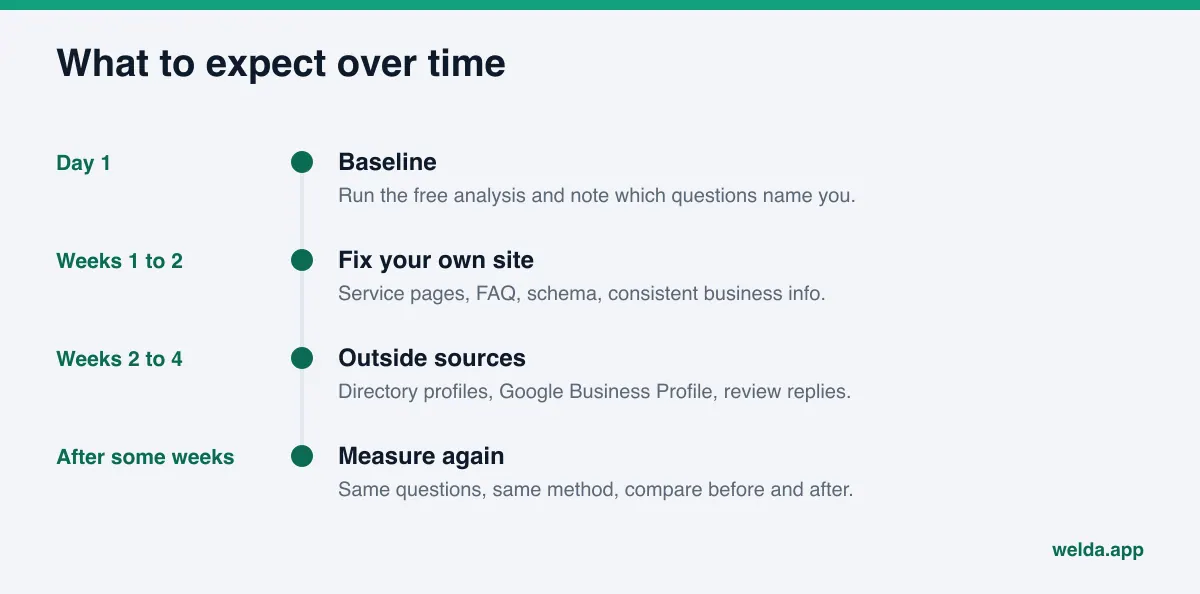
These steps are in a deliberate order. Know where you stand, fix your own site, then move to outside sources. Outside sources change more slowly, and they need to match what your site says.
- Write down the questions couples ask. Look at inquiries from the last few months. What do couples ask in their first message: is our date open, do you travel to this venue, what do you do for 150 guests? Group them into style, location, guest count, budget and process. Both measurement and content come from this list.
- Make sure AI crawlers can reach your site. If your robots.txt blocks these bots, even great copy will not be read. OpenAI, for example, explains on its official crawler page that it uses OAI-SearchBot for search features and ChatGPT-User for visits a user triggers. A website template or security plugin can block these without you noticing.
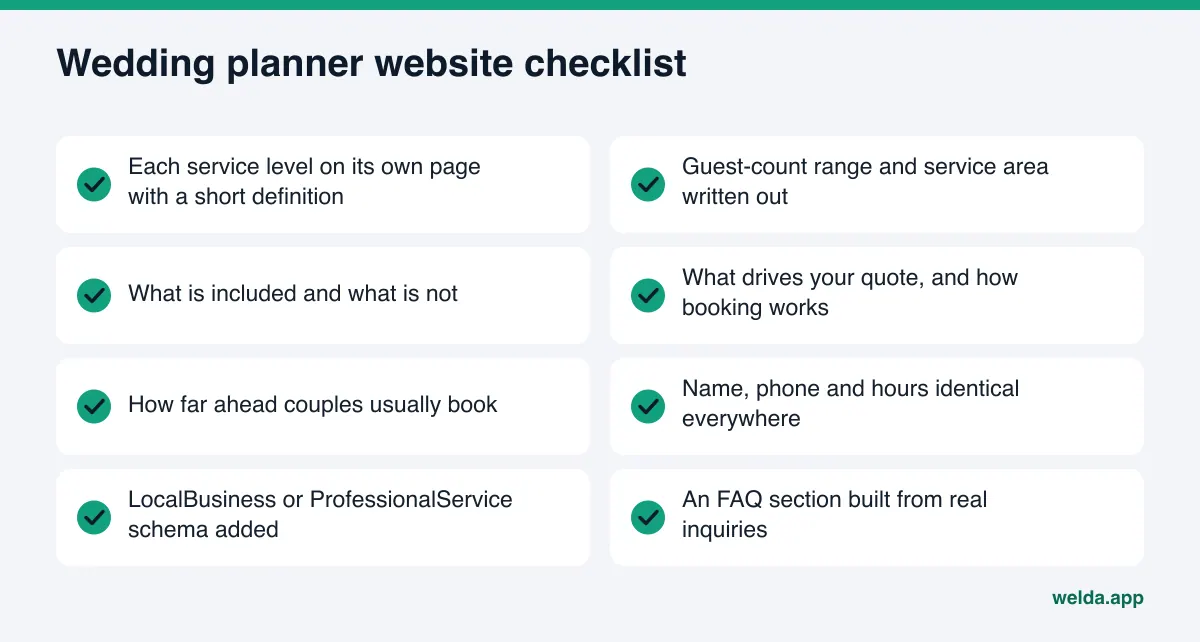
- Give each service level its own page. Full planning, partial planning, day-of coordination, elopements, destination weddings. Each page should say three things: what you handle, the guest range you work with, and where and at what kinds of venues you work.
- Explain scope and pricing logic. You do not need to publish prices. You can explain what drives your quote: guest count, travel distance, number of vendors to coordinate, design complexity, the length of the event day. That gives the model a reason to name you for "mid-range budget" questions.
- Make business information consistent. Business name, phone, email, address or service area should match on your site, your Google Business Profile, Instagram, Yelp and every wedding directory. Add structured data to your site. schema.org has no type specifically for wedding planners; ProfessionalService or the general LocalBusiness type works, with the service area stated.
- Write an FAQ section. Pick the eight to ten most common questions from step one and answer each in two or three plain sentences. "How far ahead should we book", "Do you have a rain plan", "Do you coordinate the caterer" are exactly the kind of text an answer engine can quote.
- Review outside sources. Reply to Google and Yelp reviews, check that your directory profiles are current, and if a Reddit thread mentions you, read it. Do not buy or incentivize positive reviews. The FTC's final rule on fake reviews and testimonials, announced in August 2024, bans fake reviews, including AI-generated ones, and paying for reviews with a required sentiment. This is not legal advice; check the rule itself or ask a lawyer.
- Measure and repeat. Ask the same questions at regular intervals and track the change. New content usually takes weeks to show up in AI answers; do not expect results overnight.
Choosing AI visibility software for wedding planners
Tools in this space fall into two broad groups. Some only monitor: they send prompts to AI engines and report whether you were named. Others also help you close the gaps: they draft copy, suggest profile text, and keep a to-do list. We compare the two approaches in AI visibility monitoring vs done-for-you AEO. Which one fits a wedding planner depends mostly on how much time you and your team have.
When you evaluate a tool, ask these wedding-specific questions:
- Can it build prompts around your region and your service levels, or does it only ask a generic "wedding planner" question?
- Does it measure across more than one AI engine? ChatGPT and Google AI can name different planners for the same question.
- Does it ask each question more than once? AI answers vary from run to run; a single check can mislead.
- Does it show why a competitor wins: which source it is cited from and which question cluster it leads?
- Does it give you ready-to-use copy for each gap, or just say "add content"?
- Do you keep the final say on what gets published? A planner's voice is personal; publishing without approval is a risk.
How Welda does this for a wedding planner
Welda is software that measures where a business shows up in AI answers and fills the gaps on the business's behalf. For a wedding planner, three parts matter most: prompt tracking, the competitor view and the to-do list.
Prompt tracking. First, the questions couples would ask your business are set up: style, location, guest count, budget and process. In the Welda dashboard, each question is asked three times in ChatGPT, Gemini, Perplexity and Google AI. Each question is a row, and for each engine you see whether you were named and in what position. Click a question and you see the answer itself and the sources it relied on. You might find, for example, that Gemini names you for "barn wedding planner near Asheville" while ChatGPT does not. That makes the next decision easier: is the gap on your site, or in an outside source ChatGPT leans on?
Competitor view. For wedding planners, the real competition is usually three or four businesses working the same region. The competitor view shows each one's share of mentions, which question cluster they lead, and, most usefully, which source they are cited from: a detailed directory profile, a cluster of Google reviews, a local wedding blog. That turns "why do they show up and I don't" into a concrete answer.
To-do list. Gaps from measurement land in one list, each with ready copy next to it: an intro paragraph for your elopement page, draft FAQ answers, a Google Business Profile description, or a suggested reply to a review. Welda does not invent facts. If it does not know your guest range or service area, it asks you, and the item stays on the list as missing information until you answer.
Approval always stays with you. On WordPress sites, Welda connects through a separate Editor user and an application password created for it, with no code to install; drafts open on your site as drafts and go live only when you approve. For other site builders, Welda gives you a ready package and you or your web person apply it. Google Business Profile, Instagram and Facebook can be connected; if they are not, the task is listed as a manual one. Content always lives on your own site; Welda does not host it.
The dashboard also includes a one-page monthly report, a before-and-after comparison, and a compliance check that flags patterns such as pricing, guarantee or superiority claims before publishing. That check is not legal advice.
To be clear about where things stand: the Welda dashboard is in early access and is opening in stages, starting with businesses in Türkiye. Regular four-engine measurement is being added during early access, and sample screens in the dashboard use illustrative data. What anyone can use today, including in English, is the free site analysis. Pricing is discussed in the early access conversation.
What the free site analysis tells a wedding planner
You do not need to wait for the dashboard to start. The free site analysis reads your home page and a few inner pages (services, pricing, about, contact) the way Google and AI tools would. For a wedding planner, the most useful findings are usually:
- Whether AI crawlers can reach your site.
- Whether your page title, meta description and main heading say what you plan and where.
- Whether you have business schema and clear address, phone or service area details.
- Whether your Instagram and Google profiles are linked from your site.
- Your FAQ section, review and trust signals, how clearly services are described, and page speed.
You get a score out of 100, split into technical and content, plus what was found for each gap, why it matters and how to fix it. You also get suggested copy for your home page (title, description, main heading, intro paragraph, FAQ), a simulation showing how much each fix would move the score, a competitor comparison, a ready fix package including business schema code, and a PDF and shareable score card. On top of that, five questions a customer might ask are sent to an AI assistant that can search the web, and the analysis checks whether your business name appears in the answers. That is a one-time check, not ongoing tracking.
The analysis is free once per site. Email and phone are verified, the result link arrives by email and stays open for 14 days. It does not measure rankings and does not promise any.
An example: a small barn wedding planner
This scenario is an example, not a real business. Picture a two-person planning business in western North Carolina that focuses on barn and mountain weddings. The website is a single page: a large hero photo, the line "Your dream day, done right", and a contact form. Instagram, on the other hand, is busy, with new setups posted every week.
The business is not named for "barn wedding planner near Asheville". Measurement shows two competitors named for that question, one cited from a detailed wedding directory profile and the other from its Google reviews. The to-do list has four items: a barn wedding page, an elopement page, guest range and service area (the planner is asked for these), and an FAQ section. The planner answers the questions, edits the drafts into their own voice, and approves them. They update their directory profile and Google Business Profile description themselves.
After that comes waiting. New content can take weeks to show up in answers, and no tool can tell you the outcome in advance. The way to see change is to ask the same questions the same way again. We explain how to set that up in before and after AEO measurement.
Limits: what Welda does not do for wedding planners
Knowing what a tool does not do matters as much as knowing what it does. For Welda, these are clear:
- No ranking guarantees. Welda does not promise you will "show up in ChatGPT" or land in a specific position. No tool controls AI answers.
- No made-up facts. Welda does not guess your venues, guest range or scope; it asks you.
- No fake reviews. Reviews must come from real couples. Welda only drafts replies to real reviews.
- No publishing sensitive content without approval. Drafts come to you first.
- Some work stays with you. Handling negative reviews, managing directory accounts and press outreach are the planner's job. Welda can suggest wording but does not log into those accounts for you.
- Results take time. New content usually takes weeks to show up in AI answers.
Photography, venue sourcing, client management and vendor booking are outside this topic too. Welda's job is to measure how your business is named in AI answers and to prepare the text that improves it.
Checklist: is your planning business ready?
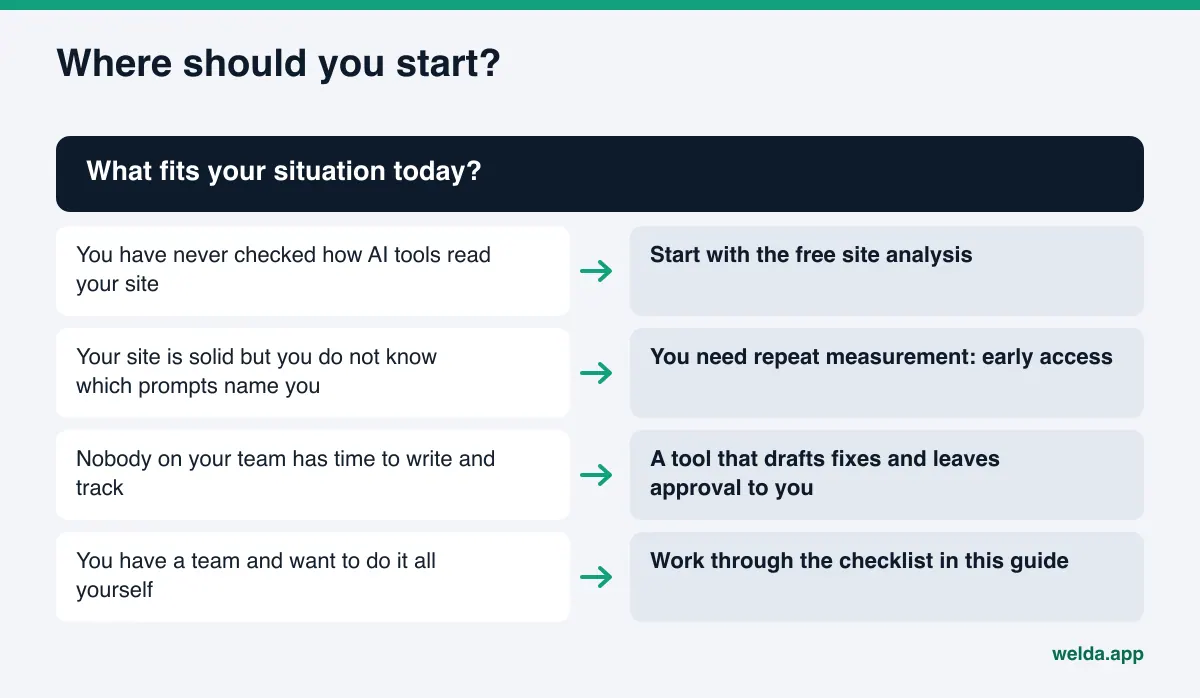
Use this table for a quick read on where you stand. If you can answer "yes" to a row, the basics are in place; the "no" rows are your first tasks.
| Question | If yes | If no |
|---|---|---|
| Does each service level have its own page? | Add guest range and service area to each | Start with the service that books most often |
| Is your service area written out? | Define the same area on Google Business Profile | List cities, counties and venue types |
| Do you explain what drives your quote? | Summarize it in your FAQ as well | Write out guest count, travel and scope |
| Is your name and phone identical everywhere? | Add business schema | Align site, Google, Instagram, Yelp and directories |
| Do you know which prompts name you? | Re-measure the same prompts on a schedule | Start with the free analysis |
| Do you reply to reviews? | Keep replies short and specific | Start with the most recent ones |
Frequently asked questions
What does AI visibility software for wedding planners measure?
It sends the questions couples would ask to AI engines and checks whether your business is named, in what position, and which sources competitors are cited from. In the Welda dashboard, each question is asked three times across four engines.
I mostly market on Instagram and have a basic site. Can I still show up?
It is possible but harder. Answer engines rely on text they can read, and Instagram is not always a strong source. Even a short site that clearly states your services, region and contact details gives them something solid to cite.
Do I have to publish my prices?
No. Explaining what drives your quote is usually enough: guest count, travel, scope and design complexity. That helps an AI model name you, with a reason, for budget-related questions.
How long until I see a change?
New content usually takes weeks to be reflected in AI answers. Nobody can promise a date or a position. To see change, re-measure the same questions with the same method.
Will Welda publish to my site on its own?
No. Nothing goes live without your approval. On WordPress, content opens as a draft and is published when you approve it. On other platforms, Welda gives you a ready package to apply.
Does Welda manage my wedding directory profiles?
No. Directory accounts stay with you. Welda shows which directories AI engines rely on and can suggest profile text.
See where your planning business stands today
For many couples, the first question about a wedding planner now goes to an AI assistant. Getting named in that conversation is not about a trick. It comes down to clear, consistent information: what kind of weddings you plan, where, for how many guests, and how you work. Start by running the free site analysis to see how AI tools read your site, which gap to close first, and whether your name comes up for five sample questions. From there you can also request early access to the dashboard for ongoing tracking and ready-made fixes.