What does AI visibility software for pet groomers and boarding kennels actually do? It checks whether your business gets named when pet owners ask ChatGPT, Gemini, Perplexity or Google's AI features questions like "safe dog boarding near me" or "groomer that's good with anxious cats." Good software doesn't stop at a score. It drafts the missing details, profile copy and FAQ answers for you, and leaves the final approval in your hands.
Nobody picks a boarding kennel the way they pick a lunch spot. Before price, pet owners want to know about trust: Is someone on site overnight? Are cats kept away from dogs? Which vaccines are required? Will my doodle be sedated for a haircut? A growing share of those questions now goes to AI assistants instead of a search box, and the assistant builds its answer from what it can find about you on the web. If your website, your Google Business Profile and the places people talk about you don't answer those questions clearly, an AI engine has very little to recommend you with, even if it knows you exist. This guide covers what AI visibility software for pet groomers and boarding kennels should measure, what you can fix yourself, and how Welda handles the work. If you'd like a baseline first, run a free AI visibility analysis of your website; reading the rest with your own results in hand makes it far more useful.
What is AEO, and why do groomers and kennels need to think about it?
AEO, or answer engine optimization, is the work of getting your business mentioned in the answers AI assistants give. You'll also see it called GEO (generative engine optimization); for this article, the two mean the same thing. The basics apply to every local business, but pet care has three quirks that change the playbook.
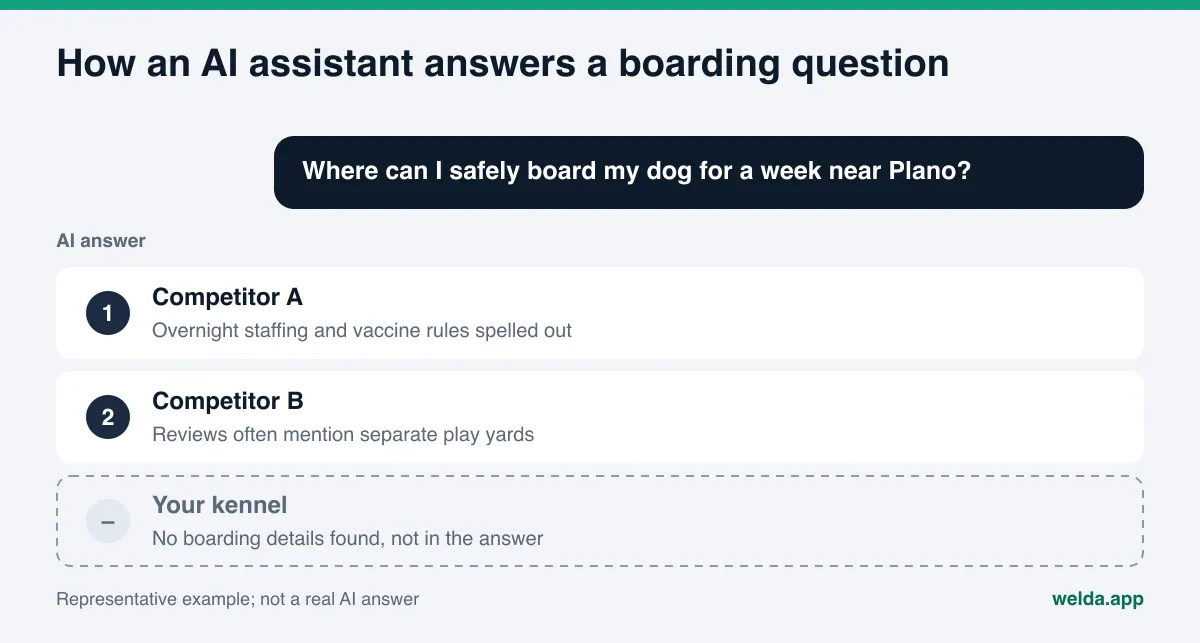
The decision runs on trust. A bad restaurant pick costs you one dinner. A bad boarding pick means a stressed or sick pet and a ruined vacation. That's why pet owners ask long, specific questions, and why AI assistants answering them look for specifics: overnight staffing, play groups, feeding routines, what happens in an emergency. "We treat every pet like family" gives an AI engine nothing to work with. "A staff member is on site overnight" and "cats stay in a separate, quiet room" do.
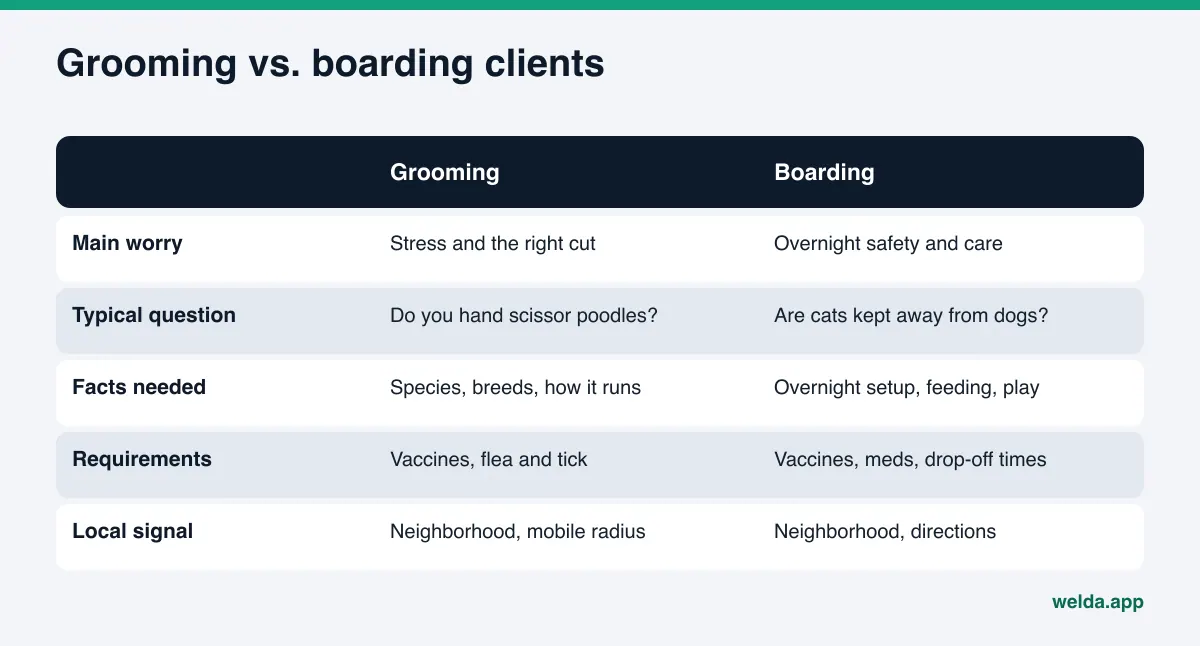
Two very different services often share one roof. Many shops offer both grooming and boarding, sometimes daycare too. Grooming clients ask about breed cuts, appointment length and how you handle nervous dogs. Boarding clients ask about sleeping arrangements, exercise, medication and vet access. One generic "Services" page rarely answers either group well.
It's hyper-local. People don't drive across town for a nail trim. Questions come with a neighborhood or suburb attached: "dog groomer in Park Slope," "cat boarding near Plano." If your address, service area and any mobile grooming radius aren't written out in plain text, the AI engine can't place you in that answer.
What do pet owners ask AI assistants?
The table below shows the kinds of questions pet owners may ask and the information an AI engine needs to include you in the answer. The example questions were written for this article; they are not survey data. When you build your own list, add the questions your front desk hears most often.
| Question type | Example question | What the answer depends on |
|---|---|---|
| Proximity | Best dog groomer near me in Austin? | Address, service area, Business Profile category |
| Trust | Where can I safely board my dog for a week? | Overnight staffing, policies, reviews |
| Special needs | Boarding for a senior cat that needs daily meds? | Medication policy, special care, vet access |
| Breed and service | Groomer who does hand scissoring for poodles | Service list, breed experience, technique |
| Requirements | What vaccines do kennels usually require? | Requirements page, FAQ |
| Comparison | Cage-free boarding vs. traditional kennel? | A clear description of how you board |
The last column is the one that matters. An AI answer is assembled from sentences it finds about you. If a fact isn't written anywhere, it won't show up in the answer. If you want to be named for "senior cat that needs daily meds," your site or profile has to say plainly that you give medication and how.
To build a realistic question list, pull from three places. First, your phone and message history: write down the five questions you heard most last month. Second, your reviews: what do people praise and what do they complain about? Praised topics are where AI can name you; complaints point to answers you need to make clearer. Third, competitor websites: which questions do they answer that you don't? Split the list into grooming, boarding and both, and include the nearby neighborhoods your clients actually drive in from, not just your own.
Where do AI engines get their information about pet businesses?
AI assistants that search the web read a handful of sources and summarize them. For groomers and kennels, those sources usually include:
- Your website: service pages, requirements, FAQ, address and contact details. AI crawlers also need to be able to reach your pages; OpenAI, for example, documents OAI-SearchBot as the crawler it uses to surface sites in ChatGPT search. We cover how to check this in are AI bots crawling my website.
- Google Business Profile and Google Maps: category, hours, photos, reviews and your replies. Google notes in its help center that your primary category affects how you show up in local search, and that you should pick the most specific one available.
- Review and community sites: Yelp, Nextdoor, local Facebook groups and Reddit threads where pet owners swap recommendations. A bad boarding story posted there can surface in an AI answer too. We look at this in how Reddit and forums shape AI answers.
- Lists and local guides: city "best of" lists, local news roundups and neighborhood blogs. If those lists matter in your area, getting onto the best-of lists ChatGPT cites explains the approach.
Trouble starts when these sources disagree. If your site says "open seven days" but your profile shows Sundays closed, or your site never mentions cat boarding at all, the AI engine sees conflicting information and may lean toward a competitor whose details line up.
Step by step: improving AI visibility for a grooming salon or boarding kennel
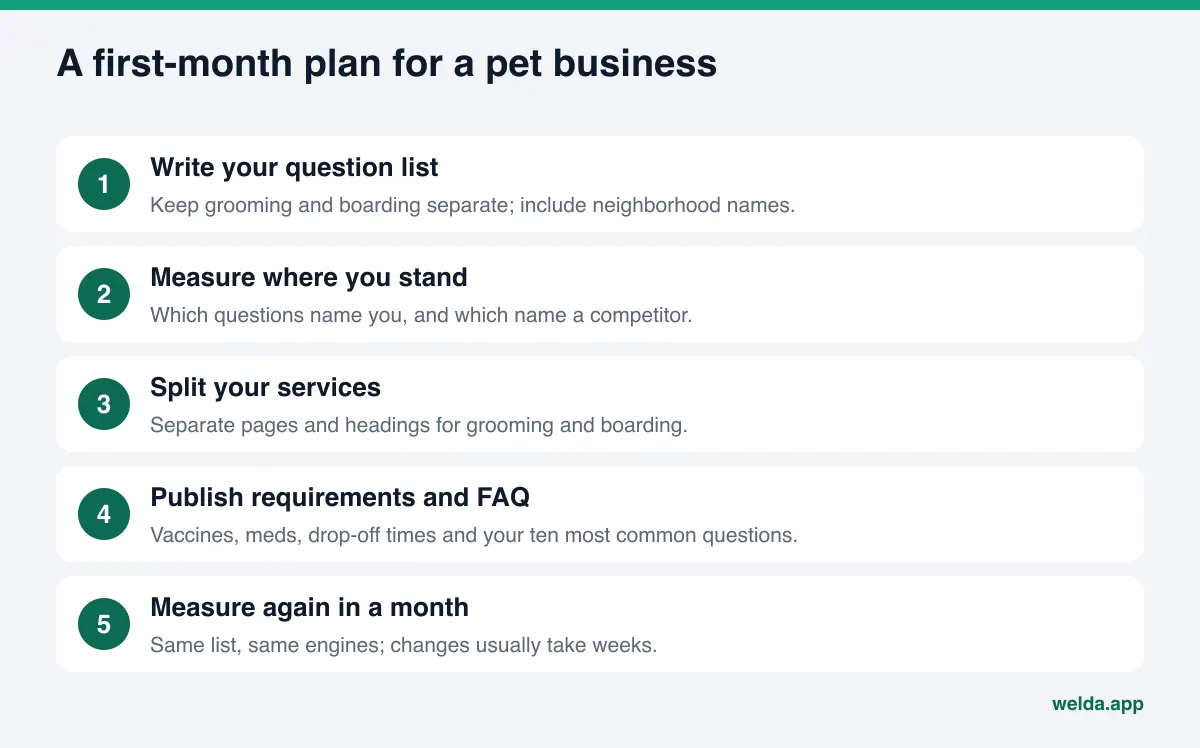
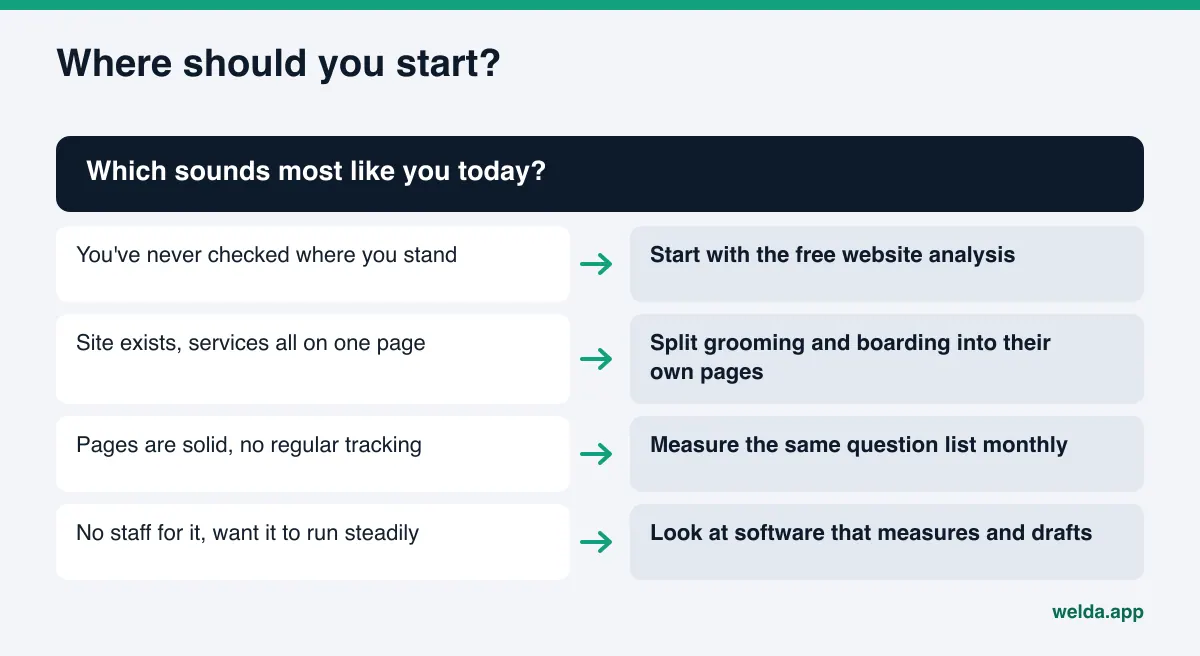
You can do these steps with or without software. Order matters: measure first, then start with the gap that affects the most questions.
- Write your question list. Aim for 20 to 30 questions, with grooming and boarding kept separate and neighborhood names included.
- Measure where you stand. Ask those questions in the AI assistants your clients use, or have software do it. Note which questions name you and which name a competitor. Don't trust a single try; answers change from one run to the next.
- Open the door for crawlers. Make sure robots.txt isn't blocking AI search bots. Your page title and meta description should say what you do and where.
- Split your services. Give grooming and boarding their own pages. On the grooming page, list species and breeds you work with and how an appointment runs. On the boarding page, describe overnight arrangements, exercise, feeding and the daily routine.
- Publish your requirements. Vaccines, flea and tick prevention, spay or neuter rules, medication, drop-off and pick-up times. If your state or city licenses or inspects boarding facilities and you hold that license, say so in plain words.
- Add an FAQ section. Answer the ten questions your front desk hears most, briefly and accurately.
- Clean up your Google Business Profile. Right category, right hours, real photos of the space, a service list. Keep it consistent with your website.
- Reply to reviews. Calm, specific replies to positive and negative reviews alike.
- Measure again in a month. Use the same question list. New content usually takes weeks to show up in AI answers.
Choosing AI visibility software for pet groomers and boarding kennels
All of the steps above can be done by hand, but keeping them up is hard. A team that's bathing dogs in the morning and checking in boarders in the afternoon isn't going to type hundreds of questions into four assistants every month. That's where software earns its keep. When you evaluate options, these questions matter most for pet care:
- Can it measure local questions with real neighborhood and city names, not just generic national queries?
- Can you see grooming and boarding questions separately?
- Does it show which source a competitor is winning from, such as Yelp reviews, a city guide or their own detailed boarding page?
- When it doesn't know something (your vaccine policy, overnight staffing), does it make it up or ask you?
- Does anything go live without your approval?
The last two matter more in pet care than almost anywhere. A tool that writes "24-hour veterinary supervision" when you don't offer it will cost you trust the first time a client asks.
How Welda handles AI visibility for groomers and kennels
Welda is software that measures where a business appears in AI answers and prepares the fixes on the business's behalf. For a groomer or a boarding kennel, three parts of it do most of the work.
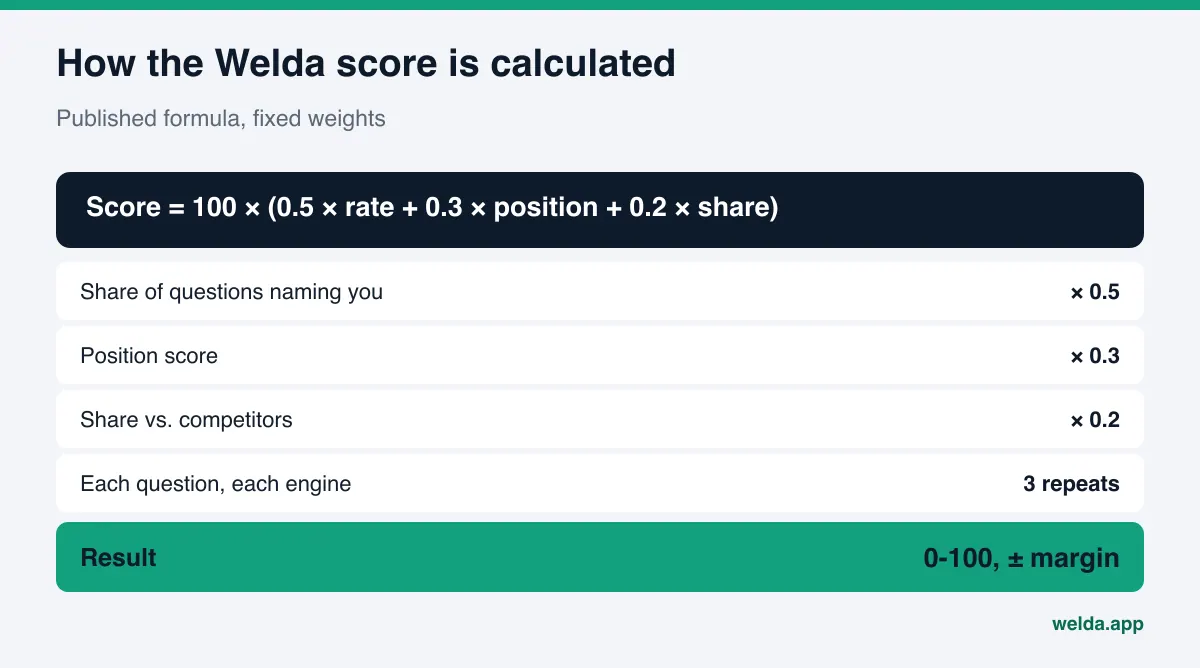
Question tracking. In the Welda panel, the questions your clients are likely to ask are sent to ChatGPT, Gemini, Perplexity and Google AI three times each. The questions view shows, line by line, which engine names you and in what position. For an example boarding kennel, the picture might look like this: you're named in "cat boarding" questions but missing from "where can I leave my dog while I travel." That split tells you which page to work on first. Splitting the list into grooming and boarding makes the weaker side obvious. The score behind it uses a published formula, and the three repeats produce a margin of error, so you can tell a real change from noise.
Competitors and sources. The competitors view shows which business gets named ahead of you, on which topic, and from which source. In an example scenario, Competitor A wins "cage-free boarding" questions because its site describes its setup in detail. The sources view lists the sites AI engines lean on and where you're missing. Instead of "let's fix everything," you get "write these two pages and fix the profile."
To-do list and ready-made copy. Welda pulls every gap into one list. When it doesn't know something, it leaves the field blank and asks: which vaccines you require, how overnight care works, whether cats and dogs are separated. You answer once, and the answer flows into the pages and copy it prepares. Profile descriptions, FAQ answers and review replies arrive as ready text. If your site runs on WordPress, Welda connects through a separate Editor user and an application password, no code to install, and opens content as drafts that go live only when you approve. Without a connection, you get a ready-made package and apply it yourself. Google Business Profile, Instagram and Facebook can be connected; anything that isn't connected shows up as a manual task.
There's also a monthly one-page report and a before-and-after view, but for a pet business the early value is simpler: seeing why a question slipped away and closing the gap quickly. Your content always lives on your own website. Welda doesn't host it.
A plain note on availability: the Welda panel is in early access and opening first to businesses in Turkey. Regular four-engine measurement is being added during early access, and sample screens in the panel use representative data. What anyone can use today, in English, is the free website analysis. Pricing is discussed in an early access conversation.
What does the free website analysis tell a pet business?
The free analysis reads your homepage and a few inner pages (services, pricing, about, contact) the way Google and AI engines see them. For groomers and kennels, the most common gaps tend to be services lumped into one paragraph, an address or phone number that only appears inside an image, missing business markup (Schema), no FAQ section, and a Google Maps profile that isn't linked from the site.
You get a score out of 100, with technical and content scored separately. Each gap comes with what was found, why it matters and how to fix it. You also get suggested homepage copy (title, meta description, main heading, intro paragraph and FAQs), a simulation showing how much each fix could move the score, a competitor comparison, and a fix package with ready-to-add business markup. The analysis also asks five customer-style questions to an AI assistant that can search the web and checks whether your business is named. That's a one-time check, not ongoing tracking, but it shows you where to start. It's free once per site; your results link arrives by email and stays open for 14 days.
Limits: what Welda doesn't do
Knowing what a tool won't do is as useful as knowing what it will.
- Welda doesn't guarantee rankings or a spot in ChatGPT's answers. AI answers are rewritten every time; nobody can promise placement.
- It doesn't invent facts. Overnight staffing, vaccine rules and vet arrangements come from you.
- It doesn't write fake reviews. It drafts replies, not reviews.
- Negative reviews themselves, directory account setup and press outreach stay with you. Welda can draft text for them, but you own the accounts and you hit send.
- Nothing sensitive goes live without your approval.
- New content usually takes weeks to show up in AI answers. Expecting a change after a week sets you up for disappointment.
Pet care has one more boundary: health claims. Lines like "our grooming clears up skin problems" or "no illness ever spreads in our kennel" can mislead owners and create risk. Welda's compliance check flags patterns such as pricing claims, guarantees, superiority claims and diagnostic suggestions before anything is published. It isn't legal advice and hasn't been reviewed by counsel; for wording you're unsure about, talk to your veterinarian and your attorney.
Reviews and replies: what works for pet care
Reviews are one of the strongest trust signals AI engines read for pet businesses. Pet owners tend to describe concrete experiences: "my cat came home calm for the first time," "they texted me photos during her stay." Those details tell an AI engine how you work. Your replies do the same job. A specific reply turns into another source describing your service; a generic one-word thank-you adds nothing.
Take an example negative review: "My dog's coat was still damp when I picked him up." Instead of a defensive one-liner, a reply like this tells both readers and AI engines something useful:
Thanks for letting us know. Drying takes longer for thick double coats, so we now schedule appointment length by coat type and check every dog before pickup. We'd be glad to talk it through at your next visit.
That's an example; only describe changes you've actually made. And keep the FTC in mind: its rule on fake reviews and testimonials, announced in August 2024, bans fake reviews, paying for reviews with a particular sentiment and suppressing negative reviews through threats or intimidation. This isn't legal advice, but it's a good reason never to trade discounts for edits. For more on how reviews shape AI answers, see AI reputation management.
Content plan: what goes where?
Turning a measurement into work means deciding where each fact should live. Use this table as a starting plan and adapt it to your services.
| Page or place | For grooming | For boarding |
|---|---|---|
| Service page | Species and breeds, steps, appointment length | Sleeping setup, overnight care, feeding, play |
| Requirements | Vaccines, flea and tick prevention | Vaccines, medication, drop-off and pickup times |
| FAQ | Sedation, can owners stay | Cameras, separate areas, emergencies |
| Google Business Profile | Right category, service list, photos | Right category, hours, photos of the space |
| Review replies | Specific replies naming the service | Replies that mention the stay and updates |
Decision checklist
Run through this before you trial a tool or start a month of work.
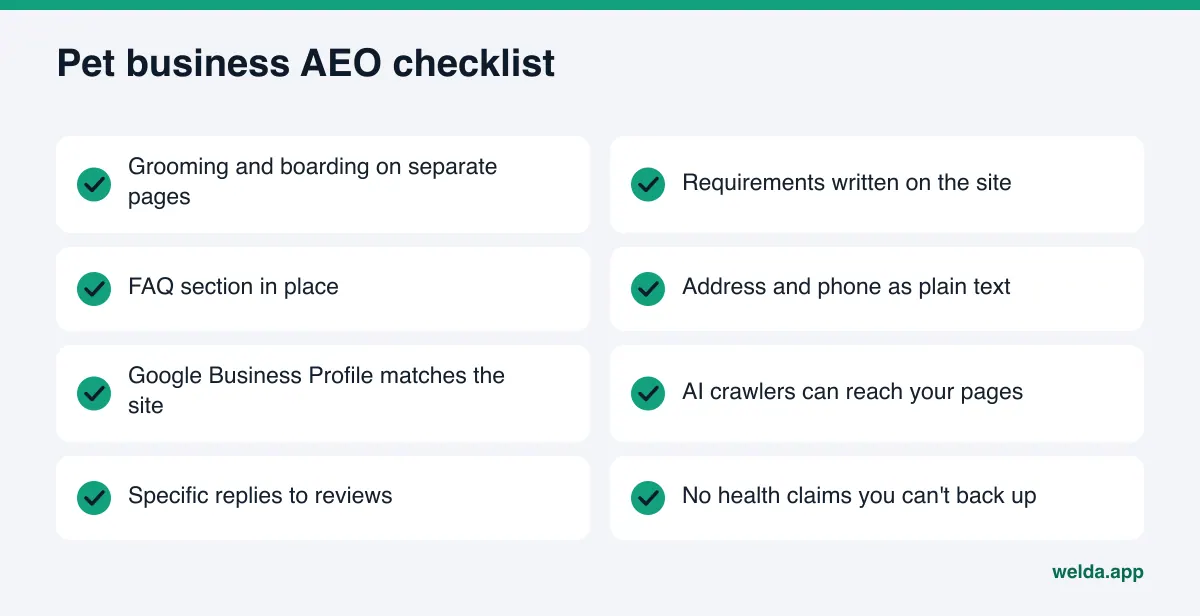
- Are grooming and boarding described on separate pages with clear headings?
- Are your requirements and an FAQ written out on the site?
- Do your address, phone and service area appear as text?
- Does your Google Business Profile match your website?
- Can AI crawlers reach your pages?
- Does the software measure local questions and show competitor sources?
- Do you keep publishing approval, and does it ask rather than guess?
For a similar local service business working through the same questions, AI visibility software for gyms is a useful comparison; swap memberships for appointments and stays and the logic is much the same.
Frequently asked questions
Does a small grooming shop really need to think about AI search visibility?
If your clients ask AI assistants for a groomer nearby, yes. A small shop's advantage is speed: a few clear pages and a clean profile are often a solid start.
Why doesn't my boarding kennel show up in ChatGPT?
The usual reasons: your boarding setup isn't described on your site, requirements aren't written down, your profile and site disagree, or crawlers can't reach your pages. The free analysis shows which of these apply to you.
Do I need separate websites for grooming and boarding?
No. Separate pages with clear headings on one site are enough. What matters is that the two services don't blur together.
Will Welda reply to my reviews?
Welda drafts review replies. You approve what gets posted. It doesn't write fake reviews or remove negative ones.
How long until I see results?
New content usually takes weeks to appear in AI answers. Measuring monthly with the same question list tells you more than checking every few days.
Is the Welda panel available in the US?
The full panel is in early access and opening first in Turkey. The free website analysis works in English today, and pricing is discussed in an early access conversation.
AEO for a pet business isn't a one-time fix; it's routine upkeep, like your intake forms. The first step is knowing where you stand. Run your grooming salon or boarding kennel through the free AI visibility analysis, see your score, your gaps and the result of the five-question AI check, then decide which page to tackle first.