What does AI visibility software for jewelry stores actually do? Shoppers now type questions like "trustworthy jeweler near me", "where can I get a custom engagement ring made" or "who resizes rings the same week" into ChatGPT, Gemini, Perplexity and Google's AI Overviews. AI visibility software for jewelry stores checks whether your store is named in those answers, shows which facts are missing, and gives you ready-to-use copy to fill the gaps. Nobody can guarantee a placement, but a store that never explains itself rarely gets named at all. This guide covers the work, how Welda handles it, and where Welda stops.
Why AI answers matter for jewelry stores
Buying jewelry is not a routine purchase. An engagement ring, wedding bands, an anniversary gift, a family piece that needs repair, or old gold someone wants to sell: these are occasional decisions that involve real money and a lot of trust. The shopper usually knows roughly what they want. What they do not know is who to trust. A few years ago they would ask friends, scroll through Yelp, or drive past a few storefronts. Today many of them type a full sentence into an AI assistant and expect two or three names back.
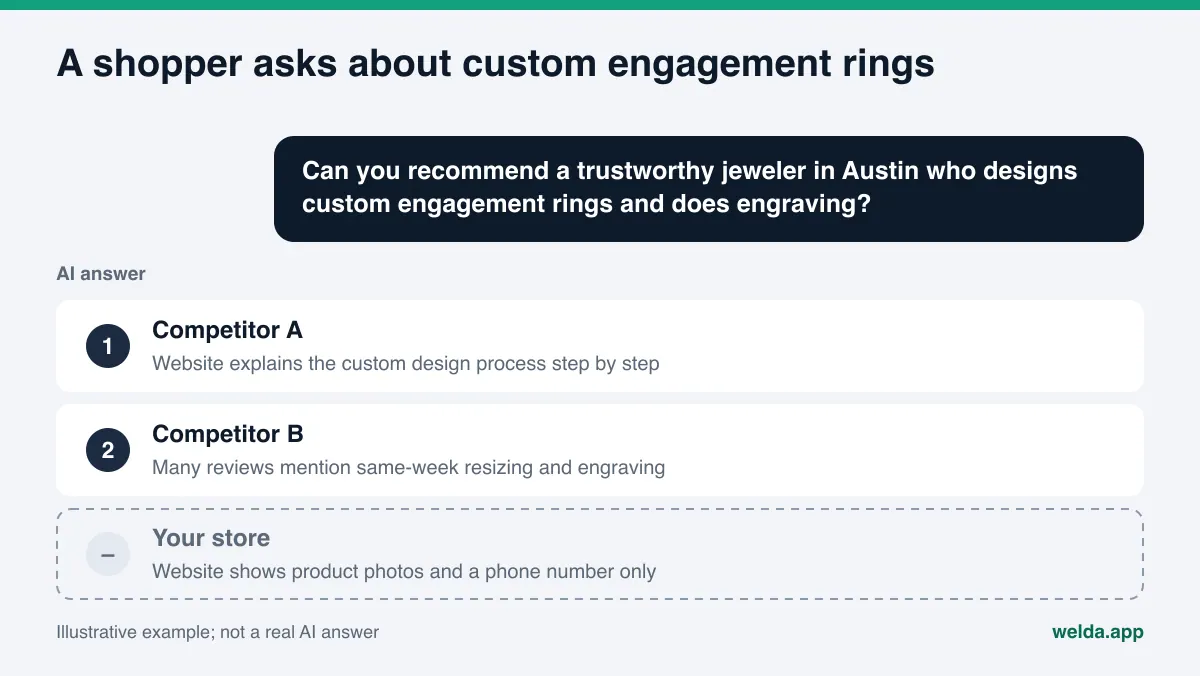
That answer is short. The AI tool lists a few stores and attaches a reason to each one: "known for custom design", "does repairs and resizing in-house", "reviewers mention clear paperwork for diamonds". To write those reasons, the system needs facts it can read about your store. If the facts are missing or scattered, it recommends the competitor that explains itself better.
Many jewelry store websites look the same: large product photos, an Instagram feed, a phone number. There is no services page, or it says "full-service jeweler" and nothing else. Whether you repair chains, how resizing works, which pieces you engrave, whether you buy gold or estate jewelry: none of it is written down. The photos are beautiful, but an AI system cannot reliably infer "this store designs custom engagement rings in South Austin" from an image carousel.
That is the core of answer engine optimization, or AEO, for jewelers. You may also see it called GEO (generative engine optimization); the idea is the same. It is not about uploading more products. It is about stating clearly who you are, what work you do, how you do it and why customers can trust you, keeping those facts consistent across your site and profiles, and measuring the result. If you want to see where your site stands today, run the free site analysis. It reads your site the way Google and AI tools do and lists each gap with a fix.
What do shoppers ask AI tools about jewelers?
Jewelry shoppers ask from a handful of intents, and each intent needs different information on your site. The table below shows that split. The questions are our own examples, written to show which fact answers which kind of question.
| Intent | Example question | Facts the answer needs |
|---|---|---|
| Trust and choice | "Who is a reputable jeweler in Scottsdale?" | How long you have been there, paperwork you provide, reviews |
| Custom work | "Where can I get a custom engagement ring designed in Denver?" | Design process, in-house bench work, steps to pickup |
| Repair and care | "Which jeweler resizes rings quickly near me?" | Repair, sizing, soldering and cleaning listed as separate services |
| Diamonds | "Where can I buy a lab-grown diamond with a grading report?" | How you label mined and lab-grown stones, which reports you provide |
| Selling gold | "Where can I sell old gold jewelry locally?" | Whether you buy gold or estate pieces and how the evaluation works |
| Personalization | "Is there a jeweler that engraves wedding bands?" | Which pieces and metals you engrave, and how long it takes |
Look at the pattern. Most of these questions are not about a product. They are about a service or a trust signal. Nobody asks for "item 4471". They ask "who does this, and who can I trust". Product photos cannot answer that. Written descriptions of your services and your process can.
The second pattern is location. Jewelry is a local business, and shoppers add a city or neighborhood to their questions all the time. If your neighborhood does not appear in your page title, on your homepage and in your Google Business Profile, it is harder for an AI system to connect your store to that place. Our guide to AI visibility software for wedding planners covers a closely related customer journey, since engagement and wedding shoppers often ask about both in the same week.
What signals do AI tools use to recommend a jeweler?
No AI engine publishes its full recommendation logic. But when you read the reasons that appear in answers and the sources they cite, the same signals keep showing up. For jewelry stores the important ones are these:
- A crawlable site. AI search crawlers have to be able to reach your pages. OpenAI, for example, states on its crawler documentation page that sites opted out of OAI-SearchBot will not be shown in ChatGPT search answers. An old robots.txt rule can close that door without anyone noticing.
- A clear list of services. Sales, custom design, repair, resizing, engraving, appraisals, buying gold. Each one with its own heading and a few plain sentences.
- Location and contact facts. Address, neighborhood, hours, phone. Written the same way on your site, Google Business Profile, Yelp and social accounts.
- Structured business data. Schema.org has a dedicated type for this: JewelryStore. It lists your name, address, hours and profile links in a format machines can read.
- Reviews and trust signals. The content of reviews matters as much as the count. "They resized my ring in two days" or "they explained the diamond report before I paid" are sentences an AI tool can reuse as reasons.
- An FAQ section. When the questions people ask you on the phone are answered on your site, AI systems can read those answers too.
- Third-party sources. Google Business Profile, Yelp, the BBB, local guides and community threads. AI tools look at these as well, and inconsistencies there can cost you.
Notice what is not on the list: "most inventory" or "lowest price". AI tools recommend a jeweler because the store clearly does the job the shopper asked about and looks trustworthy, not because it claims to be cheapest. Metal prices move daily anyway, so a fixed price on your site goes stale fast.
Step-by-step AEO for a jewelry store
You can do every step below without any software. Order matters: first make sure AI crawlers can reach your site, then write what they should read, then measure.
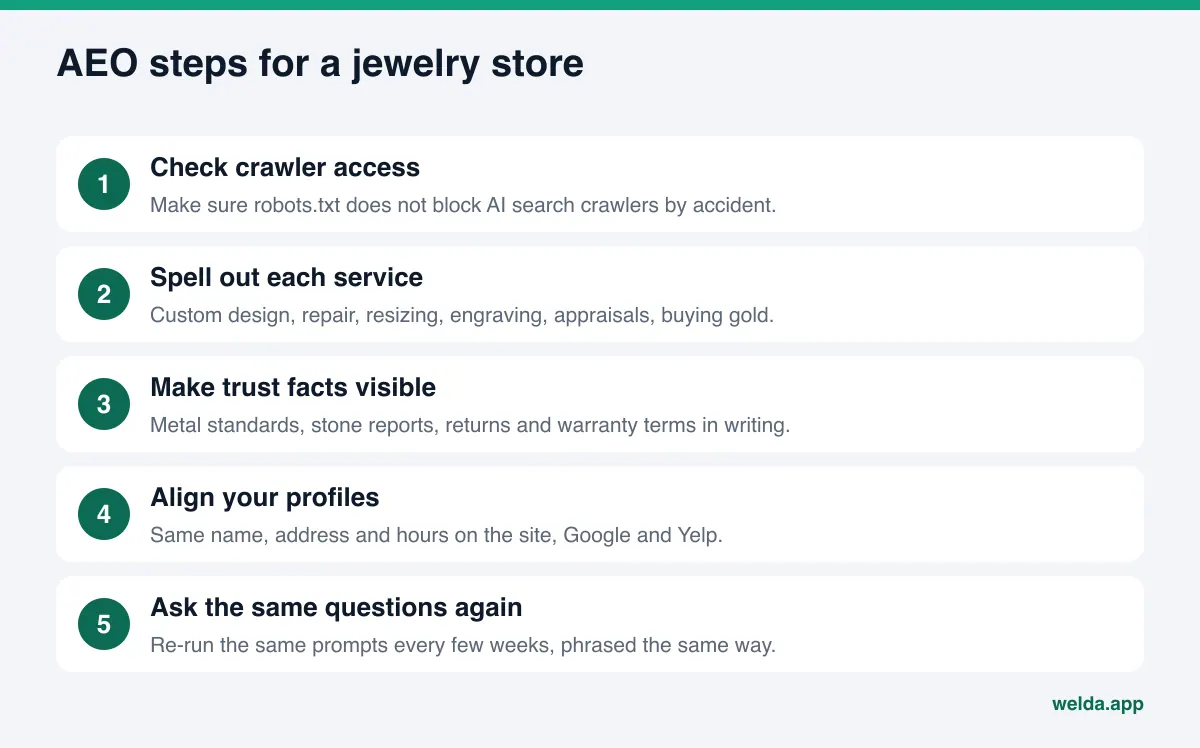
- Check crawler access. Open your robots.txt file and look for lines that block AI search crawlers. A web developer may have added a blanket "block all bots" rule years ago.
- Rewrite the homepage intro. The first paragraph should answer three questions: who you are, what you do, where you are. Example: "We are an independent jeweler with an on-site workshop in South Austin. We design custom engagement rings and wedding bands, and we handle repairs, resizing and engraving at our own bench."
- Give each service its own section. What it is, which pieces it applies to, how the process works, what the customer should bring. If turnaround depends on the job, say so plainly instead of promising a number.
- Make trust facts visible. Which metals and karats you work in, what paperwork comes with a purchase, which grading reports you provide for diamonds, your return and warranty terms. These are the points jewelry shoppers hesitate over most.
- Label diamonds correctly. If you sell lab-grown diamonds, say so clearly and early. The FTC's Jewelry Guides cover this, and the agency has written about disclosing lab-created stones close to where the word "diamond" appears. Clear labeling also gives AI tools an accurate fact to repeat.
- Explain buying gold. If you buy gold or estate jewelry, write which pieces you accept and how the evaluation works. You do not need to post a price; explaining the process is enough.
- Add JewelryStore schema. Include name, address, phone, hours and links to your profiles.
- Align your profiles. Category, services, hours and description on Google Business Profile should match your site. The same goes for Yelp and your Instagram bio.
- Add an FAQ. Write down the five or six questions you hear most often on the phone, with short answers.
- Measure, then measure again. Ask the questions your customers would ask in several AI tools and note whether your store is named. A few weeks later, ask the same questions the same way.
None of this requires deep technical skill. The hard part is doing all of it consistently and measuring over time. A jeweler is at the bench and the counter all day; there is little time to write web copy, compare profiles and re-run the same prompts every few weeks. That is where software earns its place.
What should a jewelry store website say?
Picture two stores with similar cases and similar inventory. One gets named in AI answers and the other does not. The difference is rarely the jewelry. It is what the website can say about the store. The comparison below shows it line by line.
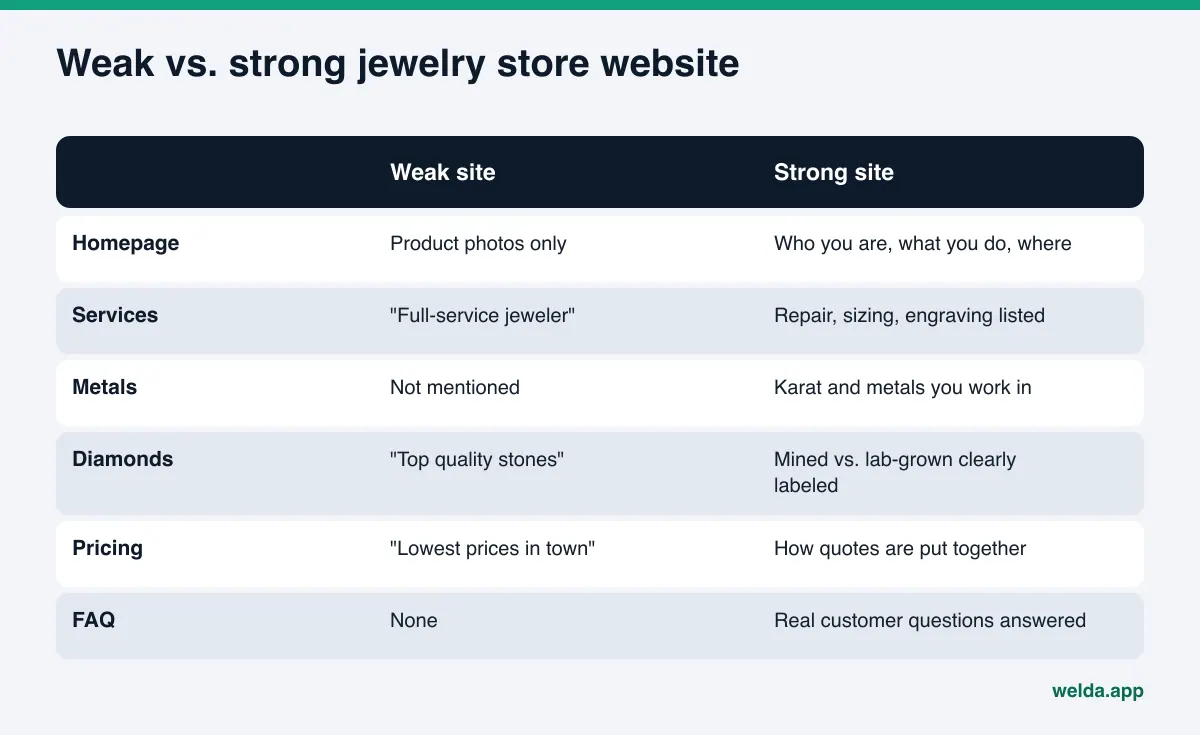
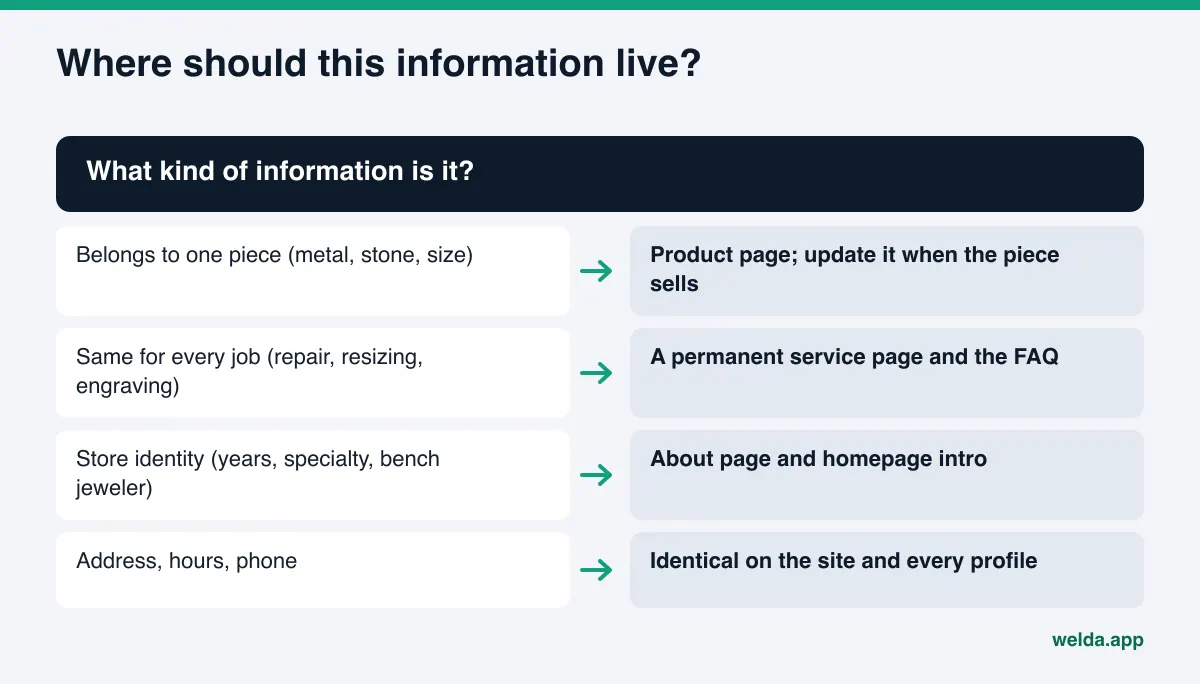
One more split matters for jewelers: which facts belong on a product page and which belong on a permanent page. Product pages change; a piece sells and a new one arrives. AI tools usually recommend the store rather than a single ring. "How custom design works", "what happens during resizing" and "which report comes with a diamond" are the same for every piece and belong on a permanent page. The chart below sums it up.
A word of caution on claims. Jewelry advertising in the US is shaped by FTC guidance on metal content, stone descriptions and claims like "lab-grown" or "natural". Every trust statement on your site should be accurate and something you can back up. "Guaranteed", "purest gold" or "lowest prices in town" can mislead shoppers, and they are not the kind of fact an AI tool can use as a reason anyway. Plain, specific sentences work better than big claims. For your own situation, talk to a qualified attorney; this article is not legal advice.
How Welda works as AI visibility software for jewelry stores
Welda is software that measures where a business appears in AI answers and helps close the gaps on the business's behalf. For a jewelry store the work comes down to three parts: question-by-question measurement, a transparent score, and ready-to-approve copy.
Question-by-question measurement. In the Welda dashboard, the questions your customers would ask are sent to ChatGPT, Gemini, Perplexity and Google AI three times each. The three runs exist because AI answers shift from one run to the next; a single check can mislead. For a jeweler, the question list follows the intents above: trust, custom design, repair and sizing, diamonds, buying gold, engraving. On the questions screen you see, for every question and every engine, whether your store is named and in what position. Open a question and you see how the answer was put together and which sources it relied on.
The decision this screen supports is simple: which intents am I strong in, and where am I missing? Say you are named for repair questions but never for custom engagement rings. The likely gap is a page that explains your design process. Measurement lets you prioritize based on data instead of guessing. The competitors view works the same way: it shows which question group a competitor wins and which source they win it from.
A transparent score. Welda publishes its score formula, so you can see what moved and why.
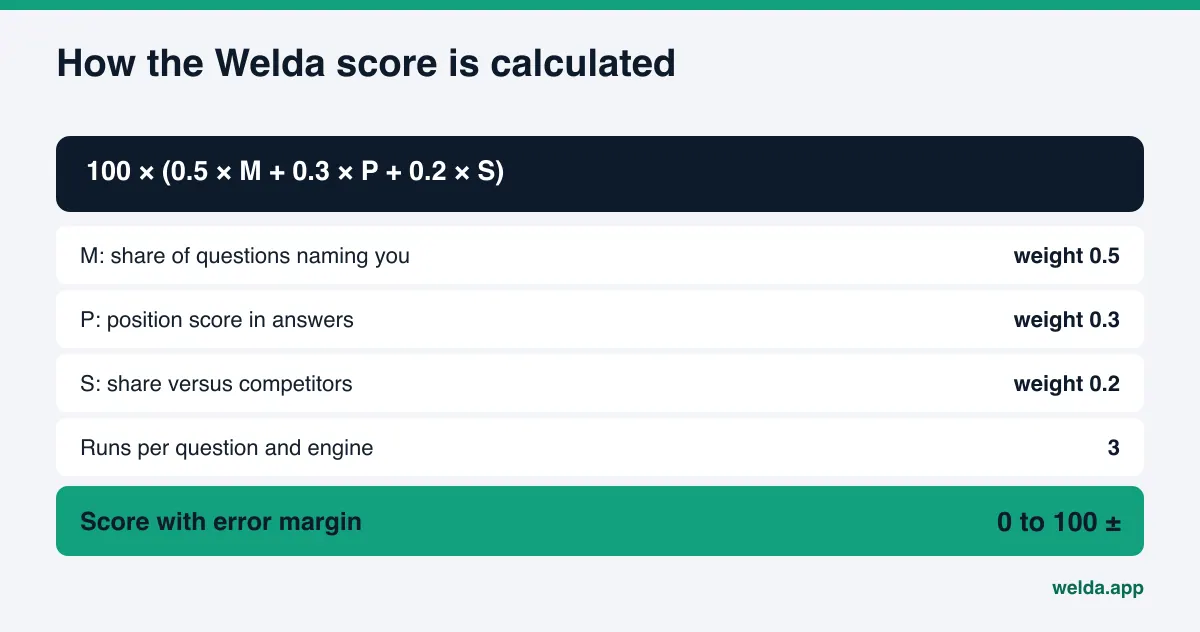
Half the weight goes to how often you are named at all, which is usually the first thing a jeweler needs to fix. Position and share against competitors matter once you are in the answers. The spread across the three runs produces a margin of error, so a small change from one week to the next is not mistaken for progress.
Ready-to-approve copy. Welda drafts service page copy, FAQ answers, profile descriptions and review replies. For a jeweler that might be a short "Ring resizing" section or an FAQ answer on "How we buy gold". Welda does not invent facts it does not have. Whether resizing happens in-house, which karats you work in, which grading reports you provide: these become open questions on your to-do list, and the copy is written after you answer. The legal check flags patterns like price claims, guarantees and superiority claims before anything goes live, which catches phrases like "guaranteed" or "lowest prices" that are common in jewelry copy. It is not legal advice and has not been reviewed by legal counsel.
You keep the final say on publishing. On WordPress, Welda connects through a separate Editor user and an application password, with no code to install; content opens as a draft on your site and goes live when you approve it. On other platforms, Welda hands you a ready package and the changes are applied by hand. Google Business Profile, Instagram and Facebook can be connected; if they are not, the task appears as a manual item with the copy ready. Your content always lives on your own site.
An honest note on availability: the Welda dashboard is in early access and is opening first to businesses in Turkey. Regular four-engine measurement is being added during early access, and the sample dashboard screens use illustrative data. The part anyone can use today is the free site analysis, which works in English. Pricing is discussed during the early access conversation.
What the free analysis shows a jeweler
Before any dashboard, the free analysis shows where your site stands. It reads your homepage and a few inner pages such as services, about and contact. Typical findings for jewelry sites: the page title has no city or service, the main heading is just the store name, there is no structured business data, services are vague, there is no FAQ, and the Google Business Profile is not linked from the site.
You get a score out of 100, with technical and content scored separately. Each gap comes with what was found, why it matters and how to fix it. You also get suggested copy for your homepage title, meta description, main heading, intro paragraph and FAQ. A simulation shows how much each fix would raise the score, so you know what to do first. The report also includes a competitor comparison, a ready-to-install fix package including the business schema code, a PDF and a shareable score card.
The analysis also sends five questions a customer might ask to an AI assistant that can search the web, and checks whether your store's name appears in the answers. That is a one-time snapshot, not ongoing tracking. The analysis is free once per site. Your email and phone are verified, the results link arrives by email and stays open for 14 days. It does not measure rankings or promise any.
Limits: what Welda does not do
Knowing what a tool will not do matters as much as knowing what it does. For Welda:
- No guarantees. Welda does not guarantee rankings or that you will "show up in ChatGPT". Nobody can honestly promise that; AI answers vary by engine, question and time.
- No invented facts. Welda cannot know what your bench jeweler does or which reports you provide. It asks you.
- No publishing without approval. Sensitive content is not published without your sign-off.
- No fake reviews. Welda never writes reviews. It drafts replies to real ones.
- Some work stays with you. Handling negative reviews, setting up directory listings and press work stay with the business. Welda can draft copy for them, but you do the work.
- It takes time. New content usually takes weeks to show up in AI answers. Expecting results in the first week is not realistic.
A jewelry-specific note: daily metal prices, investment commentary and item prices are not good material for lasting AEO content. They change quickly and are easy to misread. Explaining how your process works is enough, and price or guarantee phrasing gets flagged by the legal check before you publish.
Checklist: choosing AI visibility software for jewelry stores
Whether you look at Welda or another tool, these questions help separate what will be useful from what will not. For a broader look at tool types, see our guide to the best AEO tools for small businesses. Similar decisions for other local service businesses are covered in AI visibility software for insurance agencies and AI visibility software for pet groomers and boarding kennels.
| Question | Why it matters |
|---|---|
| Which engines does it check? | Shoppers use ChatGPT, Gemini, Perplexity and Google AI Overviews, not just one. |
| How many times does it ask each question? | One run can mislead; repeats and a margin of error make results trustworthy. |
| Is the scoring formula published? | If you do not know what is measured, you cannot interpret the score. |
| Can it separate jewelry intents? | Custom rings, repairs and selling gold are different questions; one blended score hides the gaps. |
| Does it only measure, or help fix too? | A list of gaps is not enough; writing and applying fixes takes time. |
| Who approves publishing? | Every sentence about your store should pass your approval. |
| Where does the content live? | On your own website; content hosted elsewhere is not yours. |
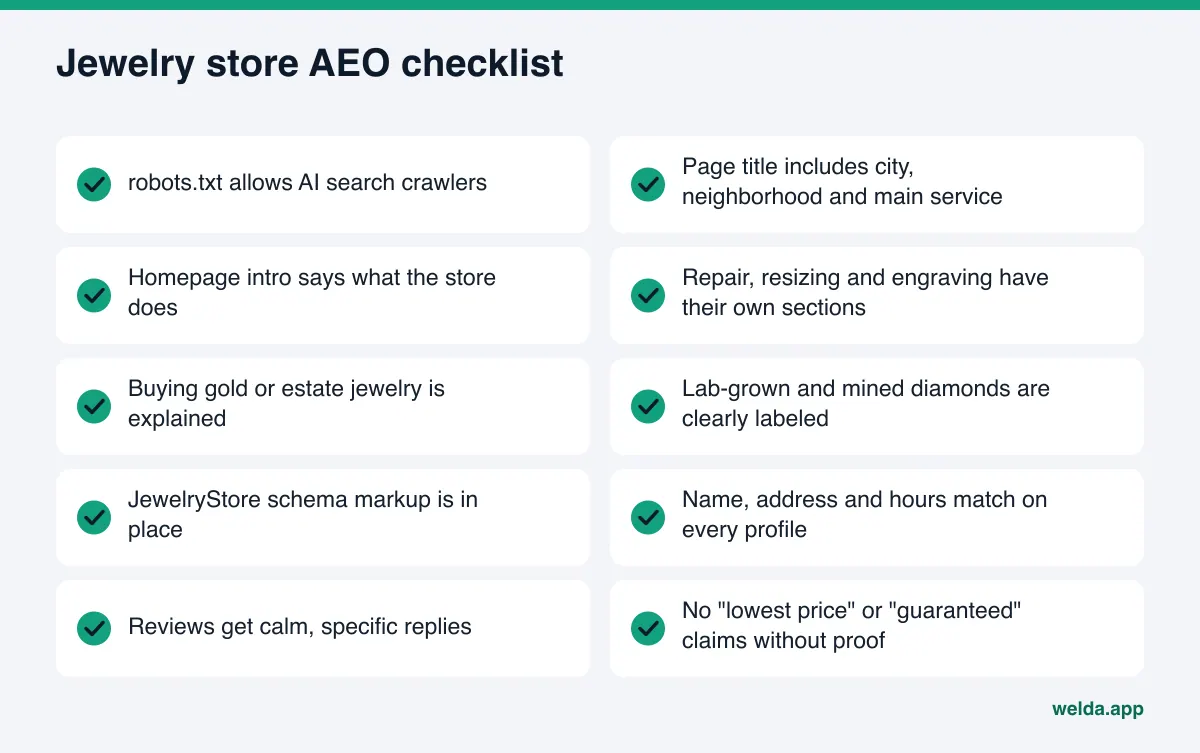
For a quick self-check of your own site and profiles, go through the list below item by item.
Frequently asked questions
What does AI visibility software for jewelry stores measure?
Whether your store is named when shoppers ask AI tools the questions they really ask, in what position, and where competitors are ahead. Welda does this across ChatGPT, Gemini, Perplexity and Google AI, asking each question three times.
Do product photos help AI visibility?
They matter to shoppers, but they are not enough for AI tools to recommend you. AI systems mostly rely on written facts: which services you offer, where you are and how you work. Put those in writing next to the photos.
Should I post gold prices on my site?
It is not necessary. Metal prices change during the day, and an outdated number can mislead. Explaining how you buy gold and how quotes are put together is a more durable and more useful fact for AI tools.
How should I describe lab-grown diamonds?
Clearly and early, following the FTC's Jewelry Guides. Accurate labeling protects shoppers and gives AI tools a correct fact to repeat. For your specific wording, check with an attorney; this is not legal advice.
How long until I see results?
New content usually takes weeks to show up in AI answers. That is why before-and-after measurement with the same questions matters. Nobody can promise a specific timeline or outcome.
What if Welda writes something wrong about my store?
Welda does not write facts it does not have; it asks you. Every draft comes to you for approval before publishing, and nothing you reject goes live.
Next step
AEO for a jewelry store is not a huge project. It is writing down what your store does and how, keeping those facts consistent everywhere, and measuring over time. The first step is seeing how your site looks to AI tools today. Run the free site analysis to get your gaps, suggested copy and a simulation of which fix moves your score the most. If you want ongoing measurement and fixes later, you can ask about early access.