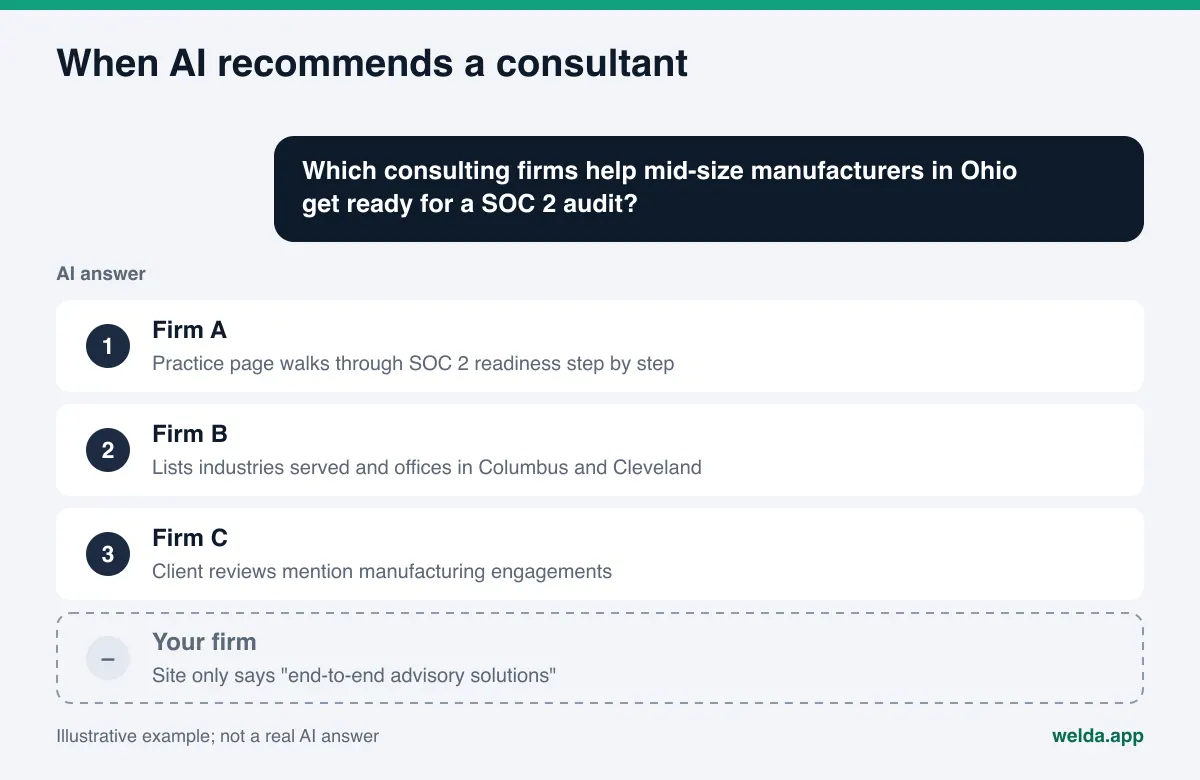
What does AI visibility software for consulting firms actually do? A COO looking for outside help now types something like "consulting firms that help mid-size manufacturers get ready for a SOC 2 audit" into ChatGPT, Gemini, Perplexity or Google's AI Mode and gets back three or four firm names. AI visibility software checks whether your firm is one of those names and helps you close the gaps that keep it out. This guide covers what a consulting firm needs to publish, what to measure, and which parts of the work Welda handles.
Why AI visibility software for consulting firms matters now
AI search visibility comes down to one question: when a buyer asks an AI assistant for a recommendation, does your firm show up in the answer? The work of earning that spot is usually called AEO, answer engine optimization. You will also see the term GEO, generative engine optimization; it means roughly the same thing. In this article we use AEO.
In classic search, a buyer sees ten links, opens a few consulting websites, skims the case studies and books two or three intro calls. In an AI answer, the buyer often sees a short list with a one-line reason next to each name. The intro calls go to that short list. If your firm is not on it, you are not in the running for that engagement.
Consulting firms feel this shift more than most service businesses, for three reasons:
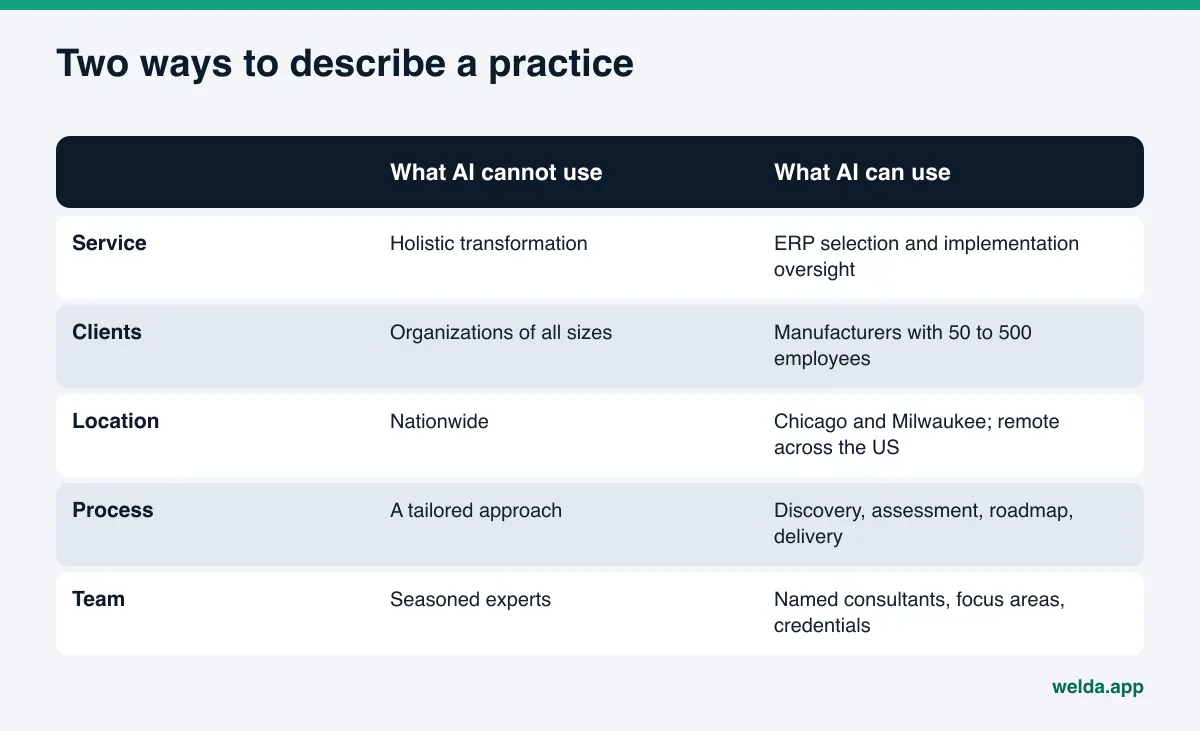
- The product is abstract. A restaurant has a menu and a hotel has rooms. A consulting firm sells expertise and a way of working, so its website fills up with phrases like "end-to-end solutions" and "unlocking value". An AI assistant cannot tell from those phrases which question your firm is the answer to.
- Buyer questions are long and specific. Nobody asks for "a consultant". They name their industry, headcount, city, the problem and often a deadline in the same prompt. A site that answers none of those conditions is not a candidate.
- Trust questions come before price. "Have they done this before", "who would actually work on our account", "what credentials do they hold". AI assistants answer those using what firms publish about themselves and what others write about them.
The fastest way to see where you stand is Welda's free website analysis. It reads your homepage and a few key pages (services, pricing, about, contact) the way Google and AI systems read them, and lists each gap separately with a fix for each one.
What do buyers ask AI when they need a consultant?
Consulting prompts carry the buyer's situation with them. The table below groups the question types a consulting website should be able to answer. The examples were written for this article; they are not survey or measurement results.
| Question type | Example prompt | Where the answer should live on your site |
|---|---|---|
| Expertise | "Consultants who help SaaS startups prepare for SOC 2" | A dedicated page for that framework or service |
| Industry and size | "Operations consultant for a 150-person food manufacturer" | Industries served and typical client size |
| Location | "ERP selection consultants in the Dallas area" | Office address, cities served, remote coverage |
| Process | "How long does a supply chain assessment usually take" | Engagement steps and typical timelines |
| Fees | "Do management consultants charge hourly or by project" | How you price and how proposals are built |
| Trust | "How to vet a cybersecurity consulting firm" | Consultant bios, credentials, client stories |
Notice that none of these questions is about your tagline. Each one asks for a specific piece of information. When an AI assistant picks firms for an answer, it leans on pages that state that information plainly.
What does AI read about a consulting firm?
AI assistants pull from several sources when they build an answer. For a consulting firm, most of these are sources you control or can at least influence.
- Your website. Practice area pages, consultant bios, process descriptions, an FAQ and structured data (schema markup). This is where you have the most say.
- Google Business Profile. Category, address, hours and reviews. It matters most when a prompt names a city or region.
- LinkedIn. Your company page and your consultants' profiles. A consultant's focus area reads as more credible when LinkedIn and your site say the same thing.
- B2B review platforms and directories. Sites like Clutch, industry association member directories and chamber of commerce listings.
- Reputation sites. The BBB and general review sites, where others write about you and you can reply.
- Bylines and media. Articles your consultants write, podcasts they appear on, conference talks with published abstracts.
The first step is making sure AI crawlers can reach your site at all. OpenAI, for example, says in its crawler documentation that OAI-SearchBot surfaces websites in ChatGPT's search features and that sites which opt out of it will not appear in ChatGPT search answers. Security plugins and old robots.txt rules on corporate sites sometimes block these bots without anyone noticing. Welda's free analysis checks this first.
A second problem is common in consulting: the firm's name is written in too many ways. The legal name runs long ("Smith Advisory Group, LLC"), the website uses a short brand name, LinkedIn shows a third version and a directory a fourth. A human reader knows these are the same firm; an AI system does not always connect them. Pick one short name, keep the legal name for legal notices, and use the same name, address and phone number everywhere. If your firm is known through a founder or senior partner, link the person and the firm in both directions: the bio names the firm and the firm page names the consultant. AI assistants sometimes answer "who is good at this" with a person rather than a company, and that answer should lead back to you.
Step by step: preparing your consulting firm for AI answers
You do not have to follow this order, but for most firms it closes the most gaps with the least effort.
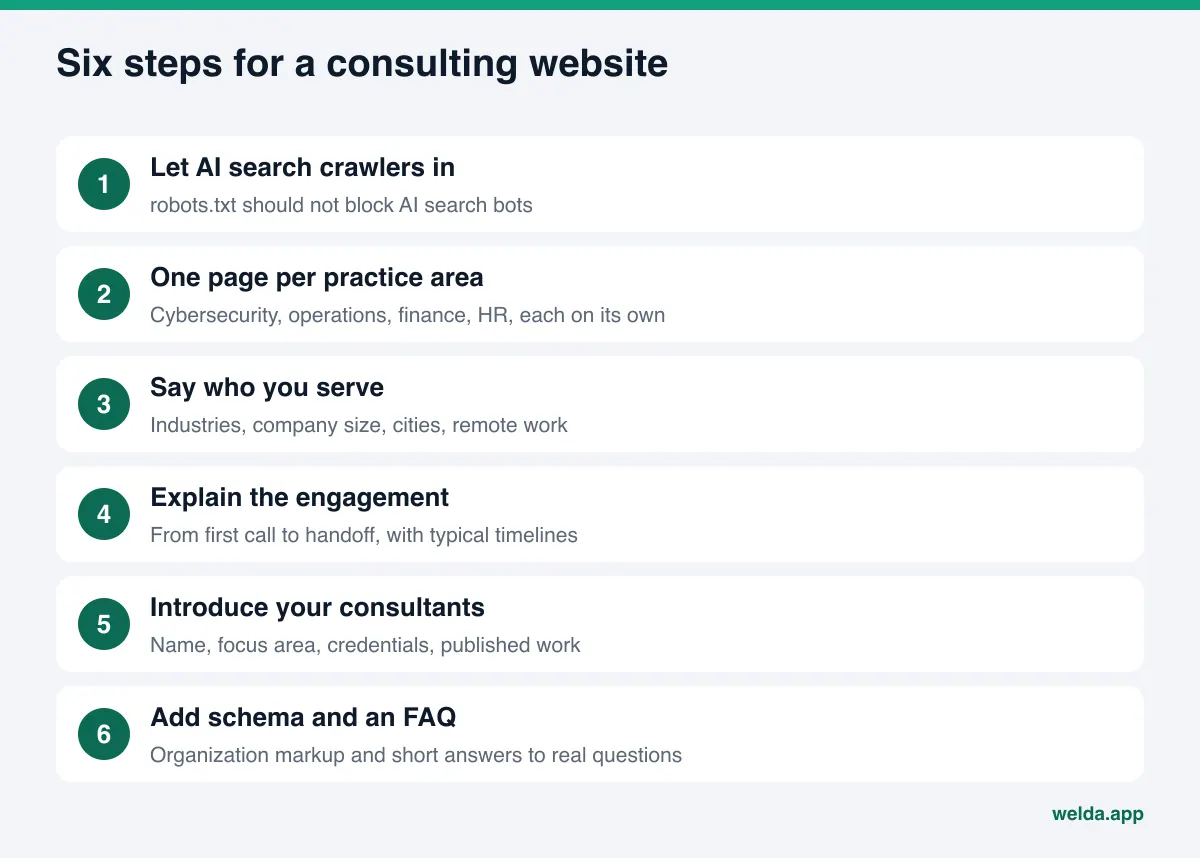
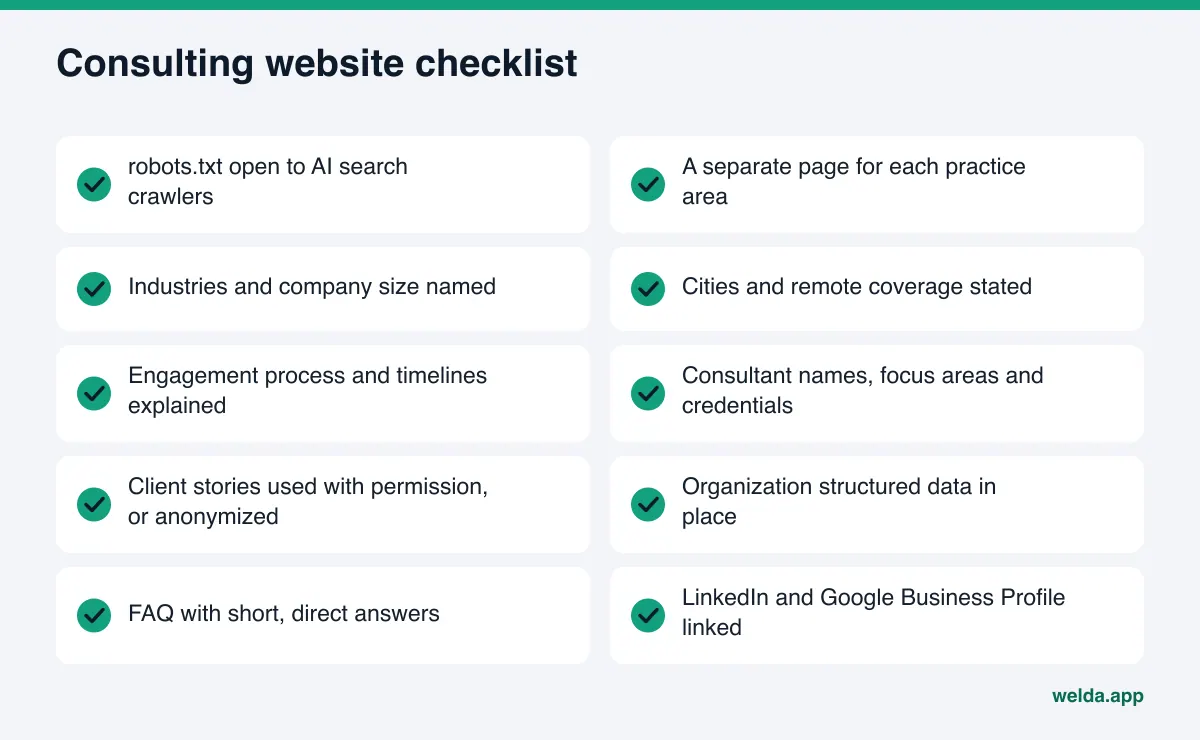
- Check robots.txt and access. Make sure AI search crawlers can reach your site. If they cannot, everything else has limited effect.
- Give each practice area its own page. Instead of one services page listing five areas in a paragraph, write a page each for cybersecurity, operations, finance, HR or whatever you actually sell. Each page should say what you do, for whom and how.
- Say who you serve. Name the industries, the typical company size (for example, "manufacturers with 50 to 500 employees") and where you work on site versus remotely. "Organizations of all sizes" tells an AI assistant nothing.
- Explain the engagement. Discovery call, assessment, roadmap, delivery, follow-up. For each stage, what you need from the client and roughly how long it takes. This answers "what is it like to work with a consultant" questions directly.
- Introduce your consultants. Name, focus area, certifications and published work for each. Keep it consistent with their LinkedIn profiles.
- Show proof without breaking confidentiality. If you cannot name clients, write anonymized summaries of real engagements: industry, size, problem, what you did. Do not invent case studies or use logos without permission.
- Add structured data and an FAQ. Mark up your firm name, address, phone, service area and linked profiles with schema. In the FAQ, answer the questions buyers really ask in two or three sentences each.
Expertise, client stories and fees: what to write on your site
Consulting firms tend to struggle with three things: making expertise concrete, showing proof while respecting confidentiality, and answering the fee question. All three show up directly in AI answers.
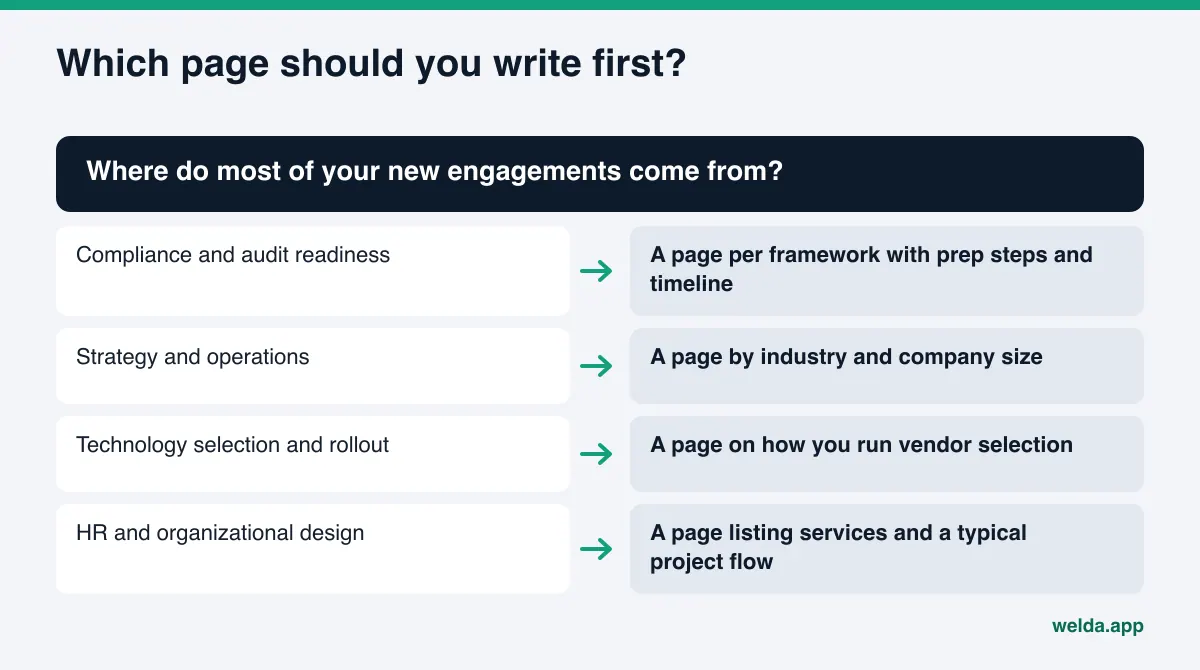
Expertise. "Strategic advisory" is not a practice area. When an AI assistant answers a question, it looks for a meaningful match between the question and a page. A heading like "Succession planning for family-owned manufacturers" is a candidate for "consultant for family business succession". A generic heading is not. Start with the area that brings in the most work.
Client stories. Many consulting engagements are covered by an NDA. That does not mean you cannot show proof. If the client agreed, name them. If not, describe the engagement in anonymized form ("a 120-person textile manufacturer in the Southeast"). What matters is that the story is real. In the US, the FTC's guidance on endorsements says that an endorsement must reflect the honest opinion of the endorser, and it expects advertisers to be careful about presenting exceptional results as typical. This is not legal advice; check your own testimonials with counsel. We cover how reviews feed into AI answers in reviews and AI recommendations.
Fees. You do not have to publish rates. But explaining how you price (project fee, monthly retainer or hourly), what a proposal is based on and whether the first call is free makes you a candidate for "how do consultants charge" questions. It also filters out mismatched inquiries.
How Welda handles AI visibility for a consulting firm
Welda is software that measures where a consulting firm appears in AI answers and prepares the fixes on the firm's behalf. Here are the three parts that matter most for consulting, in detail.
1. Measurement by practice area. In the Welda dashboard, the questions your buyers would ask are put to ChatGPT, Gemini, Perplexity and Google AI three times each. For a consulting firm, that question list is built by practice area: compliance questions, operations questions and technology questions sit in separate rows. On the questions screen you see, row by row, which engine names your firm and in what position. In consulting this split tells you a lot. A firm can be named regularly on compliance questions and never on operations questions. The table shows which practice page is weak without guesswork.
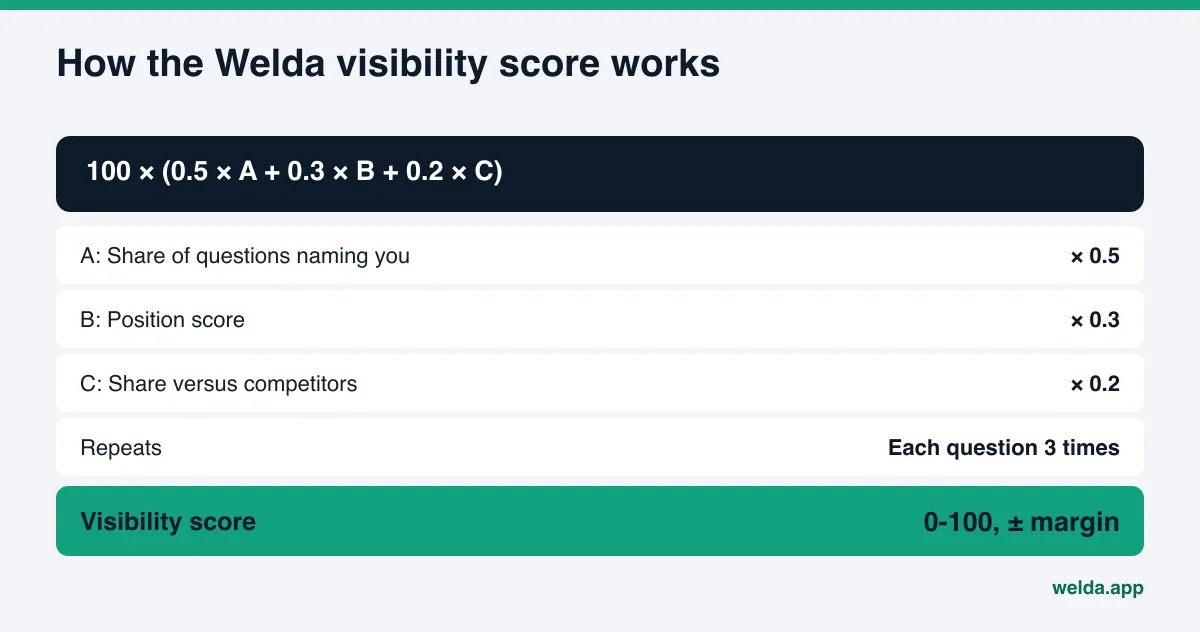
Each question is asked three times because AI answers shift from one run to the next. We explain why in why AI answers change every time. The score uses a public formula: the share of questions that name you carries a weight of 50 percent, your position 30 percent and your share against competitors 20 percent. The spread across the three runs becomes the margin of error shown next to the score. For how to read the number, see what is a good AI visibility score.
2. Source view. In consulting questions, AI assistants often rely on sources beyond the firm's own site: B2B review platforms, association directories, LinkedIn, trade publications. The sources screen shows which sites the AI cites for your questions and whether your firm is listed there. If you see that answers about technology selection lean on one directory where your profile is incomplete, the next task is obvious. We explain the method in citation gap analysis.
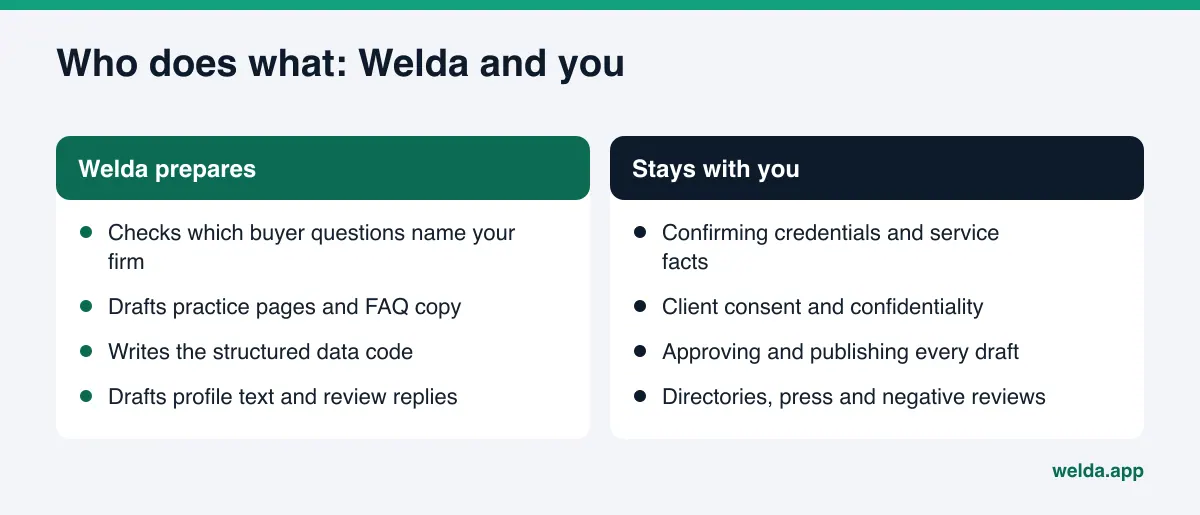
3. It asks what it does not know and drafts the rest. At the top of the to-do list sit the facts Welda could not find on your site. For a consulting firm, that might be your consultants' certifications, the cities where you work on site, which clients you may name, or whether the first call is free. Welda does not guess. It asks, you answer once, and the answers flow into the drafts: practice page copy, FAQ entries, structured data code, Google Business Profile text and review replies. The ready text sits next to each task.
If your site runs on WordPress, Welda connects through a separate Editor user and an application password, with no code to install. Drafts open on your site as drafts and go live only when you approve them. On other platforms, Welda gives you a ready package and you or your web person apply it. Google Business Profile, Instagram and Facebook can be connected; tasks on profiles that are not connected are listed as manual tasks. Content always lives on your own site. A compliance check flags patterns such as guarantees, superiority claims and pricing statements before anything is published; it is not legal advice.
Where Welda stands today: the dashboard is in early access and is opening first in Turkey. Regular four-engine measurement is being added during early access, and the dashboard screens shown in our materials use representative data. The part anyone can use today is the free website analysis, and it works in English. Besides reading your site, it asks an AI assistant with web search 5 questions a buyer might ask and checks whether your firm's name comes up. That is a one-time check, not ongoing tracking. Pricing is discussed in the early access conversation.
Example scenario: visible for compliance, missing for operations
The following is an example, not a real firm or measurement. Picture a twelve-person consulting firm in the Midwest. For years it has done compliance and audit readiness work. The growing part of its business is operations consulting for manufacturers.
The firm runs the free analysis first. The report shows that services are listed as bullet points on one page, operations consulting has no page of its own, the main heading is a slogan ("Your partner in performance"), structured data is missing and there is no FAQ. The simulation shows that adding structured data and splitting services onto separate pages would move the score most. The competitor comparison shows that a firm in the same region describes its operations engagements step by step.
Suppose the firm later gets early access. Its question list then covers operations prompts as well as compliance ones: "operations consultant for a mid-size manufacturer in Ohio", "lean manufacturing consultants near Indianapolis". The questions screen makes the picture clear: on compliance prompts the firm is named by some engines, on operations prompts by none. The sources screen shows that operations answers lean on a B2B review platform and a trade association directory.
On the to-do list, Welda asks three things: which operations services the firm actually offers, what data it asks a client for in the assessment phase, and whether the discovery call is free. The firm answers. Welda drafts the operations practice page, an FAQ for that area and the structured data code. The site runs on WordPress, so the drafts open there; a partner edits two sentences and publishes. The incomplete directory profile sits on the manual task list with ready description text.
After that, it is a matter of waiting. New content usually takes weeks to show up in AI answers. The before and after comparison and the one-page monthly report let the firm follow the change on operations questions. Nothing is guaranteed; the point of measuring is to see what worked and what did not.
Limits: what Welda does not do
A consulting firm sells trust, so it should know what a tool will not do. For Welda, these are clear:
- No guarantees. Welda does not guarantee rankings or a spot in ChatGPT. AI answers vary, which is why measurement is repeated and shown with a margin of error.
- No guessing. Welda does not invent a consultant's credentials, an engagement outcome or a client name. Missing facts are asked of you.
- No fake proof. Welda does not produce fake reviews, fake testimonials or made-up case studies. It drafts replies to real reviews.
- No publishing without approval. Sensitive content does not go live without your sign-off; the publishing decision is always yours.
- Some work stays with you. Handling negative reviews, directory and association memberships, press work and updating consultants' LinkedIn profiles are the firm's job. Welda can suggest copy, but it does not run those accounts for you.
- No legal opinions. The compliance check flags risky patterns. It is not legal advice and has not been reviewed by counsel.
Checklist for choosing AI visibility software for consulting firms
When you evaluate Welda or any other tool, ask these questions. Each one maps to something specific about consulting work.
| Question | Why it matters |
|---|---|
| Can I group questions by practice area? | Visibility in consulting varies by area; one total score is not enough. |
| Does it measure several engines, with repeats? | A single answer can mislead; you need repeats and a margin of error. |
| Is the scoring formula public? | You cannot interpret a number if you do not know what it measures. |
| Does it show which sources competitors win from? | Directories and review platforms can decide consulting answers. |
| Does it ask for missing facts or make them up? | One wrong sentence about a credential damages trust. |
| Do I keep publishing approval? | Clients under NDA require control over every word. |
| Does content stay on my own site? | If you stop using the tool, the content should stay with you. |
Here is a short checklist for the website itself. If you already have older practice pages, updating them is often enough; we describe the approach in update old content for AI search.
Frequently asked questions
Do AI assistants really recommend consulting firms?
Yes. Business owners ask AI assistants for consultants and advisors, and the answers name firms. Which firms get named depends heavily on how clearly each one describes its expertise.
We cannot name clients. What should we do?
Write anonymized summaries of real engagements: industry, company size, problem and what you did. Name clients only with their permission. Do not invent case studies or use logos without consent.
Do we need to publish our rates?
No. But explaining how you price, what a proposal is based on and whether the first call is free helps you show up in fee-related questions.
Is our LinkedIn company page enough?
LinkedIn is an important source, but not the only one. The detail on practice areas, process and common questions belongs on your website, and both places should say the same thing.
What does the free analysis show?
It reads your site, gives a technical and a content score out of 100, describes each gap and how to fix it, and suggests ready copy for your homepage. The results link arrives by email and stays open for 14 days. It is free once per site.
When will we see results?
New content usually takes weeks to show up in AI answers. In the Welda dashboard, the before and after comparison and the monthly report let you follow the change. There is no guarantee of results.
More and more buyers pick the consulting firm they call first during an AI chat. The first step is seeing how your site reads today. Run the free website analysis to get a list of gaps and ready copy suggestions for your homepage.