Why doesn't ChatGPT or Gemini recommend my sushi restaurant, and what does AI search optimization for sushi restaurants actually involve? When an answer engine recommends a sushi spot, it looks for clear, consistent facts on your website, your Google Business Profile, Yelp and the reviews people leave. If your menu is a photo, or it's unclear whether you're a sushi bar, a Japanese restaurant or a fusion place, you either don't get named or you get described wrong. AI search optimization for sushi restaurants means finding those gaps, fixing them in the right order and checking whether answers change. This guide walks through the work and shows which parts Welda handles for you.
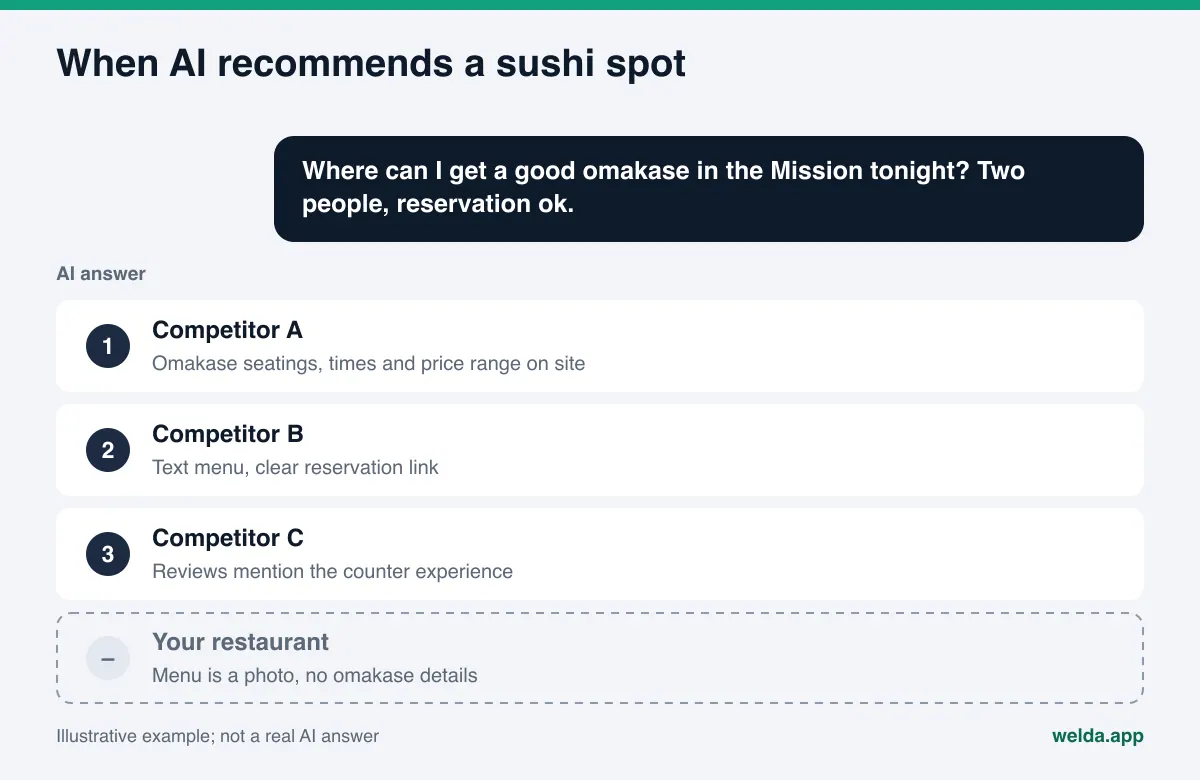
What is AI search optimization for sushi restaurants?
In the US the practice is usually called AEO, short for answer engine optimization. You'll also hear "AI search visibility," "AI visibility" and occasionally GEO (generative engine optimization), which means the same thing. The idea is simple: when someone asks ChatGPT, Gemini, Perplexity or Google's AI Overviews and AI Mode for a restaurant, does your name come up, and is what they say about you accurate?
Classic search gave diners a page of ten links to compare. An AI answer usually gives three or four names, each with a sentence of reasoning. If you're not in that short list, the diner decides without ever seeing you. Being on page one of Google doesn't automatically carry over, a gap we cover in why you can rank first on Google but not show up in ChatGPT.
Sushi makes this shift sharper than most cuisines. Price ranges are wide, and the experiences differ a lot: an eight-seat omakase counter and a takeout-heavy sushi kitchen are not answers to the same question. Diners know this, so they ask detailed questions. Is there an omakase tonight? Is there something for a friend who doesn't eat raw fish? Do they have gluten-free soy sauce? Do I need a reservation for two on a Friday? An answer engine can only answer those questions about you if you've written the answers down somewhere it can read.
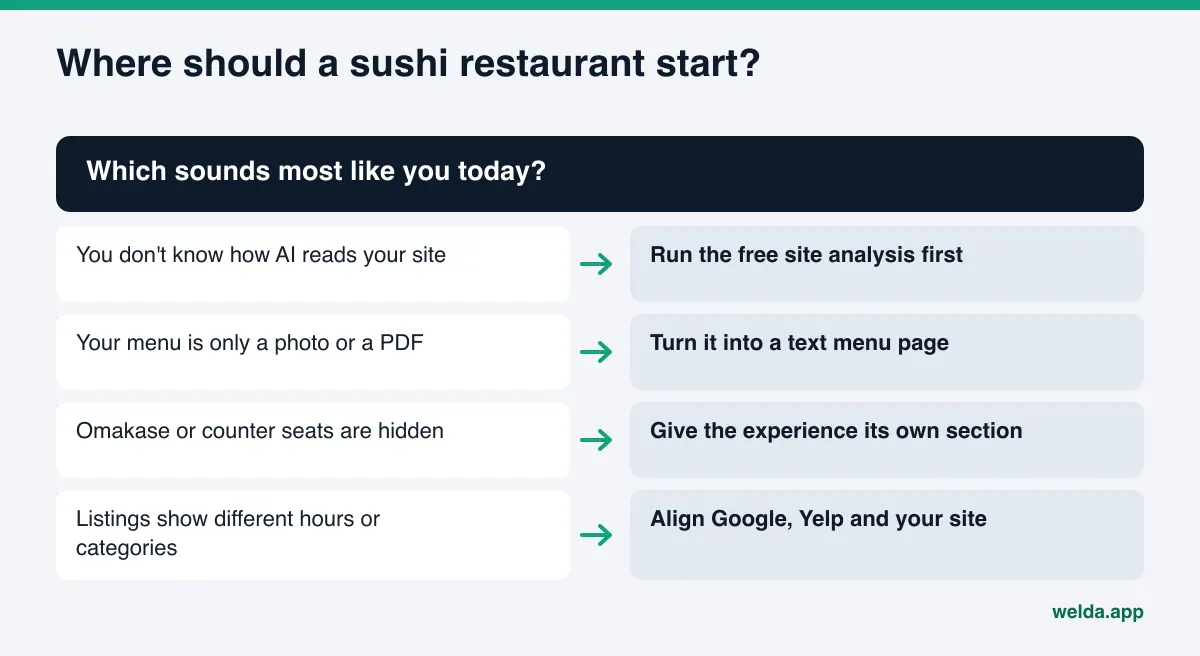
The work has three parts. Measure: which diner questions mention you, in what position, and where competitors win. Diagnose: why the engine skipped you and which gap on your site or listings caused it. Fix: write the missing menu copy, FAQ answers, structured data and profile text, then publish with your approval. If you want to see where your site stands before reading further, Welda's free site analysis reads your home page and key inner pages the way Google and AI assistants do and lists the gaps one by one.
What do diners ask AI about sushi restaurants?
Diner questions about sushi tend to combine a place, a moment and a constraint. The examples below are illustrative, not measured data, but they follow the patterns you'll recognize from your own guests:
- "Best omakase in the Mission under $150 a person?"
- "Sushi place near Midtown for a quiet business lunch?"
- "Where can I take someone who doesn't eat raw fish for sushi?"
- "Sushi delivery open late near me tonight?"
- "Sushi restaurant with gluten-free soy sauce in Austin?"
- "Kid-friendly sushi spot with a conveyor belt?"
Each question type pulls on different information. The table below maps the question to what the engine needs and where that fact should live.
| Question type | What the engine looks for | Where it should live |
|---|---|---|
| Neighborhood plus cuisine | Address, neighborhood name, cuisine type | Home page, contact page, Google Business Profile, schema |
| Experience ("omakase," "counter") | Seatings, days, party size, booking rules, length | A dedicated omakase section, FAQ |
| Constraint ("no raw fish," "gluten-free") | Cooked and vegetarian rolls, tamari, allergen notes | Text menu, FAQ |
| Timing ("tonight," "late," "delivery") | Hours, takeout and delivery windows | Google Business Profile, site, schema hours |
| Budget ("under $150," "business lunch") | Price range, lunch menu, prices in text | Text menu, schema priceRange |
| Trust ("fresh," "clean," "worth it") | Reviews, your replies, consistent facts | Yelp, Google reviews, Tripadvisor, your replies |
The last row matters most for sushi. Trust is what diners care about with raw fish, and engines weigh what others say about you more than what you say about yourself. Your review replies and your listings matter as much as your homepage. For location-driven questions specifically, see how "near me" searches work in AI answers.
How do answer engines evaluate a sushi restaurant?
Answer engines don't rely on a single source. They run web searches, read several pages, compare what they find and favor businesses whose facts line up. For sushi restaurants, five signals stand out.
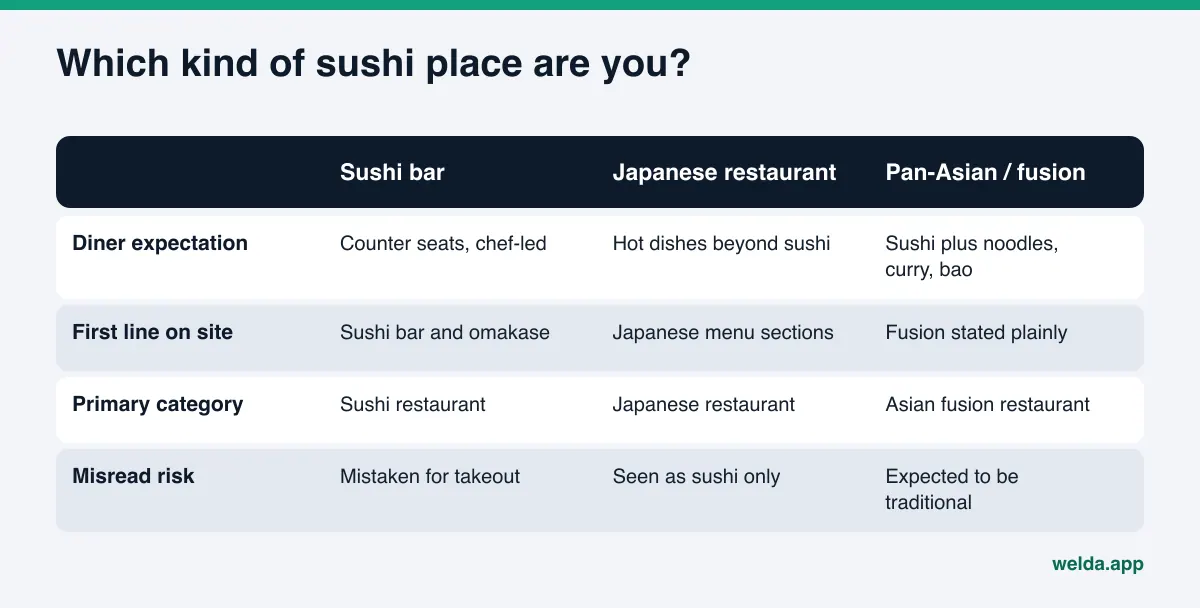
Clear positioning. "Sushi," "Japanese," "Asian fusion" and "pan-Asian" are related but not interchangeable. If your site says Japanese, your Google Business Profile says Asian and Yelp lists you as a sushi bar, the engine can't tell which is right. When it's unsure, it tends to recommend the competitor it is sure about. Pick one primary description and repeat it, word for word, everywhere.
A readable menu. Many sushi restaurants publish beautiful menu photos or a designed PDF. Guests like that. Answer engines either can't read text inside a photo or can't read it reliably. If the answer to "which rolls have cooked salmon" lives inside an image, the engine can't get it from you.
Experience details. Omakase, counter seating, chef's choice and tasting menus drive the highest-intent questions. If you offer them, describe them plainly. If you don't, saying "we don't offer omakase; we serve an à la carte menu" prevents a bad match and a disappointed guest.
Constraints and allergens. Sushi involves fish, shellfish, sesame, soy and often gluten. A restaurant that states these clearly is a safer recommendation for "is this OK for someone with a shellfish allergy." There's also a regulatory angle: many state and local health codes, based on the FDA Food Code, require a consumer advisory on menus for raw or undercooked animal foods, as Oregon's consumer advisory fact sheet explains for that state. Rules vary by jurisdiction, so check with your local health department; this isn't legal advice. If that advisory already sits on your printed menu, make sure the text menu on your website carries it too.
Consistent practical facts. Hours, address, phone, reservation link and delivery windows should match across your site, Google Business Profile, Yelp and Tripadvisor. If one says you close at 11 p.m. and another says 10 p.m., recommending you for "sushi open late tonight" becomes a risk the engine may not take.
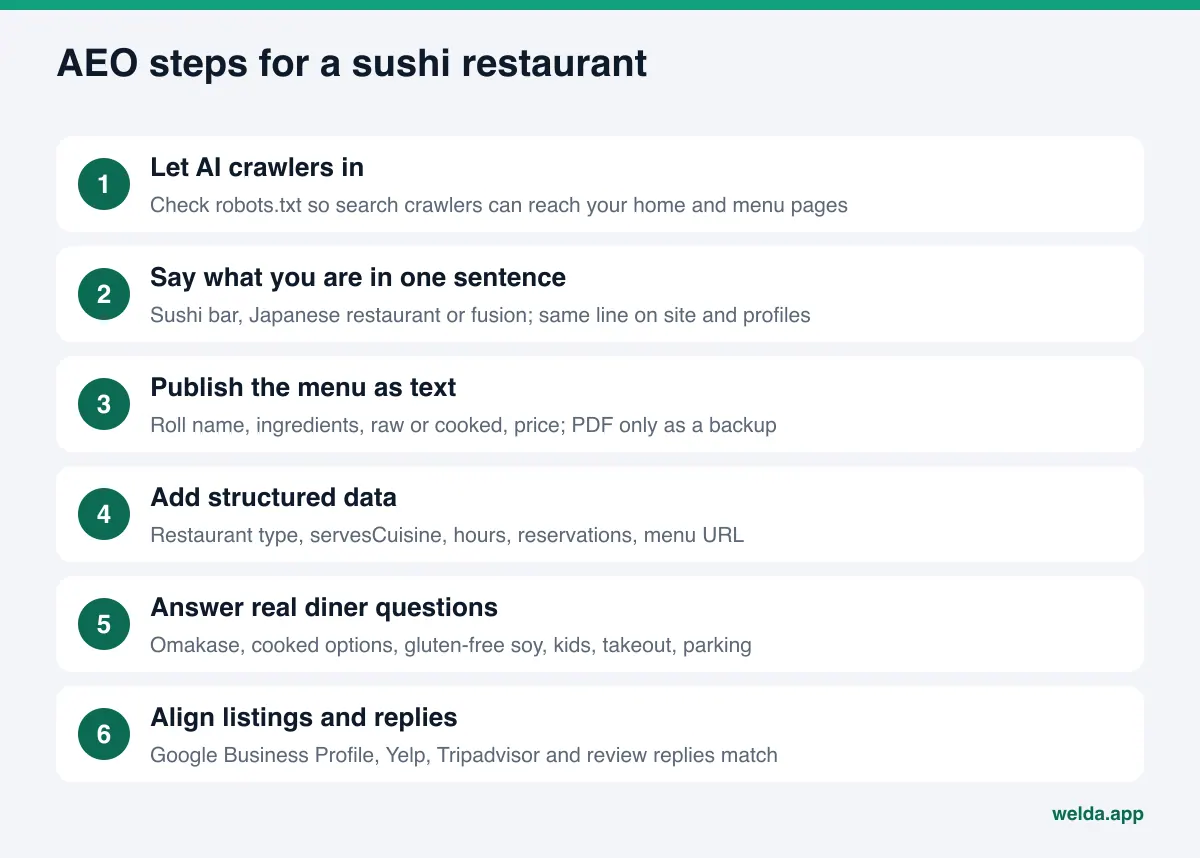
AI search optimization for sushi restaurants, step by step
This sequence aims for the most effect with the least effort. The first two steps are technical; the rest are content and consistency.
- Make sure AI crawlers can reach your site. If robots.txt blocks search crawlers, nothing else you do will matter. OpenAI, for example, says in its crawler documentation that sites which opt out of OAI-SearchBot won't be shown in ChatGPT search answers. Confirm your menu page is reachable too, not just the home page.
- State what you are in one sentence. Something like "A 10-seat sushi bar in the Mission serving omakase and à la carte nigiri." Put it in the first paragraph of your home page and in your Google Business Profile description.
- Publish your menu as text. For every roll, nigiri and sashimi: the name, main ingredients, raw or cooked, and price. Keep photos and the PDF as extras.
- Describe the experience separately. If you have omakase, give it its own section: days, seatings, party size, approximate length, deposit or cancellation rules. If you don't, say so.
- Add structured data. Use schema markup so restaurant type, cuisine, hours, address, reservations and menu URL are machine-readable.
- Write an FAQ from real guest questions. Cooked options, gluten-free soy, kids, takeout, parking, large parties. Short, direct answers that an engine can quote.
- Align your listings. Category, description, hours and menu link on Google Business Profile, Yelp and Tripadvisor should match your site.
- Reply to reviews consistently. In replies, naturally restate what you are: the omakase counter, the lunch sets, the late delivery. It reinforces the description engines see.
Most of these aren't one-week jobs, and order matters. Fixing the menu on a site crawlers can't reach does nothing, and an FAQ is half-finished if the menu is still an image. New content also takes weeks, not days, to show up in AI answers. We cover realistic timelines in how long AEO takes.
Making a sushi menu readable for answer engines
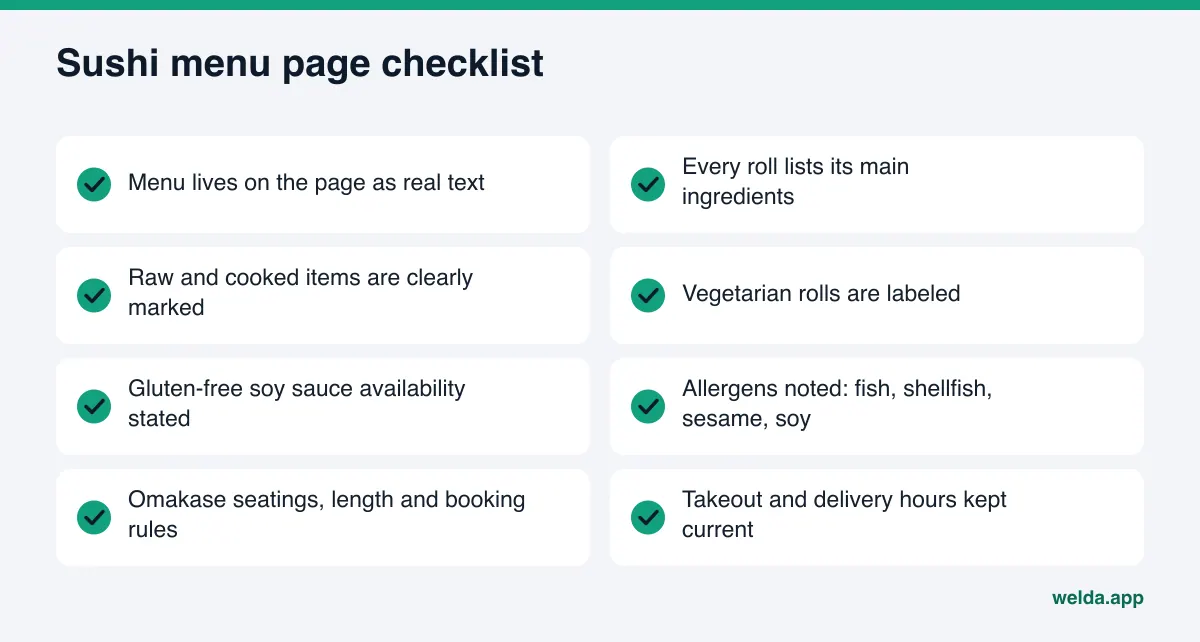
The menu page is where AI search optimization for sushi restaurants takes the most effort and pays back the most. It's where questions like "anything for someone who doesn't eat raw fish," "vegetarian rolls," and "what's the signature roll" get answered.
A strong sushi menu page lists, in real text, for each item: the name, a short ingredient line ("salmon, avocado, cucumber, sesame"), raw or cooked, a vegetarian mark where it applies, and the price. Sections follow how diners think: nigiri, sashimi, maki, specialty rolls, hot dishes, desserts. Omakase or a tasting menu gets its own heading with its conditions.
Alongside the visible menu, add structured data. The schema.org Restaurant type supports servesCuisine for cuisine, hasMenu for the menu, acceptsReservations for booking, priceRange for price level and openingHoursSpecification for hours. Keep these in sync with the visible text. If the markup says "Japanese" and the page says "fusion," you've recreated the inconsistency you were trying to remove.
A common trap: the menu only stays current on a delivery app. The app menu changes, the website menu doesn't, and engines see two different menus. Treat your own site as the source of truth and update everything else from it, including prices.
Which sources shape AI answers about sushi restaurants?
For US restaurants, the sources that tend to feed AI answers include Google Business Profile and Google Maps reviews, Yelp, Tripadvisor, local food media and "best sushi in..." roundups, Reddit threads in city subreddits, reservation platforms, and your own website. You won't control most of them, but you can influence how accurate they are.
Each source calls for a different action. On Google Business Profile you control category, description, hours, attributes and menu link. On Yelp and Tripadvisor you control your business details and your replies, not the reviews. On roundup articles you can check facts and request corrections when something is wrong, such as a closed location or an old price range. On Reddit, the honest move is a signed, transparent reply when it's genuinely useful.
One thing to never do is manufacture reviews. The FTC announced a final rule banning fake reviews and testimonials in August 2024, including AI-generated ones. Beyond the legal risk, a cluster of suspicious reviews undermines the trust signals you're trying to build. If an engine is already saying something wrong about you, such as a closed location still listed or an omakase you stopped offering, the cause is usually an old or conflicting source. We walk through that case in what to do when ChatGPT has wrong information about your business.
How Welda handles AI search optimization for sushi restaurants
First, an honest status check. The part anyone can use today is the free site analysis, and it works in English. The Welda panel is in early access and opening gradually, starting with businesses in Turkey. Regular four-engine measurement is being added during early access, and panel screens shown in examples use representative data. Pricing is discussed in the early access conversation.
What the free analysis shows a sushi restaurant. It reads your home page plus pages like menu, about and contact. For sushi restaurants, the findings that come up most often are a menu that can't be read as text, missing or incomplete restaurant structured data, a main heading that's just the restaurant name, no FAQ section, and a Google Maps profile that isn't linked from the site. Each finding explains what was seen, why it matters and how to fix it. You get ready-to-use suggestions for your page title, description, main heading, intro paragraph and FAQ, plus a simulation showing which fixes move your score the most, so you can decide what to do first. The analysis also asks five likely customer questions to an AI assistant with web search and shows whether your name appears in the answers. That's a one-time snapshot, not ongoing tracking. The result link arrives by email and stays open for 14 days.
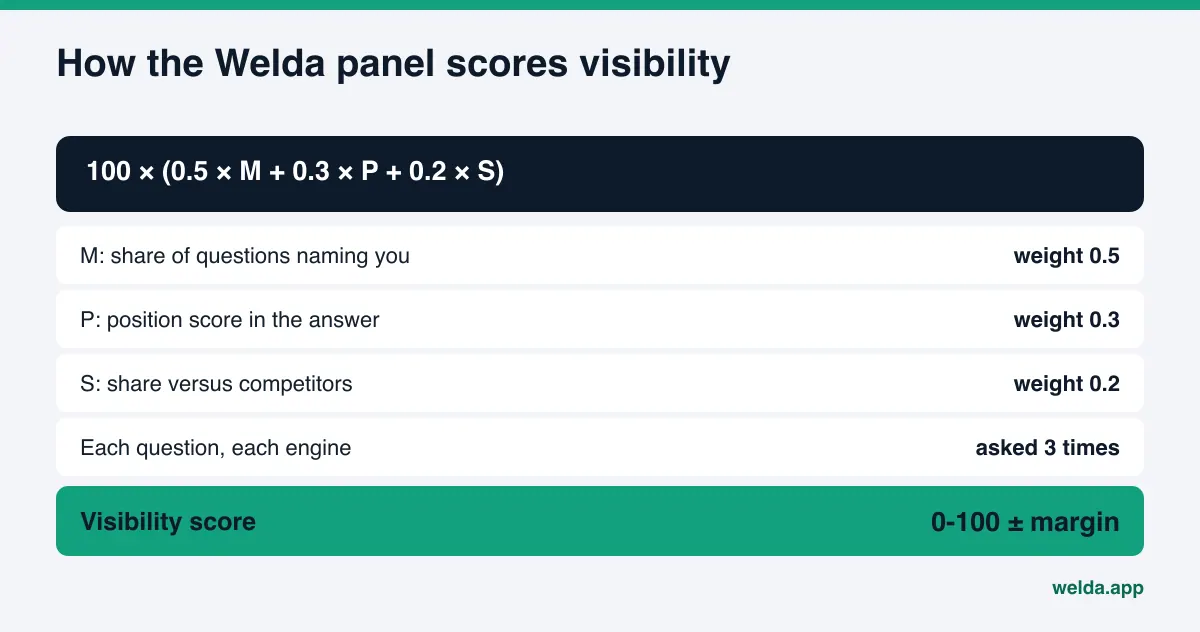
Question-by-question tracking in the panel. In the early access panel, diner questions are asked to ChatGPT, Gemini, Perplexity and Google AI three times each. For a sushi restaurant, those questions group by intent: omakase, takeout, no raw fish, business lunch. You see, for each question and engine, whether you were named and in what position. If you show up for takeout questions but never for omakase, you know the gap is how you describe the experience, not the menu page. The choice of what to do about it stays with you.
Drafts, approval and where content lives. The to-do list holds ready-made copy for each task: menu descriptions, FAQ answers, profile text and replies to real reviews. Welda doesn't invent facts. If it doesn't know your omakase party size or whether you stock tamari, it asks. On WordPress sites, Welda connects through a separate Editor user and an application password, with no code to install; drafts open on your site and go live only when you approve. Other systems get a ready-made package to apply by hand. Content always lives on your own site.
Limits: what Welda doesn't do
Restaurant marketing invites big promises. Here is what Welda won't promise or do.
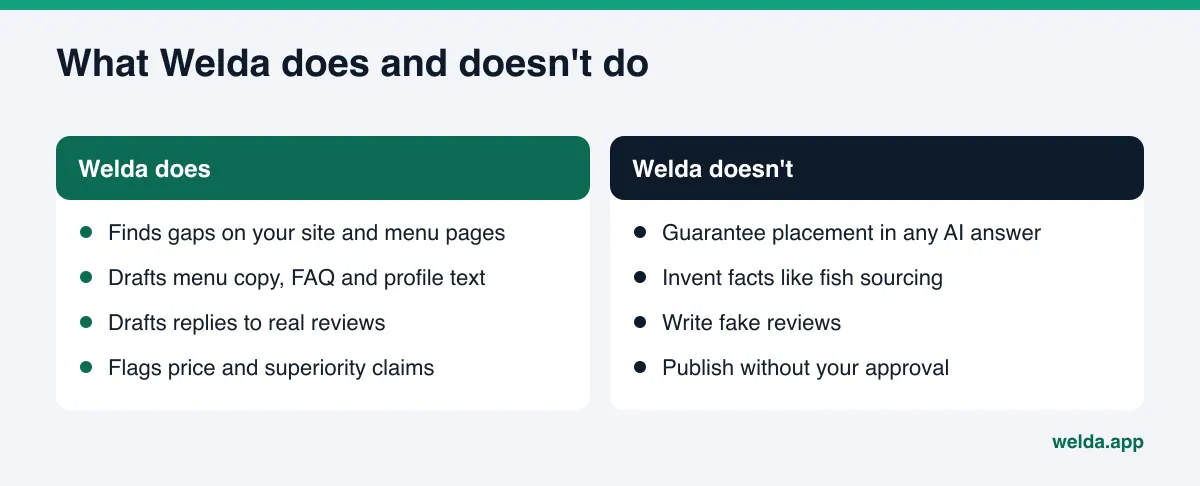
- No placement guarantee. Welda doesn't guarantee you'll appear in ChatGPT or any other engine. No one can; the answer is the engine's decision.
- No invented facts. "Fish flown in daily" gets written only if it's true and you've confirmed it.
- No fake reviews. Welda drafts replies to real reviews and never writes reviews.
- No publishing without approval. Price claims and superiority claims are flagged before anything goes live. That check isn't legal advice.
- Some work stays with you. Handling negative reviews, managing directory accounts and press outreach remain the restaurant's job.
- It takes time. New content usually takes weeks to show up in AI answers.
Sushi restaurant AEO checklist
Run this against your own site today. Every "no" is a task.
| Check | Why it matters | How to tell |
|---|---|---|
| Does the home page say what you are in one sentence? | Engines match you to the right questions | Read the first paragraph: are "sushi" and your neighborhood there? |
| Is the menu real text? | Constraint and ingredient questions come from here | Can you select and copy a word from it? |
| Are omakase or counter details explicit? | High-intent questions depend on it | Does a site search for "omakase" return anything? |
| Is there restaurant structured data? | Hours, cuisine and reservations become machine-readable | The free analysis checks this for you |
| Do hours match everywhere? | Trust for "open tonight" questions | Compare site, Google, Yelp and Tripadvisor |
| Is there an FAQ section? | Short, quotable answers | At least five real questions with short answers |
| Do you reply to reviews? | Trust and consistent positioning | Count how many recent reviews have your reply |
If seafood beyond sushi is a big part of your menu, AEO for seafood restaurants covers freshness claims and sourcing language in more depth.
Frequently asked questions
Is AI search optimization for sushi restaurants different from SEO?
The foundation overlaps: crawlable pages, readable text, correct business details. The difference is the goal. Instead of ranking on a results page, you're trying to be named in a short AI answer, which makes clear menu, experience and constraint details more decisive.
Our menu is already on Instagram and a delivery app. Isn't that enough?
Those sources get read too, but your website is the one place you fully control and can keep current. A text menu on your site reduces conflicts between sources.
We don't offer omakase. Should we say so?
Yes. A plain "we serve à la carte only" stops engines from recommending you for the wrong question and keeps guests from showing up disappointed.
What does the free site analysis show for a sushi restaurant?
A score out of 100, the gaps on your home page and key pages with how to fix each one, ready-to-use copy suggestions, a competitor comparison, a fix package including structured data, and a one-time five-question AI test. It's free once per site.
Can US restaurants use the Welda panel now?
The panel is in early access and opening first in Turkey. The free site analysis works in English today, and you can request early access.
How soon will we see a change?
There's no fixed timeline. Technical fixes are quick, but new content usually takes weeks to appear in AI answers. Measuring before and after is the honest way to see what changed.
See where your sushi restaurant stands today
AI search optimization for sushi restaurants isn't a big campaign. It's steady, specific work: a readable menu, one clear description, and the same facts everywhere diners and engines look. The first step is knowing how your site reads right now. Run the free site analysis, review the gap list and copy suggestions, then decide what to fix first.