What does AEO for baby product brands involve? Parents now ask ChatGPT, Gemini, Perplexity and Google's AI Overviews which stroller fits in a small trunk or which bottle to try for a gassy newborn. AEO for baby product brands is the work of getting named in those answers: writing age ranges, weight limits, materials, safety certifications, returns and shipping as plain text on your own site, and keeping that story consistent everywhere else parents look. This guide walks through the steps and shows which parts Welda takes on.
Why AEO for baby product brands is its own problem
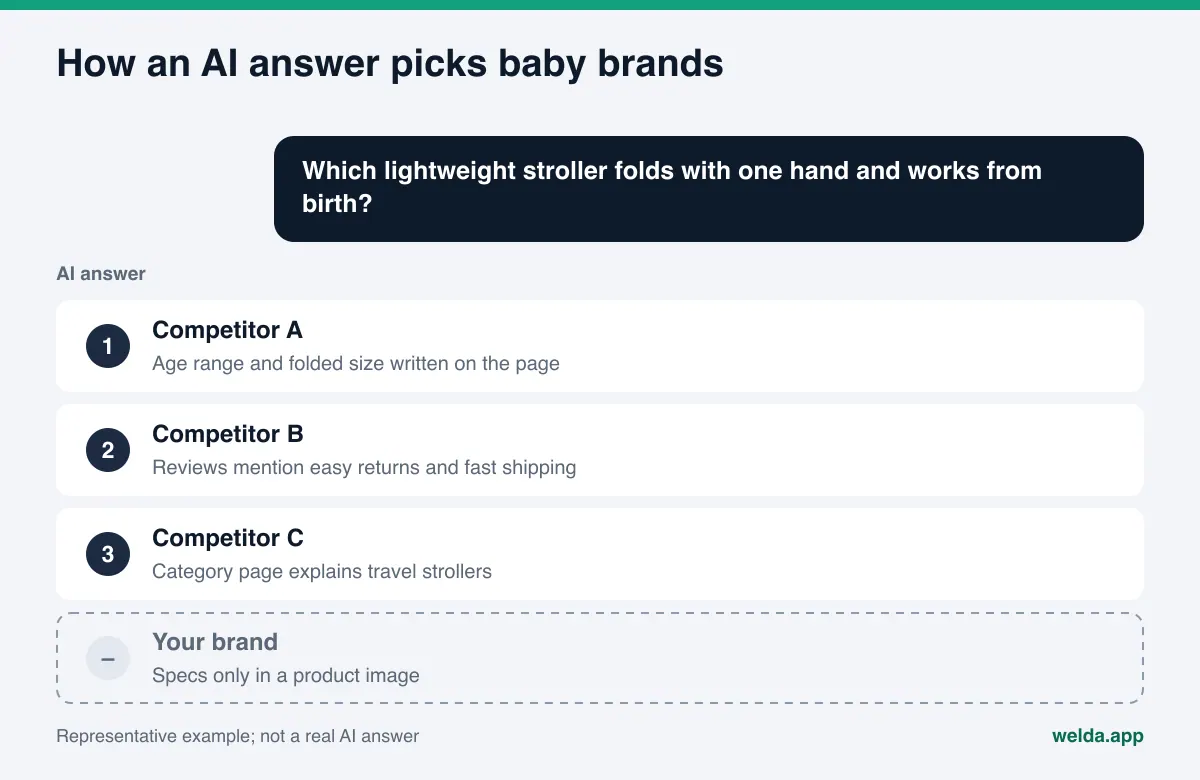
AEO (answer engine optimization) means getting your brand mentioned in the answers AI assistants give. You will also hear it called AI search visibility, or GEO (generative engine optimization); they describe the same goal, and we use AEO here. In classic search a parent scrolls a page of links and shopping results. In an AI answer, the assistant usually names three to five brands or stores with a line about each. If you are not on that short list, that parent may never reach your site.
Baby products feel this more than most categories, for three reasons.
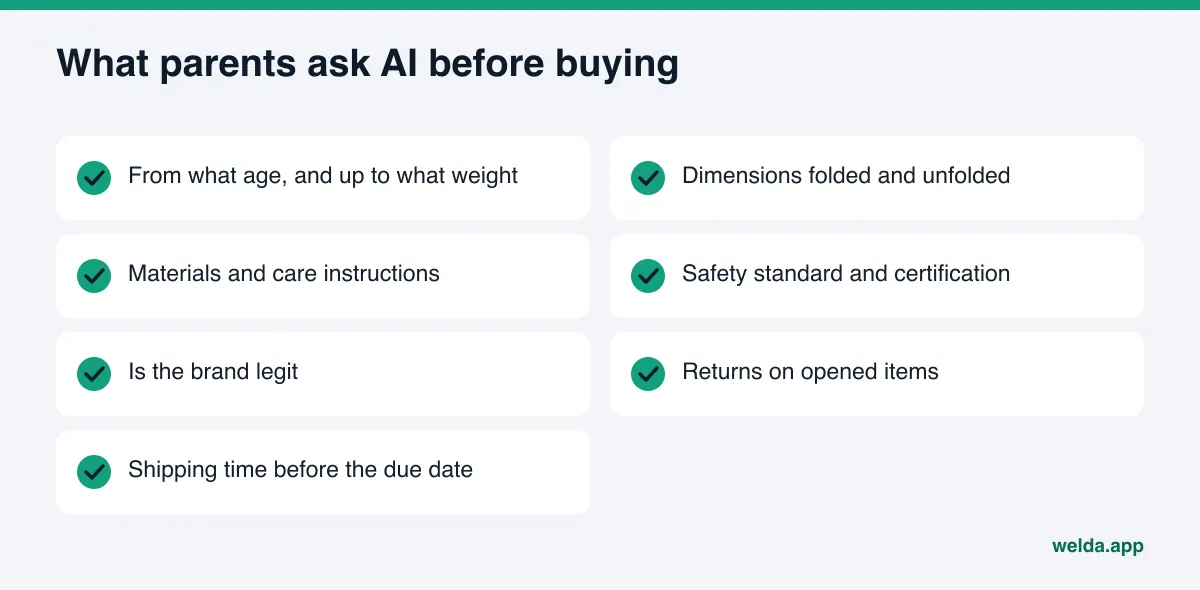
First, the questions are specific. Nobody asks an assistant for "a stroller". They ask for "a lightweight stroller that folds with one hand and works from birth", "a convertible car seat that fits three across in a midsize SUV", or "an organic cotton sleep sack for a baby who runs hot". To answer, the assistant looks for brands that have written the age range, the dimensions, the weight limit and the material down somewhere it can read. A brand that keeps those details in a spec image or a PDF manual gets skipped.
Second, trust carries more weight. A first-time parent is careful, and asks careful questions: "is this brand legit", "has this product been recalled", "will they take back an opened bottle set". The assistant builds its answer from reviews, Reddit threads, registry guides and complaint sites. If your own site does not answer those questions plainly, other people's posts answer them for you.
Third, the catalog is wide. A single baby brand or store can sell sleep, feeding, travel, bath and nursery products, and each category has its own question pattern. Fixing everything at once does not work. You start with the categories parents ask about most.
The fastest way to see where you stand is to measure. Welda's free site analysis reads your homepage and a few core pages the way Google and AI assistants do and lists every gap it finds. It runs in English. If you also sell kids' apparel, our guide to AEO for fashion brands covers the overlapping ground.
What do parents ask AI about baby products?
Parent questions fall into five broad groups. The examples below were written for this guide to show the shape of the questions; they are not taken from a study.
- Age and stage: "best high chair for a 6-month-old", "which bottle nipple size for a newborn", "when do babies outgrow an infant car seat".
- Safety and materials: "BPA-free bottles made of glass", "non-toxic wooden teething toys", "flame-retardant-free crib mattress".
- Comparisons: "travel system or separate infant seat", "glass or silicone baby bottles", "bassinet or bedside sleeper".
- Trust and seller questions: "is this baby brand legit", "where to buy a stroller with a good return policy", "does this brand have recalls".
- Registry and timing: "what to put on a baby registry for a small apartment", "car seat that ships in two days, due date next week".
Every one of these questions is answered by something written down. "From birth to 22 lb", "glass, 4 oz, slow-flow nipple", "returns accepted on unopened items within 30 days" are sentences an assistant can repeat. "The safest choice for your little one" and "premium quality" are not. Values here are examples; your own come from your manufacturer documents.
Where does AI get its information about your baby brand?
AI assistants read several sources side by side and look for agreement between them. Some of those sources are fully yours. On others, the best you can do is reply.
| Source | What AI finds there | Who controls it |
|---|---|---|
| Your website | Product facts, age ranges, certifications, returns, shipping, contact | You |
| Instagram, Pinterest, YouTube | Product range, how products are used, proof the brand is active | You |
| Google Business Profile | Address, hours and reviews if you have a physical store | You; reviews are customers' |
| Amazon and other retailers | Ratings, reviews, product Q&A | Partly you |
| Reddit, parenting forums, BBB, Trustpilot | Shipping, returns, quality and customer service stories | Parents; replies are yours |
| Registry guides and best-of lists | Comparisons and recommendations | The publisher |
The first two rows are where you move fastest. If your site does not spell out your return policy or the certification behind a safety claim, the assistant fills the gap from forum threads. You cannot rewrite those threads, but you can give the assistant a clear, checkable answer from the source that matters most.
There is also a technical layer. If AI crawlers cannot reach your site, nothing else matters. OpenAI explains that sites need to allow its OAI-SearchBot crawler to appear in ChatGPT search answers. robots.txt files sometimes change through platform settings, apps or security tools, so it is worth checking now and then. Google, for its part, says its AI Overviews and AI Mode need no special markup beyond the usual search basics.
AEO for baby product brands, step by step
These steps fit most baby brands and stores, whether you sell direct-to-consumer, through retailers, or both. The order matters: the first steps close the most common gaps and usually take a day or two.
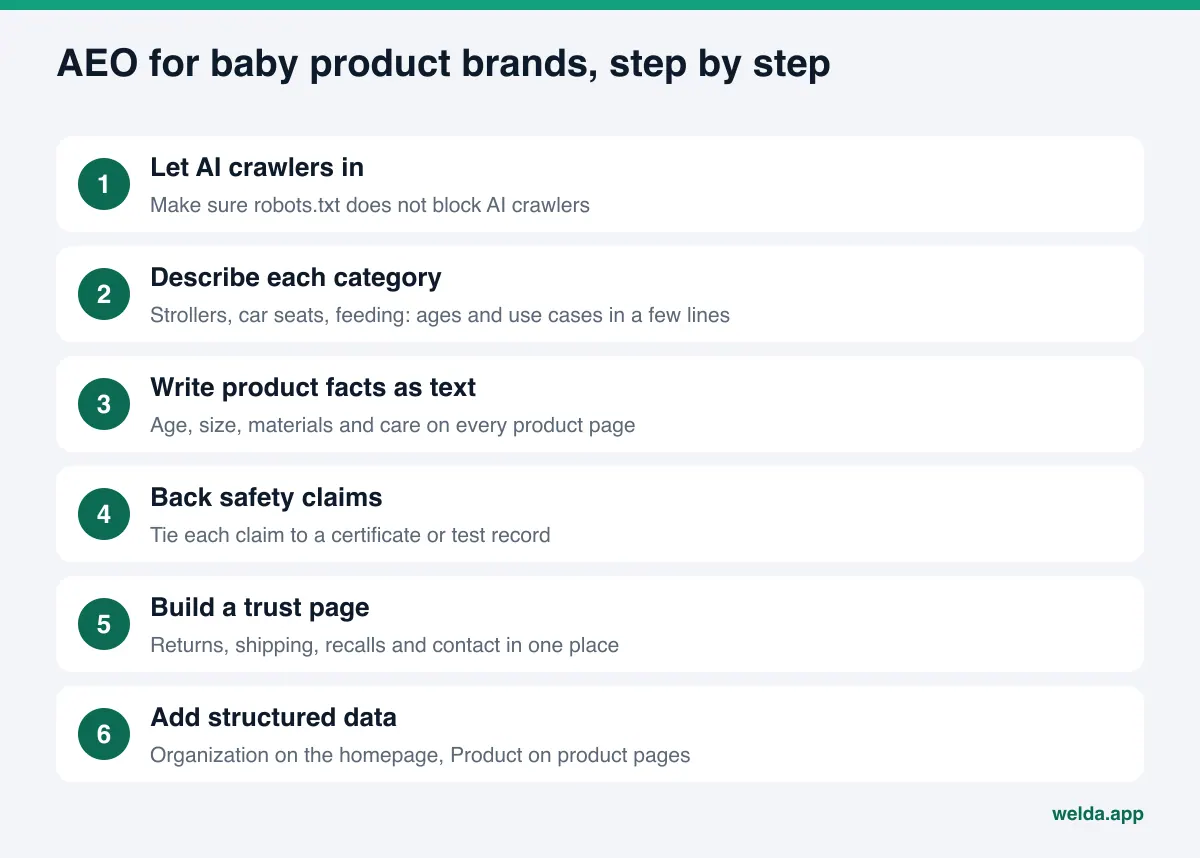
- Let AI crawlers in. Check robots.txt for lines that block AI crawlers. If your ecommerce platform manages the file, check the setting in its admin.
- Describe each category in a few sentences. At the top of your strollers or feeding page, say which ages and use cases the category covers and what you pay attention to. Assistants read category pages to understand what a brand actually sells.
- Write product facts as text. Age or weight range, dimensions folded and unfolded, materials, care instructions and the safety standard the product is tested to belong on the page as text, not only in an image or a PDF manual.
- Tie every safety claim to evidence. In the US, children's products generally need a Children's Product Certificate based on testing by a CPSC-accepted lab. If your page says a product meets a standard, the certificate should back it, and the page can say so plainly. This is not legal advice; check your own obligations with counsel.
- Build one trust page. Returns (including opened and hygiene items), shipping times, warranty terms from the manufacturer, where to find recall information, company details and contact channels, in short sentences on one page.
- Add structured data. Organization markup on the homepage and Product markup on product pages, as described in Google's product structured data documentation. Price, availability, shipping and returns can live in that markup too.
- Answer real questions in a short FAQ. "Do you accept returns on opened items", "where are your products made", "which car seats fit compact cars", "how do I register my product for recall notices".
- Link your profiles. Instagram, Pinterest, your Amazon storefront and, if you have one, Google Business Profile should be linked from your site, with the same name, address and phone everywhere.
Most of this is done once and then becomes a template. Adding a fixed product details block to your product page template, with fields for age range, dimensions, materials, care and certification, scales better than fixing hundreds of pages one by one.
How should baby product pages be written for AI answers?
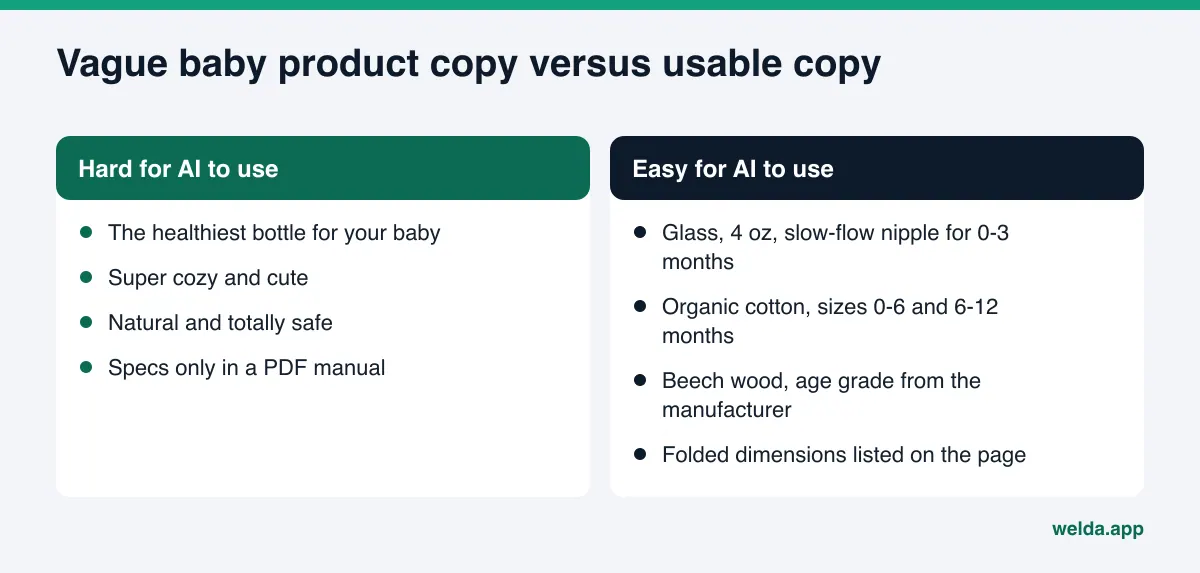
When an assistant builds an answer, it looks for concrete, repeatable facts. The table below shows the same products written two ways. Values are examples.
| Product | Copy AI cannot use | Copy AI can use |
|---|---|---|
| Baby bottle | The healthiest bottle for your baby | Glass, 4 oz, slow-flow silicone nipple for 0-3 months |
| Infant car seat | Ride with total peace of mind | Weight and height limits as stated in the manual, LATCH or seat-belt install |
| Sleep sack | Super cozy and cute | Organic cotton, sizes 0-6 and 6-12 months, machine wash cold |
| High chair | Fits every home | From 6 months, folds flat, dishwasher-safe tray |
| Wooden toy | Natural and totally safe | Beech wood, age grade from the manufacturer, small parts warning where required |
Each fact in the right column answers a question a parent might ask. The left column tells neither the parent nor the assistant anything, and phrases like "totally safe" or "the healthiest" are claims that would need support. Stick to the manufacturer's documents. If you do not know a weight limit or a certification, leave it out until you do. A wrong fact that makes it into AI answers can take weeks to correct.
Reviews deserve a note too. Parents trust reviews, and so do assistants. Ask real customers for reviews, answer the critical ones, and do not buy or write fake ones. The FTC's final rule banning fake reviews and testimonials makes this a legal matter as well as a trust one.
How Welda handles AEO for a baby brand
Welda is software that measures where a business shows up in AI answers and fills the gaps on its behalf. For a baby product brand, three parts matter most.
The free site analysis: where you can start today
The analysis reads your homepage and a few core pages such as about, contact and pricing. Typical findings for a baby brand: AI crawlers blocked in robots.txt, a homepage title that is only the brand name and never says what you sell, no business schema, no FAQ, and return and contact details scattered across the site. For each gap you see what was found, why it matters and how to fix it. You also get ready-to-use homepage copy (title, description, main heading, intro paragraph and FAQs), a simulation of how much each fix would lift your score, a competitor comparison and a fix package you can add to your site, including the schema code.
As part of the analysis, Welda asks five questions your customers might ask to an AI assistant that can search the web, and checks whether your brand is named in the answers. That is a one-time check. The analysis does not crawl every product page and does not measure rankings. It is free once per site, works in English, and the results link stays open for 14 days.
The questions view: which parent questions name you
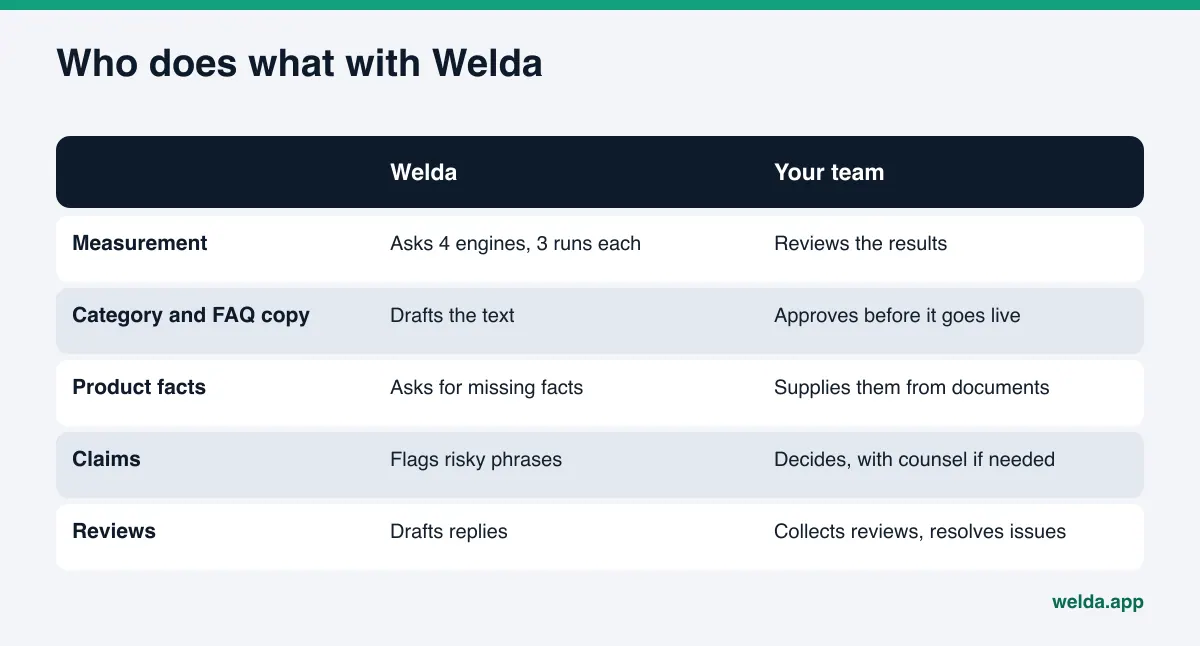
In the Welda dashboard, measurement runs on a schedule. The questions your customers would ask are put to ChatGPT, Gemini, Perplexity and Google AI three times each. The questions view lists each question and shows on which engine your brand appears and in what position. For a baby brand, that might show you are named on Perplexity for "lightweight travel stroller" but missing on ChatGPT, or absent from every answer to "is this baby brand legit".
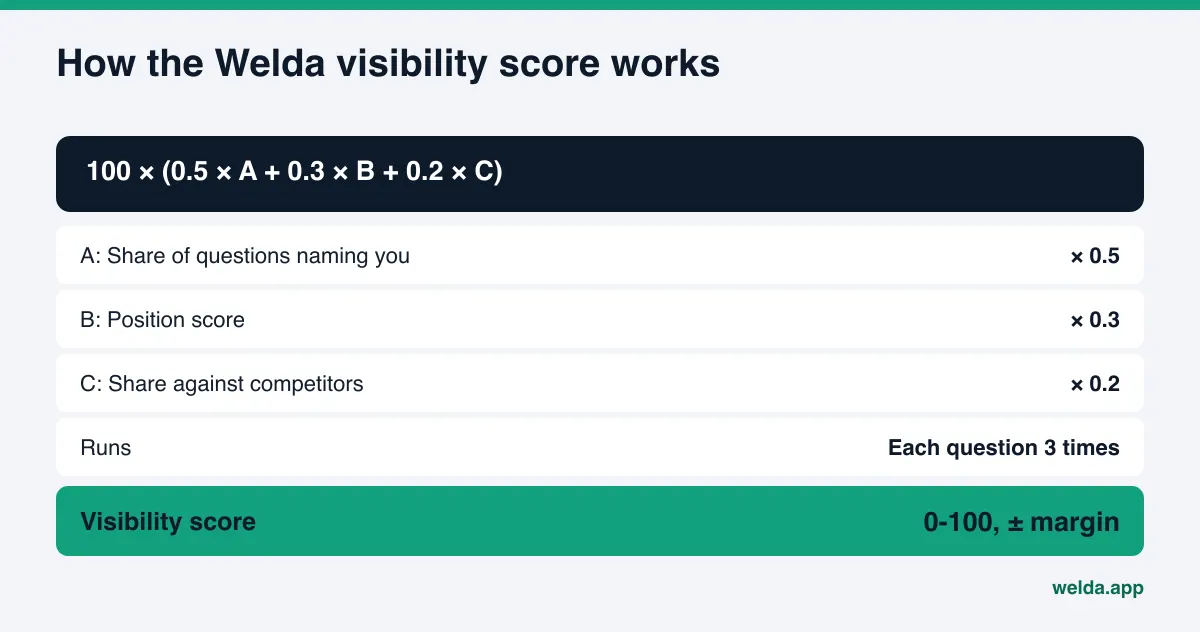
The decision this view supports is where to put effort first. If competitors win car seat questions and that is a strong category for you, the category page and product facts come first. If you are missing from trust questions, the trust page comes first. The score formula is public: 100 × (0.5 × share of questions naming you + 0.3 × position score + 0.2 × share against competitors). The spread across the three runs gives a margin of error, so you do not act on one lucky or unlucky answer.
Sources, drafted content and the claims check
The sources view shows which sites the assistants lean on and how complete your presence is there. For baby brands that list often includes retailers, parenting forums, review sites and registry guides. Welda then drafts the work: category descriptions, FAQs, profile text and review replies. You approve before anything goes live. On WordPress sites, Welda connects through a separate Editor user and an application password, with no code to install, and drafts open on your site for review. On other platforms Welda hands you a ready package and the changes are made by hand. Content always lives on your own site.
For baby products, the most useful part is the claims check. Before publishing, Welda flags patterns such as price, guarantee and superiority claims. "The safest bottle", "100% harmless" or "the lowest price anywhere" come to your approval screen with a warning. The check is not legal advice and has not been reviewed by counsel; the final decision is yours. If you also sell bath or skin care items, see AI visibility software for beauty and skincare brands, which covers similar claims issues for bath and skin products.
The rest briefly: a home view with your score and next tasks, one to-do list for missing facts and pending approvals, a competitors view, and a one-page monthly PDF report.
Limits: what Welda does not do
Honesty matters here, because AEO is sometimes sold with promises nobody can keep.
- No guarantees. Welda does not promise rankings or a spot in ChatGPT. No tool can honestly promise that, because AI companies produce the answers.
- No guessing. If a weight limit, material or certification is unknown, Welda asks you instead of filling it in.
- No unapproved publishing. Sensitive content and claims do not go live without your sign-off.
- No fake reviews. Collecting reviews, resolving negative ones, directory listings and press work stay with you. Welda can draft replies.
- It takes time. New content usually takes weeks to show up in AI answers.
One more thing to be clear about: the Welda dashboard is in early access. It is opening in stages, first for businesses in Turkey, and regular four-engine measurement is being added during early access; sample screens in the dashboard use representative data. What anyone can use today, in English, is the free site analysis. Pricing is discussed in the early access conversation.
AEO readiness checklist for baby product brands
Use this table to review your own site in an afternoon. Mark each row yes, partly or no. If you are comparing tools before you start, our roundup of AEO tools for small businesses explains what to look for.
| Check | Where to look | Why it matters |
|---|---|---|
| AI crawlers allowed | robots.txt | If blocked, nothing else gets read |
| Homepage title says what you sell | Title and meta description | Assistants learn your category here |
| Category pages have a short description | Strollers, car seats, feeding, sleep | Basis for category questions |
| Product facts written as text | Product page template | Answers age, size and material questions |
| Safety claims backed by documents | Product pages, certificates | Claims are cross-checked against other sources |
| One clear trust page | Returns, shipping, recalls, contact | Your own answer to "is this brand legit" |
| Business and product schema | Page source | Machine-readable facts about you |
| Profiles linked from the site | Footer and contact page | Consistency across sources |
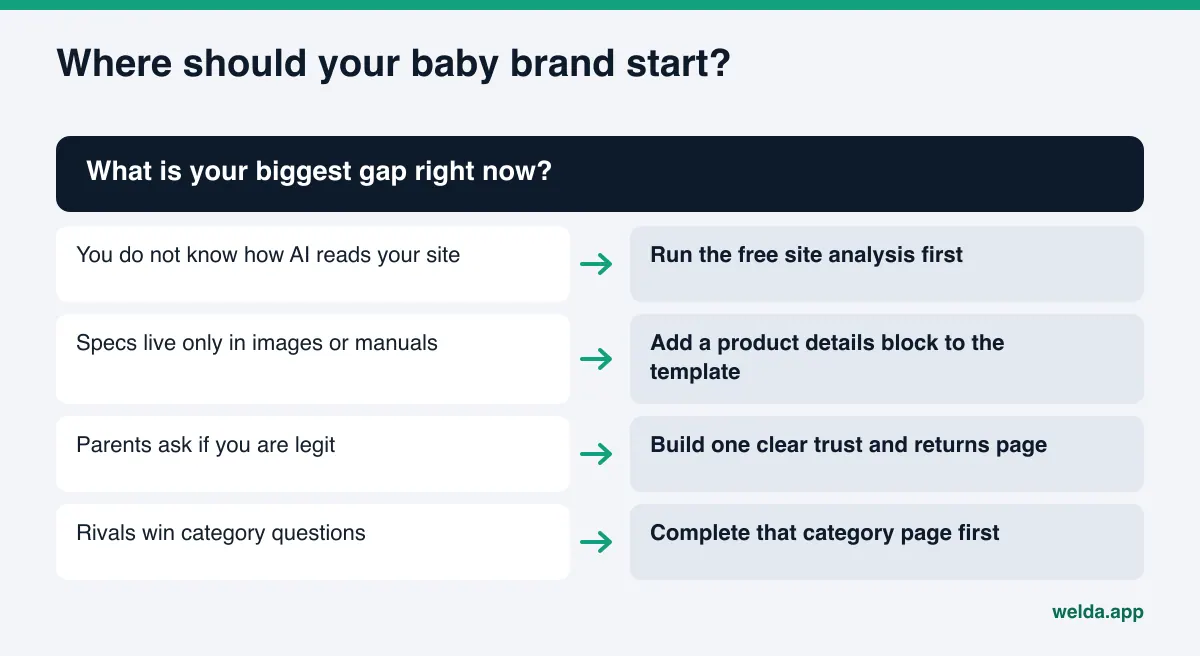
If more than three rows say no, keep the order: crawlers first, then homepage and trust page, then categories. The product template comes last because it takes the most work. If you also sell jewelry or keepsakes, the guide on how jewelry brands get recommended by ChatGPT covers gift and engraving questions.
Frequently asked questions
Is AEO for baby product brands different from SEO?
The foundation is the same: a readable site, clear facts, consistent sources. The difference is the short list. Ranking tenth on Google can still bring a click; in an AI answer you are either named or you are not. That makes plain-text product facts and on-site answers to trust questions more decisive.
I sell mostly on Amazon. Does my own site still matter?
Yes. A retailer listing carries ratings and reviews, but your own site is where you explain who you are, how you test, how returns work and what each product is for. Assistants read sources together, and your site is the one you fully control.
What should I keep in mind when writing safety information?
Write only what your documents support. Copy age ranges, weight limits and standard names exactly as the manufacturer states them, and avoid superlatives like "safest". This is not legal advice; check specific obligations with counsel or the CPSC's own guidance.
Will Welda rewrite all my product pages?
Welda first shows which questions and categories you are missing from, then drafts content for the priority pages. It does not invent product facts; it asks. Everything goes through your approval and lives on your own site.
How long until results show?
New content usually takes weeks to show up in AI answers. Timing depends on the engine, how often your pages are read and what other sources say. Anyone who gives you an exact date is guessing.
What does the free analysis include, and what not?
A score out of 100 split into technical and content, an explanation and fix for each gap, ready homepage copy, a fix simulation, a competitor comparison, a fix package, a PDF and a shareable score card, plus a one-time five-question AI check. It does not measure rankings or promise any.
See how AI reads your baby brand today
Parents' questions keep getting more specific, and AI assistants favor brands that have written clear answers. The first step is seeing how your site reads today. Run the free site analysis to get your score, your gaps and ready homepage copy in one report. Regular measurement and fixes through the dashboard are part of early access, and pricing is discussed in that conversation.