Beauty salon software pricing moves with three things: how many locations you run, how many people need their own login, and which modules you switch on. For a salon that sells courses of treatments, three more lines matter just as much: how sessions are tracked, how many reminder messages you send, and how much room you get for client photos and consent forms. Most of the gap between two quotes comes from these lines being covered differently, not from one vendor being cheaper. Compare them only after you have converted both to the same scope and the same time period.
That conversion takes an afternoon, and it is what this guide walks through. All the worked examples use neutral "units" rather than a currency. A pounds or dollars figure would fit one market and mislead another, and list prices shift with promotions anyway. The arithmetic stays the same wherever you trade, so you can drop your real quotes straight into it.
Write a scope sheet before anyone quotes you
If you let each sales rep ask their own questions, you will get answers to different questions. One vendor will quote for "a small salon", another for "five staff", a third for the plan they want to move this month. A single page sent to everyone fixes that, and it has a side benefit: writing it forces you to find out how your business really runs.
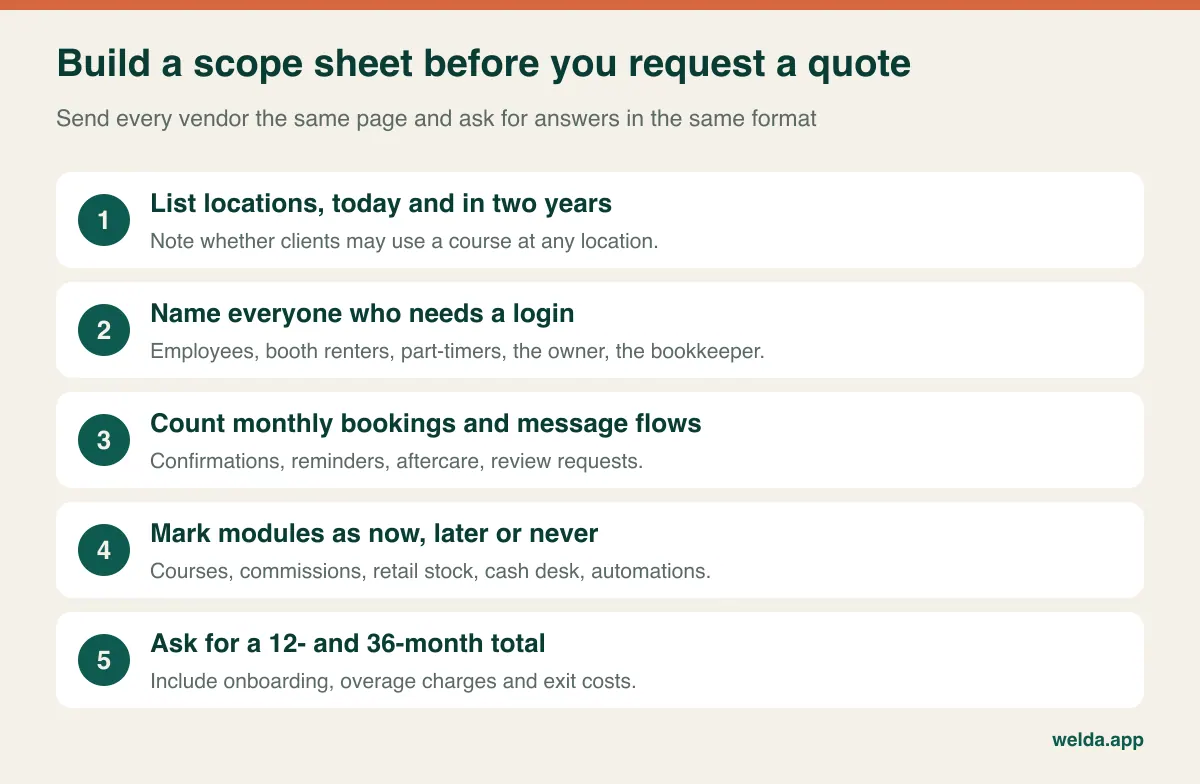
Be specific about the future as well as the present. If you intend to open a second site in two years, say so now and ask for the upgrade terms in writing. A plan that looks generous at one location can jump sharply at two, and you want to know that before your data is inside the system.
The modules line deserves more thought than it usually gets. Instead of reading the vendor's feature grid, write out an ordinary Tuesday. Who takes the bookings? Where does the therapist record what she did? How is a part-payment taken? Where does a retail serum sale go? How is commission worked out at month end? Each answer points at a module. Sort them into now, later and never, and you will avoid paying for an automation suite you won't open, as well as the unpleasant surprise that commissions sit in the plan above yours.
The login question: employees, part-timers and booth renters
Staff count and user count are different numbers. Three employed therapists, a receptionist and an owner make five logins, and that much is easy. Salons get complicated at the edges. A lash artist who comes in on Saturdays might only need to appear on the calendar while reception records her work. A self-employed aesthetician renting a treatment room is a harder case: she may keep her own clients and her own records, so simply adding her as a user can blur who is responsible for whose data, and whose revenue shows up in your reports. Ask each vendor how they would set this up, and take advice if the arrangement is formal.
The tempting saving is a shared login on the room tablet. It lowers the user count, and it also means nobody can tell who recorded a session, who opened a client's health notes or who should earn the commission. For a business holding allergy and medical information, that is a poor trade. Budget for named logins for anyone who treats clients or sees their records, and ask what a "user" means in the contract: some vendors count only active logins, others count every staff profile on the calendar.
Courses and prepaid packages: money for work you haven't done yet
A hair salon does the cut, takes the money and moves on. A beauty salon often takes payment today for six laser sessions spread across most of a year. This single fact is why comparing beauty software to the hair salon calculation only gets you part of the way, though our guide to hair salon software cost is useful for the general method. Each course you sell is a promise on your books, and the software has to keep track of that promise accurately for months.
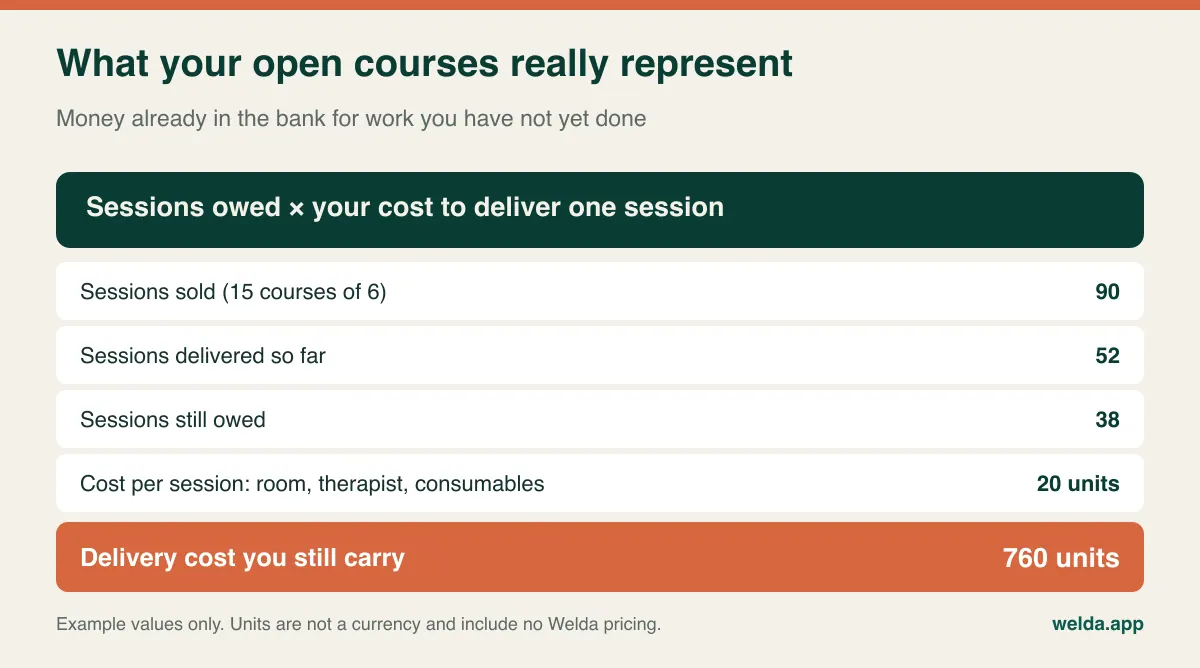
Almost every vendor will tick "packages" on a feature list. The tick tells you little. Put these situations to them instead:
- Part-paid courses: A client has used three of six sessions and paid for half. Are the sessions remaining and the balance owed visible together, on one screen, at the front desk?
- Late cancellations: Your policy may forfeit a session or may let it stand. Can staff apply your rule, and does the record show which happened?
- Pauses: Laser courses often stop for pregnancy, medication or a summer tan. Can the expiry date be extended without a workaround?
- Transfers and changes: A client wants to pass sessions to her sister or swap underarm sessions for a different area. How is that recorded?
- Gift vouchers: Is a voucher a separate feature, an add-on or missing altogether? The tax treatment of vouchers varies by country, so ask your accountant how they should be recorded and check the system can follow that advice.
If the honest answer to most of these is "write it in the notes", the software is cheaper because the work has moved to your front desk. Price that in. For the operational side, see our guide to session and package tracking.
Rooms and devices: why a staff calendar is not enough
A beauty appointment usually needs a therapist, a room and sometimes a specific machine, all free at the same time. Two laser-trained therapists with open diaries still can't both do hair removal at 2 pm if you own one laser. A calendar built around stylists, where each person is effectively their own resource, will happily let the double booking through and you will discover it when the second client walks in.
So ask more than "do you have a calendar?" Are therapist and room checked together when a booking is made? Can a service carry its own duration and a cleaning buffer? Can one therapist take longer than another for the same service? Can a machine be set up as a resource in its own right? The price difference between simple and resource-aware scheduling can be real, and whether it is worth paying depends on your floor plan. One room and one therapist doesn't need it. Four rooms and a shared device very likely does.
Treatment records, patch tests and the storage line nobody reads
Lash tints, brow tints, peels and laser treatments create records that a hair salon rarely needs: patch test dates, contraindications, skin type notes, consent forms and before-and-after photos. Wherever you keep them, they are part of the true cost of running the salon, and in many countries health-related notes get stricter legal protection than an ordinary contact list.
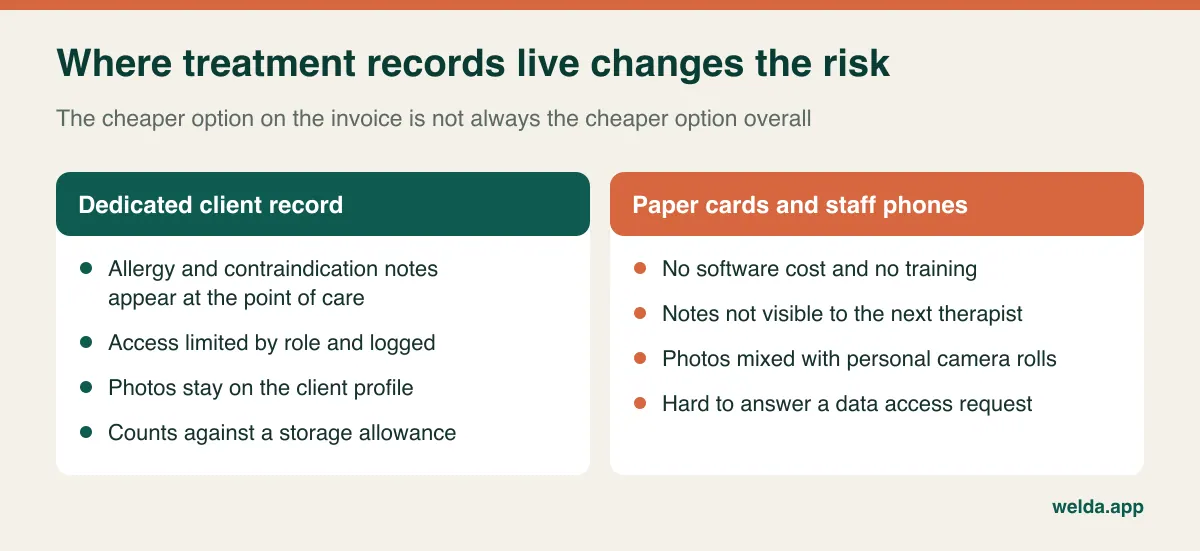
Photos are what make storage allowances matter. Here's an example calculation. Suppose you photograph 120 sessions a month, two pictures each, at 2 MB per picture. That's 480 MB a month, so a 1 GB allowance is gone in a little over two months, while 10 GB lasts nearly two years. If only some treatments get photographed, or the images are compressed, the numbers look very different. The useful question for a vendor isn't how many gigabytes you get, but what happens at the limit: do uploads stop, does an extra charge start, or can older files be archived?
Does your market actually use WhatsApp?
Message bundles look like a small line until automated flows go live. A confirmation, a reminder, an aftercare note, a review request and an end-of-course nudge can add up to several messages for a single booking. Work out your monthly figure from your real booking volume, then add your busiest season. Hair removal demand before summer doesn't resemble a quiet February, and a plan that fits the average month may not fit the peak.
The channel matters as much as the count, and the right answer varies by country. In many parts of Europe, the Middle East and Latin America clients are used to hearing from businesses on WhatsApp. In other markets, including much of North America, a text message is what people expect. Reminders only help if clients read them, so check this before you compare bundles. Our guide to reducing no-shows covers how to measure whether your reminders are doing their job.
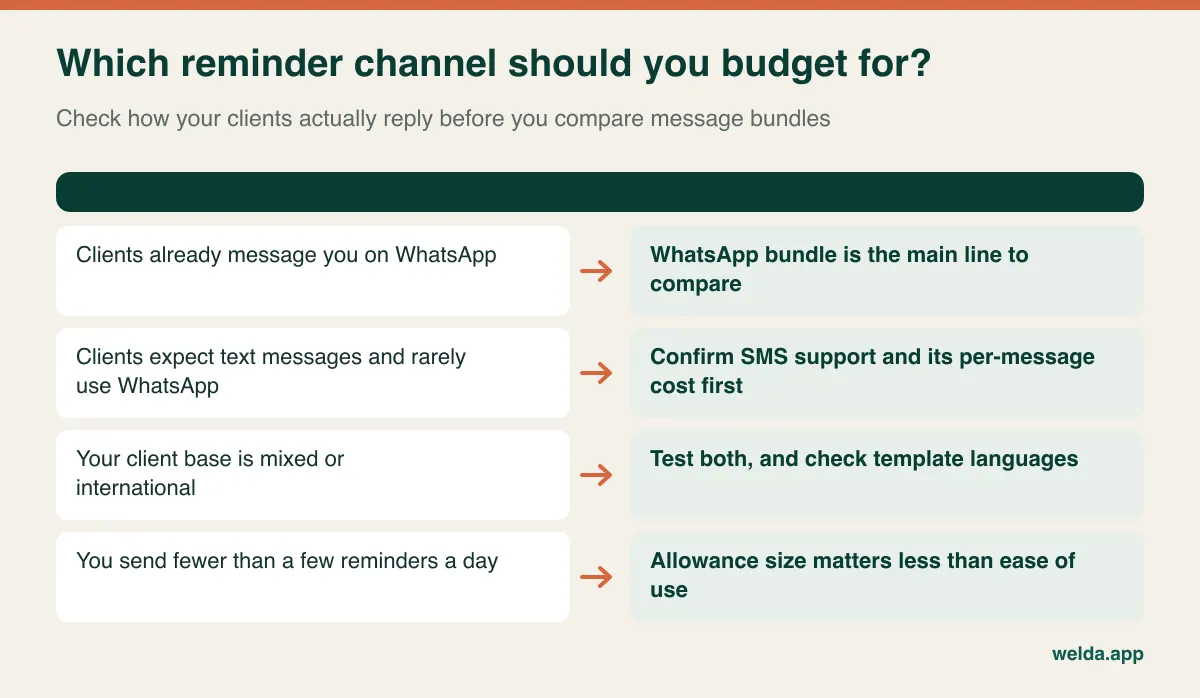
On this point we should be plain about our own product. Welda CRM sends automatic reminders and message flows over WhatsApp, with templates in English, German and Turkish. Our product information doesn't list SMS as a channel, so if your clients expect text messages, raise it at the start of the conversation. It could decide the matter on its own.
Booking routes, deposits and commission
How clients reach your diary changes the bill in ways the subscription line doesn't show. A marketplace listing can bring in new clients, but the fees may also apply to people who were already yours, depending on the terms. Your own booking page normally sits inside the subscription, but you have to bring the visitors yourself. A request-and-confirm flow lets reception check the room and device before accepting, at the cost of a slower reply.
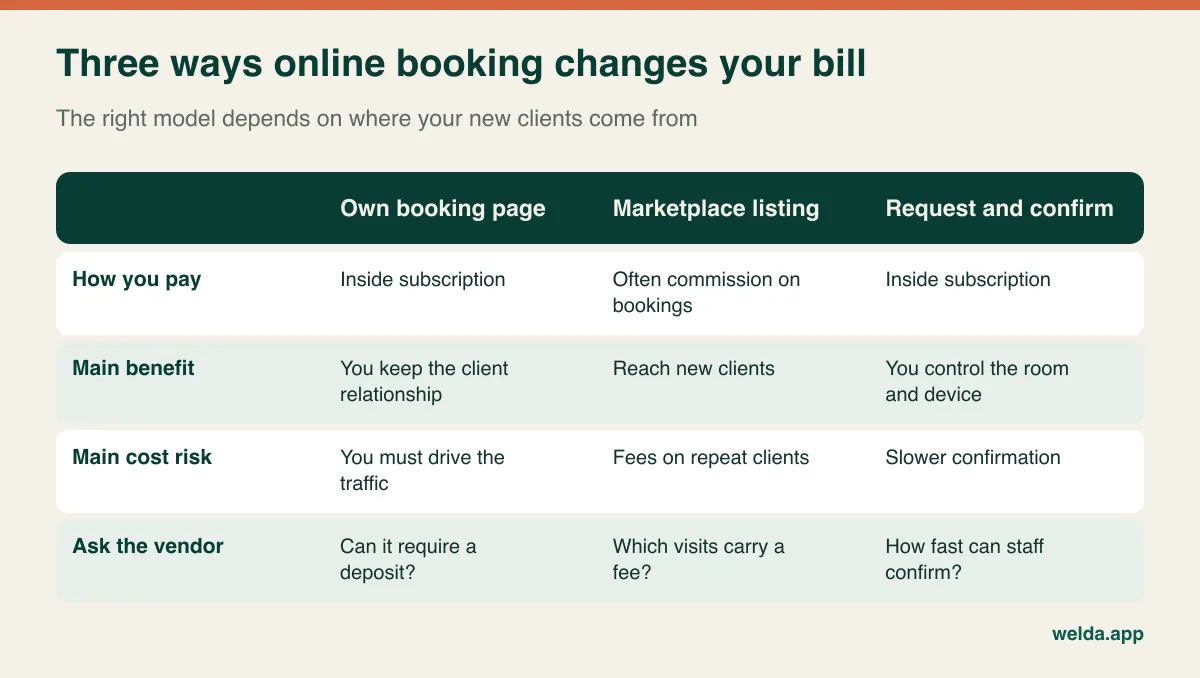
Deposits deserve their own question. Long treatments in a fixed room are exactly the appointments that hurt when someone doesn't show, so many owners want a payment taken at booking. Ask whether the software can do this, which payment provider it depends on, and what that provider charges per transaction. Those fees normally go on a separate statement, so add them to your comparison by hand. Welda CRM handles online booking as a request that your team confirms, and also offers a waiting list that notifies the next client when a slot opens. We don't list card deposits at booking among its features, so if that is essential for you, ask us directly and judge from a live demonstration.
Putting three quotes on the same footing
Here is an example of how the arithmetic works. The salon has one location, six logins, about 1,000 messages a month and active course sales. All figures are invented for illustration and the units are not a currency.
| Line | Quote X | Quote Y | Quote Z |
|---|---|---|---|
| Advertised monthly fee | 45 | 95 | 30 |
| Extra users per month | 32 | Included | Included |
| Message overage per month | 18 | Included | Included |
| Course tracking add-on per month | 12 | Included | Included |
| Commission on online payments per month | None | None | 70 |
| Real monthly cost for this salon | 107 | 95 | 100 |
| One-off onboarding | 250 | 100 | Included |
| 12-month total | 1,534 | 1,240 | 1,200 |
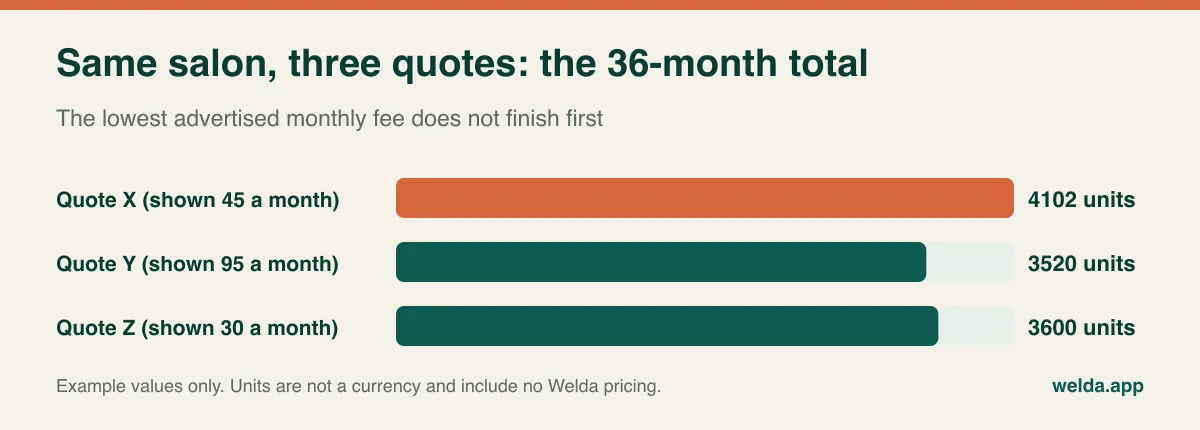
| 36-month total | 4,102 | 3,520 | 3,600 |
The cheapest advertised fee belongs to Z, which does win the first year narrowly. Over three years Y comes out ahead, and X, which looked like a sensible middle choice, ends up the most expensive. Change one assumption, such as fewer online payments, and Z could overtake Y again. That's the point of the exercise: the table shows which assumptions you are paying for and lets you test them.
Three habits keep the table honest. Record any introductory discount on its own line, along with the fee that applies when it ends. Confirm whether sales tax or VAT is included, because quotes from different countries may handle this differently. And write down the currency and billing country, which matter more than they appear to when a vendor is based abroad.
Clauses to read before you sign
None of these charges is unreasonable in itself. What hurts is finding out about them afterwards.
- What "data migration" includes: Client names may be free while appointment history, photos and open course balances are not.
- Training: Is it one session, or is it available again when you hire someone new?
- Renewal terms: Is there a stated limit on price rises, or a notice period you need to diarize?
- Minimum term: If you pay annually and leave early, is the balance refunded?
- Payment lock-in: Must you use the vendor's own card processing to keep certain features?
- Exit: In what format, and at what cost, do you get your client records, course balances and photos back?
The exit clause matters more for a beauty salon than for most small businesses. A course balance is a debt to your client, and treatment history can be something you need to keep. An export with names and phone numbers alone leaves you effectively locked in.
Privacy and regulation: what changes from country to country
What follows is general orientation, not legal advice, and rules change. Under GDPR in the EU and its UK equivalent, health-related information is a special category of personal data and generally needs an explicit legal basis, tight access control and a clear retention approach. You will usually also need a data processing agreement with your software vendor. In the US, whether HIPAA applies depends on your activity; a medical spa may be in a different position from a day spa, and state privacy laws may apply as well. If you're unsure, ask a local adviser rather than the vendor's sales team.
Marketing messages are generally treated differently from appointment reminders, and many countries expect prior consent before you send promotions by text or messaging app. Check how the software records that consent. Using a before-and-after photo in your advertising normally calls for separate permission from the client. Our article on data security in clinics covers the practical controls. Licensing rules for laser and similar treatments also vary widely, and no software solves that for you. Some countries have fiscal rules for cash registers too; if yours does, confirm how the software fits alongside your existing till.
On Welda's side, client and health records are stored encrypted, consent is managed under KVKK and GDPR requirements, access follows roles and is recorded in an audit log. These tools support your obligations; they don't take them off your hands. Invoices can be issued through e-invoice integration with a provider of your choice, so that provider's fees belong on their own line. Our cash desk and POS module tracks money movements, and we don't claim it replaces a certified fiscal till.
Who should buy now, and who should wait
A solo aesthetician with one room and few courses. A tidy calendar and a careful paper record can work for a good while, and a subscription may not pay for itself yet. Reconsider when you can no longer say from memory who has sessions left, or when missed appointments start to cost you real income.
A team of three to six with reception and steady course sales. This is where the case is clearest. A shared diary, automatic session tracking and reminders save front-desk hours and reduce empty rooms. Look for a plan that covers your real login and message numbers without add-ons.
Two or more locations. Prioritise central reporting, course use across sites, role permissions and commission by location. The right quote here is the one that stays predictable when you open your next site, even if it isn't the lowest today.
Medically led aesthetic practices. If physician records and treatment protocols are central to your work, include clinic-specific systems in your shortlist, since a salon package may not cover everything you need.
A demo script that exposes the difference
Vendor-led demos run on tidy data. Ask the presenter to work through your cases instead, with your receptionist in the room if possible, because she will live with these screens. Have them sell a part-paid six-session laser course, record one session and show the balance. Cancel an appointment late and show what happens to the session. Try to book two clients into one room. Log in as a therapist and try to open the cash report. Then export everything, including course balances, and open the file.
If even the presenter hesitates over a step, picture your front desk at 5 pm on a Friday. During a free trial, enter a few real courses rather than sample data, because the awkward cases are where problems appear. Keep notes in the same format for each vendor, and add them to your comparison table as a final row.
Switching systems without arguments over remaining sessions
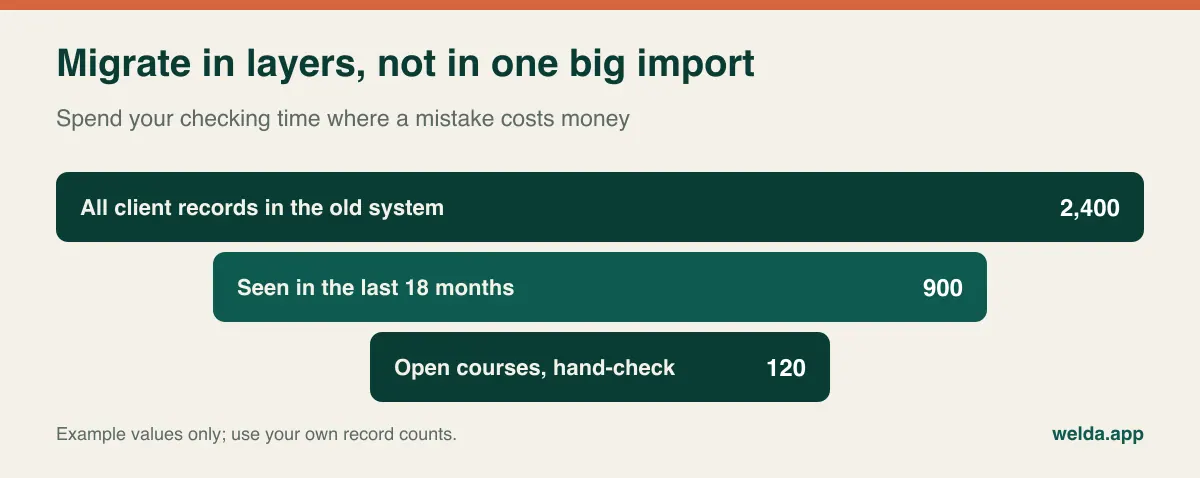
Don't treat migration as a single import. Your data has layers of different value, and your checking time should follow that value. Inactive records from years ago might only need archiving, which can also serve your data retention duties. Clients seen in the last 18 months need to come across cleanly. Clients with open courses should be checked by hand, every one, because here an error means a dispute about money.
Before go-live, message each client holding a course to confirm what your records show: "We have you down for four remaining sessions; please tell us if that doesn't match." It takes one afternoon and closes off most later disagreements. Then choose a quiet week, away from pre-summer laser season or the December gift rush. Keep the old records for a short time as a reference, but don't run two systems side by side for long, or your team will stop trusting either.
How pricing works with Welda CRM
Here is our own product in the same terms. Welda CRM is a monthly subscription with no separate setup fee. Setting up your account, branches and staff calendars, migrating your existing client and appointment data, and hands-on team training are all included in every plan. There are three plans, and they differ on the same lines discussed above.
| Line | Starter | Pro | Enterprise |
|---|---|---|---|
| Branches | 1 | Up to 3 | Unlimited |
| Users | Up to 3 | 10 | Unlimited |
| WhatsApp messages per month | 500 | 5,000 | 50,000 |
| Photo and document storage | 1 GB | 10 GB | 100 GB |
| Modules | Appointments, online booking requests, waiting list, client records, packages, health records, payments and invoicing | Starter plus stock, expenses, quotes, automation flows, cash desk and POS, staff commissions, open API | All modules, priority support, white label |
Our six-login example salon sending about 1,000 messages a month would go past Starter's user and message limits, so Pro would be the plan to discuss. A smaller team that only sends reminders may land differently, which is why we look at your own numbers. Ask us the same questions you ask anyone else: what happens when a message allowance runs out, how calendar-only staff are counted, how pauses and transfers on a course are handled, and how you get your data out if you leave. Where something isn't spelled out on our product pages, ask us to show it live rather than assuming it works the way you need.
You can see how the screens adapt on our page about beauty salon software pricing and features. You pick your industry and the starting modules and on-screen terms follow it, and individual modules can be switched on or off later. Welda CRM is web-based, so there's nothing to install, and reception and therapists can work from different devices at the same time.
We agree the figure once we understand your salon, because a number given before the scope is clear can't be fairly set against your other quotes. Bring your login list, typical daily bookings and how you sell courses, and we can settle your beauty salon software pricing in a free consultation. The result is something you can write straight into your comparison table. The Welda CRM plans page sets out what each plan includes. A 7-day free trial unlocks every module, and if you decide not to continue your data isn't deleted; the account simply becomes read-only.
Frequently asked questions
Why does beauty salon software pricing vary so much between vendors?
Because vendors aren't pricing the same scope. Course tracking, user seats, message volume and data migration may be included in one quote and sold separately in another. Convert each quote to your own salon over 12 and 36 months, and most of the difference becomes explainable.
Do I need a paid login for every therapist?
If a therapist records her own sessions, reads client notes or earns commission calculated from the system, she should have a named login. Someone who works occasionally and whose appointments are entered by reception may only need to appear on the calendar. Ask each vendor how they count people who don't log in.
Is hair salon software good enough for a beauty salon?
Sometimes, if you sell few courses and have a simple layout. It tends to fall short once you need sessions tracked over months, room and device availability checked together, or contraindications and consent forms stored per client. Test those three things before relying on a lower price.
Should I pay annually for a discount?
That can make sense once your team has used the system for several months and is happy with it. For a new system, starting monthly keeps your risk lower. If you do pay upfront, get the early exit terms and the second-year fee in writing.
Will my open courses survive a move from another system?
That depends on the export your current vendor provides and what the new vendor's migration covers. Ask for a file that includes balances before you commit. Migrating existing client and appointment data is included in every Welda CRM plan, and we'd confirm how open courses transfer once we've seen your file. Either way, confirming balances with clients before the switch is a sensible safeguard.
How much does Welda CRM cost?
The price depends on your locations, users, message volume and the modules you need, and we agree it in a free consultation. Setup and data migration are included with no separate fee, and you can try every module free for 7 days.