The short answer to what therapist SEO services should do is this: meet every distinct question a prospective client types into Google with a page written specifically for that question, and written within ethical limits. When someone searches "what is EMDR", "couples counselling in Leeds" or "online therapist", your site should have a page that answers exactly that search, shows your qualifications and training clearly, makes no promises about outcomes and makes contact easy. Do that well and you get a steady flow of enquiries without fighting health advertising restrictions. Skip it and even an excellent therapist stays invisible in search. A good SEO service plans those pages, writes them with you, fixes the technical foundations, tidies your Google Business Profile and measures the enquiries that result every month.
This guide is written for psychologists, psychotherapists, counsellors, couples and family therapists in private practice, and for small counselling centres. It is not a generic SEO explainer. We go through the things that are specific to this profession: the sensitivity of health advertising, client confidentiality, searches by therapeutic approach and the growing demand for online sessions. At the end you will find the questions to ask when choosing an SEO provider, the mistakes we see most often, and how Welda handles this work.
Why therapist SEO is different from ordinary local SEO
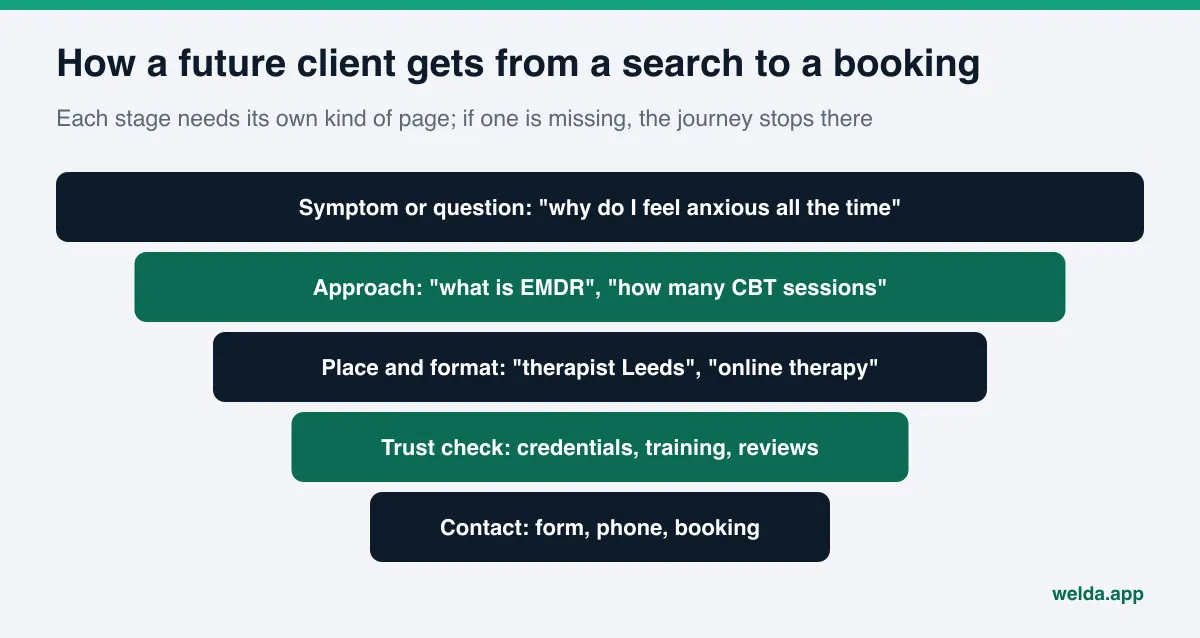
For a café or a plumber, SEO is mostly about showing up for "near me" searches. Therapy works differently. A prospective client usually starts by trying to understand what they are going through, then reads about which approach might help, then looks for a suitable practitioner, and only at the end decides whether they trust that person enough to get in touch. That journey can take weeks, and each stage uses different words.
The second difference is trust. Google applies extra scrutiny to topics that can directly affect someone's health, finances or safety, and mental health sits right at the centre of that group. Who wrote the content, what training they have and how responsibly the information is presented matter far more here than in most sectors. Anonymous, unsourced, promise-heavy pages do not hold their positions for long in this space.
The third difference is advertising restrictions. Health advertising in the UK is governed by the CAP Code, enforced by the Advertising Standards Authority, and the rules apply to your own website as well as to paid ads. Professional bodies add their own ethical frameworks on top. Ad platforms also restrict health-related targeting and, for some treatment categories, require extra certification before ads can run. All of this makes paid search a less dependable channel on its own and makes organic visibility more valuable. Honest, informative content already sits inside what the rules permit, so well-executed SEO works with the regulations rather than against them.
The last difference is confidentiality. A hairdresser can post a happy client's photo. A therapist should not even confirm that someone is a client. Review management, case examples and the design of your enquiry form all need extra care in this profession, and whoever does your SEO needs to understand that from day one.
What prospective clients actually search for
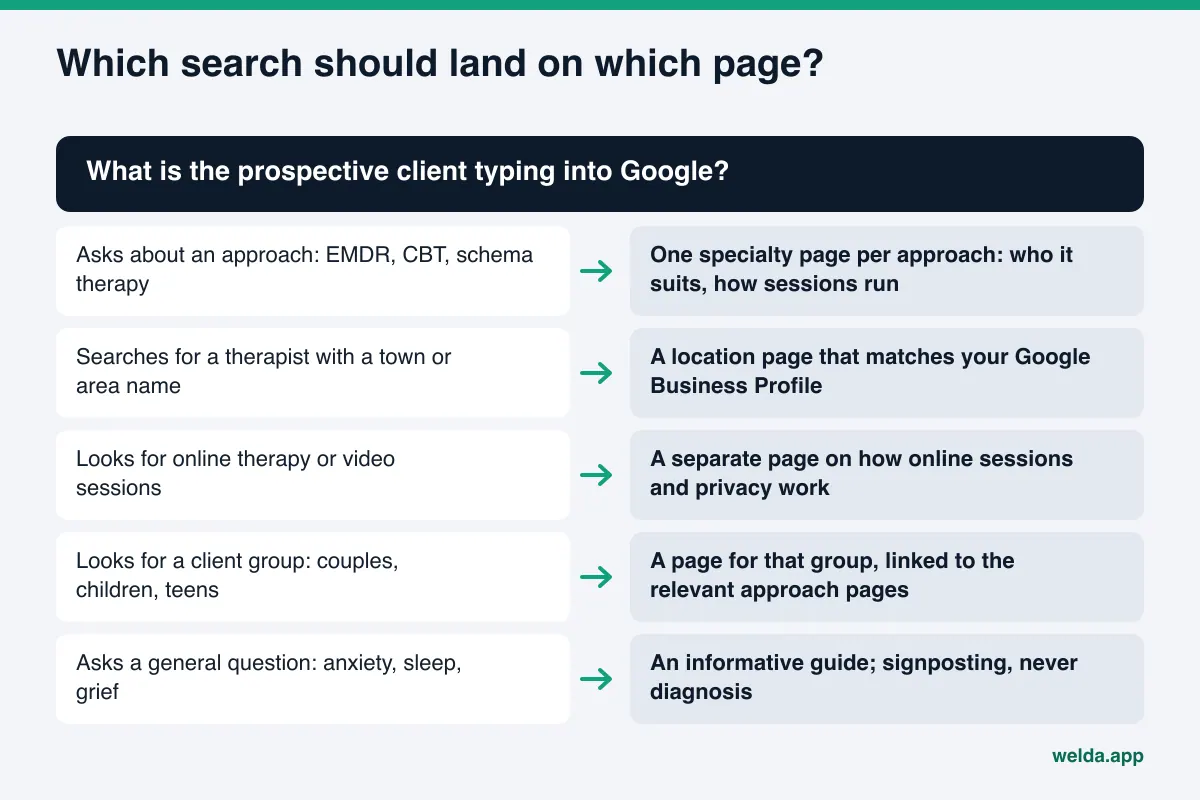
The most common mistake on therapy websites is a single "Services" page that lists everything: individual therapy, couples work, children and adolescents, EMDR, CBT, online sessions. That page answers no search fully. Real searches split into quite distinct groups, and each group expects a different kind of page.
The first group is approach searches. Queries like "what is EMDR therapy", "how many sessions of CBT do I need" or "who is schema therapy for" show that the person has heard of a method and wants to understand it. They need a dedicated page explaining what the approach is, who it may suit, how sessions generally run, and what training you hold in it.
The second group is client-group searches: "couples therapist", "therapist for teenagers", "child psychologist", "family counselling". Here the person is often looking for help for a relationship or for someone they love, not only for themselves. The language and the questions are different. A parent, for example, wants to know how involved they will be in their child's sessions.
The third group is location searches. For "therapist Leeds" or "counsellor Islington", Google pushes the map pack to the top, and those results lean heavily on your Google Business Profile. Accuracy, category choice, reviews and consistency with the address on your website matter more here than the site itself.
The fourth group is format searches: "online therapy", "video counselling", "therapist who speaks Turkish online". These are not tied to a place and the competition looks different. If you offer online sessions, a page explaining how they work, which platform you use and how privacy is protected is the most direct way to reach clients outside your town.
The fifth group is informational: "why do I feel anxious all the time", "how long does grief last", "signs of a panic attack". These rarely turn straight into a booking, but this is often where someone first meets you. A good guide informs, does not diagnose, and signposts the reader to the relevant specialty page or to appropriate support.
Specialty pages: structuring your site by approach
Specialty pages are the backbone of therapist SEO. A page per approach and per client group can sound like a lot, but even a solo practice can start well with five or six. What matters is not the count but that each page answers one search clearly.
A strong specialty page usually runs in this order: a plain-language definition of the approach or service, the situations in which it is often chosen, who it may not be right for, how the first session and later sessions generally go, your own training and experience in this area, common questions, and how to get in touch. Use technical terms where they help, but explain each one in a sentence; most readers are meeting this information for the first time.
Build natural links between pages. The couples therapy page can link to the approach you use with couples; a guide on anxiety can link to your CBT page; the online therapy page can link to every specialty page. Those internal links shorten the reader's path and tell Google which page is the main resource on which topic.
It is tempting to clone the same text for ten neighbourhoods with a few words changed. Don't. Near-identical location pages can be treated as low-value content and drag down the visibility of all of them. If you genuinely have several practice addresses, give each one its own page with real information; if you have one address, mentioning nearby areas with travel directions on that page is enough.
If your current site cannot carry this structure, that needs fixing first. SEO is built on top of that skeleton.
Ethical limits: health advertising rules and safe content
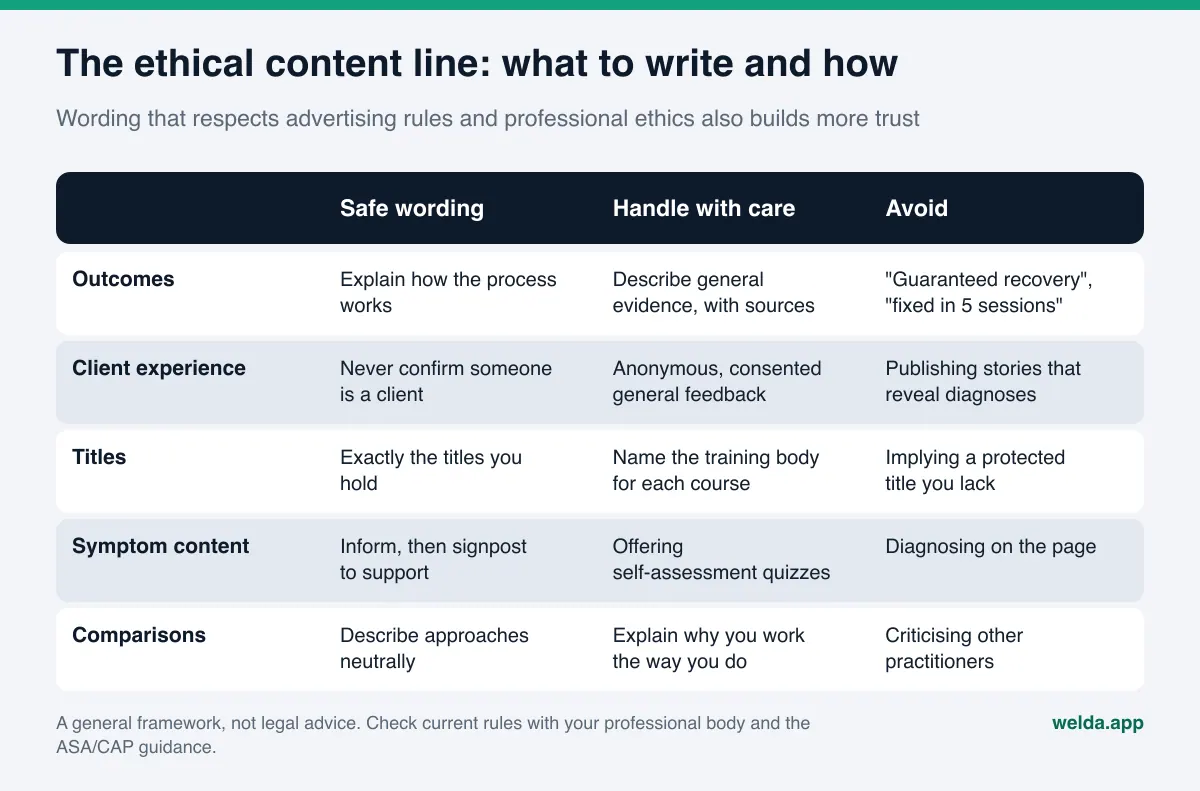
The general spirit of UK health advertising rules is simple: informing people is fine, misleading or exaggerated claims that pressure people into treatment are not. The CAP Code expects objective claims to be backed by evidence and does not allow you to discourage people from seeking appropriate medical help. Professional bodies such as BACP, UKCP, BABCP and the HCPC set their own standards on advertising and conduct. Exactly where a phrase crosses a line is a legal question, and you should confirm the current position with your professional body and, if needed, a legal adviser. This guide is not legal advice, but there is a practical line that works when writing SEO content.
Avoid outcome promises. Phrases like "guaranteed recovery", "anxiety-free in five sessions" or "100% success rate" are risky under advertising rules and at odds with how therapy actually works. Describe instead how the process runs, what the approach generally aims at, and how the client takes part. Readers find that more reassuring anyway.
Do not publish client stories. Even with consent, a story containing a diagnosis or personal details carries serious confidentiality risk. When replying to Google reviews, do not confirm that the reviewer is a client; use language that identifies no one, such as "Thank you for taking the time to leave feedback." Arguing with a negative review and adding details is the single most common mistake we see.
Use your titles precisely. Some titles, such as clinical psychologist, counselling psychologist and practitioner psychologist, are protected and require HCPC registration. "Therapist" and "counsellor" are not protected in the same way, which is exactly why clients look for registration or accredited membership. List your qualifications, approach-specific training and the bodies that awarded them accurately. This matters for SEO too: Google tries to understand who the author is and what makes them an expert.
Inform and signpost; do not diagnose. A guide about symptoms should not tell the reader "you have this". It should explain when talking to a professional is a good idea. Online quizzes and self-assessment tools need care; if you use them, say clearly that the result is not a diagnosis.
Do not criticise colleagues. Explaining why you work the way you do is natural. Language that belittles other approaches or practitioners breaches most ethical frameworks and leaves a poor impression on readers. For the wider picture of how agencies should handle sensitive health topics, see our piece on choosing a healthcare SEO agency.
Local SEO and your Google Business Profile
For a therapist who sees clients in person, the fastest gains usually come from local search. For searches that include a town or area, Google shows map results at the top, and those depend heavily on your Google Business Profile.
Choose the right primary category, write your address and opening hours exactly as they appear on your website, and add genuine photos of the entrance and waiting area. In the description, list your approaches in plain language. You may encourage clients to leave reviews, but offering anything in return or writing reviews yourself breaks platform rules and puts the profile at risk. Bear in mind that some clients will not want to leave a public review at all, and that is entirely understandable.
Your contact page must match the profile: same name, same address, same phone number. A map, public transport and parking information, directions to the right door, and an accessibility note all help the reader and give Google local context. If your room is in a shared building, explaining which buzzer to press is a small detail that matters a lot to someone arriving for the first time, often already nervous.
We cover the remaining local steps in our local SEO and Google Business Profile guide.
A separate strategy for online therapy searches
Once you offer online sessions, the field you compete in widens overnight. You are no longer up against therapists in your town but against every practitioner who works online in your language, plus large therapy platforms. Ranking for the bare phrase "online therapy" is therefore hard; more specific searches are far more realistic.
Searches like "online EMDR therapy", "online couples counselling" or "therapy in Turkish for people living in the UK" are narrower, but the intent is much clearer. People living abroad who want therapy in their first language are a particularly meaningful group for bilingual practitioners. A page that answers their practical questions about time zones, which video platform you use and how payment works is an easy way to stand apart.
Confidentiality matters even more on an online therapy page. State which video tool you use, whether sessions are recorded (and if not, say so), what kind of private space the client should join from, and how personal data is handled. Under UK GDPR, health information is special category data. Ask only for what you genuinely need in your enquiry form and make your privacy notice easy to find.
Trust signals: showing expertise to Google and to clients
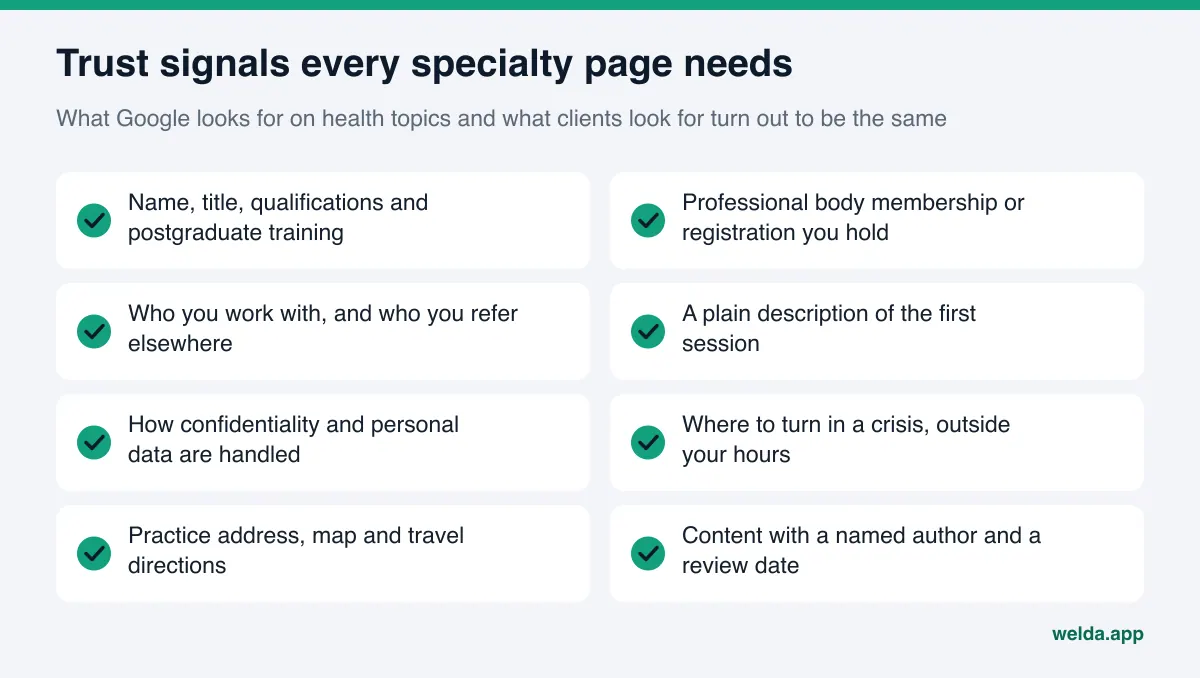
When Google assesses content on topics like mental health, it looks for signals of experience, expertise, authoritativeness and trustworthiness. In practice these are almost the same things a prospective client looks for: who is this person, what training do they have, how much experience do they bring, and do they share information responsibly?
Write your About page as an introduction, not a CV. Include your degrees and postgraduate training, approach-specific training and the organisations that provided it, your registration or accredited membership, the age groups and issues you work with, and the situations in which you refer people elsewhere. That last point builds trust in a surprising way: people trust a practitioner who knows their limits more than one who claims to do everything.
Put the author's name, a short note on their expertise and the last review date under every guide. Cite sources when you share research findings. A brief note on where to turn in a crisis, such as emergency services, NHS 111 or a helpline like Samaritans, is part of a responsible approach, especially on articles about anxiety, depression and grief.
Structured data (Schema.org) lets you tell search engines who you are, where you are and what you offer in a machine-readable way. It does not deliver rankings on its own, but it helps Google understand you correctly and keeps your details consistent across the web.
Questions to ask before hiring therapist SEO services
A team that does not know healthcare can, with the best intentions, push you into risky territory: promise-laden headlines, client stories, cloned location pages. Ask these questions in your first conversation and judge how clear the answers are.
Which phrases do you avoid in health content? A good team answers with concrete examples. A vague "we optimise everything" tells you they have not thought about it.
Who writes the content, and how involved am I? Therapy content should not go live without the practitioner's approval. Drafts can come from the agency, but there must be a workflow in which you read and correct every piece. Ask up front how many hours a month they will need from you.
What do you deliver in month one? Expect tangible outputs: a technical audit report, a keyword map and a page plan. A first month that consists only of "we have started" usually means later reports will be just as vague.
What do you measure? Rankings alone mislead. You should be hearing about impressions, clicks, enquiry form submissions and phone calls, the things that show real demand. Our article on SEO guarantees and first-page promises explains why ranking promises are a warning sign.
Do you guarantee rankings? The right answer is no. Nobody can honestly guarantee a specific position on Google. A proposal that does is either built on terms nobody searches for or relies on risky tactics.
What do I keep if I stop? Content, technical fixes and profile improvements should belong to you. Site access, Search Console and ownership of your Google Business Profile should stay in your name, with the agency added only as a user.
Common mistakes
The mistakes we see on therapy websites are remarkably similar from practice to practice. Knowing them in advance saves months of wasted effort.
Putting everything on one page. A page listing every approach and client group is strong for no search at all. Separate pages are the single step that makes the most difference for the least cost.
Academic language. Heavy terminology meant to signal expertise pushes readers away. Someone looking for a therapist is often going through a hard time; plain, warm and clear writing is better for both conversions and SEO.
Copied content. Paragraphs lifted from other sites or from an approach's official description tell Google nothing new. Text built from your own practice and the questions your clients actually ask is both original and reassuring.
Hidden contact details. If a visitor cannot see what to do next, they leave. Make the contact route visible on every page and make sure your phone number is tappable on mobile. Keep the form short and do not ask for sensitive information.
Over-sharing in review replies. A reply that begins "We met for three sessions and..." discloses a therapeutic relationship. That is a far bigger problem than any SEO issue.
Technical neglect. Slow pages, awkward mobile menus, unindexed pages and missing title tags make even the best content invisible. The easiest way to see where you stand is a free SEO report: technical setup, on-page content, server speed and mobile checks open on one page in priority order.
How Welda runs SEO for therapists and psychologists
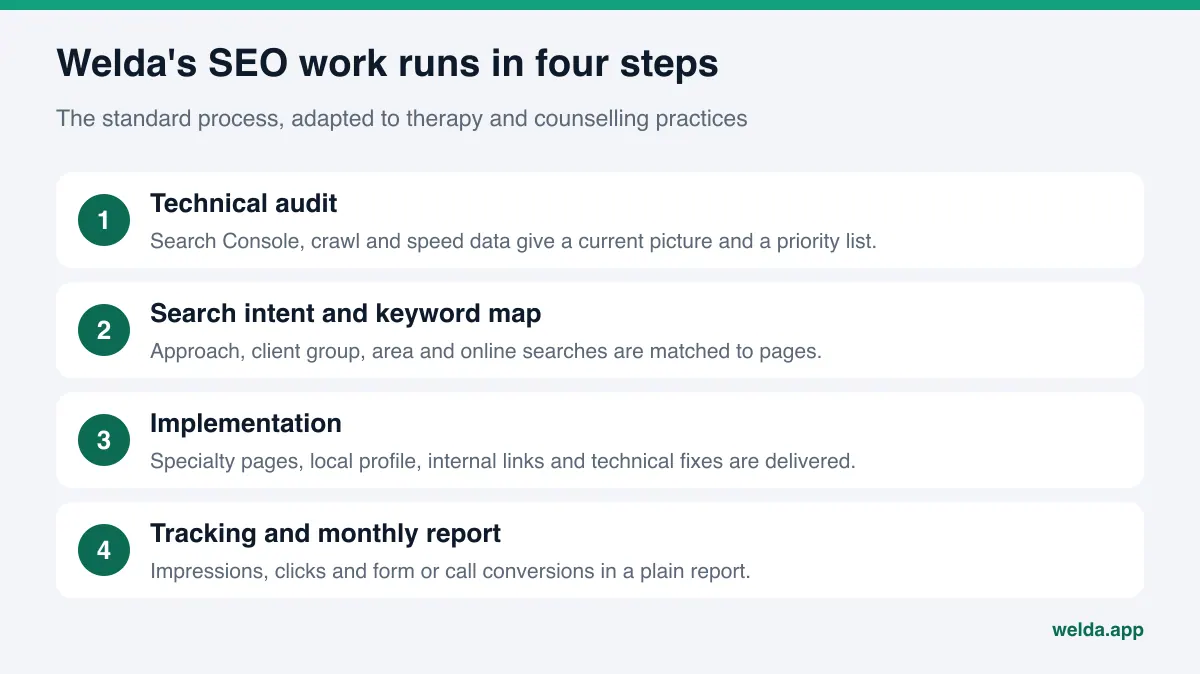
Welda's SEO services run in four steps, and for therapy practices we adapt each step to the sensitivities of the profession.
The first step is a technical audit. Using Search Console, Screaming Frog and PageSpeed Insights, we review the technical health of your site, which pages are indexed, where you already appear in search and what the competitive landscape looks like. The findings go into a prioritised audit report.
The second step is search intent and keyword research. We map approach, client-group, location and online searches, and connect each search to a single page. We decide together which pages to create and in what order.
The third step is implementation. We make the technical fixes, improve titles and meta descriptions, plan and write content, and strengthen internal linking. Google Business Profile and local directory work is part of this step. For health content, every piece goes to you for approval; we do not publish therapy content without the practitioner signing it off. We work white-hat only and do not produce padded, AI-inflated text that adds no value.
The fourth step is tracking and monthly reporting. We follow rankings, impressions, organic traffic and conversions such as form submissions and calls, share a plain report at the end of each month and agree next month's priorities with you.
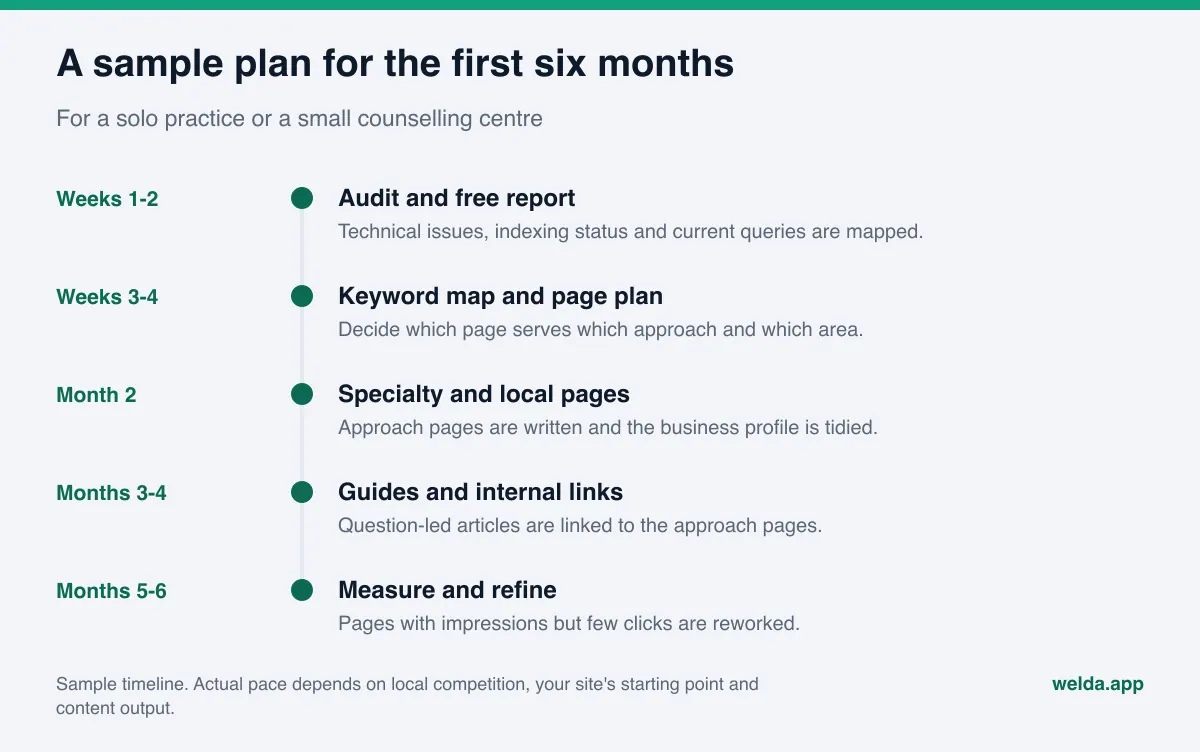
SEO is a long game. Technical fixes can show an effect within weeks, but content and ranking gains usually become clear somewhere between three and nine months. The pace depends on local competition, your site's starting point and how quickly content is produced. The content and fixes stay with you; they do not vanish the day you stop.
What drives the cost
Quoting a single figure for therapist SEO would be misleading, because the scope varies enormously from practice to practice. These are the factors that shape a proposal:
- Your site's starting point: a technically sound site and one that needs rebuilding lead to very different workloads in the first months.
- Number of specialties and services: how many approaches and client groups need their own page determines content volume.
- Locations and format: one address, several rooms in different towns, or online-only practice each call for a different local strategy.
- Competition: central areas of large cities are far more competitive than smaller towns.
- Content pace: how many guides are written each month, and how quickly you can review them, drives the timeline.
- Languages: if you want content in a second language for clients abroad, the scope grows.
We look at these factors together and prepare a scope and proposal tailored to you. If you would like to see where your site stands before we talk, start with the free SEO report; for a proposal, simply get in touch with us.
Who this suits, and who it doesn't
Therapist SEO services are not right for every practitioner at every moment. To be honest, sometimes waiting is the smarter choice.
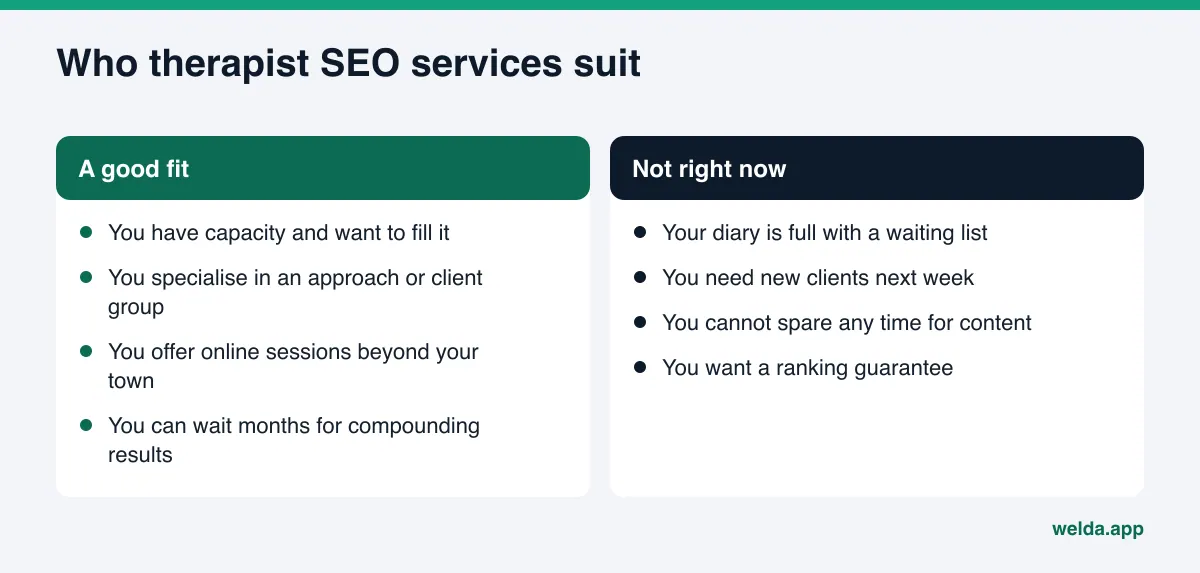
If you have capacity and want to fill it reliably, if you specialise in a particular approach or client group, if you offer online sessions beyond your town, and if you can be patient for a few months, SEO gives you a source of enquiries that does not depend on advertising.
If your diary is full and you already have a waiting list, the priority is managing existing demand well, not creating more. If you need new clients next week, SEO is not fast enough. If you cannot spare any time to read and approve content, the quality of health content suffers. And if you want a ranking guarantee, we are not the right partner, because no such guarantee can be given honestly.
Frequently asked questions
How long do therapist SEO services take to show results?
Technical fixes and Google Business Profile improvements can show an effect within weeks. Specialty pages and guides usually start to move rankings somewhere between three and nine months. The exact pace depends on local competition and your site's starting point.
Do health advertising rules apply to my website content?
Yes, in the UK the CAP Code covers marketing claims on your own website, not only paid ads. That is why outcome promises, exaggerated claims and client stories should be avoided. Confirm the current rules with your professional body; we write content with this in mind and send every piece to you for approval.
Can I use client testimonials on my site?
Confidentiality and professional ethics call for real caution here. Avoid publishing testimonials or stories that contain diagnoses or personal details, and when replying to Google reviews, use general language that never confirms the reviewer is a client. Many professional bodies discourage testimonials altogether.
I only work online. Do I still need local SEO?
If you also see clients in person, yes. If you work purely online, focusing on approach and client-group searches, and on specific audiences such as people living abroad, is usually more productive than local search. We decide what fits during the audit.
Who writes the content?
We can prepare drafts that match search intent and the keyword map. For therapy content, every piece is approved by you before it is published. If you prefer to write yourself, we can edit your text for SEO and prepare it for publishing.
How do I find out the price?
Rather than a fixed price list, we prepare a proposal based on your site's condition, the number of pages needed, your location and the content pace. Contact us, or start with a free SEO report to see where your site stands.
Do you guarantee first place on Google?
No. Nobody can honestly guarantee a specific position on Google. We carry out the technical, content and local work that improves rankings transparently and show progress with Search Console data every month.
Seeing the words clients use to look for you and where your site stands today is the first step to the right plan. Get your free SEO report, then book a conversation with us; if we are not the right fit for your practice, we will tell you so.