Hotel SEO services exist to get your own website in front of guests where the big booking platforms are weak, not to beat them at their own game. The short answer is this: an agency that genuinely grows direct bookings will not promise you the top spot for “hotels in London” or “Cornwall hotel”. Instead, it builds content that answers destination and experience searches, gives every room type its own detailed page, opens your site properly in the languages your guests speak, tidies up your Google Business Profile and hotel search visibility, marks up your structured data correctly, and shows you every month how many visitors those efforts send to your booking engine. When you choose an agency, those five areas, and how they will be measured, are what you should ask about.
This guide is written for people who run or market a boutique hotel, B&B, guesthouse, serviced apartment or city hotel. We start with why the booking platforms dominate certain searches and where your own site can realistically win. Then we cover the questions to ask when comparing proposals, the most common mistakes, a realistic first six months, and how Welda structures hotel SEO work. The aim is not to sell you an agency, but to help you tell for yourself which proposal can actually bring direct bookings to your property.
Why booking platforms lead hotel searches
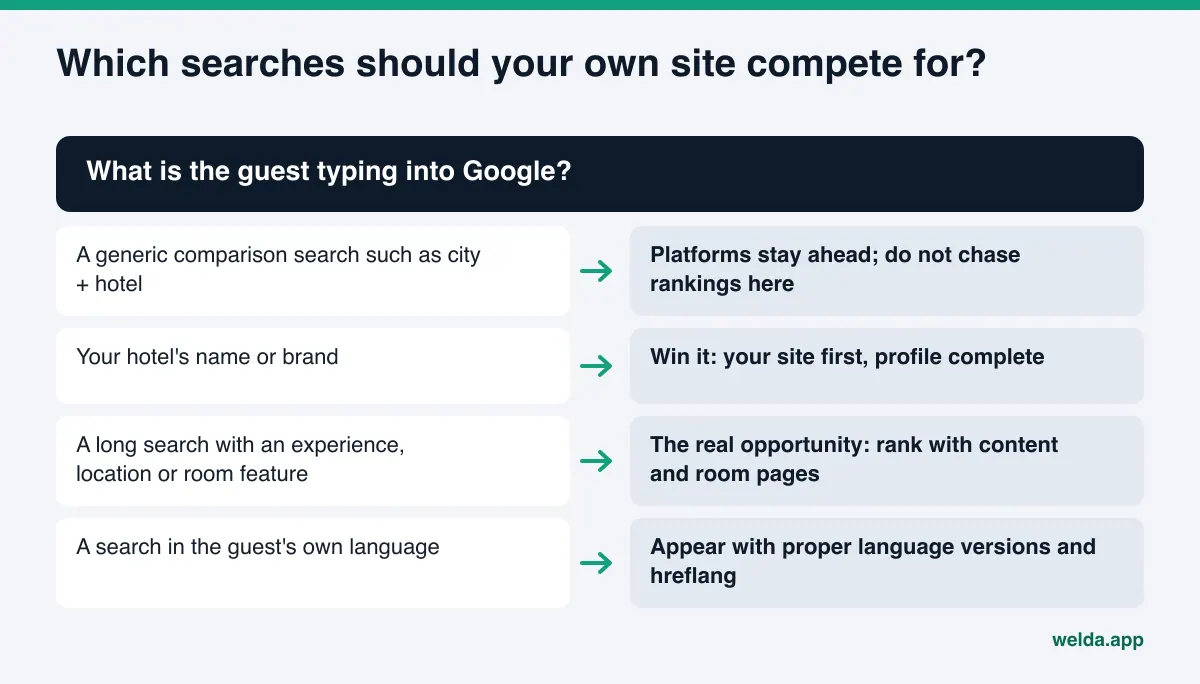
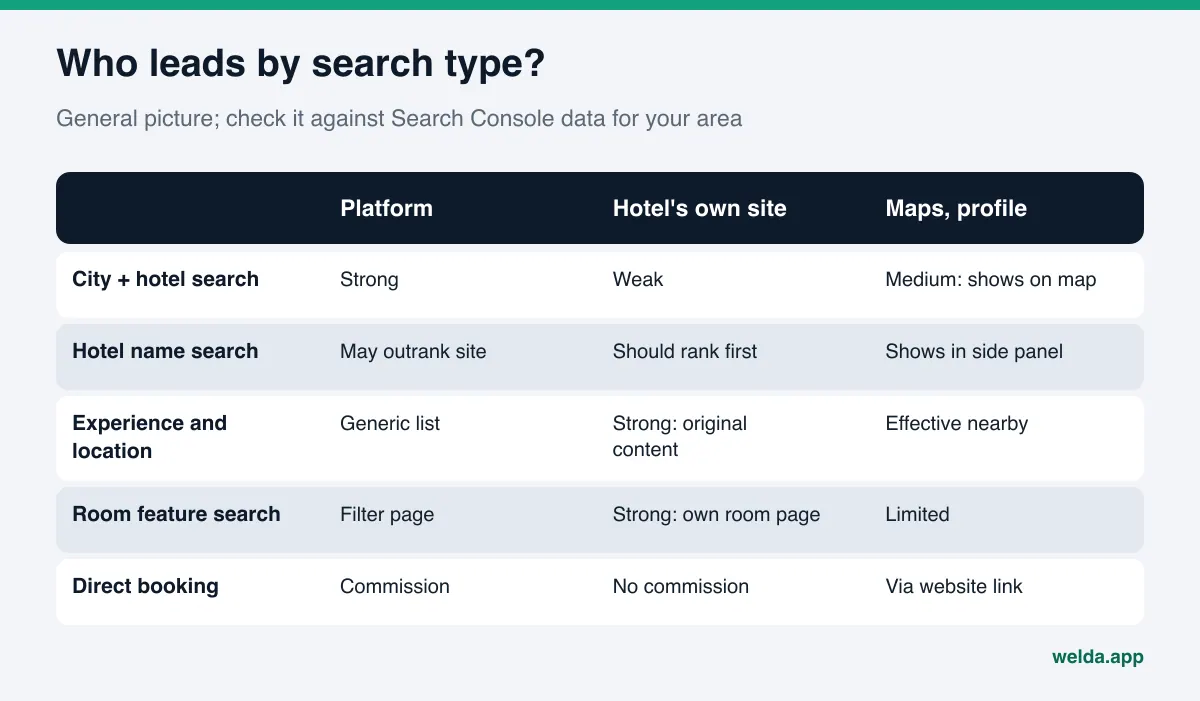
Look at the first page for “hotels in Edinburgh”, “Lake District hotel deals” or “where to stay in Bath” and you will see large booking platforms, comparison sites and Google's own hotel module. That is not because those sites are better hotels; it is down to the nature of the search. The person searching has not chosen a hotel yet. They want options, prices and dates side by side, and Google concludes that the best answer to that intent is a page showing hundreds of properties at once. A single hotel's site, however well optimised, answers that intent with “one option”.
Add the platforms' scale on top: a page for every destination, millions of guest reviews, years of accumulated link authority and content in every language. For a single-property hotel, trying to win generic destination searches means spending the budget on the hardest door available. That is why the first thing a good SEO agency should tell you is which searches you will not compete for. A proposal that promises page one for “city name + hotel” either does not understand how that search works or is selling you an unrealistic target.
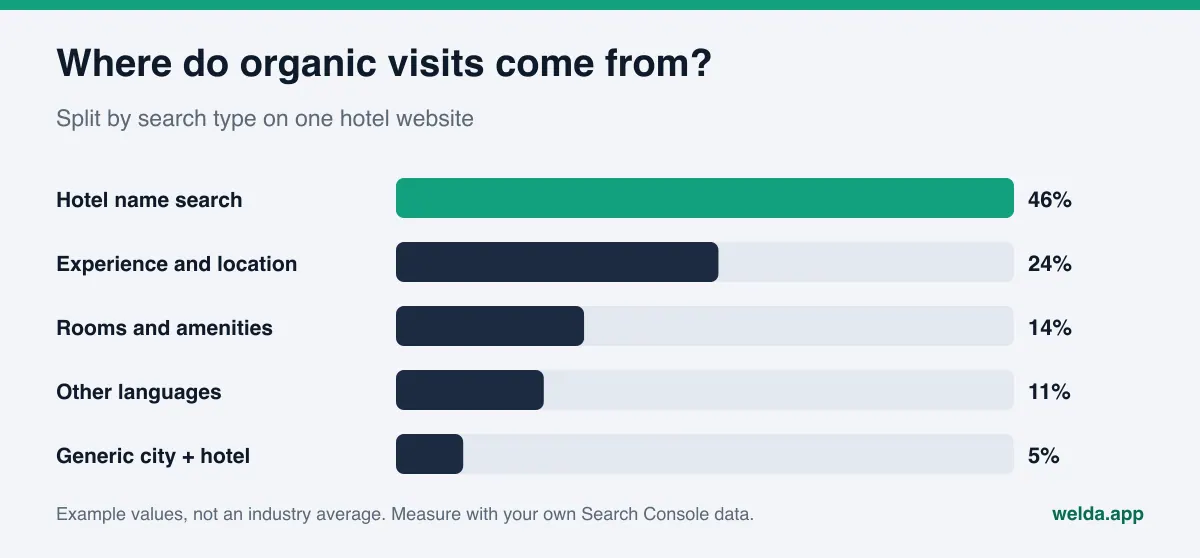
The picture is far from hopeless. Platforms take the broad, comparative searches, but things change when someone already knows your hotel, is looking for a specific experience, or is searching for the village, cove or street you are on. Most direct bookings come from exactly these searches. The job of a hotel SEO service is to make sure that in all of them the guest reaches your site and completes the booking there.
Five areas where your own site can win
The searches where your website can really compete fall into five groups. Each needs its own work, and when you assess a proposal you should look at what the agency allocates to each.
Brand searches. When a guest types your hotel's name into Google, the first result should be your website and the panel on the right should show a complete business profile. Surprisingly often, even on brand searches a platform listing ranks above the hotel's own site, or the profile carries an old phone number, wrong check-in times or a website link that points to a platform. This is the cheapest area to win and the one that brings revenue most directly.
Destination and experience searches. Long searches such as “dog-friendly hotel near the South Downs Way”, “boutique B&B walking distance to the beach in St Ives” or “family guesthouse with parking in York” are poorly served by platforms' generic listing pages. You can rank for them with pages that describe the experience your hotel genuinely offers, carry real local knowledge and answer the guest's question.
Room and amenity searches. For searches like “hotel room with hot tub”, “ground-floor accessible room” or “hotel with family suite”, hotels whose room types each have their own page, photos and clear details tend to appear. A site that squeezes every room into a single gallery page is invisible here.
Searches in other languages. If a meaningful share of your guests come from abroad, appearing in the searches they make in their own language is a separate line of work. A badly built multilingual site either does not appear in those searches at all or shows the wrong language version.
Maps and Google hotel visibility. When a guest looks at the area on the map, they should see your pin, photos, reviews and a link straight to your site. Your booking engine's link can also appear on Google's hotel search surfaces; the technical side of that is usually handled together with your booking engine provider.
Destination and experience content: the gap platforms leave
Platform destination pages work like lists: filters, price ranges, scores. The question in a guest's head is usually more concrete. Can I walk to the beach? Are you open in winter, and is there heating? Can I get there without a car? Do you provide a cot? Nobody can answer these as well as you, because the answers are the reality of your hotel.
A good hotel SEO service turns that knowledge into search visibility. First it works out what guests actually search for about your area and your type of property; this is search intent research. Then those searches are mapped to pages: an area guide, a “what to do by season” page, a getting-here page, and pages describing your standout experiences. Each page answers a search and also leads the guest to the right room page and on to the booking engine.
Two mistakes come up again and again. The first is writing broad content with no link to the hotel. A “50 things to do in London” article may bring traffic, but that traffic rarely converts into bookings, and you are competing with major publishers. The second is generic, AI-padded text that could sit on any hotel's site. Google does not find that kind of content valuable, and neither do guests. Content helps rankings and trust only when it carries information specific to your hotel, your own photos and genuine experience.
The question to ask the agency is: “Which content will you propose, and how will you show which search and which booking intent each piece serves?” Ask for a keyword map that ties searches to pages, not just a keyword list.
Room pages: where rankings and conversions happen
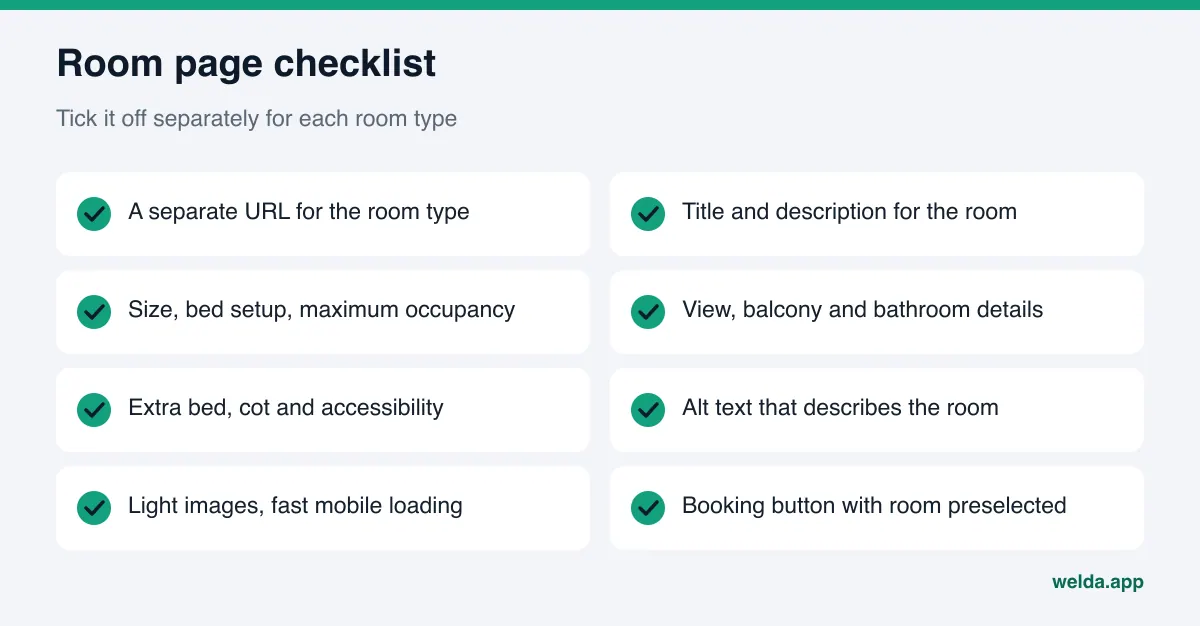
On many hotel websites the rooms are described on one page with a few photos and a short bullet list. That structure falls short for both search engines and guests. When each room type has its own address, title, description and photo set, that page can appear directly for searches such as “sea view family room” or “accessible hotel room”. The guest also finds everything they need to decide in one place.
What belongs on a room page is simply what guests ask before booking: size, bed configuration, maximum occupancy, view, bathroom, balcony or terrace, air conditioning and heating, extra bed and cot availability, accessibility, a link to cancellation terms, and a button that opens the booking engine with that room preselected. Image alt text should describe the room, and the files should be sized so they do not slow the page down.
The room page is also where conversion happens. When a guest reads the page and moves on to the booking engine, a slow-loading engine, a date picker that is awkward on mobile, or a price that differs from the page will lose the booking. So hotel SEO work should care about the booking path on the site, not just rankings. The booking engine itself usually sits with a separate provider; the agency cannot replace it, but it can tidy the steps leading to it and the way they are measured.
Multilingual hotel SEO: localisation, not translation
For a hotel that welcomes international guests, a multilingual site is close to essential. But being multilingual and appearing in multilingual searches are not the same thing. The usual problems are these: language versions switch on the same URL based on browser language, so Google only ever sees one; pages are machine-translated and use phrases nobody in that language would search for; and hreflang tags between language versions are either missing or point to the wrong pages.
In a sound setup, each language has its own URL, the pages reference each other correctly with hreflang, and the content is written for how that market searches. A German guest searches with different phrasing, such as “Hotel am Meer”, and a French or Dutch guest may arrive in a different season with different expectations. The title and description of the same room page in each language should be based on that language's searches. For the technical detail, see our multilingual SEO and hreflang guide.
The question to ask the agency: “Which languages do you suggest we prioritise, how do you decide, and who writes or reviews the content in each language?” If you have a breakdown of which countries your guests come from, bring it to the meeting; your language priority comes from there.
Google Business Profile, Maps and hotel search visibility
For a hotel, the Google Business Profile is often the face guests see before the website itself. Someone searches your hotel's name or looks at the area on Maps, and the first things they see are photos, reviews, the rating, the address and the “website” link. Having the profile in the right category, ticking off every amenity, adding fresh photos regularly and making sure the website link goes to your site rather than a platform all have a direct effect on direct bookings.
Reviews are a topic of their own. Replying to reviews regularly and personally, and handling negative ones calmly with a focus on solutions, supports both guest trust and local visibility. Buying reviews, having fake reviews written or asking only happy guests to review are all against the rules and risk getting the profile suspended; in the UK, fake reviews are also a consumer protection issue. A serious agency stays clear of these tactics and says so plainly. For more detail, read our guide to local SEO and Google Business Profile.
Showing prices and a direct booking link on Google's hotel search surfaces usually works through your booking engine or channel manager's connection with Google. That part is integration work more than classic SEO. What the agency can do here is check with you whether your provider supports the connection and make sure the profile and the website give consistent information.
Structured data and the technical foundation
Structured data means marking up the information on your pages so search engines can read it as machine data. On a hotel website that covers the hotel's name, address, location, contact details, amenities, check-in and check-out times, room types and frequently asked questions. The hotel and lodging types on Schema.org are used for this. Correct markup helps Google understand your hotel accurately and can make you appear richer in some results, but it does not bring rankings on its own and no rich result display is guaranteed. For more, see our structured data guide.
The rest of the technical foundation causes frequent problems on hotel sites too. High-resolution photos make pages heavy; gallery plugins load slowly on mobile; tracking breaks because the booking engine opens on a different domain; old seasonal offer pages are deleted without redirects; and the multilingual setup creates duplicate content. A technical SEO audit gathers these issues into a prioritised list, and the order of fixes depends on how much each one affects the guest's path to booking.
A practical starting point: if you want to see where your site stands before speaking to any agency, you can run our free SEO report. It puts the page you enter through more than 20 checks and gives you a score out of 100, with fixes, across technical setup, content structure, server speed, mobile readiness and structured data. It does not analyse rankings or competitors, but it means you arrive at the conversation with something concrete.
Questions to ask when comparing hotel SEO services
Proposals look alike at first glance: technical audit, keyword research, content, monthly report. The difference lies in how those headings will be applied to your hotel and how results will be measured. Ask these questions in the meeting and put the answers side by side.
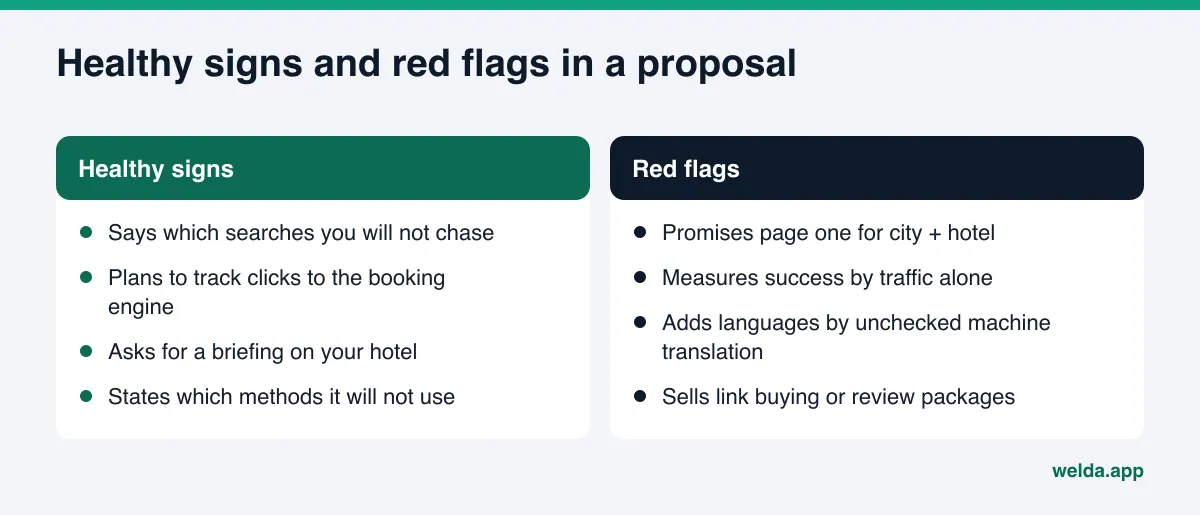
Which searches do you suggest we compete for? A good answer prioritises brand, experience, room and foreign-language searches rather than generic destination terms, and explains why.
How will you measure success? Rankings and traffic are intermediate signals. The real question is how many organic visitors move on to the booking engine and, where possible, how many bookings result. If your booking engine is on a separate domain, ask how that tracking will be set up.
Who will write the content, and how will you gather what is specific to our hotel? Content written without knowing your property is generic. Is there a briefing session with you, a plan for photos and an approval process?
Who will handle the multilingual setup? Can your site's platform serve language versions on proper URLs? If not, is that in scope, or is it a separate web project?
How will you work with our booking engine and channel manager? Will the agency contact your provider directly, and is it clear who does what on tracking and connection settings?
Which methods will you not use? An agency that says plainly it avoids buying links, fake reviews and hidden text protects your domain in the long run.
For a general framework on comparing proposals, see our guide to evaluating SEO proposals.
What drives the cost
The cost of hotel SEO services is not read off a fixed list; it comes from a scope based on your hotel's situation. So we do not quote figures here, but it helps to know what makes proposals differ.
The current state of the site. A site with a sound technical setup, separate room pages and a correct multilingual structure needs far less work than one where everything sits on a single slow page. If some technical fixes need web development, that also affects the scope.
Number of languages. Each extra language multiplies keyword research, content and review work. Focusing on one or two languages first, based on your guest data, is often more efficient.
Content volume. How many new pages or guides are produced each month, how many existing pages are rewritten, and what photography is needed are the largest cost drivers.
Competition and location. In a popular destination with many properties, competition is high even on experience searches; in a quieter area the same result takes less effort.
Number of properties. Groups with more than one property need a profile, pages and local work for each.
Once we clarify these points together, we prepare a scope and proposal for you. For a short initial conversation, get in touch through our contact page.
Common hotel SEO mistakes
Fixating on the generic destination keyword. Spending months trying to climb a few places for “city + hotel” is investing in the search furthest from a booking. Sitting below the platforms there is normal.
Leaving a platform link on the business profile. If the website field on your profile points to a platform listing instead of your own site, you are sending brand-search guests to a commission channel yourself.
Putting every room on one page. This is the most common reason for being invisible on room searches, and it also makes it harder for guests to decide.
Adding languages through machine translation. Unchecked machine translation produces phrases nobody searches for and damages trust. Good content in fewer languages beats weak content in many.
Starting without tracking. If clicks through to the booking engine are not measured, you will not be able to discuss SEO's contribution to bookings six months later. Tracking belongs in the first week.
Deleting offer pages at the end of the season. Deleted pages disappear along with the links and visibility they earned. Updating seasonal pages for reuse, or redirecting them properly, is the smarter choice.
The first six months: a realistic hotel SEO timeline
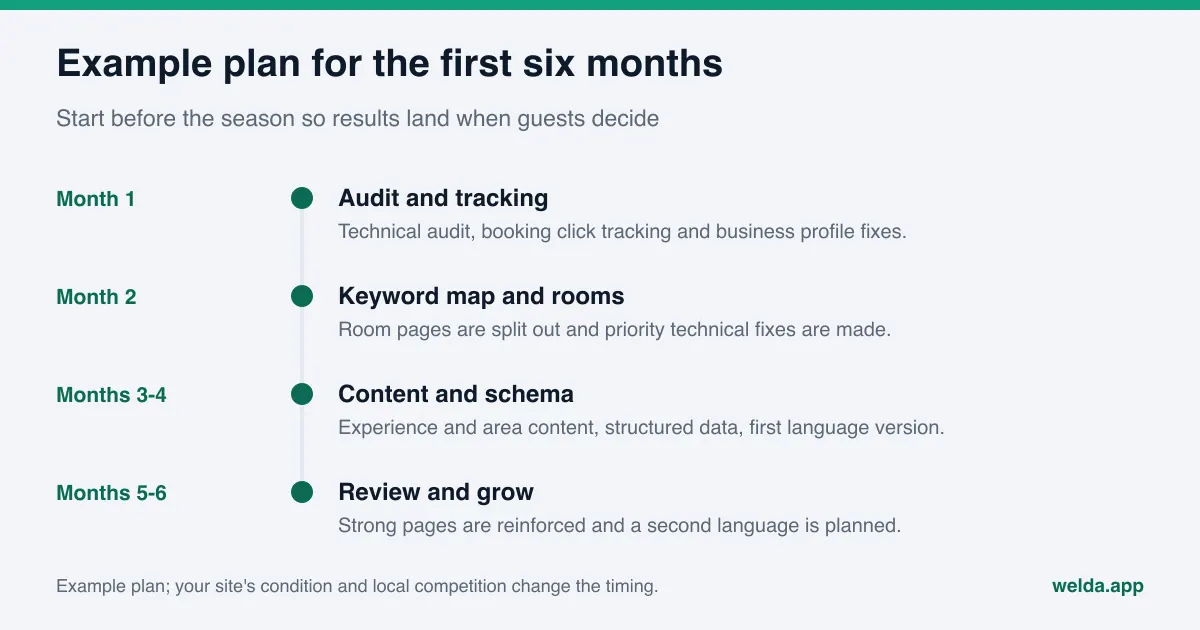
SEO is a long-term effort, and timing matters even more for hotels because guests usually plan holidays weeks or months ahead. Content for the summer season should be visible during the months when booking decisions are made, not when the season opens. Starting before the season is what makes the results land at the right time.
The first month goes on the technical audit, tracking setup and fixing the business profile. The second month brings the keyword map, restructuring the room pages and the priority technical fixes. In months three and four come experience and destination content, structured data and fixing the first language version. In months five and six the results are read, well-performing pages are strengthened and a second language or new content groups are planned. Technical fixes can show an effect within weeks; content and ranking gains usually become clear somewhere between three and nine months, depending on local competition and the site's starting point.
How Welda approaches hotel SEO
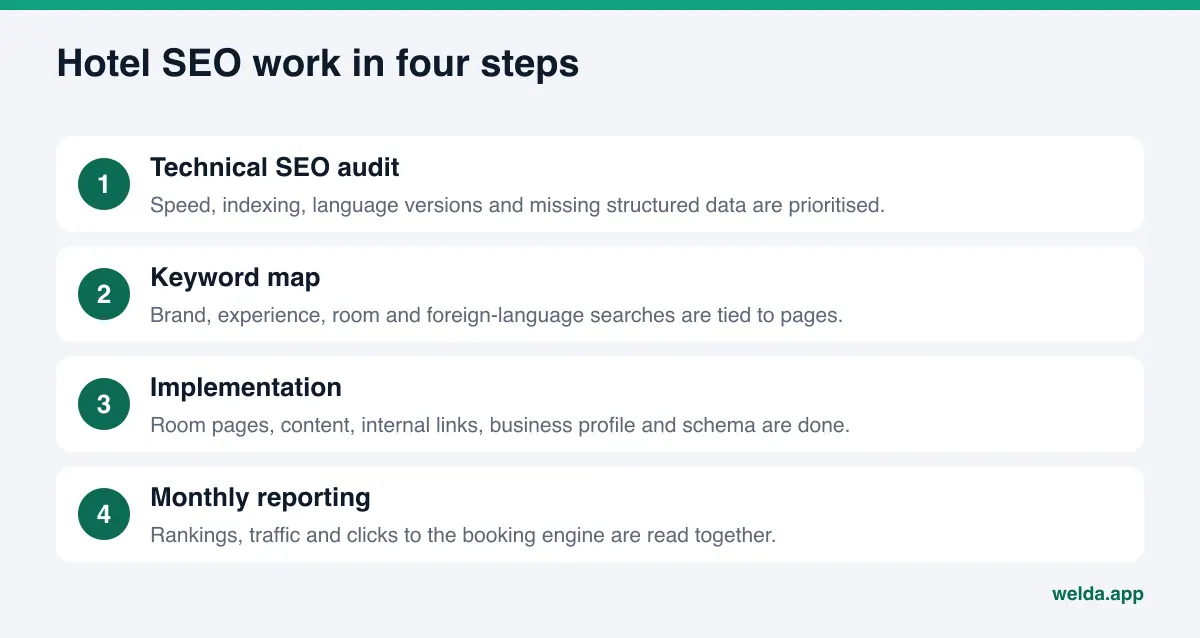
Welda's SEO services bring technical SEO, content and internal linking together under one team. For hotel websites, the work runs in four steps.
Technical SEO audit. We review your site's technical health, current rankings and the competition in your area using Search Console, Screaming Frog and PageSpeed Insights. Image weight, mobile speed, indexability, language versions and missing structured data are collected in a prioritised report.
Keyword and content strategy. Through search intent research we identify brand, experience, room and foreign-language searches, and prepare a keyword map tying them to your pages plus a content calendar for your approval.
Implementation. We carry out the technical fixes, optimise room and amenity pages, titles and descriptions, produce the content and strengthen the internal linking structure. Google Business Profile, map visibility and local directories are part of this step, and we add Schema.org structured data based on your hotel's details.
Tracking and monthly reporting. We monitor rankings, impressions, organic traffic and conversions. At the end of each month we share progress in a plain report and plan the next month's priorities with you.
We use white-hat methods only and do not guarantee you the number one spot; no agency can honestly do that. If your site needs rebuilding to support room pages or language versions, we scope that separately as web design and development work.
Who it suits, and who it does not
Hotel SEO services pay off most when your hotel has its own website and a working booking engine; when you want to reduce reliance on commission-based channels; when your property has a concrete experience, location or variety of rooms worth describing; when you can take part by sharing information and photos over several months; and when you accept that results are measured in months.
In some situations it is better to solve something else first. If there is no booking engine on your site and guests can only book by phone or message, turning traffic into bookings is hard; the booking path needs to come first. If you have an occupancy problem in the next few weeks, SEO will not solve it in time; paid advertising may suit the short term better. If the hotel is about to change hands or be renamed, starting after that decision protects the effort. We discuss all of this openly, and if SEO is not the right tool, we say so.
Frequently asked questions
Will hotel SEO services remove the need for booking platforms?
No, and aiming for that is not realistic. Platforms remain strong on generic comparison searches and are one way to reach new guests. The aim of hotel SEO is to make sure guests who are already looking for you, or for a specific experience, book directly on your site, shifting your channel mix in your favour.
When will I see results?
Technical fixes and business profile improvements can show an effect within weeks. Content and ranking gains usually become clear between three and nine months. If you are a seasonal hotel, start well before the months when guests make booking decisions.
Do I need to change my booking engine?
Usually not. SEO work runs alongside your existing engine; what matters is that the move from your site to the engine is smooth and measurable. Features such as a Google hotel search connection depend on your provider, and we check that together.
How many languages should I produce content in?
Start with the countries in your guest data. For most hotels, doing one or two foreign languages well, the ones that send the most guests, brings more bookings than opening many languages poorly.
What does the free SEO report show?
The report runs the page you enter through more than 20 checks across technical setup, content, server speed, mobile readiness and structured data, and scores it out of 100. It does not include keyword rankings or competitor analysis; we cover those with our SEO team in a call.
How is the cost of hotel SEO services worked out?
Instead of a fixed price list, we prepare a scope and proposal based on your site's condition, number of languages, content volume, local competition and number of properties. Bring your website address, the countries your guests come from and the booking engine you use, and that is enough to start.
The quickest way to see where direct bookings are slipping away is to look at your site together. Run the free SEO report first, then book a call with us; we will talk openly about which searches your hotel can win and whether SEO is the right tool for you.