Law firm SEO services are worth paying for when they bring you qualified enquiries for the work you actually want, not just traffic or a ranking screenshot. The short answer to choosing one: look for an agency that understands your regulator's publicity rules, builds content around the questions prospective clients really ask, gets your local presence right, and makes a lawyer's expertise visible without exaggerating it. Everything else (technical audits, keyword research, monthly reports) is table stakes that every agency will list. The difference lies in how those things are done for a profession where a careless sentence can be a conduct issue and a wrong answer can mislead someone at a vulnerable moment.
This guide is written for partners and practice managers at small and mid-sized firms who either have a website that produces almost no enquiries from Google, or who are comparing agency proposals and struggling to tell them apart. We cover where the line sits between information and promotion, what actually moves the needle in legal search, how to structure the sign-off workflow so it doesn't stall, and what to ask in the first meeting. It is not legal or regulatory advice; when in doubt, your regulator's guidance wins.
Why law firm SEO is different from other industries
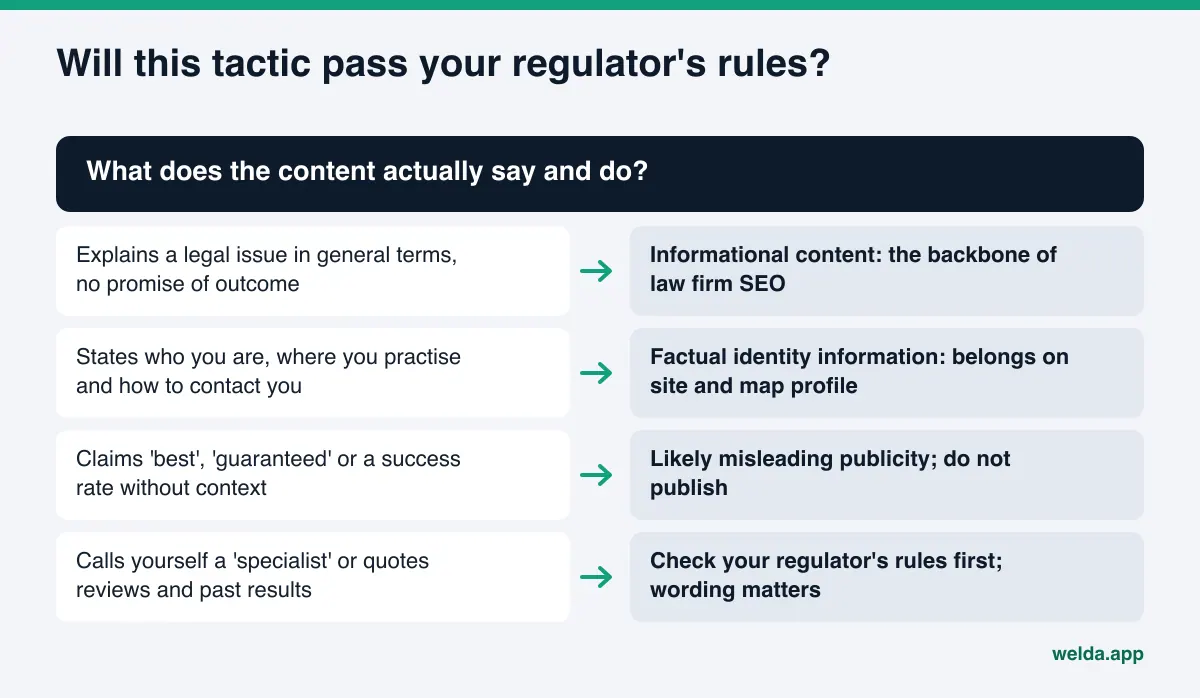
In most industries, marketing copy is judged on whether it sells. In law, it is also judged against professional conduct rules. In England and Wales, the SRA Code of Conduct requires that publicity is accurate and not misleading, and the SRA Transparency Rules require certain firms to publish information about prices and services for specified areas of work. In the United States, state bar rules based on the ABA Model Rules restrict false or misleading communications, regulate direct solicitation and limit how lawyers describe themselves as specialists. Other jurisdictions have their own versions, and some are considerably stricter.
Unlike some countries where lawyer advertising is almost entirely prohibited, firms in the UK and US can run paid search ads. That changes the economics but not the logic. Paid clicks in legal categories are among the most expensive in any market, and the moment you stop paying, the visibility stops. Organic search compounds: a well-written guide to a common client question can bring enquiries for years. Most firms that grow sustainably online use paid search tactically and treat SEO as the long-term asset.
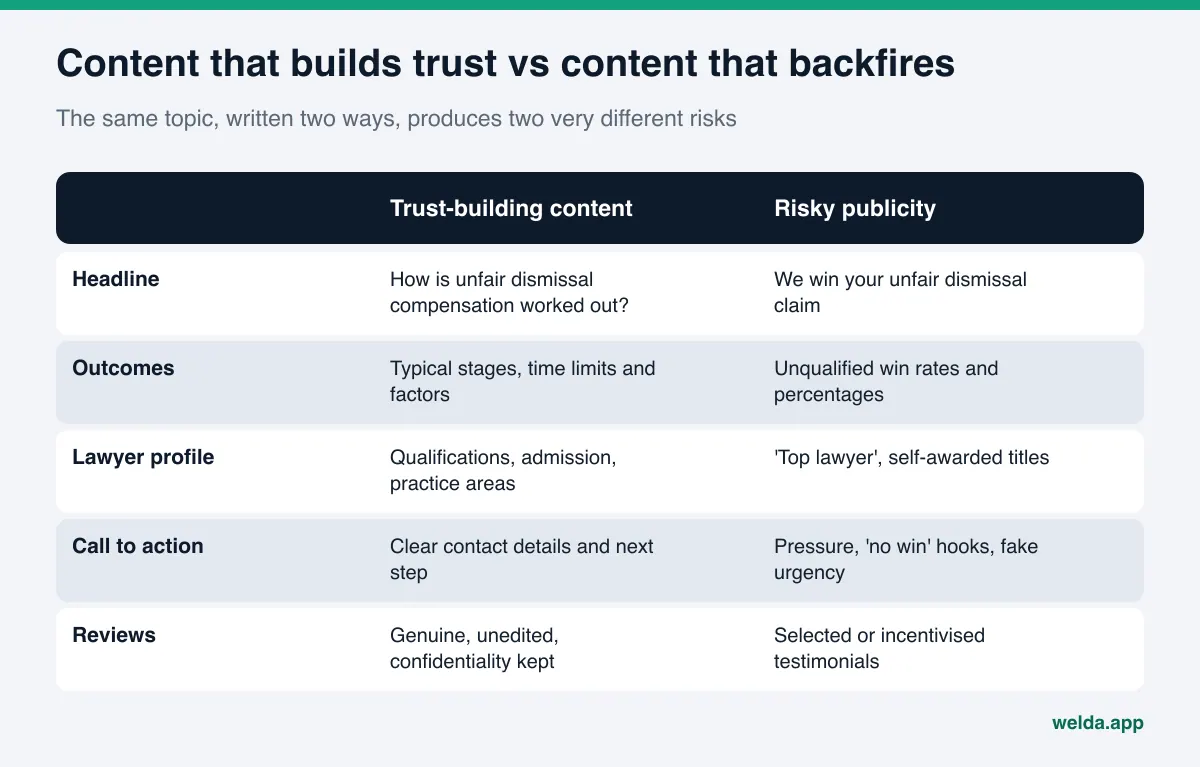
The problems start when an agency carries habits from e-commerce or lead generation into legal work. Phrases like "the best divorce lawyers in town", "guaranteed results" or "call now before it's too late" are standard elsewhere and a liability here. Selective case results, incentivised testimonials and pressure tactics fall into the same category. If an agency pitches these to you as conversion boosters, it is working from its template, not from your profession's rules.
The three pillars: content, local visibility and trust
A law firm's visibility in Google rests on three pillars. The first is informational content: guides, practice area pages and FAQs that answer what prospective clients are trying to understand. The second is local visibility: appearing for searches such as "employment solicitor Leeds" or "family lawyer near me" through your website and Google Business Profile. The third is trust: the experience, expertise, authoritativeness and trustworthiness signals Google summarises as E-E-A-T, shown consistently on your site and across the web.
When one pillar is missing, results stay weak. A brilliantly written guide on a site where it is unclear who wrote it carries little trust. A firm with a perfect map listing but no practice area pages will mainly be found by people who already know its name. A technically flawless site with no content has nothing to tell Google. A competent agency should be able to tell you in the first meeting which pillar is weakest in your case.
Informational content
The most valuable legal content is what your lawyers already say on the phone and in first meetings. "How long do I have to bring an employment tribunal claim?", "Can my landlord keep my deposit for cleaning?", "What happens if someone contests a will?" These questions are searched constantly and they are informational by nature. The answer should rest on the statute, current guidance and real-world timescales, but it must be written for a worried non-lawyer, not for a judge.
Local visibility
Most legal work is local; people look for a firm in their town or near the relevant court. Consistency between your Google Business Profile, the address and phone number on your site and your practice area pages matters a great deal. We cover the mechanics in our local SEO and Google Business Profile guide. The law-specific twist is that your profile description, posts and review replies are publicity too, so the same accuracy rules apply.
Trust signals
Legal topics fall under what Google calls "Your Money or Your Life": subjects that can affect someone's finances, safety or wellbeing. In these areas, who wrote the content matters more. Lawyer profile pages with admission details, qualifications and publications, named authors and reviewers on articles, and visible "last updated" dates form the foundation. Our E-E-A-T guide explains how these signals work in practice.
How prospective clients actually search
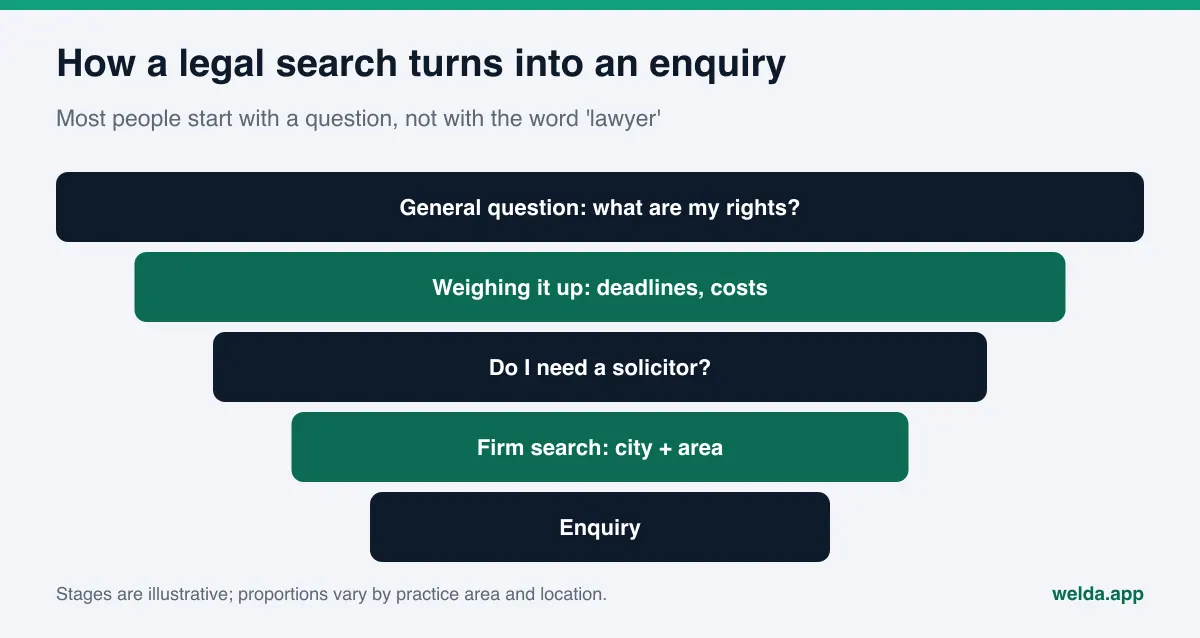
Legal searches rarely start with the word "lawyer". People first try to understand what has happened: "Is my employer allowed to cut my hours?", "What does a section 21 notice mean?" Then they weigh up their situation, looking for time limits, likely costs and what documents they need. At some point they realise they can't handle it alone and search for "employment solicitor" or "landlord and tenant lawyer Manchester". Finally, they compare two or three firms' websites and contact one.
Different content works at each stage. General guides serve the first, pages on deadlines, process and evidence serve the second, practice area pages serve the third, and lawyer profiles and the contact page serve the last. It is tempting to focus only on the final "city + lawyer" searches because intent is highest there. But that is also where competition is fiercest, and a new site with few trust signals will take time to break through. Clear answers at the earlier stages introduce your firm's name before the person has even started looking for a lawyer.
One caution: tacking a hard sell onto the end of an informational article can change its character. The better approach is to state plainly, at the end, which area your firm works in and how to get in touch. Readers who need you will find you.
What a strong practice area page looks like
Practice area pages are often the weakest part of a law firm's website. Many consist of two sentences under a heading like "Employment Law" followed by a long bullet list of matter types. That tells readers very little and gives Google no reason to believe you genuinely work in the area, yet it is exactly the page people read when searching with high intent.
A strong practice area page first explains, in plain language, the situations the area covers: dismissal, redundancy, discrimination, settlement agreements, tribunal claims. It then describes how the process generally unfolds, which documents matter and which deadlines must not be missed. Who in the firm handles this work, links to related guides and clear contact details complete the page. There is no need for "we always win" or "the most experienced team"; what readers value is understanding what happens next.
Firms with several offices often duplicate the same page for every city and swap the place name. Google treats near-identical pages like this as low value. If you create location pages, differentiate them with the office's real address and team and with genuine local information. The same applies to AI-driven search features: pages that answer a question directly, consistently and with sources are more likely to be cited in AI summaries.
How to choose law firm SEO services: the criteria that matter
Agency proposals tend to look alike: technical audit, keyword research, content production, monthly reporting. For a law firm, the difference lies in how each line item is delivered. The criteria below help you see the real gap when proposals sit side by side. For a broader framework, see our guide to evaluating SEO proposals.
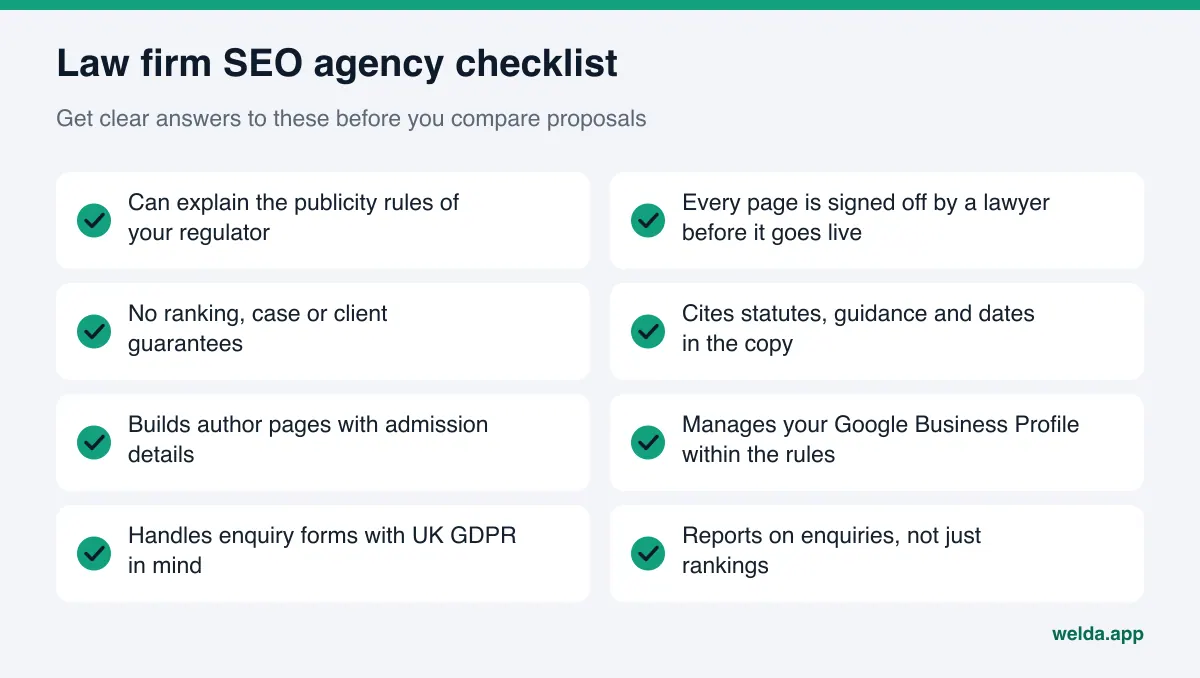
Knowledge of the rules. The agency should be able to explain, in its own words, how your regulator's publicity rules affect content. "We work in every sector" is not an answer; they should be able to give examples of wording they would never use.
A sign-off process. Every page must be reviewed and approved by a lawyer before it goes live. Check whether the agency builds this into its written process and how it chases drafts awaiting approval.
Citing sources. Legal content should cite the relevant statute, guidance and dates, and case law where it helps. Generic, unsourced paragraphs tell readers and Google very little.
No guarantees. An agency promising first place, a number of cases or a set volume of clients either doesn't understand search or is misleading you. Nobody controls Google's results.
Honest measurement. Reports should talk about impressions and clicks from Search Console and enquiries from the site, not just ranking tables.
Data protection awareness. Enquiry forms on a law firm site can carry sensitive information. Privacy notices, what your analytics tools collect and how form submissions are stored are issues the agency should raise without being prompted, with UK GDPR or the relevant local law in mind.
The law-firm workflow: lawyer time is the scarcest resource
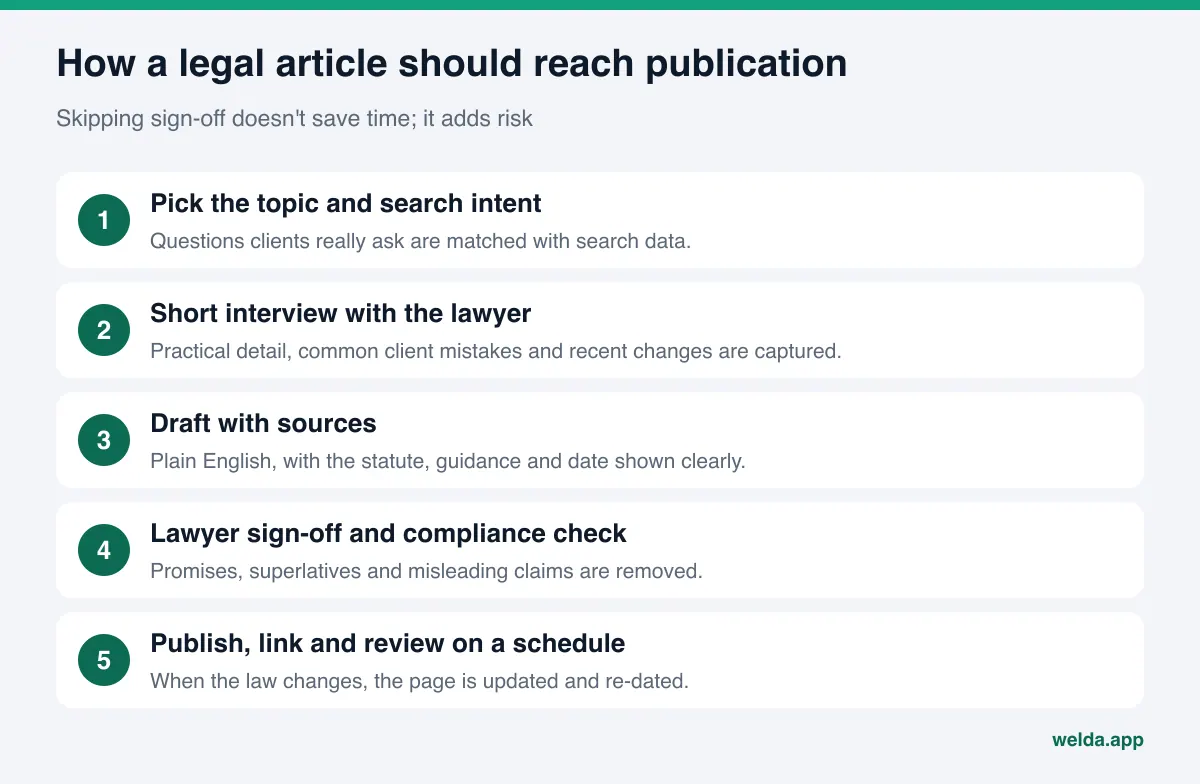
Most legal SEO projects slow down not for technical reasons but because of a sign-off bottleneck. The agency drafts a page, it sits in a partner's inbox for weeks, the schedule slips and a few months later someone concludes that "SEO didn't work". The fix is a workflow that uses lawyer time where it adds most value.
In workflows that run well, the lawyer neither writes from scratch nor merely proofreads. They join a short call at the start of each topic. In fifteen minutes the writer captures practical detail, the mistakes clients typically make and recent changes. Content built on those notes is more original and needs fewer corrections at sign-off. At review, the lawyer checks two things only: legal accuracy and compliance with the publicity rules.
The work doesn't end at publication. When legislation changes or an important judgment lands, the relevant page must be updated. An out-of-date legal article is worse than none; it misleads readers and erodes trust. Every article should show a "last updated" date, and the agency should keep a review schedule.
Questions to ask in the first meeting
Instead of sitting through a presentation, ask questions. The answers to these will quickly show whether a team is ready to work with a law firm.
- Can you name five phrases you would never put on a law firm website?
- How does your sign-off process work, and when do you chase a draft that is waiting for approval?
- How do you cite sources, and where do statutes and dates appear in the copy?
- What would you put on a lawyer profile page, and what would you leave off?
- How do you recommend we reply to Google reviews?
- How do you measure success, and how do you track enquiries?
- When the law changes, who updates old content, and how quickly?
- If we part ways, who owns the content, accounts and access?
If the answers are vague, or every question loops back to a rankings chart, the team isn't ready for the nuances of your field. A team that gives concrete examples and is willing to say "we don't know, please check with your regulator" is more trustworthy.
Common mistakes law firms make with SEO
Trying to rank for everything. A small firm with pages for crime, family, employment, commercial, immigration and property can't go deep on any of them. Focusing on the two or three areas you genuinely practise is both more honest and more effective.
Using copied or unchecked content. Text lifted from other sites, or produced quickly with AI and never checked by a lawyer, is weak in Google's eyes and dangerous in a field where accuracy matters. AI can help with a first draft; the final word must always be a lawyer's.
Casual use of "specialist" or "expert". Depending on your jurisdiction, specialist claims may be restricted or need to be backed by accreditation. Neutral language such as "our practice areas" gives readers the same information without the risk.
Mishandling reviews. Reviews can be valuable, but they must be genuine and unedited, and replies must never reveal anything about a client or matter. Incentivising or cherry-picking reviews can be misleading.
Launching the site and walking away. If the site structure isn't right from day one, adding content later becomes painful.
Onboarding: what the first months look like
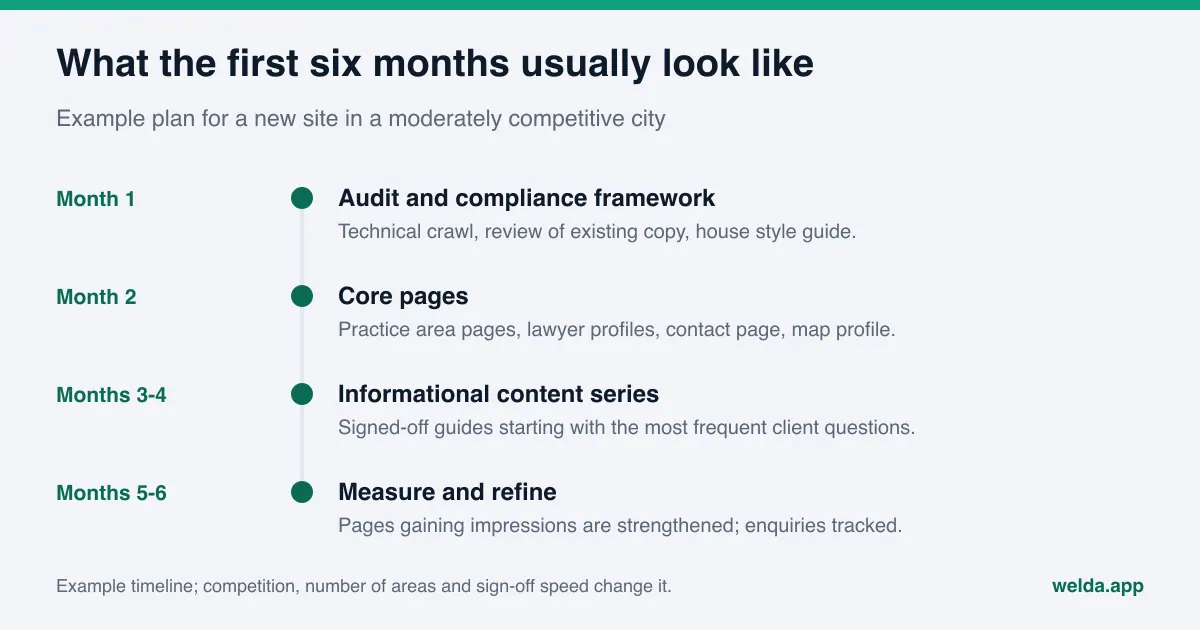
A law firm SEO engagement usually starts with an audit: the site's technical health, whether Google can see the pages, how existing copy measures up against publicity rules, and which searches competing firms appear for. A common finding at this stage is that the current site already contains non-compliant phrasing nobody noticed; that gets cleaned up first.
The second step is core pages: practice areas, lawyer profiles, the contact page and the Google Business Profile. Building guides before these are in shape is like adding floors to a building with no foundations. Then comes a content series that starts with the most frequent client questions. Measuring and refining is ongoing: titles of pages gaining impressions but few clicks are reworked, and topics of pages with no impressions are reconsidered.
The honest answer to "when will we see results?" is "it depends". In a less competitive area and town, the first enquiries may arrive within a few months; in crowded practice areas in large cities it can take a year. Prefer an agency that shows progress transparently every month over one that promises a date.
What drives the cost of law firm SEO services
Law firm SEO can't be priced with a single number because the scope varies so much between firms. The main cost drivers are the site's technical state and whether it needs rebuilding, the number of practice areas targeted, the number of locations or offices, how many articles are produced each month and how long they are, the number of interviews and sign-off rounds, whether content is needed in more than one language, and the depth of reporting.
When comparing proposals, look beyond the total and check whether each of these is actually included. A cheap proposal may leave out sign-off support or updates; an expensive one may include scope you don't need. Starting with a free SEO report on your current site means you arrive at any meeting with concrete data.
How Welda delivers law firm SEO
Welda's SEO service starts with a technical audit: site speed, indexability, mobile usability, broken links and structured data are checked with tools such as Search Console, Screaming Frog and PageSpeed Insights, and issues are gathered in a prioritised report. Keyword and search intent research then produces a keyword map that ties each page to the right search, plus a content calendar presented for your approval.
Implementation covers technical fixes, on-page optimisation, content production, internal linking and local SEO including your Google Business Profile. For law firms we shape the content side around professional rules: informational tone, cited sources, author and update details, and every page submitted for your sign-off before publication. Final responsibility for legal accuracy and regulatory compliance always stays with the firm; our job is to give you clear, sourced, promise-free drafts that make that decision easy. Our content production service supports the copywriting side.
We then track rankings, organic traffic and enquiries and share progress in a plain monthly report. We use white-hat methods only and we don't guarantee first place, because nobody honestly can.
Who this is for, and who it isn't
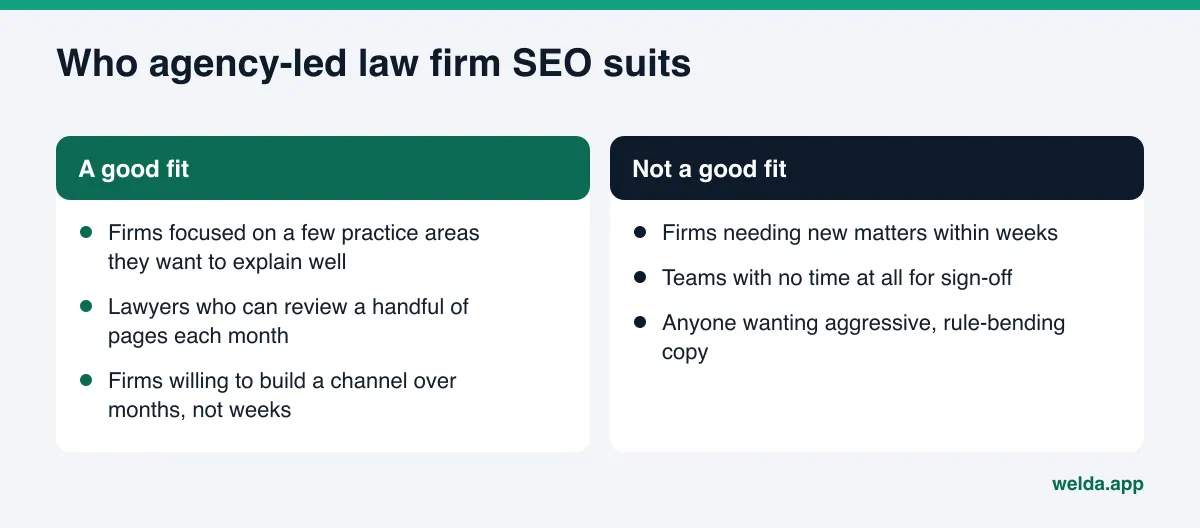
Agency-led law firm SEO suits firms that focus on specific practice areas and want to explain them well through informational content. Firms whose lawyers can review a handful of pages a month, and who are prepared to build a channel over months rather than weeks, get the most from it.
It isn't the right investment for firms that need new matters within weeks, teams with no time at all for sign-off, or anyone looking for aggressive copy that bends the rules. In that situation it makes more sense to fix the core pages and Google Business Profile first and start the content programme once there is time to support it. We say so plainly in the first conversation; taking on work that doesn't fit helps nobody.
If you'd like to talk through where your firm stands in Google today and which steps should come first, get in touch. We'll look at your site, define the scope together and prepare a tailored proposal.
Frequently asked questions
Is SEO allowed under legal advertising rules?
In most jurisdictions, publishing accurate informational content and improving your website technically is not treated as problematic. Issues arise when content becomes misleading: superlatives, unsupported claims, guaranteed outcomes or improper solicitation. If in doubt, check your regulator's guidance.
Should we use Google Ads as well as SEO?
In the UK and US, paid search is permitted for law firms, subject to the same accuracy rules. It works quickly but costs rise with competition and stop the moment you stop paying. Many firms use ads for specific campaigns and rely on SEO for long-term visibility.
Do our lawyers have to write the content?
No, but they do need to take part. The best results come from content drafted after a short interview with the lawyer and signed off by them before publication, with the lawyer named as author or reviewer.
Can we use client reviews on our website?
Depending on your jurisdiction, genuine reviews may be allowed, but they must not be misleading, edited or incentivised, and replies must never disclose client or matter information. Check your regulator's rules before featuring them.
How long does law firm SEO take to work?
It depends on competition in your practice area and location, the current state of your site and how fast content is signed off. In quieter markets, first enquiries can come within a few months; in competitive ones it can take a year. Be wary of firm dates.
How much does working with Welda cost?
Costs depend on the number of practice areas and locations, content volume, sign-off rounds and your site's technical state, so we don't use a fixed price list. In a free consultation we define the scope together and prepare a tailored proposal.