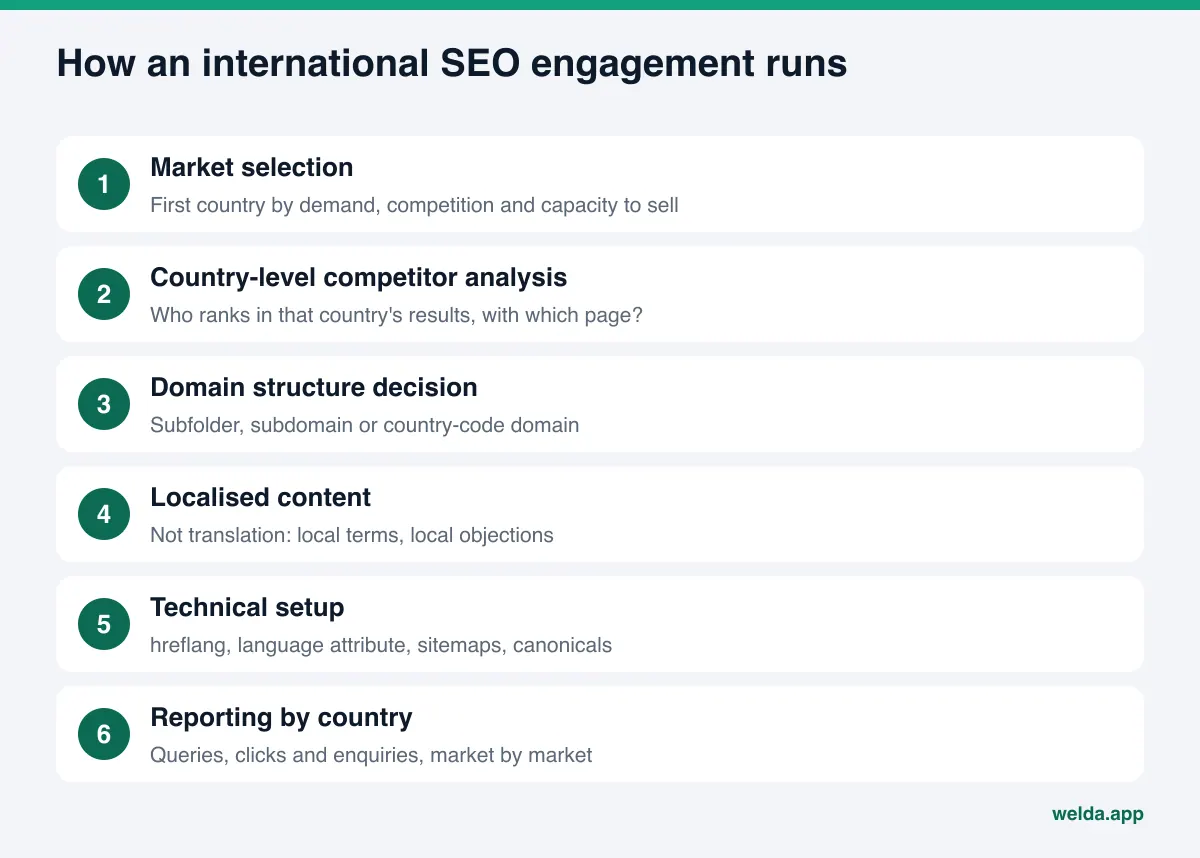
International SEO services help your website get found by buyers abroad when they search for your products or services in their own language, on their own country's Google results. Done properly, the work starts with five decisions: which market to enter first, who you are actually competing with in that country, how to structure your domain, whether content should be translated or localised, and how results will be measured market by market. hreflang tags are only the technical part of this. When you speak to an agency, the first thing you should hear is not "let's translate your site into five languages" but a data-backed answer to "which market first, and why".
This guide is for business owners and marketing leads at exporters, companies selling services across borders and anyone who wants customers from outside their home market. We cover the technical setup of a multilingual site separately in our multilingual SEO and hreflang guide. Here the subject is the buying decision: who to hire for this work, with what scope and in what order, what to ask on the call and how to track whether it is working.
What do international SEO services include, and what don't they?
In domestic SEO the target market is a given: one country, one language, one version of Google. In international SEO the target market itself is a decision. That is why a good international SEO engagement runs every component of domestic SEO (technical audit, keyword research, on-page optimisation, content, internal linking, reporting) separately for each market, and puts a market strategy layer in front of all of it.
Roughly, the scope should include: comparing candidate markets on demand and competition, studying the search results in the chosen country, deciding on domain and URL structure, building the technical links between language versions, a content plan that fits the language and habits of that market, localising priority pages and reporting separately for each market. Some of this is one-off (market selection, structure, technical setup) and some is ongoing (content, internal links, monitoring).
What may sit outside the scope should be agreed at the start too. Setting up a local entity, getting a local phone number, adding local payment methods or sorting out customs and delivery is not the SEO agency's job, but gaps there directly affect SEO results. If a visitor from Germany cannot see delivery times and returns terms in German, you will not get enquiries even if you win the rankings. A good agency won't fix those gaps for you, but it will flag them clearly in its reporting.
One more distinction matters: a multilingual website and international SEO are not the same thing. You can have a site in four languages and still be invisible in every foreign market. Equally, a handful of strong pages in one language, focused on one country, can produce meaningful demand. When you buy the service, the thing to measure is not the number of languages but your visibility for buyer queries in the target market.
Which market should you enter first?
The most expensive mistake in international SEO is entering too many markets at once. A site translated into five languages but deep in none of them stays weak everywhere, because in each country you are competing with local businesses that have been publishing in that language for years. Concentrating your resources on one market, getting results there and then moving to the second is almost always more efficient.
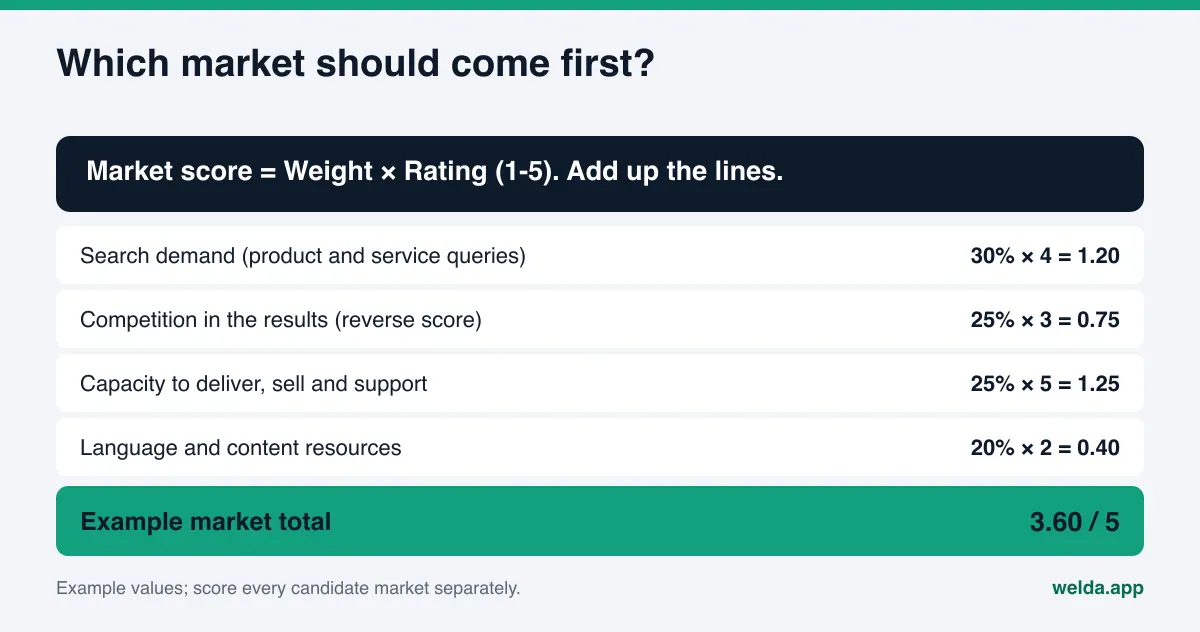
Look at four questions when choosing a market. First, demand: is anyone in that country searching for what you sell, and do those searches carry buying intent? Second, competition: who holds the top results in that country, and do you have the content and authority to compete with them? Third, capacity: can you deliver to that market, quote in that language and respond to customers in that time zone? Fourth, language and content resources: is there someone who can explain your product and answer questions in that language, or can you find one?
Turning those four questions into a simple score takes the decision out of gut feeling and makes markets comparable. The example below shows a market with high demand and strong capacity but weak language resources. A result like that doesn't say "don't enter"; it says "solve the language resource first".
A common mistake on the demand side is looking up the literal translation of your home-market product name. Buyers search for the same product with different terms in different countries; the term often differs even between the UK and the US. Demand analysis therefore has to be done in each country's own language and on its own Google results. For the same product group, the gap between countries can be significant:
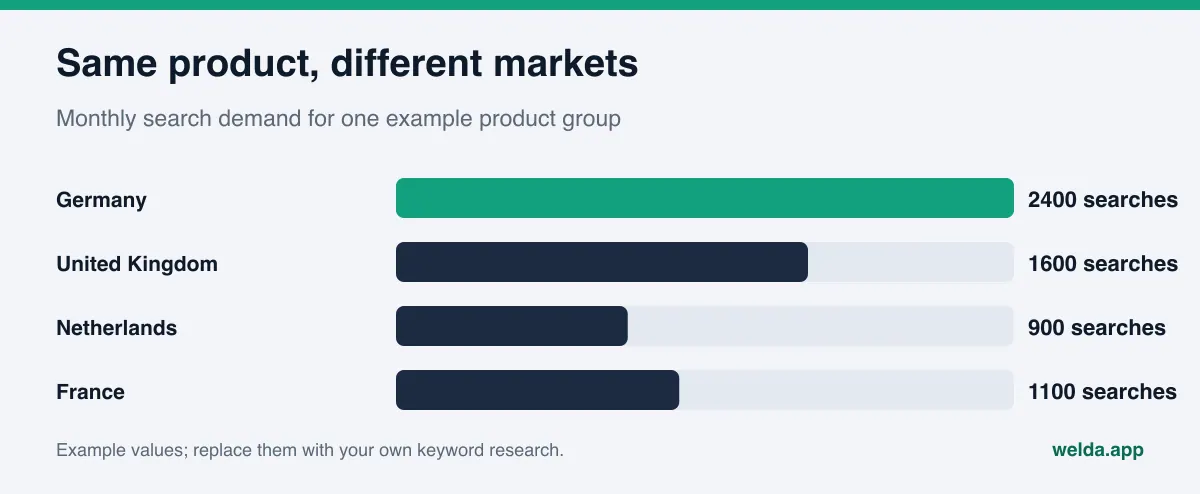
When you see a table like this, don't immediately chase the highest demand. Where demand is highest, competition usually is too. A smaller market where competitors are weak and you already have sales relationships can produce the first results faster. Wherever your existing customers, trade-show contacts and distributors are is often a good starting point, because organic visibility strengthens a sales relationship that already exists.
Country-level competitor analysis: your competitors at home aren't your competitors there
At home you usually know who you are up against. Abroad, the competitors in the search results can be entirely different from the companies you meet in the field. A product query in Germany might show a local manufacturer first, a comparison site second and a marketplace listing third. That picture tells you two things: what kind of page wins that query, and what kind of page could get you in.
From an agency's country-level competitor analysis, expect the following: a look at the target country's own Google results (in that country's language and location), the type of each first-page result for priority queries (product page, category, guide, marketplace, directory), notes on the content depth and trust signals of competing pages (delivery, certifications, contact details, returns) and a clear split of the queries where you have a realistic chance. We explain the general method in our SEO competitor analysis guide; the only difference internationally is that it is repeated for every market.
Sometimes the analysis turns up an unexpected answer: the first page in the target country is entirely marketplaces and large distributors, and an independent manufacturer's site will struggle to get in. In that case an honest agency will point you towards longer, more technical or B2B queries instead, such as searches for specific sizes, materials or applications rather than the generic product name. Those queries have smaller volume, but the person searching is often exactly your customer.
Domain structure: subfolder, subdomain or country-code domain
Where you publish your language versions is one of the most permanent decisions in international SEO; changing it later is as much work as a site migration. There are three basic options: language or country folders under your main domain (example.com/de/), subdomains (de.example.com) and a separate country-code top-level domain for each country (example.de).
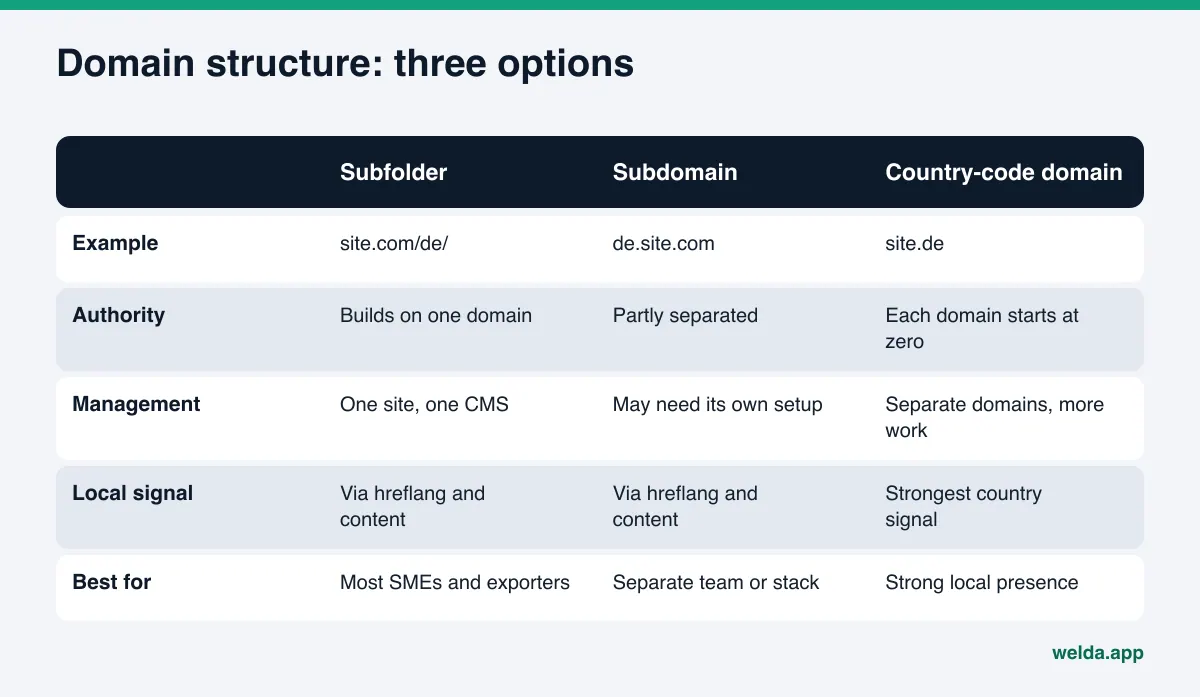
With subfolders, every language version shares the trust built up by one domain, everything is managed from one CMS and technical maintenance happens in one place. That makes it the most balanced choice for most SMEs and exporters. Welda's own site uses this structure: the Turkish version sits at the root, English under /en/ and German under /de/, with each page linked to its equivalents in the other languages. The Turkish and German versions of the article you are reading live in those folders, rewritten for their own markets.
Country-code domains send the strongest country signal; a German user may read a .de domain as a local company. But each domain builds its authority from zero, and each one means separate maintenance, separate link work and separate measurement. That option makes sense for businesses with a real local presence in the country (an entity, a warehouse, a team) and the resources to run each market separately. Subdomains are usually chosen when a different team or a different platform is involved; on their own they give no SEO advantage.
Be clear about language versus country as well. Will you serve the UK, Ireland and Australia with the same English content, or do pricing, delivery and regulation differ enough to justify separate pages? In most cases one English version is enough; a country-specific version is only needed when the content genuinely differs. Publishing the same content three times with only the country name changed creates duplicate-content problems and adds nothing for any of those countries.
Translation or localisation?
This is where most money is lost when buying international SEO services. Running your pages through a translation tool, or through someone who simply speaks the language, is fast, but from a search point of view it is often wasted. Translation carries over the keyword your original page targeted, while buyers in the other country may search for the same need with a completely different word.
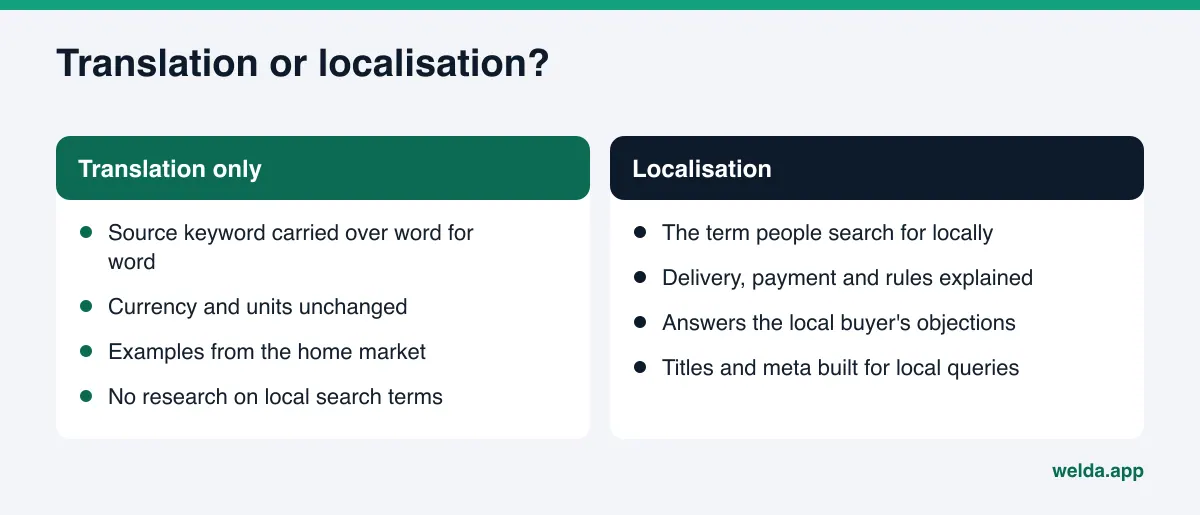
Localisation works on four layers. The first is terminology: separate keyword research for each market, with each page built around the term people actually search for there. The second is context: currency, units, delivery times, payment methods, warranty and returns explained the way that market expects. The third is regulation: selling to EU consumers brings GDPR-compliant privacy information and EU consumer-rights rules on withdrawal and returns; selling in Germany also means an Impressum. The fourth is the language of persuasion: in one market references and certifications build trust, in another it is technical data sheets and fast sample delivery.
That doesn't mean everything must be written from scratch. Product specifications, technical tables and process descriptions can be carried over with a good translation. But the title, meta description, opening paragraph, FAQs and call to action need to be rethought for the market. A practical rule: localise what the search engine and the buyer see first; translate the deeper technical detail and have a native speaker review it.
AI translation tools can speed this up, but left alone they cause two problems: they pick terms nobody searches for in the target country and they mistranslate industry-specific phrases. Always ask an agency who writes the content, who reviews it and whether the terms were researched in that country.
Technical setup: hreflang, language attributes and crawling
We keep the technical side short here because our hreflang guide covers it step by step. What you need to know when buying the service is that technical setup isn't a one-off job. Every new page, every removed product and every URL change can break the links between language versions.
The minimum technical scope to expect: each language version reachable at its own URL without forced redirects based on browser language; a correct language declaration in the page's HTML; reciprocal hreflang annotations between versions plus a defined default; a self-referencing canonical on each version; sitemaps that include the language versions; and the ability to monitor each language folder separately in Search Console. Forcing visitors into a language by IP address confuses both users and crawlers; a visible language switcher is the better option.
To see where your site stands today, you can use our free SEO report. It examines your page's raw HTML and shows core checks such as the language declaration, canonical, sitemap, robots.txt and redirects. Rankings, competitors and country-level analysis are outside the report's scope; those are what a conversation with our team is for.
Reporting: no decisions without country-level data
The most common reporting problem in international SEO is merging every market into one total. "Organic traffic is up 40%" says nothing about your foreign-market investment if the whole increase came from your home-language pages. A report has to be readable market by market.
A good international SEO report shows these lines for each market separately: impressions and clicks from that country, clicks on non-brand product and service queries, average position on priority queries, form submissions, quote requests and calls from that language version, and next month's task list for that market. Country and page filters in Search Console and a language-folder segment in Analytics make this possible. On the enquiry side, recording which language version a form or quote request came from lets your sales team verify the report too.
Patience is part of reporting as well. A new language version behaves like a new website: impressions rise slowly in the first months and clicks come even later. The timelines in our article on how long SEO takes are usually longer in foreign markets, because authority in that language starts from zero. The report should therefore include early indicators too, such as indexed pages, the number of queries earning impressions and queries moving towards page one.
Questions to ask when choosing international SEO services
On an agency call, the answers to your questions matter more than the slides. The questions below quickly show whether an agency genuinely thinks market by market.
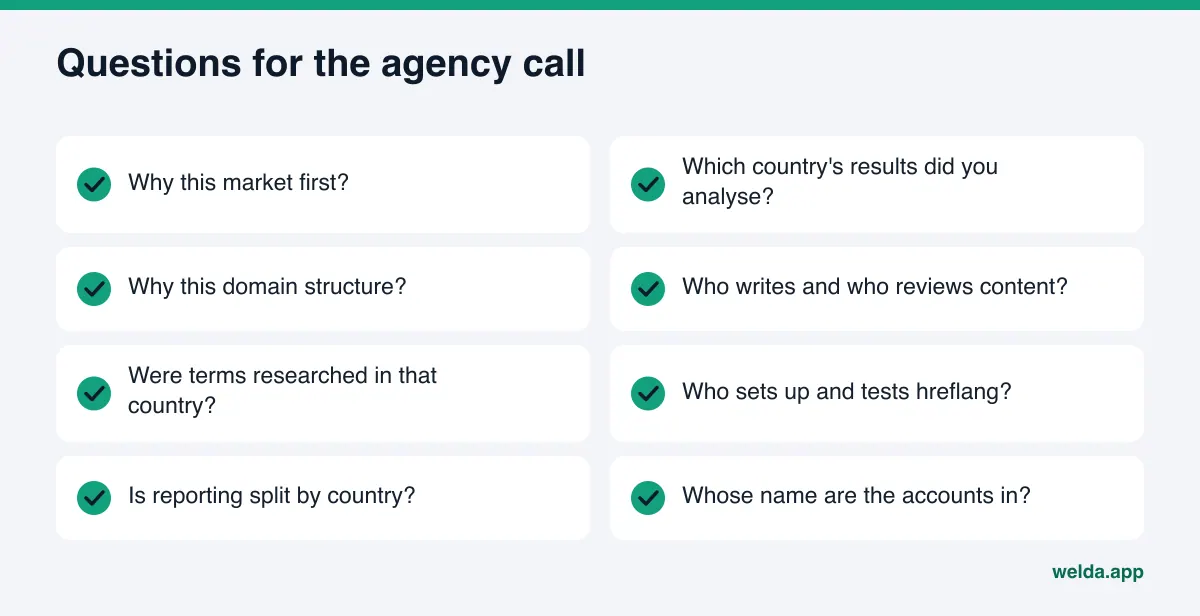
A good answer to "why did you recommend this market first?" refers to demand and competition data and to your capacity to sell. A good answer to "which country's results did you analyse?" includes concrete examples from that country's results page. A good answer to "who writes and who reviews the content?" names separately who does the writing, the term research and the native-speaker review. The only acceptable answer to "whose name are the accounts in?" is "yours": Search Console, Analytics and any business profiles in the target country should stay the property of your company.
When comparing proposals, you can use the weighted scoring from our guide to evaluating SEO proposals. For an international proposal, look for three extra lines: the market choice and its rationale, a separate task list per market, and reporting by country. A proposal without those three is most likely a domestic SEO proposal multiplied by the number of languages.
The warning signs are clear too. Be wary of proposals that guarantee a position in a foreign market, sell packages by number of languages without looking at your site's data, rely only on machine translation for content, or keep account access in the agency's name. Proposals that sell link building as a count, such as an "international backlink package", also deserve scrutiny; links that don't come from genuinely relevant sites in the target country bring risk rather than benefit.
Common mistakes
The first mistake is translating the whole site at once. Moving hundreds of pages into a foreign language in one go uses up the budget and gets low-quality pages indexed. Localise the pages that bring in sales first (services, product categories, best-selling products, contact and quote pages) and leave the blog and support content for later.
The second mistake is translating your home-market keyword list and using it as the target list. As explained above, each market searches with different terms. A translated list often contains words nobody searches for in that country, or words searched with a completely different intent.
The third mistake is leaving foreign visitors in a home-language process. If the page is in English or German but the form shows error messages in another language, the quote email arrives in your own language or the phone number only appears in your domestic format, organic visibility won't turn into enquiries. Before you start, decide who will answer a foreign-language enquiry, how quickly and in which language.
The fourth mistake is automatic country redirection. Forcing visitors into a language version by IP address can stop Google's crawler from seeing some versions at all, and it sends your own expatriate customers to the wrong language. The fifth mistake is measuring results with total traffic; without a country split you can't tell which market is working. Finally, language versions get neglected: the main page is updated while the foreign versions keep old product details or old contact information.
What drives the cost of international SEO services
Quoting a single market figure for international SEO services would be misleading, because scope varies so much from business to business. Knowing what drives a quote is more useful: it lets you compare the proposals you receive like for like.
The first driver is the number of markets. Each new market means separate keyword research, separate competitor analysis, separate content and separate reporting; two markets create close to twice the work of one. The second is the number of pages to localise: twenty prioritised pages and a full catalogue are very different jobs. The third is who produces the content: will the agency write it, or will your team write it with the agency optimising? The fourth is the technical starting point: is the site ready for a multilingual structure, or does the platform need changes first? The fifth is competition in the target market; a competitive query group needs more content and more time.
At Welda we don't publish a fixed price list for SEO. We define the scope together based on your site, your target markets and your content volume, then prepare a tailored proposal. Agreeing the drivers above on the call means you can see from the start exactly what the proposal covers.
The process: what the first six months look like
Every project is different, but you can picture the first months of a typical international SEO engagement that starts with one new market like this. The timings are examples; site size, whether the platform is ready and how quickly you approve content all change the schedule.
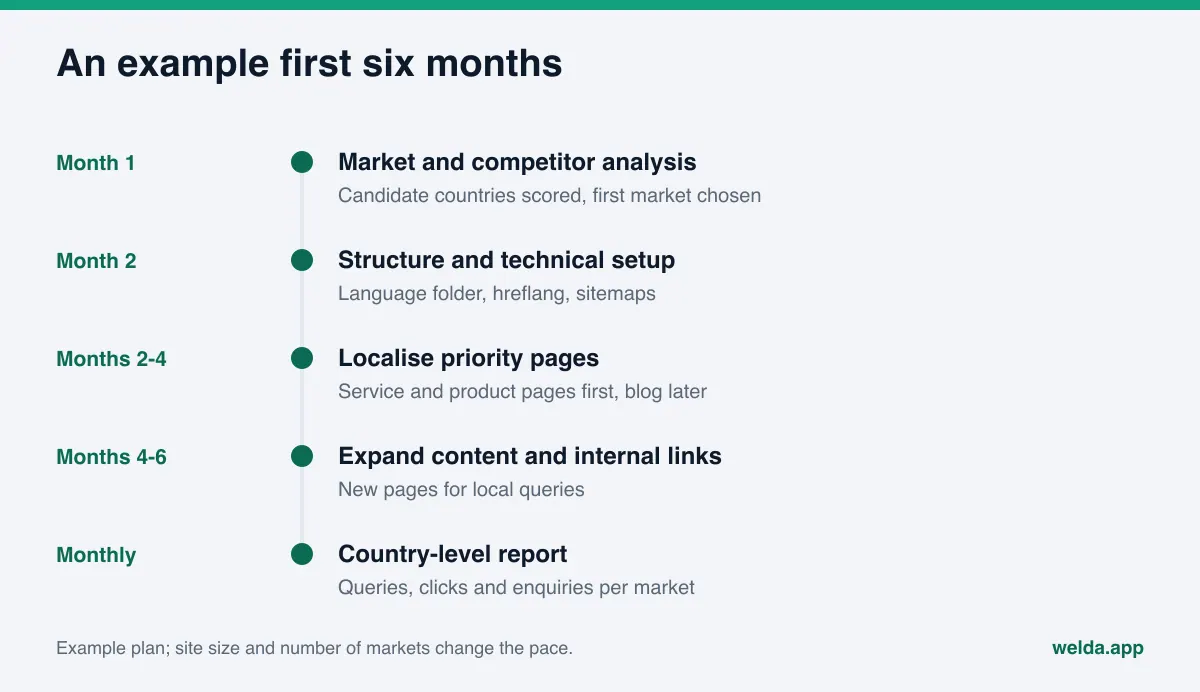
In month one, candidate markets are scored, the results in the chosen market are analysed and a keyword map for that market is built. In month two, the domain structure is implemented and the technical setup is done and tested. Between months two and four, priority pages are localised: first the service and product pages that bring in sales, then the guides that support them. From month four, new content and internal links are added based on that market's queries. Every month a per-market report arrives and the next month's priorities are set from it. Once the first market produces steady demand, the same cycle runs faster for the second, because the structure and process are already in place.
There is work on your side too: approving product details on localised pages, setting up how foreign-language enquiries are handled and clarifying delivery and payment information for the target market. If those steps slip, the SEO schedule slips with them. Planning them alongside the SEO timeline means you won't be caught unprepared when the first enquiries arrive.
How Welda handles international SEO
Welda's SEO service covers technical audits, keyword and search-intent research, on-page optimisation, content strategy and production, internal linking and site architecture, and monthly reporting based on Search Console and Analytics data. For international work we run these steps separately for each target market and put market selection and structure decisions in front of them.
We start with your Search Console and Analytics data. The impressions your current site already earns from other countries are often the first hint as to which market is ready. We then run keyword research for candidate markets in each country's language using Ahrefs or Semrush and study that country's results for priority queries. We recommend a domain structure based on your platform and goals; in most cases that means language folders under your main domain.
We built our own site the same way. welda.app is live in Turkish, English and German; the language versions sit in subfolders, pages are connected with hreflang and blog posts are rewritten for each market's own terms. This English version was written for UK and international English-speaking readers, and the German version separately covers that market's topics such as DSGVO and the Impressum. For languages other than Turkish, English and German, we discuss the scope and who will produce the content openly on the call.
We use white-hat methods only and we don't guarantee any position in any market, because nobody honestly can. The accounts stay in your name, and every month you see on separate lines what was done in each market and what came of it. If your site isn't ready for a multilingual structure, our web design and development team can build that foundation within the same project.
Who it suits and who it doesn't
International SEO services make sense when you can genuinely sell or deliver abroad, when there is demand for your product in the target market, when you have a team that can respond to foreign-language enquiries in reasonable time and when you accept that results build up over months. Exporting manufacturers, healthcare and hospitality businesses with international patients or guests, software and service exporters and e-commerce sites selling to foreign buyers are typical candidates.
In some situations another step comes first. If you have no organic visibility at home yet and your site's technical foundation is weak, it is more efficient to build that foundation on the main site first. If you can't deliver to the target market, organic visitors won't convert when they arrive. If you need enquiries within weeks, paid search may be a better way to test a new market; SEO is the better tool for making demand you have already validated with ads permanent. We can work out together on the call which of these applies to you.
If you want organic customers in foreign markets, the first step is simple: check your site's current state with the free SEO report, then get in touch with us to talk through your target markets, your capacity to sell and your priorities. On the call we'll use your data to work out which market should come first, which structure fits your site and what the scope should include.
Frequently asked questions
Are international SEO services the same as building a multilingual website?
No. A multilingual website publishes content in more than one language. International SEO makes those language versions visible in the target countries' search results, using the terms people actually search for there. You can have a multilingual site and still be invisible in every foreign market; international SEO closes that gap.
How many markets should I start with?
For most businesses, starting with one market is the most efficient route. Once the market with the best score on demand, competition and capacity is producing results, moving to the second is faster because the structure and process are already in place. Entering many markets at once spreads your resources thin.
Is a subfolder or a country-code domain better?
For most SMEs and exporters a subfolder is more balanced: authority builds on one domain and everything is managed in one place. A country-code domain sends the strongest local signal, but each domain builds authority from zero; it is worth considering if you have a strong local presence in the target country.
Is machine translation good enough for SEO?
On its own, usually not. Machine translation can speed things up, but it doesn't pick the term people search for in the target country and it can mistranslate industry language. Titles, meta descriptions, opening paragraphs and FAQs should be localised for the market, and the rest reviewed by a native speaker.
How long does international SEO take to show results?
Because a new language version behaves like a new website, results usually take longer than in domestic SEO. Early indicators such as indexing and rising impressions are tracked in the first months; enquiries build up over months depending on competition, content volume and the site's starting point.
What determines the cost of international SEO services?
The number of markets, the number of pages to localise, who produces the content, the site's technical starting point and competition in the target market. At Welda we don't use a fixed price list; we agree these drivers on a call and prepare a tailored proposal. You can request a call via our contact page.