The right healthcare SEO agency is the one that can show you how a medical page gets reviewed before it goes live, which patient searches it would prioritise for your specific services, and how it will connect its work to booked appointments rather than rankings alone. If a pitch answers those three points with process and evidence of how they work, keep talking. If it answers with a guaranteed position, a monthly article count and a tracking setup nobody has thought through, move on, however polished the slides are.
This guide is for practice owners and clinic managers who already know they want organic patient enquiries and now have to choose who to trust with that work. It focuses on what makes healthcare different from other SEO: where your patients are affects which rules apply, clinical accuracy has to survive a marketing workflow, and analytics can quietly become a privacy problem.
Start with geography, because the rules follow your patient
Most agency comparisons start with services. In healthcare, a better first question is jurisdiction. A dental group in Texas, a private dermatology clinic in Manchester, a physiotherapy practice in Melbourne and a hair transplant clinic marketing to patients abroad do not share one rulebook. An agency that talks about "healthcare SEO compliance" as if it were a single checklist has not worked through the detail, or is hoping you have not.
You do not need your agency to be your lawyer. You do need it to know which questions to raise, to stop before publishing something doubtful, and to accept that your counsel or professional body has the final word. The table below is a set of starting points to discuss, not legal advice, and these rules change, so verify the current position locally.
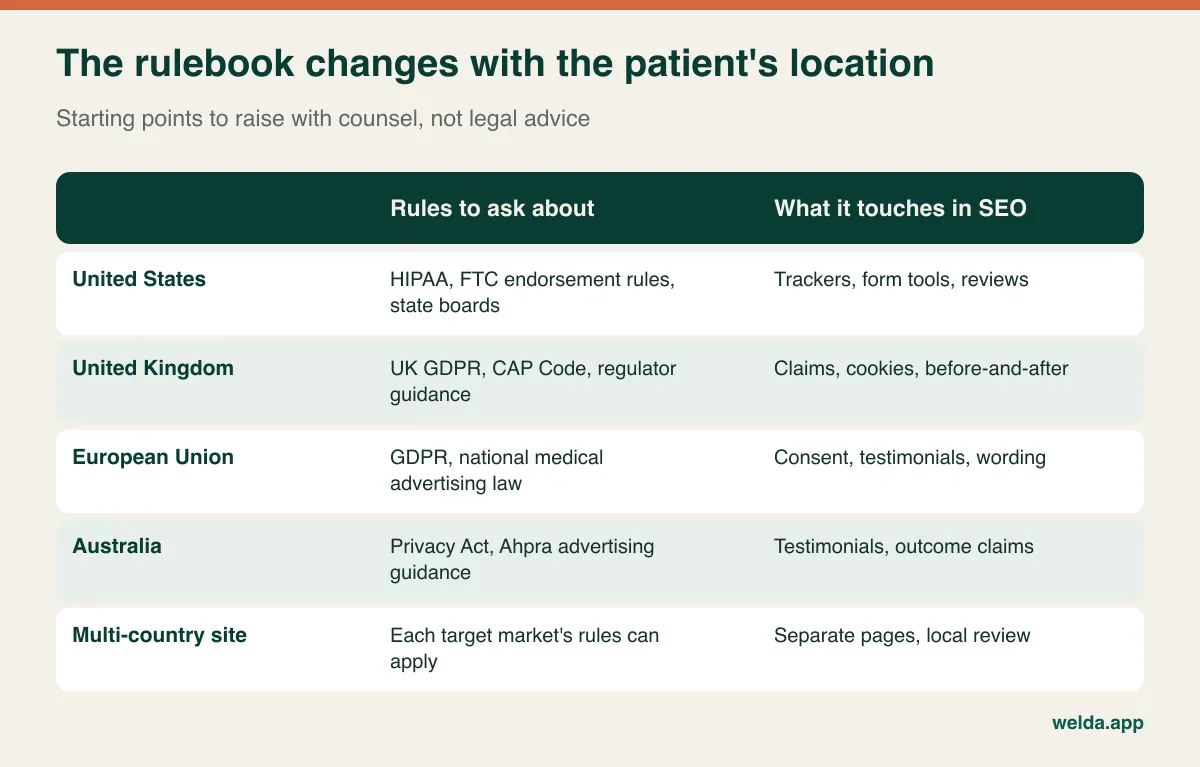
A few concrete illustrations of why this matters to a marketing decision:
- United States. Federal HIPAA guidance on online tracking technologies has been contested in court, so ask counsel where it stands now. Separately, some states have passed consumer health data laws, and the FTC's rules on endorsements and fake reviews apply to how testimonials are gathered and presented. An agency installing a tag on your appointment page should be able to discuss all of this, not just the conversion it wants to count.
- United Kingdom. Advertising is governed by the CAP Code, enforced by the ASA, alongside guidance from professional regulators. Prescription-only medicines generally cannot be advertised to the public, which regularly catches aesthetic clinics writing landing pages about branded anti-wrinkle treatments. A keyword with attractive volume can be a keyword you should not target in that form.
- Australia. Regulated health practitioners face restrictions on using testimonials in advertising. The review-driven playbook that works for a restaurant needs careful adaptation here.
- Cross-border care. If you market to patients in another country, that country's rules may be relevant as well as your own. Translating a home-market page into German or Arabic does not solve this, and a good agency will say so before quoting for it.
When you interview agencies, name your jurisdiction and ask what they would check first. You are not testing for perfect legal knowledge. You are testing for reflexes.
Decide what kind of healthcare SEO you are buying
"Healthcare" covers very different search behaviour. An urgent care clinic competes in the next ten minutes on a phone. An orthodontist competes over weeks of comparison. A hospital group has an architecture problem before it has a content problem. A healthcare SEO agency that recommends the same plan for all of them is selling a package rather than a diagnosis.
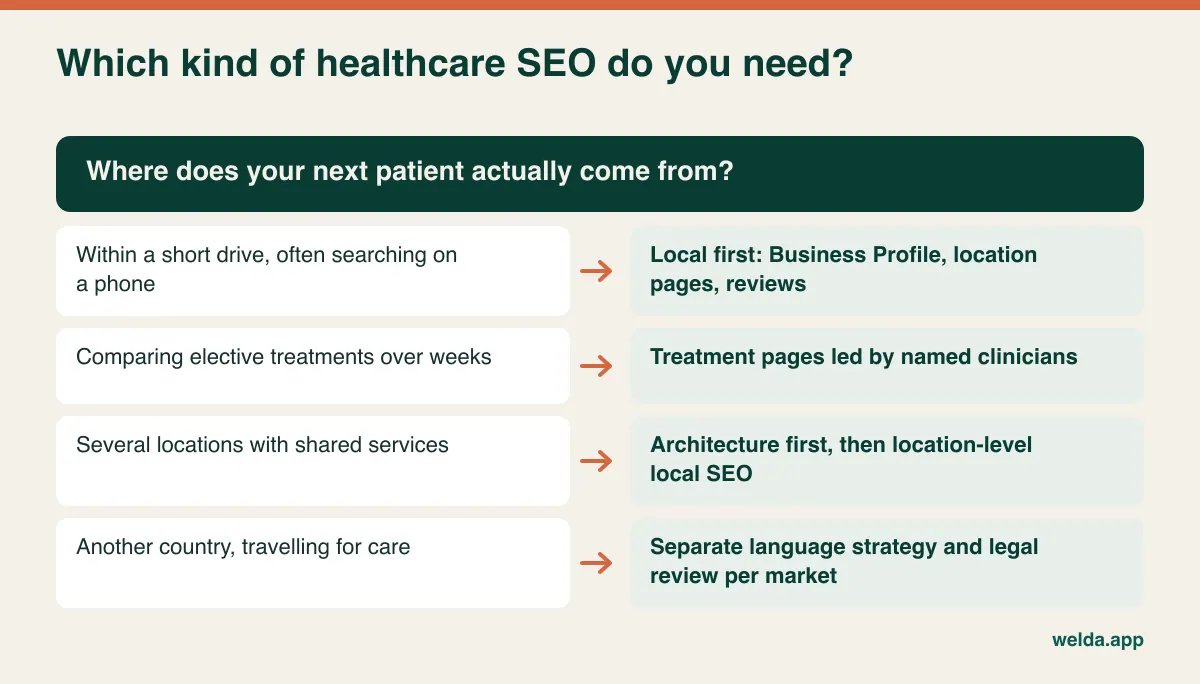
For a single-site practice, the first months usually belong to local visibility. Google Business Profile categories, accurate services, a strong location page and clear clinician information tend to matter more than a blog calendar. Our local SEO guide covers the groundwork. A sensible agency will also warn you off the tempting shortcut of stuffing keywords into your business name, which conflicts with Google's guidelines and creates a suspension risk.
For multi-location groups, the difficult questions are structural. Does each clinician have one profile or several? Should a service live under each location or centrally, with locations linking to it? What happens when a clinician moves between sites or leaves? Ask the agency to sketch this for your group. If the sketch is one page per service per suburb with the city name swapped, you are looking at doorway-style pages, which Google's spam policies specifically address.
For elective and self-pay care, the question is capacity and case mix. Ask yourself which procedures you actually want more of, because search volume will not tell you that. One useful test for an agency: does it ask which treatments have spare clinical capacity and which would simply extend your waiting list? An example: a clinic where laser appointments already fill up does not benefit from more laser enquiries, however good the traffic chart looks, while a quieter skin-check service might. That conversation belongs in the first meeting, not month six.
What YMYL means for an agency's writers
Google's Search Quality Rater Guidelines treat health as a "Your Money or Your Life" topic, where inaccurate content can cause real harm and raters are told to expect higher standards. Rater scores do not directly set rankings, but the guidelines describe what Google's systems aim to reward. For a clinic, that means knowing who wrote a page, who checked it, whether they have relevant experience and when it was last reviewed. We explain the concept in more depth in our guide to E-E-A-T and trust signals.
The practical issue is workflow. Most agency writers are not clinicians, and that is not automatically a problem. It becomes one when the writer's only source is the top ten results, which produces the same average article that already exists, with your logo on it. The better model is a short clinician interview before drafting, which also tends to produce the only original sentences on the page: how your team explains a risk, what patients commonly misunderstand, when you would refuse to treat.
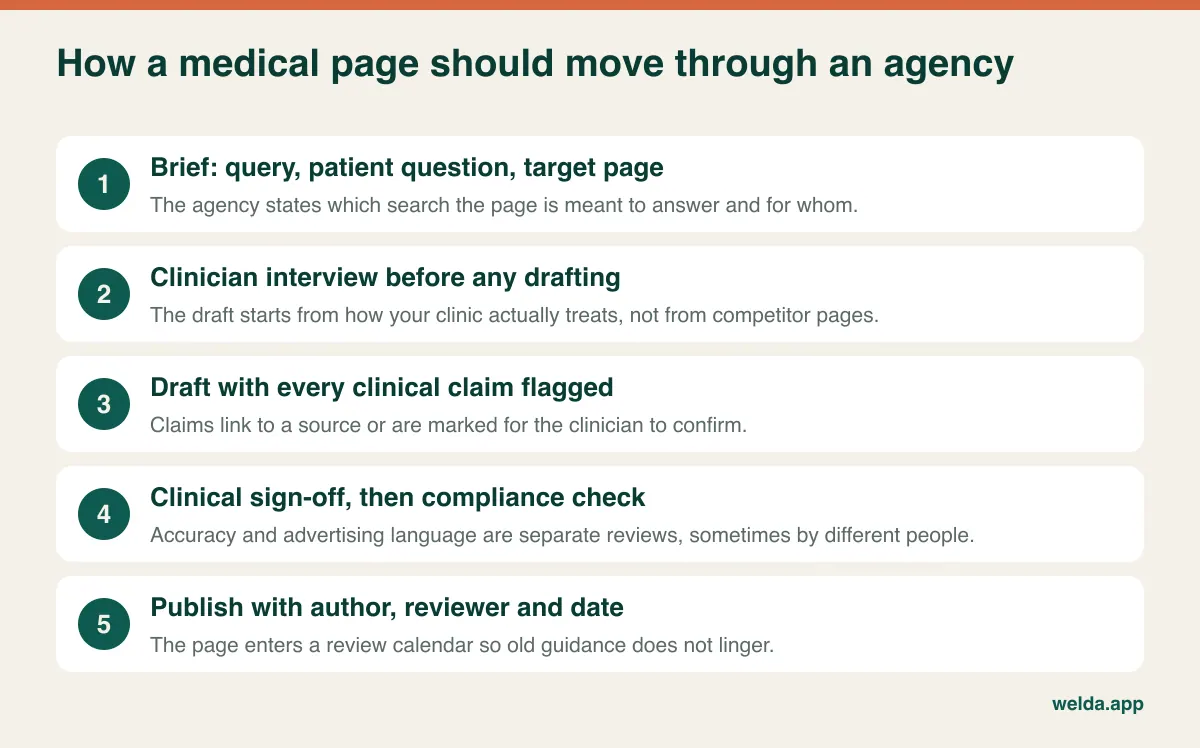
Ask to see the actual workflow, including who is accountable at each stage. Then ask these harder questions:
- Do you use generative AI for drafts? If so, where, and what stops an invented citation or an outdated dosage reaching the page? A flat "never" is worth probing as much as a casual "of course".
- How do you record that a clinician approved a specific version, and what happens if the text changes afterwards for SEO reasons?
- How would you handle conflicting guidance between professional bodies, and who decides which your site follows?
- What is your process for reviewing old pages when guidance changes? A symptom page written years ago is a liability, not just stale content.
- How do you feel about a clinician rejecting a keyword? The honest answer is that it will sometimes happen, and that clinical judgement outranks search volume.
Be wary of scale for its own sake. Offers to publish a page for every condition and every town appeal because the output is easy to count. Google has a spam policy on scaled content, and your own risk is greater still: publishing wrong clinical information under a clinician's name is a professional problem before it is a ranking one. Ask how many pages your own clinical lead can realistically review each month, and treat that as the ceiling.
Sign-off is where healthcare SEO stalls
Technical skill rarely limits these projects. Clinician time does. A draft waits three weeks because the only person who can approve it is seeing patients until seven. The agency keeps billing, the page does not ship, and six months later the report looks disappointing for reasons nobody raised at the start.
Raise it now. Name one person inside the practice who owns approvals; often this is a practice manager with access to the clinical lead, rather than the lead directly. Agree a turnaround, such as five working days for review, and what happens when it slips. Decide who approves which specialty if you have several. Get clinicians' agreement to being named on pages, and agree what happens to their author profiles if they leave. These details are dull and they prevent most of the friction later.
A strong agency proposes this structure itself and sizes the work to fit. If your clinical lead can give an hour a month, a proposal built on eight new medical articles a month is fiction. A smaller programme that actually publishes will beat a larger one stuck in someone's inbox.
Forecasts: make the agency show the arithmetic
Traffic projections are common in healthcare SEO pitches, and they usually stop at the wrong line. Sessions do not treat anyone. Ask the agency to walk from clicks to patients for a specific service, and to use your numbers wherever possible.
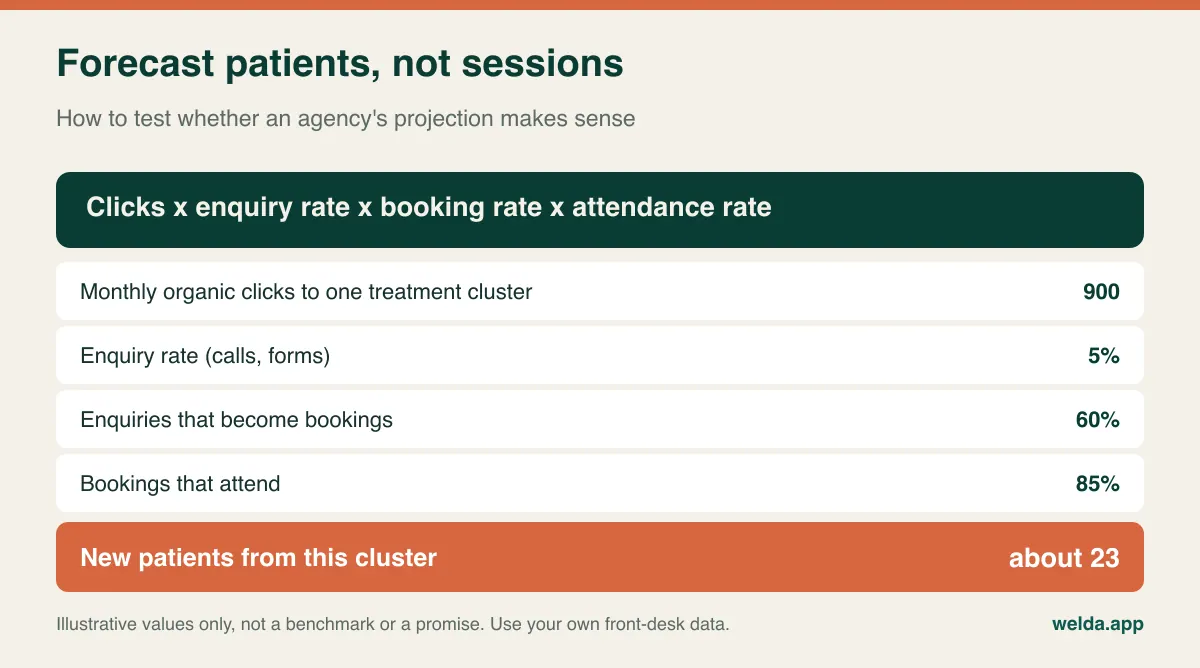
This simple chain does more than sanity-check a projection. It also splits responsibility. Low clicks point at visibility, which is the agency's job. Clicks without enquiries point at the page, the trust signals or the location fit. Enquiries that do not become bookings often point at your phones, your waiting time or your insurance position, which no SEO work can fix. An agency willing to tell you that the leak is at your front desk is showing you honesty you can use.
Then look at how results will be reported. Useful reporting for a clinic should separate branded from non-branded search, because people typing your name already know you. It should group performance by service line rather than one site-wide average. It should also be honest about informational content: a symptom article may attract many readers and few patients, and AI Overviews can absorb some of those clicks entirely. That content can still earn its place, but it should not be the headline of your report.
On timing, technical fixes can show effects within weeks, while content and ranking progress generally becomes clear somewhere between three and nine months, depending on competition, your site's state and content volume. Nobody can honestly guarantee a first-place position. A dated promise of a position should end the conversation.
Analytics can be the riskiest thing an agency touches
Agencies want to measure conversions, and they should. The risk in healthcare comes from what travels with that measurement. A tag on an appointment confirmation page can reveal that a specific browser booked with an oncology department. A page title or URL can carry a condition. A form with a free-text "describe your symptoms" field can pour health information into a CRM, an inbox or an ad platform without anyone having decided that it should.
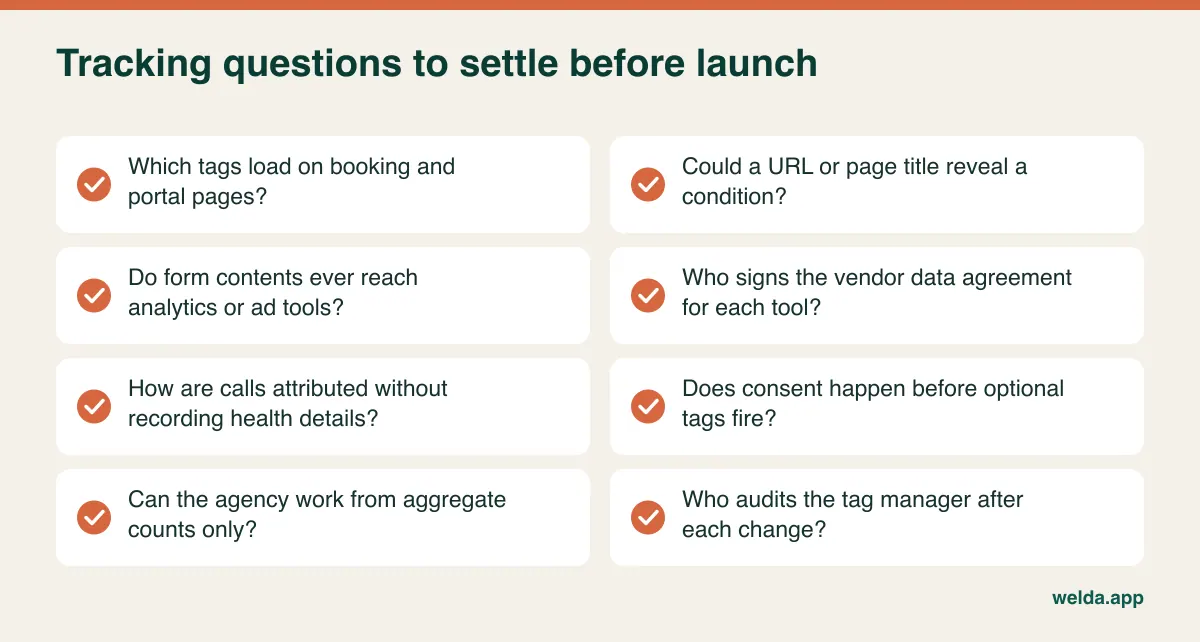
Good practice varies by country, but the instincts are similar. Collect the minimum on web forms and leave clinical detail to clinical systems. Do not build remarketing audiences from sensitive service pages, even if the platform allows it. Run consent properly where it is required. Sign the relevant data processing agreement, or in the US a business associate agreement if the vendor will handle protected health information, and check that each tool the agency adds has one where needed. Keep tag manager access narrow and check it after changes.
Expect imperfect attribution as a result. You will not know which search led to every phone call, particularly if you choose not to deploy aggressive call tracking. An agency comfortable working with aggregate counts, a "how did you find us?" field completed by your front desk, and trends over time is usually a safer partner than one claiming to track every patient from first click to treatment. In a clinic, that claim is the thing that should worry you.
Reviews: the clinical twist in reputation work
Review generation is standard in local SEO, but a healthcare setting adds a constraint most other businesses never face. Responding to a complaint with "we're sorry your root canal went badly" can confirm that someone is your patient and disclose details of their care. Confidentiality duties reach all the way to a public reply.
Ask any agency offering reputation services to show you its response templates. They should acknowledge, invite an offline conversation, and reveal nothing about whether the person was treated. Ask how review requests are sent, too: emailing a patient list through a marketing tool may itself need a privacy review, and offering any incentive for reviews conflicts with Google's policy. Buying reviews is not a grey area, and an agency hinting at it should not get your business.
Reading proposals without a shared price list
Two proposals labelled "monthly SEO" can describe entirely different jobs. Before comparing totals, normalise the scope. We go further on method in how to evaluate SEO proposals; for healthcare, these are the items that move the cost.
| What drives the cost | Why it varies in healthcare | Look for in the proposal |
|---|---|---|
| Number of specialties and services | Each one needs its own research and clinical reviewer | Services named in scope |
| Locations | Separate profiles, pages and local competition | Work defined per location |
| How content is made | Interview-based writing takes longer than compiling from other sites | Method, not only article count |
| Compliance load | More regulated services and markets mean more review cycles | Who checks, and how often |
| Technical condition | Legacy CMS, duplicate clinician pages, third-party booking tools | Who implements fixes |
| Languages and countries | Each market needs its own research and legal context | Scope per language |
Then look for the costs that do not appear on the first page. Are developer hours included, or does every fix go into a separate quote? Is clinician photography or medical copy review assumed to be free on your side? Is link building described in specifics, or is "digital PR" a polite name for paid placements, which conflict with Google's link policies and leave you with the cleanup? What is the minimum term, and how do you exit if the work is not delivering? A cheap twelve-month lock-in can cost more than a higher fee you can leave.
At Welda we scope SEO to the job rather than using a fixed list, so the figure comes after a free conversation about your services, locations and site. If you bring a competing proposal, we are happy to go through the line items with you.
Specialist or generalist, and who is not ready yet
Do you need a healthcare-only firm? Not necessarily. Specialists tend to arrive with a review process and regulatory awareness already built. They can also carry conflicts if they work with competitors in your area, and specialism on a website is easy to claim. A capable generalist with a clear clinical workflow can do this work well, provided it is candid about what it has not done before. Judge the process rather than the label.
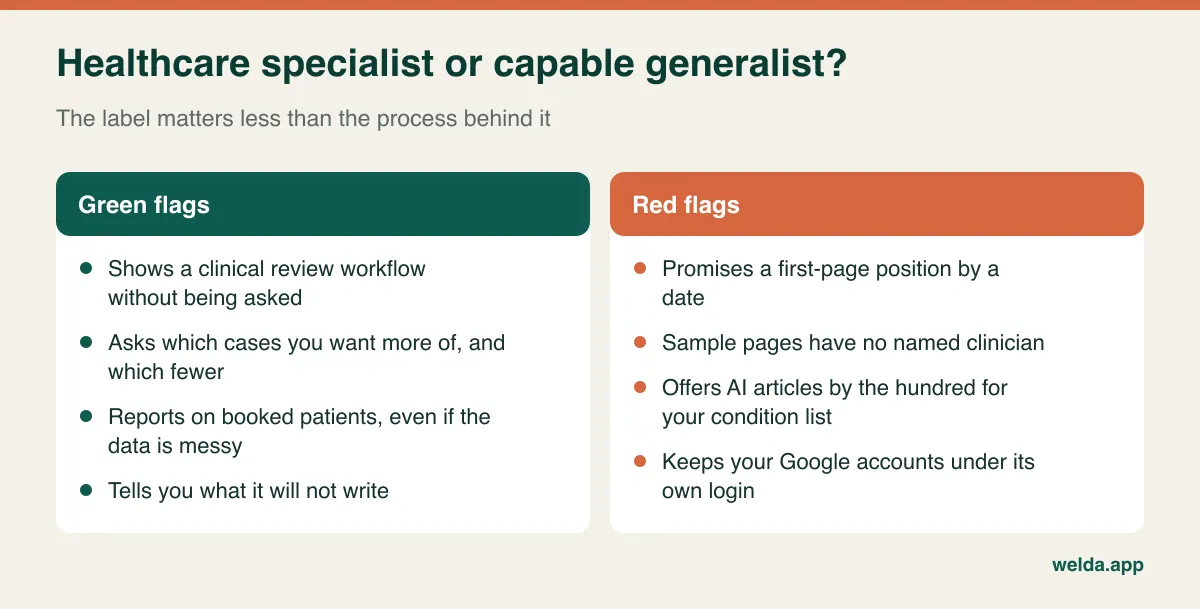
Some practices should also pause before hiring anyone. If you open in six weeks and need patients at once, organic search should not be your only channel. If your clinical lead truly cannot review anything, solve that first. If your diary is full and capacity will not grow, you need a narrow project aimed at case mix, not general growth. If your site is badly outdated, a clinic website rebuild may need to come before a monthly retainer. A good agency will say these things even though they shrink the deal.
Questions for the first meeting
- "What wouldn't you write for a practice like ours?" A team without limits has not yet met the limits.
- "Who will actually do the work, and may we speak to them?" The salesperson is rarely the strategist.
- "Whose login owns Search Console, Analytics and our Business Profile?" The practice should own every one.
- "How do you separate branded from non-branded results in reporting?" If it does not, growth can be flattering.
- "How do you earn links in healthcare?" Listen for real reasons someone would cite you, such as clinician commentary or useful local resources.
- "Do you work with a competing clinic in our area?" You are entitled to a direct answer.
- "What do we keep when the contract ends?" Content, accounts, and reports should all be covered.
- "Can you show us a clinical sign-off from start to finish?" Client details can be anonymised; the process cannot be improvised.
If you are replacing an agency
A switch adds its own risks. Accounts may sit under your old agency's email, your site may live on their server, and your Business Profile ownership may be unclear. Sort this out before you send notice, since goodwill can vanish after it.
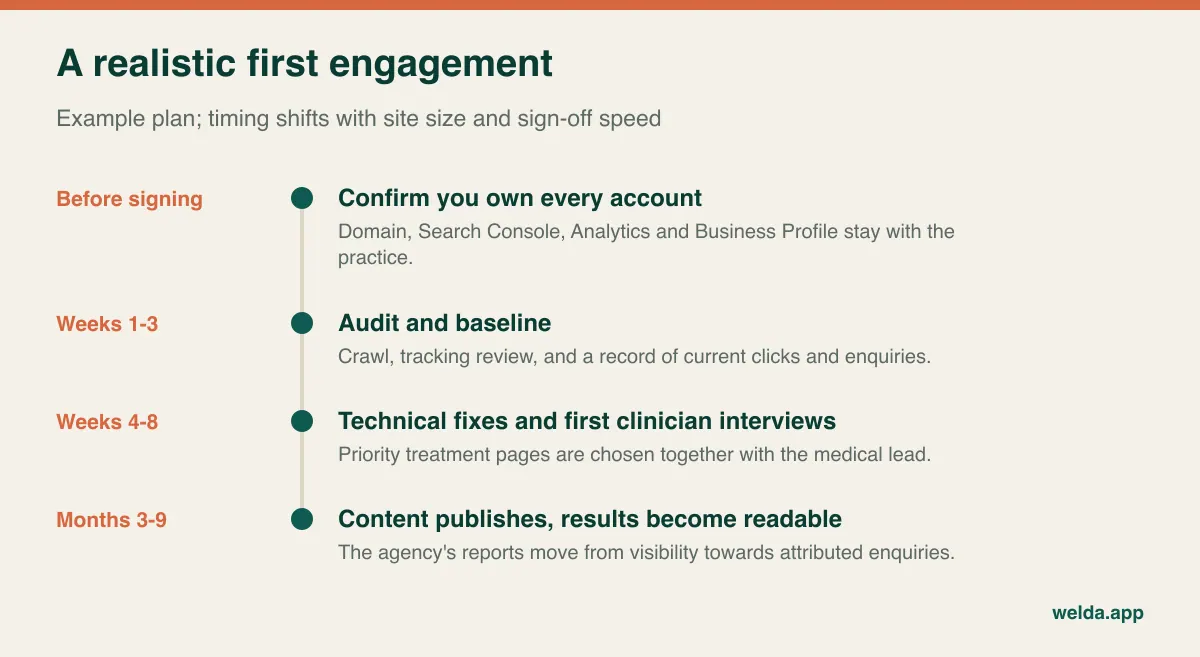
The incoming agency should audit what it inherits and put findings in writing: purchased links, satellite sites, unreviewed medical content. Record your current clicks and enquiries first, because without a baseline neither of you can show what changed. Be cautious of a new agency that blames everything on its predecessor before reviewing the data.
Where Welda fits, and where it does not
If you are considering Welda as your healthcare SEO agency, what we offer is the SEO work described on our service page: technical audit, keyword and search-intent research, on-page work, content strategy and production, internal linking, local SEO with Google Business Profile, and monthly reporting based on Search Console data. We use white-hat methods only and do not guarantee a number-one ranking.
We should also be clear about the limits. We are not clinicians, so clinical accuracy stays with yours. We are not lawyers, and regulatory sign-off belongs with your counsel or professional body. If your market has highly specific requirements, such as HIPAA-related tooling in the US, raise them early so we can tell you plainly whether we are the right fit. If that division of work suits you, have a look at how our healthcare SEO agency work is scoped and book a free conversation about your services, capacity and current site.
Frequently asked questions
How is healthcare SEO different from regular SEO?
The technical foundations are the same. The differences lie in clinical review, advertising rules, privacy constraints on measurement and much higher expectations of accuracy. That adds process and usually slows publishing, which should be reflected in plans and timelines.
Should a clinician write the content?
Not necessarily. Few have time, and a skilled writer can do the drafting. What matters is that a qualified clinician shapes the content through an interview and reviews the final version, and that the page says so accurately.
Can I use patient testimonials on my website?
It depends on your country, your profession and the wording, and in some places testimonials are heavily restricted. Consent is a separate question. Ask your regulator or counsel before publishing, and treat any agency suggesting them as a routine conversion tactic with caution.
How much should I budget?
That depends on your number of services and locations, how content is produced, your site's condition and the markets you target, so a generic figure would not help you. Compare proposals on normalised scope. For Welda's work, the price is set after a free conversation.
Can an agency guarantee more patients?
No honest agency can, because rankings depend on Google and competitors, and bookings depend on your capacity and front desk too. What it can commit to is scope, method, transparency and regular reporting.
Should we run paid ads while SEO builds?
Often, particularly for new practices, as long as the ads obey the same advertising rules and the platform's own healthcare policies. SEO and paid search answer different time horizons. Treat them as complementary rather than as rivals for one budget.