Switching SEO agency makes sense when you have had at least six to nine months of work, enquiries from non-brand searches have not moved, and the agency cannot explain why using your own data. A single traffic dip, a competitor overtaking you or an irritating account manager is not enough on its own. If you do decide to leave, the order matters more than the choice of replacement: secure your accounts and data first, serve notice second, and start the new agency last. Reversing that order puts your history at risk, and occasionally your Google Business Profile too.
This guide is for the business owner holding a tidy monthly report and a flat sales line. You do not need to be an SEO specialist to make this call. You need to know what your report is not telling you, how to tell an agency problem from a website or sales problem, what to pull out before you give notice, and what to ask the next agency so that you do not repeat the last two years.
The report is accurate. It is just answering a different question
Most SEO reports are not dishonest. They are answering "has our visibility improved?" when you are asking "is this bringing me customers?" Impressions, average position, the number of keywords in the top 100 and third-party authority scores are all real measurements. They also sit several steps away from a sale, and a metric can climb for years without anybody's phone ringing.
Picture a hypothetical commercial roofing contractor. The agency publishes articles such as "how long does a flat roof last" and "what is EPDM". Impressions climb, the chart looks great and the report is full of green arrows. But for "commercial roof replacement quote" and "flat roof repair [city]", the searches a buyer actually types, the site is still on page three. Everything in the report is true and the work was real effort, yet the contractor gets no extra quote requests. Fire the agency without seeing this distinction and the next one may draw you the same chart.
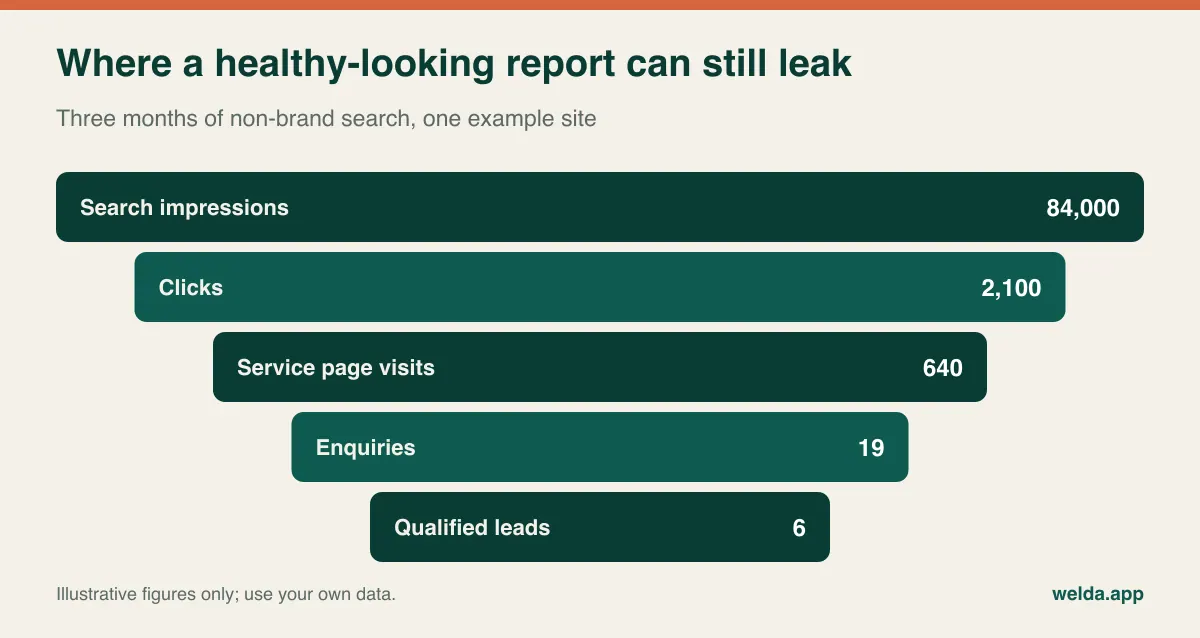
That funnel is the single most useful thing you can bring to an agency review. Ask for each stage split by brand and non-brand. Then read the gap: if clicks rise and enquiries don't, the leak is on the site or in the offer; if impressions rise and clicks don't, the rankings are for the wrong terms or positions are too low to earn clicks. We have a separate walkthrough on how to read a monthly SEO report if you would like every line explained. For this decision, the following translations are enough.
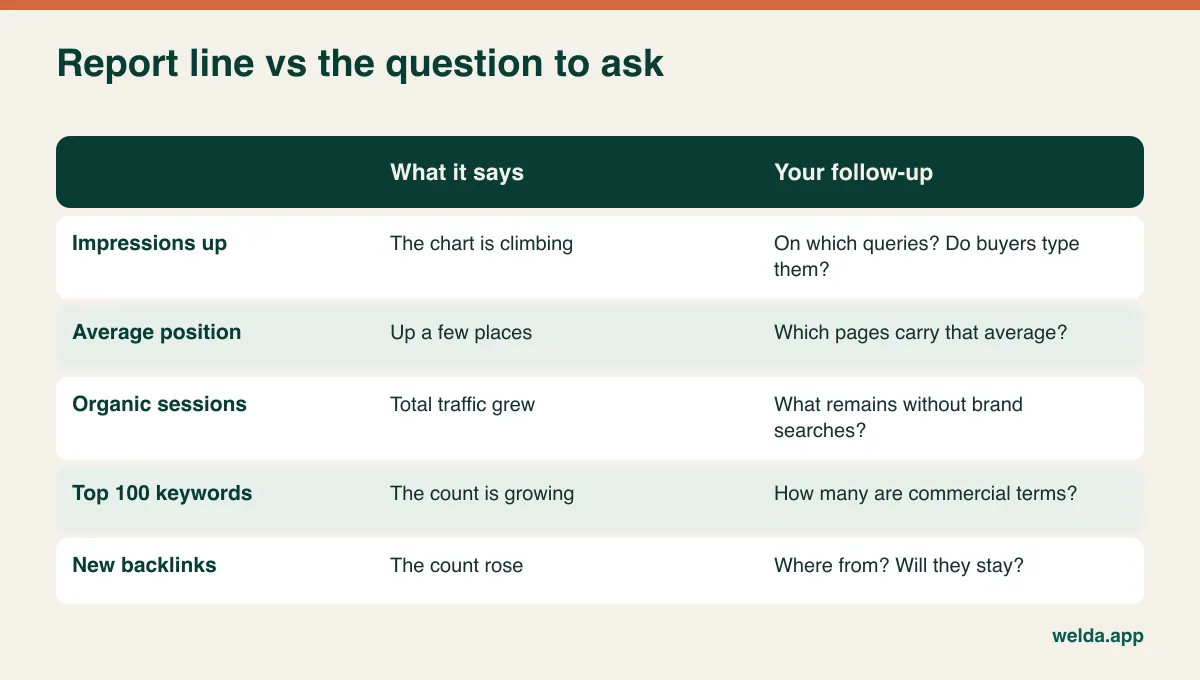
An afternoon in Search Console, without asking anyone
Before you say anything to your agency, spend an afternoon with your own data. If you do not have Google Search Console access, you have your first finding already. If you do, work through this:
- Compare year on year. Set the last three months against the same three months last year. Comparing against the previous quarter misleads anyone with seasonal demand; a heating engineer's spring will always look poor next to their winter.
- Remove your brand. Filter out your company name and common misspellings. Someone searching for you by name already knows you, so that click usually came from referrals, ads or reputation rather than SEO.
- Look at pages, not totals. Are clicks landing on the service and product pages that make money, or on blog posts only loosely related to what you sell?
- Line up demand. Put form submissions, calls and any "how did you hear about us" notes next to the search data for the same months. You are looking for direction, not perfect attribution.
- Count what actually shipped. List the concrete changes made on the live site in the last six months. Compare them with what your invoices and reports say was done.
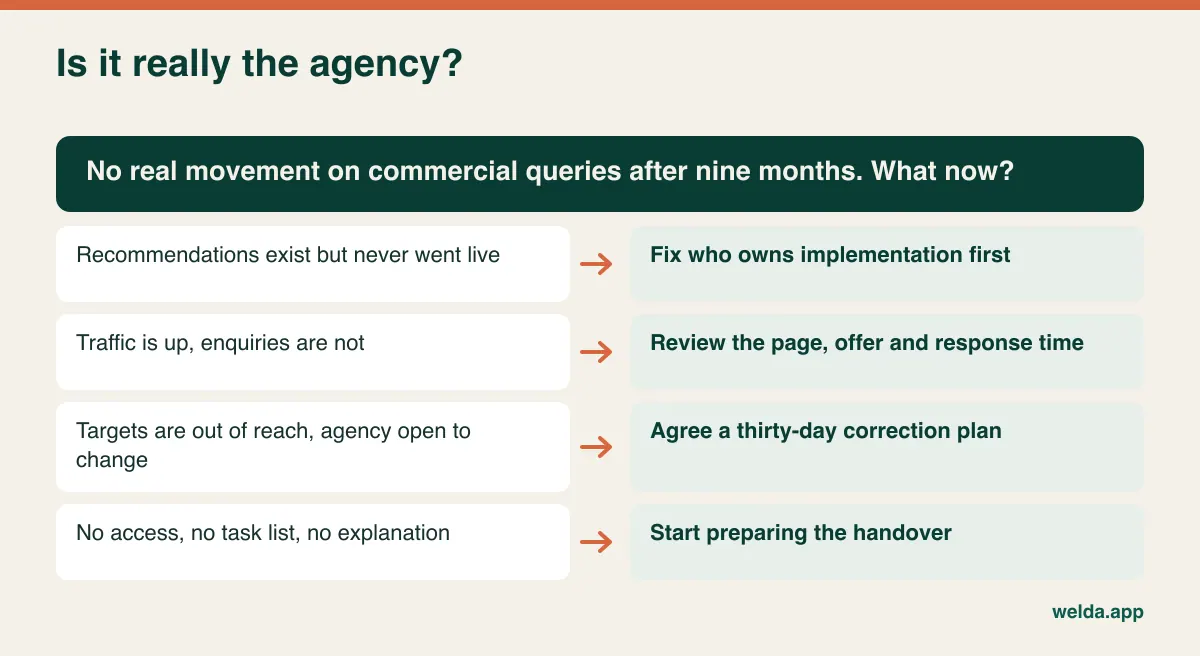
Be fair about time while you do this. How long SEO takes depends on competition and where your site started; content and ranking gains usually become clear over 3 to 9 months. Two months of work cannot be judged with any data. Twelve months with nothing moving on commercial queries is different, and "SEO takes time" stops being an adequate answer at that point.
Three suspects to clear before you blame the agency
The most expensive version of this decision is switching when the problem lives somewhere else. Your new agency then spends months walking into the same wall, on your budget. Clear these first.
The recommendations might be stuck on your side. A common arrangement: the SEO agency writes recommendations and a separate developer or web agency controls the site. The technical tickets sit in someone's queue while the same items reappear on the report every month. Count how many recommendations went live. If most did not, what you need is a named owner for implementation and permission to touch the site, not a new agency. A fair agency should still have escalated this rather than quietly reporting it for a year.
Traffic might be arriving and failing to convert. If visits to service pages are up and enquiries aren't, look at the offer, trust signals, the tap-to-call button on mobile and how fast someone responds to a form. Sometimes the form works perfectly and nobody replies for two days. That is not an SEO failure, although a good agency would have noticed and said so.
The goal might be unrealistic. Demand in your category may have shrunk, or you may be trying to win head terms dominated by marketplaces and national brands with a small regional site. The clue is whether your agency told you this early and proposed reachable alternatives, or simply accepted the keyword list that made you happy at kick-off.
What deserves a conversation and what deserves an exit
Not all dissatisfaction carries the same weight. A late report is annoying. An agency that will not give you access to your own Search Console property is in another category. The useful split is this: quality problems can often be corrected, while transparency and trust problems rarely are.
| What you're seeing | What it may mean | Sensible response |
|---|---|---|
| Accounts were created under the agency's email and access requests get deflected | Your data is not really yours; leaving gets harder every month | Request ownership in writing; if refused, plan your exit |
| You can't see where links came from | Possible paid link packages, which can conflict with Google's spam policies | Ask for the list and get it independently reviewed |
| Guaranteed rankings still feature in the sales language | Promises are replacing expectations management | Ask which keywords, what timeframe, what conditions |
| Sudden traffic spikes with almost no engagement | Possibly automated traffic; needs checking, not assuming | Compare source, geography and engagement in analytics |
| Reports arrive, but no list of completed work does | Work is not happening or is not visible | Ask for a task log for one month |
| Targeting is wrong, but the agency is open about it | A direction error, not bad faith | Rebuild the keyword map together |
| Your account manager left and communication collapsed | An operational issue | Speak to leadership; often fixable in one meeting |
A word on rankings guarantees, since Google's own guidance warns against them too: nobody controls the algorithm. When you hear one, you don't have to walk out, but ask how it is constructed. Sometimes it is built on a list of terms nobody searches for. That is also why we make no number-one promises when a business talks to us about switching SEO agency.
Give them thirty days, on paper
If nothing on the trust side has come up, one structured meeting can save you a lot of effort. It tests the agency properly, and if you leave anyway, you leave with useful documents. Don't arrive with a list of complaints. Arrive with three questions: why are our commercial queries where they are after this long, which three pieces of work would change that, and which of them will be live within thirty days?
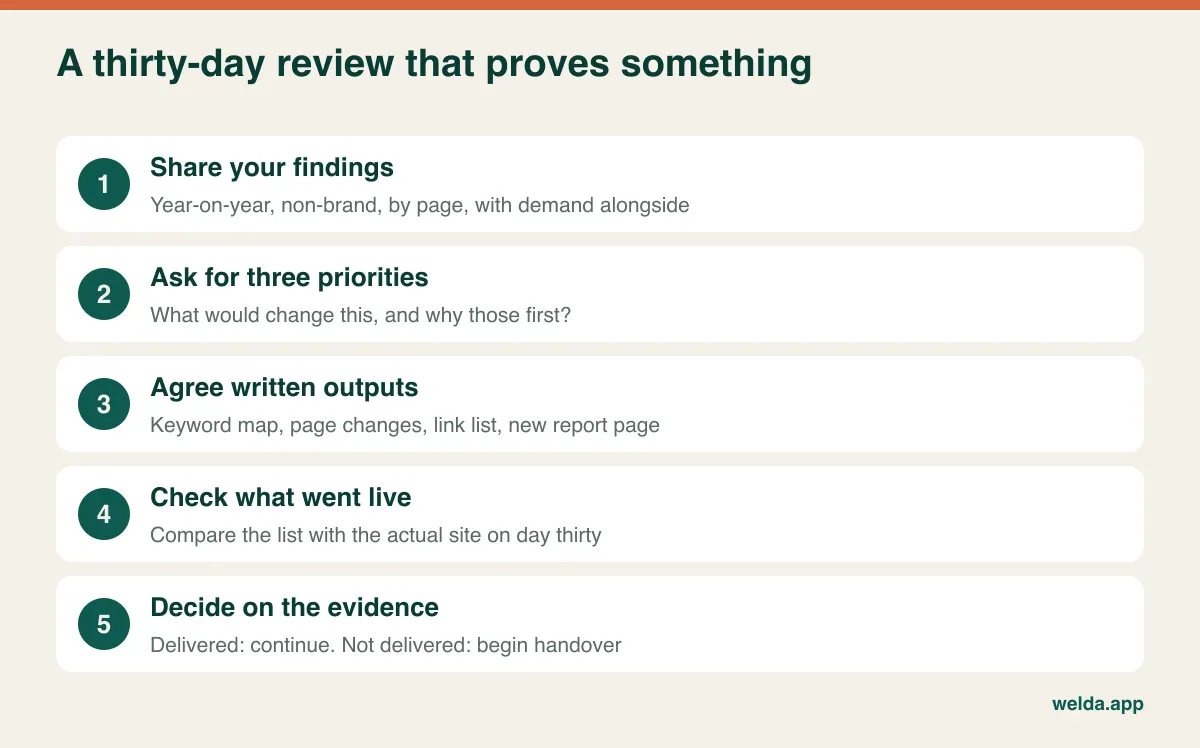
Don't ask for ranking improvements in thirty days. It isn't reasonable and it pushes agencies towards exactly the shortcuts you want to avoid. Ask for outputs instead: a corrected keyword map, specific changes to named service pages, a full list of acquired links and a report page that separates non-brand traffic. An agency that delivers all that may well be worth keeping, having simply been aimed at the wrong target. An agency that can't has handed you the evidence for your decision.
Before you give notice: whose name is on everything?
This is the most important section here, because goodwill can thin out once notice has been served. It need not be malicious. The person who set up an account may have left, or the password may live in a shared vault nobody can find. What felt convenient when the agency opened accounts on your behalf can become the hardest part of leaving.
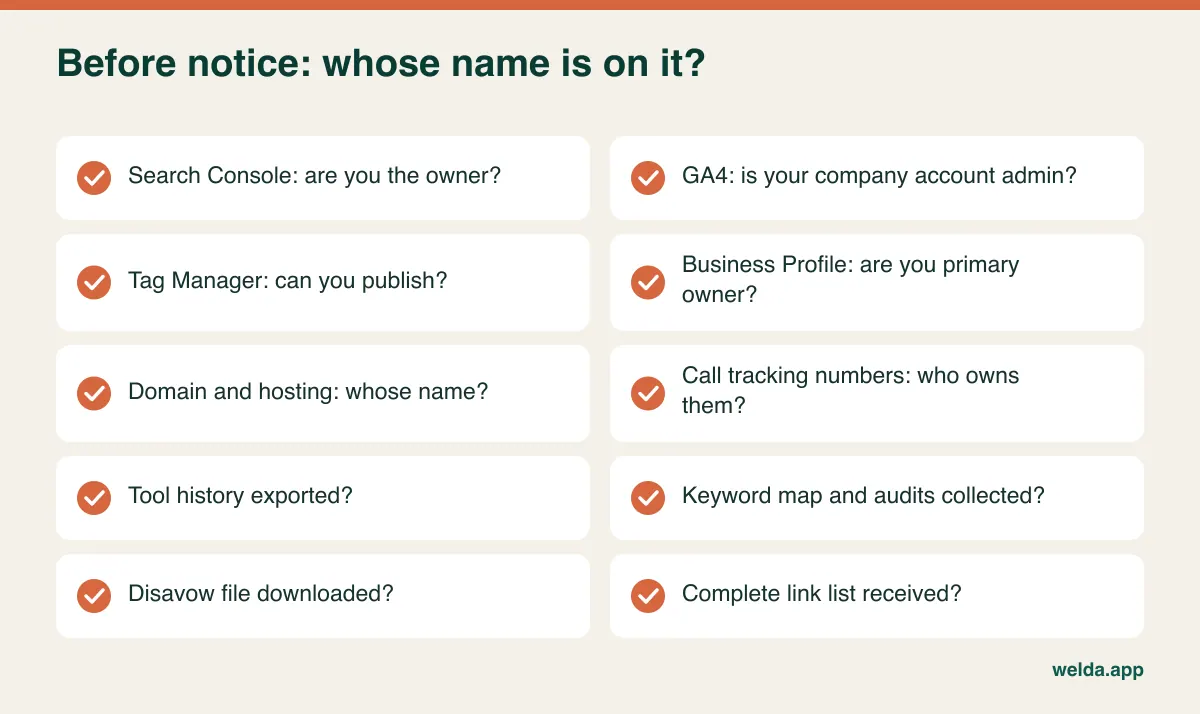
The items that are easiest to miss:
- Google Business Profile. Manager access isn't enough; you want primary ownership. For a locally dependent business this profile can matter as much as the website.
- Search Console verification tokens. When you remove the old agency as an owner, remove their verification method too. If their DNS record or HTML file stays in place, access can return by itself.
- GA4 and Tag Manager. Hold administrator rights at account level. If the property sits under the agency's own account, access to historical data becomes something you have to negotiate. Check the data retention setting too, because the short default limits how far back exploration reports can go.
- The disavow file. If one has been uploaded, download it and ask why each domain is on it. Your new agency should see it before overwriting anything.
- Tool history. Rank tracking inside the agency's platform leaves with the agency. Ask for an export. Export your Search Console data as well, since its performance reports only reach back 16 months.
- Working files. Keyword maps, audits and content drafts. Check whether your contract entitles you to them.
- Domain and hosting. Often a web agency matter, but SEO agencies sometimes set these up. Look up the registrant yourself. Our guide to switching web agencies covers this ground in detail.
Contracts, data and rights, wherever you operate
Contract and privacy rules vary by country, so treat this as a list of questions for your own adviser rather than legal advice. Look for the minimum term, the auto-renewal date and the required form of notice. A retainer can renew quietly, and missing a date by a week can extend your commitment considerably. Check how the final invoice treats prepaid work that was never delivered.
Check who owns what was produced. In many jurisdictions copyright in text doesn't automatically pass to the client just because they paid for it, so look for an assignment or licence clause covering content and any stock images bought in the agency's name. If the agency could see personal data such as form submissions or call recordings, ask for written confirmation that access has ended and copies were deleted. If you operate under GDPR, UK GDPR or similar rules, your data processing agreement probably addresses this directly, and your new agency will need its own. And if your tag setup changes in the transition, make sure your privacy notice and cookie banner still describe what the site actually does.
Rankings rarely fall because you switched. They fall because something was removed
Google neither knows nor cares which agency you use, and changing supplier is not a ranking event. When a drop follows a switch, the likely cause is something that quietly left along with the agency. Find out where they are embedded in your site now.
- Rented links. Links placed on a network of sites for a monthly fee can disappear when the payments stop, and paid links of that type can conflict with Google's spam policies anyway. Ask which links are permanent. If you depended on rented ones, expect a correction.
- Agency-licensed plugins. If your SEO, caching or schema plugin runs on the agency's licence, titles and structured data may break when it lapses.
- Redirect rules. Redirects held in a CDN account or plugin controlled by the agency can vanish, and old URLs begin returning 404s.
- Tracking phone numbers. If an agency call-tracking number is on your Business Profile or site, your phone can stop ringing the day the contract ends. That hits revenue before rankings ever move.
- Satellite sites. Landing pages built on the agency's own domains belong to the agency. Identify any that bring real traffic and agree what happens to them.
One more trap: a switch can coincide with "while we're at it, let's redesign the site". Keep them apart if you possibly can. When a new agency and a redesign arrive together, you will never be able to separate the causes of what happens next.
A handover calendar with deliberate overlap
Plan around your trading calendar. The worst moment is just before your busiest season: pre-Christmas retail, or spring for a landscaper. The switch doesn't harm rankings, but a new agency's learning weeks leave no time to fix mistakes when your peak is underway. A notice period that overlaps your new contract isn't wasted money. Treat it as insurance.
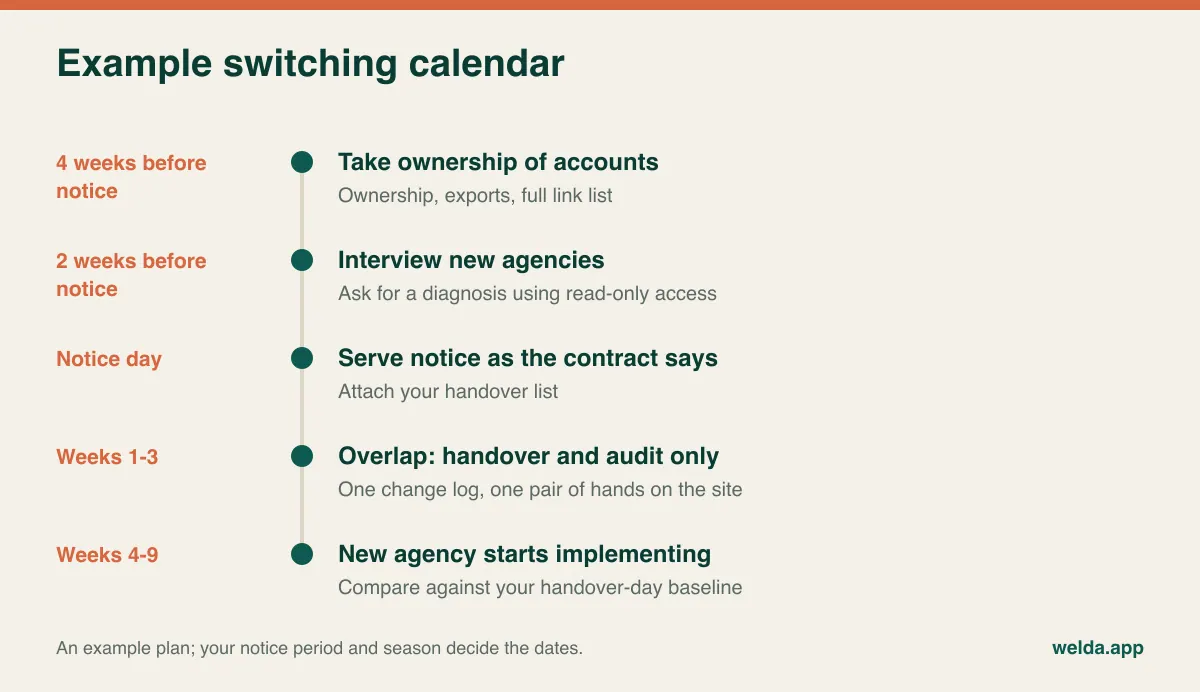
During the overlap, don't let both agencies change the site. The outgoing agency only hands over, and the incoming agency only audits. Keep one change log, because you will need it when you interpret ranking movements later. And take a baseline on handover day: commercial query positions, indexed pages, and monthly forms and calls. You will judge your new agency against that table, not against what anybody remembers. If you serve several countries, take the baseline per market and check hreflang and country targeting are intact, since those issues can stay hidden behind healthy-looking totals.
What to ask the next agency, and what a good answer sounds like
Don't sit through a presentation. Ask questions. Our guide on evaluating SEO proposals covers the general ones. A business that is switching should add these:
- "Looking at our Search Console, what do you see first?" Give short-term read-only access before you receive a proposal. A good answer discusses specific queries, pages and periods. A weak one explains SEO in general.
- "What would you keep from our previous agency's work?" Be careful with anyone who finds everything wrong; a rebuild may be what they're selling. Someone who can also name what works is actually diagnosing.
- "How do you earn links, and will you share the list?" You want sources disclosed as a matter of course. If "network" or "package" comes up, ask for specifics.
- "Whose name do the accounts go under?" Only one right answer: yours, with the agency as an authorised user.
- "Who changes the site? If our developer is separate, who chases implementation?" If this was your old gap, this answer may decide things.
- "What's on page one of your report?" Say that you want non-brand commercial queries and enquiries there. Ask to see a real template.
- "What should we be able to see at three months and at six?" Look for checkable deliverables and measurement points, not promised numbers.
- "If we part ways, how does the handover work?" It's a fine question for a first meeting. An agency answering easily doesn't plan to keep clients by holding their data.
Comparing proposals as more than a monthly number
People who have been burned tend to be more careful the second time, yet still compare on the retainer. What really sets a fee is scope: site size, how competitive your market is, content volume, who implements technical changes, and whether the work is local, national or international. Two proposals can look alike when one includes writing content and the other only recommends it.
So go through the costs that tend to hide. Is the initial audit included? Is the content volume written down, or "as needed"? Are technical fixes done, or listed and left with you? Will your developer's hours become a new cost? Who pays for tool licences? Without these on paper you're comparing two differently loaded baskets. The fee itself gets settled once scope is clear, which is what a first conversation is for. A weighted score keeps you honest about your priorities.
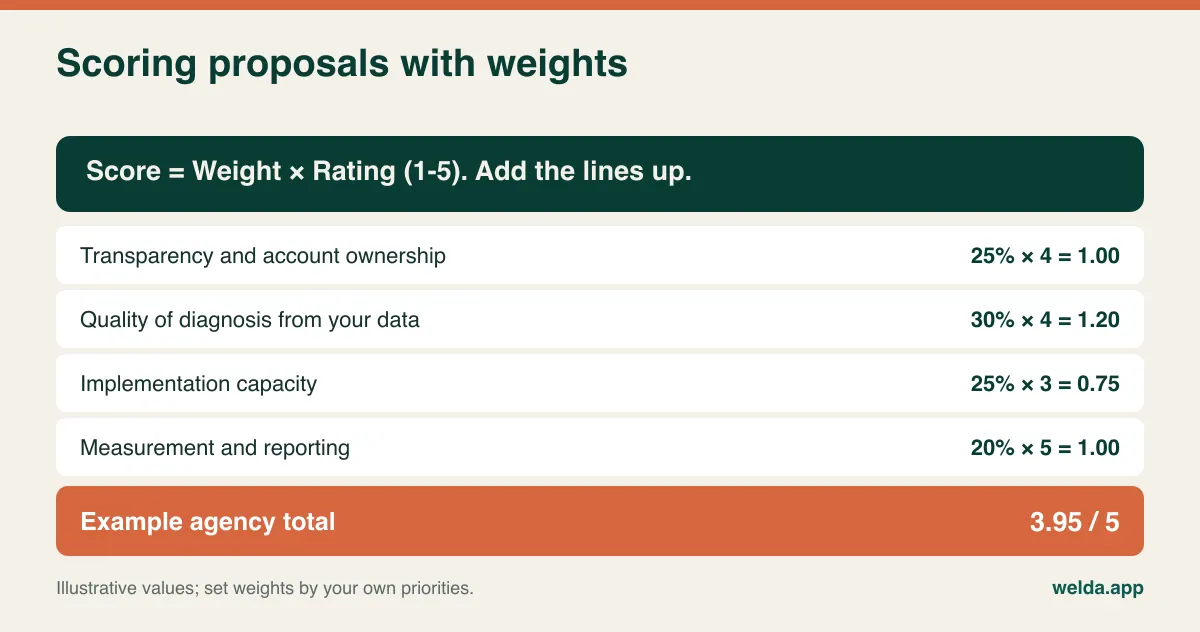
If two agencies end up close, lean towards the one with stronger implementation capacity, especially if your previous disappointment came from recommendations that never went live.
Where Welda fits, and where it doesn't
Keeping this short. If you come to us about switching SEO agency, we start from Search Console and Analytics data. We run a technical audit with Screaming Frog and PageSpeed Insights and present the findings as a prioritised report. From keyword and search-intent research we build a keyword map, then carry out on-page changes, content production, internal linking and, where relevant, local SEO and Google Business Profile work. Each month you get a report covering rankings, traffic and conversions. We use white-hat methods only and do not guarantee a number-one ranking. If the work stops, the technical fixes and published content stay with you.
Now the limits. If your main need is a digital PR or link-building campaign, that is not listed as a separate item in our service scope, so raise it directly with us. If you need demand next month, SEO alone may be the wrong tool and paid search deserves a look. And if you haven't yet had the thirty-day conversation with your current agency, we'd suggest doing so first. There is no fixed price list; we prepare a scope and quote for your situation, and the fee becomes clear in a free consultation.
Frequently asked questions
Will my rankings drop if I change SEO agency?
The change itself has no effect on rankings. Drops usually trace back to rented links disappearing, redirects breaking, plugin licences lapsing or a redesign landing at the same time. Listing these in advance reduces the risk of surprises, although no agency can honestly promise zero fluctuation.
How long should I give an SEO agency before judging it?
Technical fixes can show within weeks, while content and ranking gains usually become clear over 3 to 9 months. During that window, judge delivery and direction rather than positions. Beyond nine months with no movement on commercial queries and no credible explanation, it's time for a serious conversation.
What if my old agency won't hand over access?
Ask in writing, with a date. Google offers an ownership request process for Business Profiles, and you can re-verify Search Console using your own DNS or site access. If the analytics account sits entirely under the agency, history may be hard to recover, so create a new property and start measuring today. Speak to a lawyer about contractual rights.
Can two agencies work on my site at the same time?
Overlapping contracts are fine. Two agencies changing the same site is not, because you can't tell which work caused what. Restrict the outgoing agency to handover and the incoming one to audit during the overlap.
Should I bring SEO in-house instead?
It can work if you already publish regularly and can change the site quickly. One person may struggle to cover technical, content and analysis work, and tools are an additional line. It comes down to volume of work and whether anyone can manage that hire properly.
What should I give the new agency on day one?
Access to Search Console, Analytics and Business Profile; the last twelve months of reports; the link list; any disavow file; a site change log; and your demand data from forms and calls. Having this ready shortens the learning curve and lets you judge the quality of their diagnosis sooner.