Short answer: if you work alone, take fewer than about eight appointments a day and sell no packages, WhatsApp booking is usually fine and you do not need to pay for software yet. Once a second person touches the bookings, you pass roughly fifteen appointments a day, you sell multi-session packages, or health details start arriving in chats, the sums change. WhatsApp can stay as the way clients talk to you. It just should not be your calendar any more.
Those lines are our own rule of thumb, drawn from how a booking actually flows, not findings from a study. You may hit the wall earlier or later. That is why this guide to WhatsApp booking vs appointment software also shows you how to get your own number in two weeks, with nothing more than a sheet of paper.
"WhatsApp booking" can mean three very different setups
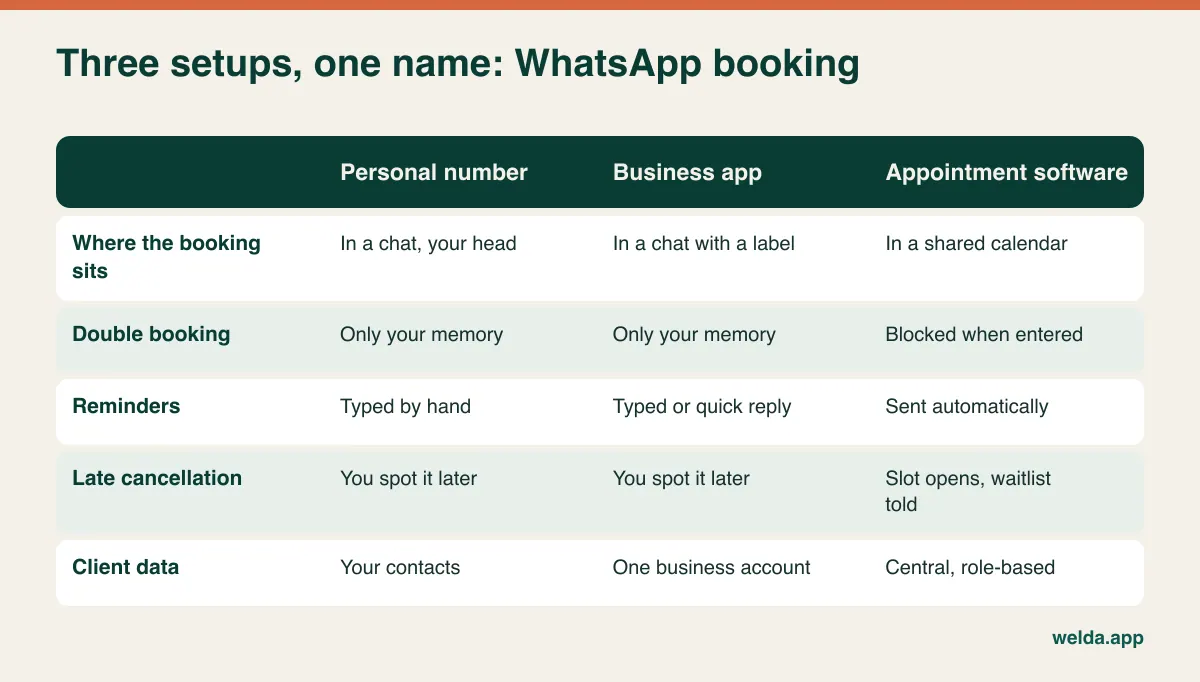
People compare WhatsApp with software as if WhatsApp were one thing. Before you decide anything, work out which of these you are actually running, because the limits differ.
A personal number. Clients message your own phone. It costs nothing, it mixes bookings with family chats, and the client list lives in your contacts. This is where most solo barbers, lash technicians and mobile therapists start.
The WhatsApp Business app. Still free, with a business profile, labels, quick replies and away messages. This is a genuine upgrade, and our WhatsApp Business guide covers how to set it up well. You can also link other devices to one account, so a receptionist can reply from a computer. What you still do not get is a calendar that knows the 3pm slot is gone.
A chatbot or automation on the WhatsApp Business Platform. Clients tap through menus and a slot gets offered. People often picture this when they say "WhatsApp booking", yet it almost always needs a calendar or booking system behind it. So it is not really an alternative to appointment software; it is a front door to one. If a vendor pitches you a bot, the first question is where the bookings are stored.
The comparison in the rest of this article is mostly about the first two setups against a real booking system, because that is the decision most owners are facing.
Count conversations, not appointments
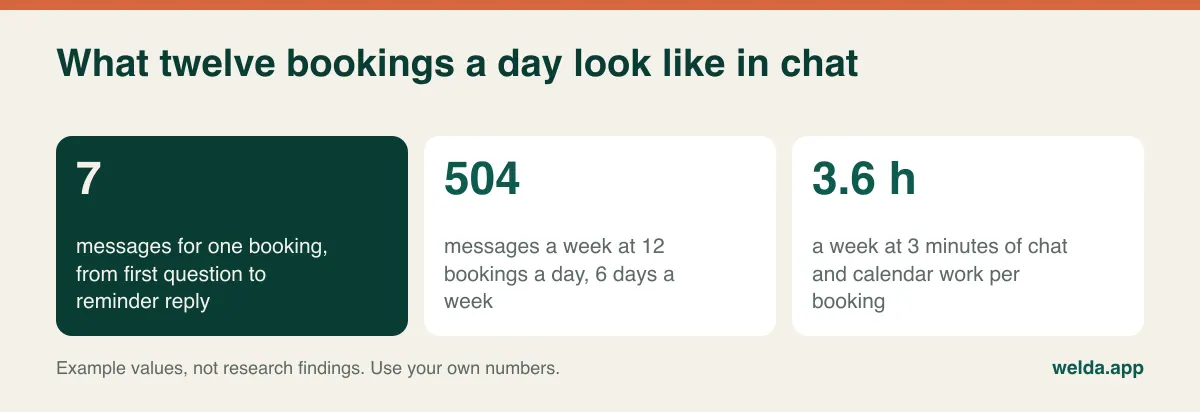
"I only do twelve clients a day" sounds manageable, and twelve clients are manageable. The conversations around them are what eat the day. A typical booking at a salon goes like this. Client: "Any chance of tomorrow at 3?" You: "3 is gone, 4 works." Two hours pass while she checks with work. "4 is good." You: "Booked." Next morning you remind her. She replies: "Thanks, may be ten minutes late." That is six or seven messages across two days for one haircut.
At a clinic the thread runs longer: which doctor, how much, does the patient need to fast, can the follow-up move to Thursday. And each message lands at the worst moment. You cannot answer with foils in your hands or during a treatment, so demand arrives exactly when you are busiest.
None of this is a disaster on a quiet Tuesday. The trouble starts when volume rises and replies slip, because a slow reply on a chat app is visible. The client sees that you have read the message or that you were online. If nothing comes back, she books elsewhere, and she will not tell you she did.
Where the wall actually is
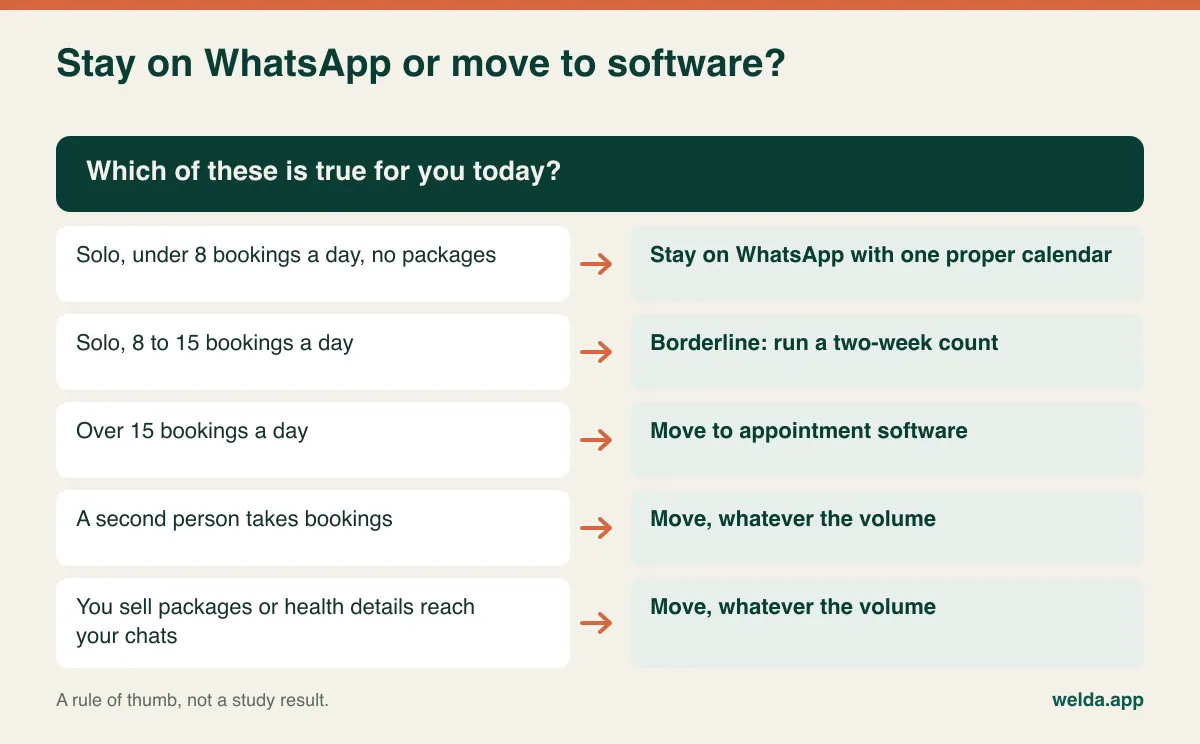
A single appointment count would be misleading, because volume is only one of four signals. Use this as a starting point:
| Your situation | What happens in chat | What to do |
|---|---|---|
| Solo, under 8 bookings a day, no packages | It all fits in your head and on one phone | Stay on WhatsApp, keep one proper calendar |
| Solo, 8 to 15 bookings a day | Replies get later, evenings go to admin | Borderline: run the two-week count below |
| Over 15 bookings a day | Changes outrun your memory, empty slots go unnoticed | Move to software |
| A second person handles bookings | Two people can promise the same slot | Move to software, whatever the volume |
| Packages, memberships or group classes | Balances live in scrollback and arguments follow | Move to software, whatever the volume |
The fourth row surprises people. A two-chair shop with six bookings a day often breaks before a solo practitioner with twelve. The reason is simple: WhatsApp is a single-person tool, and the real system is the memory of whoever holds the phone. That person knows that this client never comes on Mondays, and that the "ok will see" from last night was not a confirmed booking. None of it can be handed over.
Three things a chat thread cannot do, however disciplined you are
You can run WhatsApp very well. Some owners do. But three limits are structural, and no amount of care will remove them.
It sorts by who spoke last, not by time
A calendar answers "who is coming tomorrow morning?" at a glance. A chat list answers "who wrote to me most recently?" So every booking has to be carried by hand from one to the other, which means you are doing the job twice. On a heavy day, the second copy is what gets skipped.
It cannot refuse a double booking
Even with a shared account on several devices, nothing stops two people saying yes to the same hour. Software with conflict detection refuses the second booking at the moment it is made. That is the whole difference, and you only need to apologise to a client who took an hour off work once to appreciate it.
It cannot act on a cancellation
A client cancels at 7am; you see it at noon. The slot is dead, and even if you remember someone who wanted that time, it is too late to reach them. A waiting list that notifies the next person when a slot opens works while you are busy with someone else. If you want to go deeper on this, see how to reduce no-shows, which covers reminder timing and cancellation policies.
The nine o'clock problem: bookings you never knew you lost
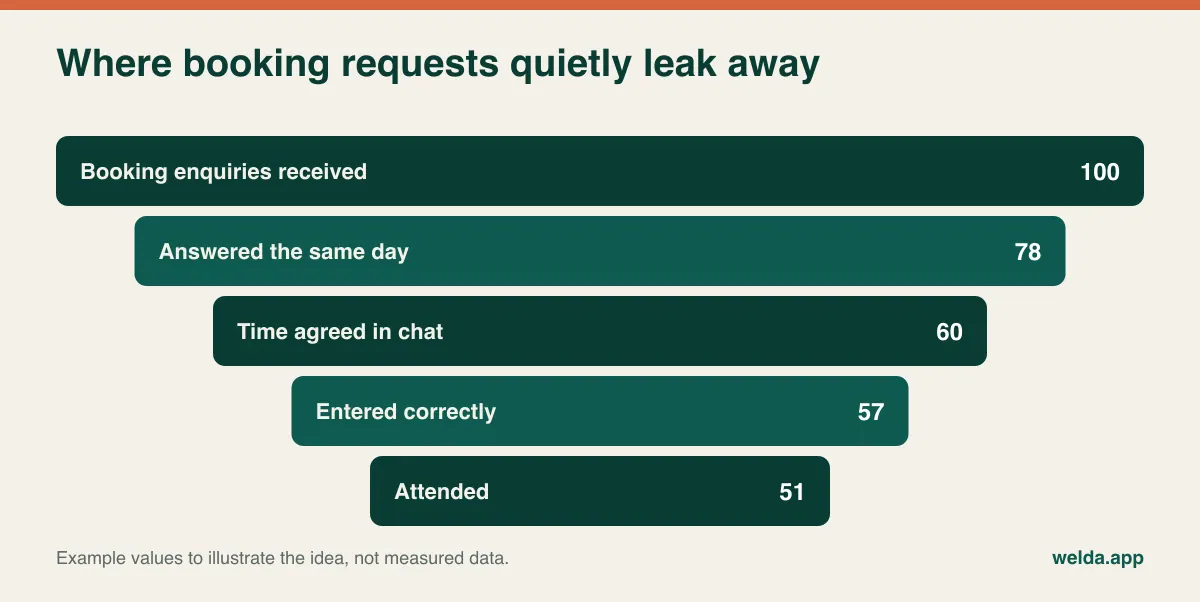
People tend to book when they are free, and that usually means when you are closed. A client decides on a Sunday evening that she needs an appointment and sends a message. If you reply on Monday at ten, you may still get her. If she also messaged two other places and one offers a way to request a time right there, you may not.
This is the loss that never shows up anywhere. Your phone holds the chats you answered. It does not hold the people who gave up. Thus the only way to estimate it is to look at the steps a request has to pass through and count where they thin out.
An away message helps, and it is free, but it does not capture a preferred time. An online booking request does. In Welda CRM the client leaves a request and your team confirms it. That is deliberately not the same as instant self-booking: nothing lands on the calendar until you accept, which suits businesses where a service needs a judgement call, and suits less well if you want clients to lock in a slot at midnight with no human involved. Ask about this difference in any demo, with any vendor.
Clients who do not share your language or your time zone
WhatsApp is the default channel in many of the markets where this question comes up most: across Europe's expat communities, the Gulf, much of Latin America and South Asia. That brings a wrinkle you rarely see discussed. A clinic or salon that serves foreign residents or visitors ends up writing the same instructions in two or three languages, by hand, and writing them slightly differently each time.
Time zones matter too. A patient flying in for treatment may book from another country weeks ahead. "Tuesday at 10" in a chat needs no time zone until it suddenly does, and pre-visit instructions sent the night before may land at 3am. Whichever tool you end up with, check what it does about the timing of its messages for clients abroad. Welda CRM has message templates in English, Turkish and German and sends reminders automatically over WhatsApp, so the repetitive part stops depending on who is on shift. If you need another language, ask before you commit rather than assuming. We would sooner tell you it is not there than have you find out in week two.
Group classes deserve a word here as well. Plenty of pilates and yoga studios run sign-ups in a WhatsApp group: "who's in for 6pm?" Past one class it gets messy. You scroll up to work out who answered first, the seventh person signs up for six mats, and every member can see every other member's phone number. Software with class capacity and a waiting list exists for this. For a studio, this one reason can justify moving, regardless of how many bookings you take in total.
Is it worth paying? Work it out in hours first
Do not start from price lists. Start with a tally sheet by the till and, for two weeks, mark five things: booking enquiries; messages you could not answer within an hour; time changes and cancellations; slots that stayed empty; and mix-ups such as a wrong time or a double booking.
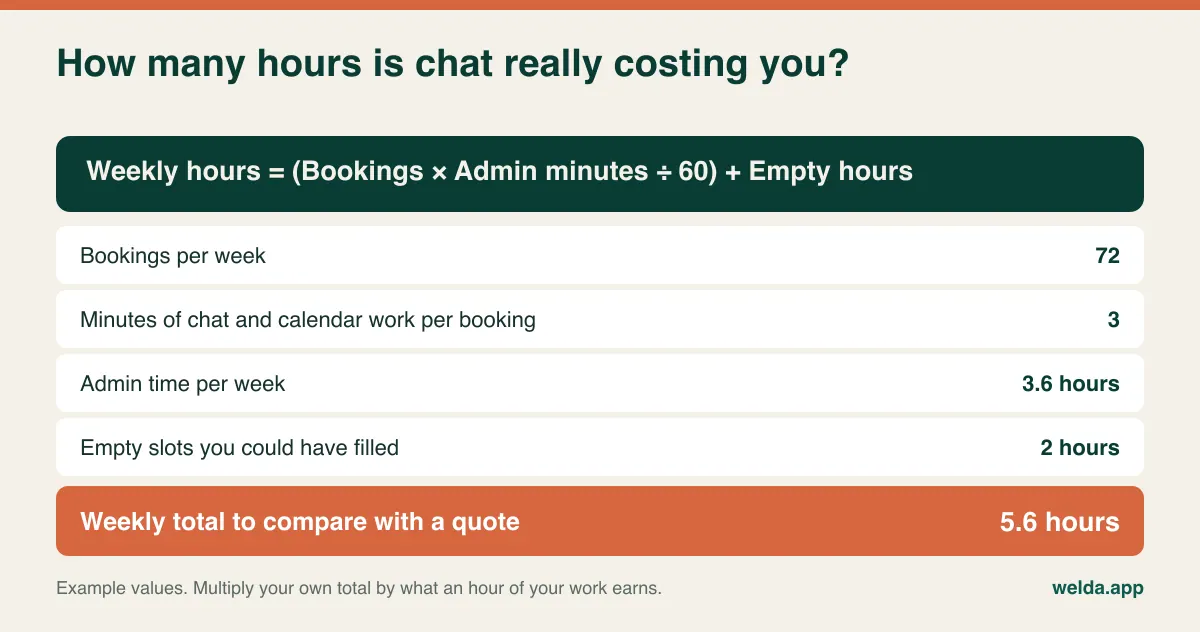
Then convert it to hours and multiply by what an hour of your work actually brings in. Set that figure next to any quote you receive. If your count comes back with almost no missed replies and hardly any empty slots, the honest conclusion is that you do not need software yet. Keep your money.
Comparing quotes without getting caught out
Appointment software pricing is driven by much the same items everywhere, even if vendors present them differently:
- Users and locations. Who needs a login, including part-timers and freelancers?
- Message allowance. Are WhatsApp messages included, how many a month, and what happens beyond that? This is the most common surprise, since messaging often carries its own per-conversation cost somewhere in the chain.
- Setup and migration. Is moving your client list included, or left to you?
- Modules. Are packages, payments and automated flows in the plan you are being quoted, or one tier up?
- Leaving. Can you export your data if you cancel?
Run every quote against the same scenario, your actual monthly bookings and your actual team. Welda CRM is a monthly subscription; the figure depends on branches, users, message volume and modules, and we work it out with you in a free call. Setup and data migration are included.
Privacy: the client list on someone's personal phone
Rules vary by country, so treat this as a prompt to check rather than legal advice. Under GDPR and the UK's version of it, client names, numbers and appointment history are personal data, and health information gets stricter treatment. In the United States, healthcare providers need to think about HIPAA and whether a given messaging setup is suitable at all. Other countries have their own regimes. A local adviser can tell you what applies to you.
The practical questions hold up nearly everywhere. Whose phone holds the client list? What happens to it when that employee leaves, and to the chat backups on their personal cloud account? If a client asks you to delete their data, do you know which phones to look in? When a patient sends a photo of a rash or a lab result, where does it end up? Often, in the phone's camera roll.
Welda CRM stores client and health records encrypted, offers consent management and role-based permissions, and keeps an audit log of who accessed what. Software does not make you compliant on its own; your notices and consent process remain your responsibility. Note, too, that reminders sent over WhatsApp still pass through WhatsApp, so keep what they contain to the minimum and make sure clients have agreed to receive them.
Questions for the demo, using your own messy Tuesday
Every demo begins with a tidy calendar. Bring last week's real messages instead and ask the vendor to walk through them.
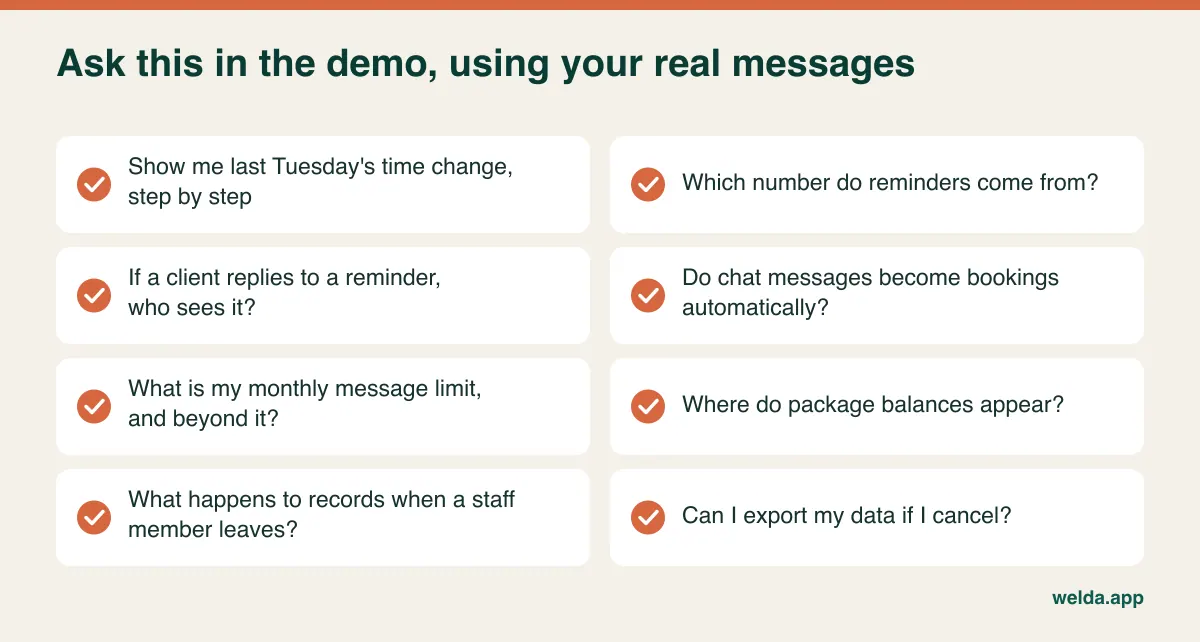
Go deep on the reminder question. Which number does the message come from? If a client replies, who sees that reply? "WhatsApp integration" on a features list answers neither. Also ask plainly whether incoming chat messages get turned into appointments automatically. In Welda CRM they do not: reminders and message flows go out automatically, but a booking agreed in a chat is entered by your team. Knowing that upfront will save you from disappointment later. For clinics, how to choose clinic appointment software gives a fuller criteria list.
Switching without confusing your regulars
Owners tend to fear that loyal clients will not adapt. In most cases the client sees very little change: they can still write to you, they still get a confirmation, and now a reminder arrives on time. The people who have to adapt are your team. Plan for them.
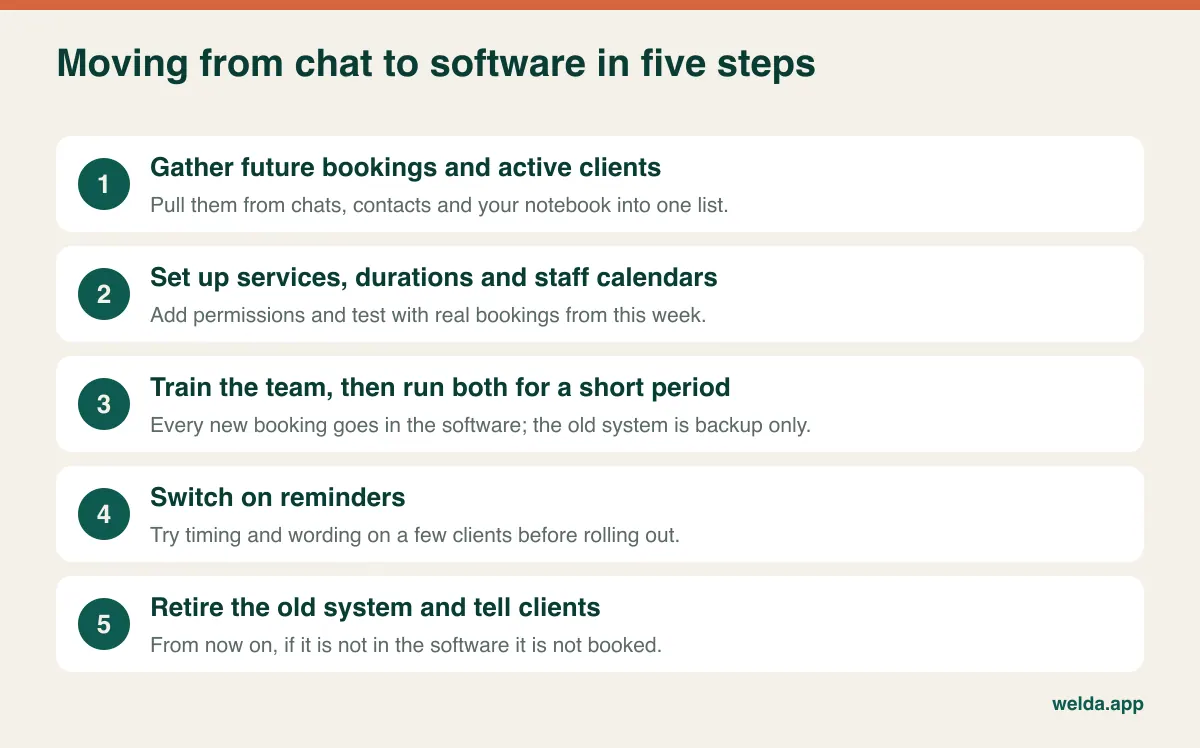
The classic failure is keeping two systems alive. Set a date after which, if it is not in the software, it is not booked, and hold yourself to that as well. If the owner keeps a private notebook, everybody else will too.
Your message to clients can be one line: "Hi, we've tidied up how we manage bookings. Keep messaging us here as usual, and you'll now get an automatic reminder before your appointment." Test reminder timing on a handful of clients first. A 7am reminder may work, but nobody thanks you for it.
With Welda CRM, setup covers your account, branches and staff calendars, moves over your existing client and appointment data, and includes hands-on training. You can also try it free for 7 days with all modules open. Use that week to repeat your tally. If unanswered messages and empty slots have not moved, that tells you something too. If you are still weighing up WhatsApp booking vs appointment software, see how the calendar and reminders fit together and book a free call.
FAQ
WhatsApp Business is free. Why would I pay for appointment software?
If you are solo and quiet, you may not need to. WhatsApp Business handles conversations. It does not manage a calendar, block double bookings, track package balances or record who changed what. Those records are what you pay for.
How many appointments a day is too many for WhatsApp?
As a rough guide, 8 to 15 a day is the grey area and above 15 most one-person setups strain. A second person handling bookings, package sales or health data can bring the point forward regardless of volume. Your own two-week count is a better answer than any general figure.
Will my clients have to stop using WhatsApp?
No. They can keep writing to you. What changes is where the result is recorded. Clients who prefer it can also leave an online booking request instead.
Isn't a WhatsApp chatbot enough on its own?
A bot is an interface. It still needs a calendar behind it that knows what is free, and someone has to maintain that. If you are considering a bot, compare what stands behind it, not just how the menu looks.
Can Welda CRM turn a WhatsApp message into a booking automatically?
We do not offer that. Reminders and notifications go out automatically over WhatsApp, and clients can leave an online request that you confirm. A time agreed in a chat is added to the calendar by your team.
What does it cost?
Welda CRM is billed monthly, and the price depends on branches, users, message volume and modules. We settle it in a free call. If you come with your daily bookings and a description of your current setup, that conversation will be short.
What happens to my data after the trial?
The trial lasts 7 days with all modules open. When it ends your data is not deleted, and if you continue on a plan you carry on where you left off.