Medical tourism website design is not ordinary clinic web design with a language switcher added. A good brief answers three questions before anyone opens a design tool: which patients, from which countries, for which treatments; what those patients need to verify before they commit to a flight; and how an enquiry travels from a stranger's phone to a clinician's assessment. Those answers also set the budget. Most of the gap between two agency quotes comes from languages, medical copy and the enquiry flow, not from how the homepage looks.
This guide is for clinic owners, hospital marketing leads and medical travel facilitators who are about to talk to agencies. It gives you a method for scoping the site, a way to compare proposals line by line, and a list of what to keep in-house. It does not quote figures. A four-language hair restoration group and a dental clinic targeting one country are buying different projects, so any number given before scope exists would be fiction.
Start with your enquiry log, not a sitemap
Most briefs begin with a list of pages. For cross-border care, a better opening document is your own record of who has already asked. Pull together the last year of emails, WhatsApp threads, coordinator notes and completed treatments, however messy they are. You are looking for answers to a few plain questions. Which countries actually wrote to you? Which treatments did they ask about? Which of those people went on to be treated, and what did they ask just before deciding? What language did they use, and who replied?
That log does three jobs. It tells the agency which treatment pages deserve the most effort. It supplies real questions for the copy, in the words patients use rather than the words clinicians use. And it exposes the honest constraint on the whole project, which is how many enquiries your team can answer well. If the log is empty because you have never treated a patient from abroad, that is useful too: you are testing a market, not scaling one, and you should buy something smaller than a full international site.
From the log, write a short market card for each target. Keep it to country, language, two or three priority treatments, the terms people search for, the channel they prefer and the named person who replies. A patient in Manchester comparing dental work abroad, an English-speaking patient in Dubai looking for bariatric options and a German speaker in Vienna are three different briefs, even when two of them read the same language. If you can't fill in the last field on a card, that market isn't ready.
Clinic or facilitator: whose name carries the risk?
Patients crossing a border want to know who is responsible for them. The answer shapes the architecture. A clinic can put a named surgeon on each treatment page, show its own theatre and publish its own registrations. A hospital group has to connect that evidence to each location, because a credential held by one site says nothing about another. A facilitator has the hardest job. It sells access to other people's care, so its site must explain what it does, what the clinic does, how it is paid and who the patient calls if something goes wrong.
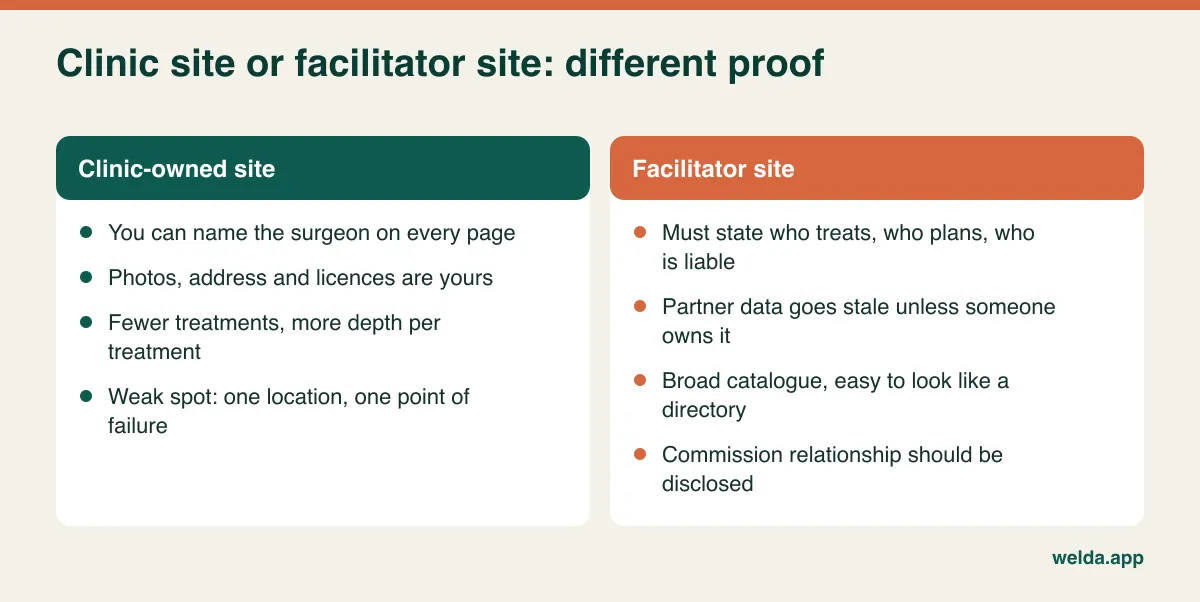
For facilitators, ask the agency how partner data stays current. A surgeon leaves, an accreditation lapses, a partnership ends, and the old profile sits on the site in four languages until a patient notices. A structured content model with a single source for each clinic and clinician, a last-reviewed date and a clear owner is worth paying for here. For a single clinic, the same model would be over-engineering. A handful of carefully written surgeon pages will do more.
Disclosure matters more than it first appears. A facilitator page that reads like an impartial ranking while earning commission from the clinics it lists invites distrust and, depending on where the patient lives, possibly regulatory questions as well. Saying plainly how you are paid is an easy decision for the site, and a hard one to reverse once patients have found out on their own.
Languages are a staffing decision before they are a design decision
An extra language looks cheap in a proposal and turns out to be expensive in operation. It means more pages to write, more approvals, more updates whenever a protocol or a clinician changes, and, most of all, someone who can reply in that language the same day. Our rule for this sector is blunt. If nobody on your team can answer a patient in German, don't publish in German yet. A polished page followed by a machine-translated reply loses more trust than having no page at all. The broader version of this argument is in when you actually need a multilingual website.
Once you know the languages, decide the structure. Subfolders suit most clinics because all your authority builds on one domain and one team can run it. Country domains can make sense when you have a genuine local presence and the budget to maintain several sites. Whichever you choose, the technical checklist includes hreflang annotations, per-language sitemaps, localised titles and descriptions, and redirects that don't force visitors into a language based on their IP address. Our multilingual SEO and hreflang guide covers the details. In a proposal, ask to see each of those listed, because "multilingual setup" can mean anything from a full international build to a translation plugin.
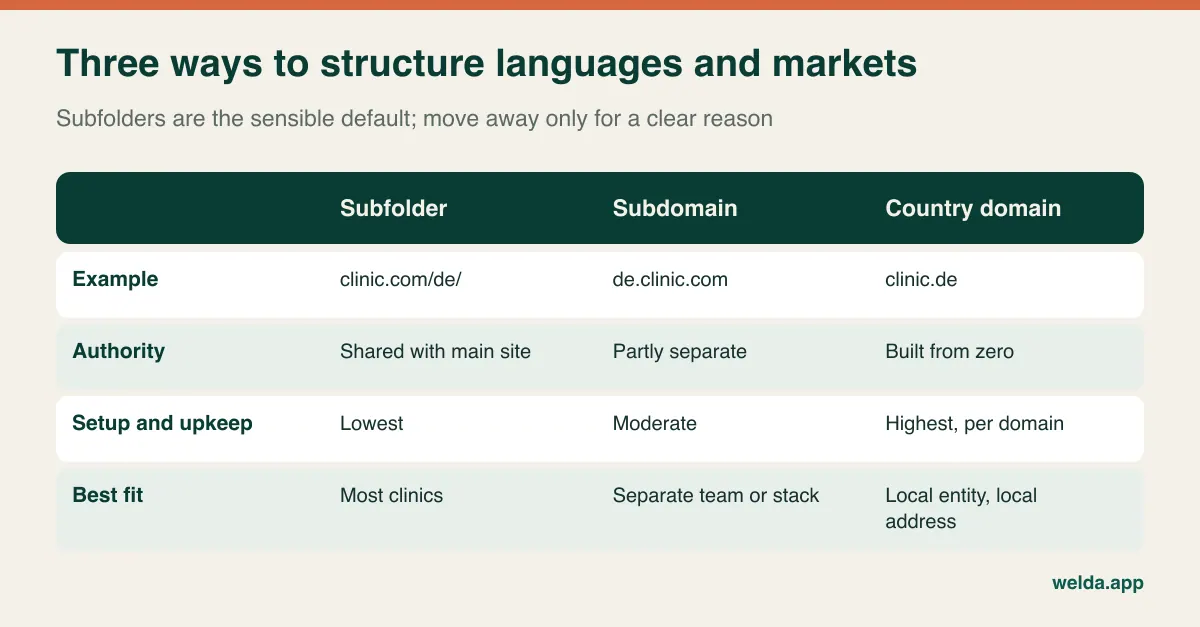
Now do the arithmetic the agency will eventually do. Count your treatment pages and core pages, then multiply by languages.
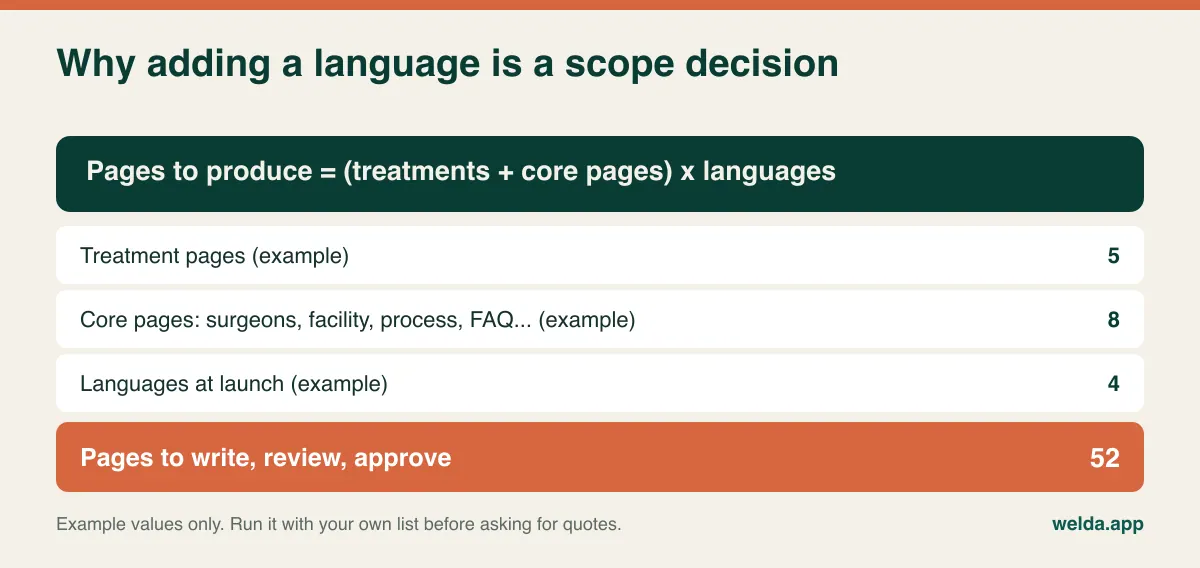
That number is what you are really buying. It determines writing effort, reviewer hours and the size of every future update. It can change the conversation, because a clinic that wanted four languages and twelve treatments may realise it can launch two languages and five treatments to a much higher standard and learn something before spending more.
Right-to-left languages deserve an early mention. Arabic isn't just translated text. Navigation, forms, icons, tables and even the order of before-and-after images need to mirror properly, and a design that ignored this usually looks patched afterwards. If the Gulf is in your plan, say so before design begins, and ask to see a right-to-left site the agency has actually shipped. The same care applies to phone number formats, date order, country pickers, units (kilograms or stone) and how currencies appear. Small mismatches here produce a surprising amount of unusable form data.
Finally, think about where the servers sit and where patients are. Performance tests run from the agency's office tell you little about how the site opens on a mid-range phone in Riyadh or Leeds. Ask where Core Web Vitals will be measured, on which devices and on which templates. Clinic sites tend to carry heavy galleries and facility videos, so image handling is worth discussing before it becomes a problem.
Medical copy needs a named approver
The most common reason these projects stall isn't design or code. It's copy. The agency assumes the clinic will supply it, the surgeon has no time, the translator is nervous about clinical terms, and finished templates wait for months. Your brief should name three people: who drafts each page, which clinician signs it off, and who reads the final version in the target language. Build their time into the schedule, because a reviewer who gets forty pages on a Friday won't return them on Monday.
Not every page deserves the same treatment. Privacy notices need careful translation. Process and about pages need localising. Treatment pages usually need rewriting for the market, because the literal translation of your source text may not match what patients type or how they talk about the procedure. AI tools can speed up drafting, but responsibility for what goes live stays with a person. Publishing the reviewer's name and a last-updated date is a small addition that signals real care to readers.
Advertising rules follow the patient as well as the clinic. Terms like "best", "guaranteed" or "painless", patient testimonials and before-and-after images may be restricted in your own country and separately in the countries you target. In the UK, for instance, the advertising codes enforced by the ASA can be relevant to marketing aimed at UK consumers. In many markets the rules for cosmetic procedures are stricter still. We aren't lawyers and this isn't legal advice. What you should expect from an agency is a schedule that leaves time for a legal read and a page structure that lets you remove or change a claim everywhere at once. What you should not expect is an agency's assurance that the copy is compliant.
The proof stack: answering "what if it goes wrong?"
Treatment abroad asks patients to trust people they have never met, far from home. A "why choose us" block won't carry that weight. Patients believe what they can check, and many will check. They may search a surgeon's name, look up a licence or read reviews on independent platforms, and health authorities and professional bodies in several countries publish advice for people considering treatment abroad, so many of the questions below are the ones those patients have been told to ask.
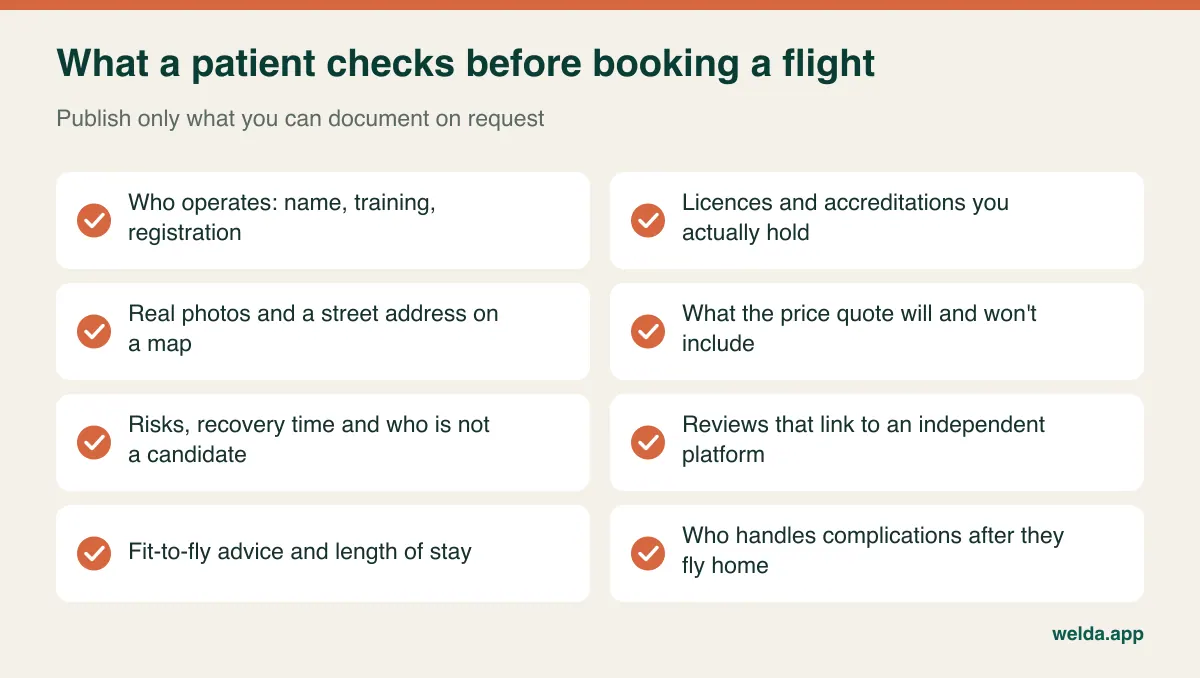
The item clinics avoid most is aftercare. Talking about complications feels like bad marketing, yet it is the exact question on a patient's mind at two in the morning. Spell out what happens if they have a concern after flying home: who they contact, in what language, what records they will carry so their local doctor can help, and how long you stay involved. Add a clear statement of who is not a candidate. Besides being honest, it saves your coordinators from long conversations that were never going to end in treatment.
Design's contribution is to move evidence up the page. Put the clinician's card in the middle of the treatment page, not behind an "our team" link. Use real photographs, including the unglamorous ones of reception and recovery rooms. Show accreditation logos only for those you hold, link them to the issuing body where possible, and put someone in charge of checking expiry dates. A countdown timer and a flashing discount banner might suit a holiday deal. On a surgical page they can undo all of that work in a moment.
Publish prices, hint at them, or keep them for the assessment?
Price is a primary reason many patients travel, so this decision will come up in the first agency meeting. There are three common positions. Publishing fixed packages is simple to read but hard to keep accurate across languages and hard to defend when a plan needs changing after assessment. Explaining what determines the cost, and sending the figure after an assessment, is more honest for variable treatments but must be clearly explained, or the form looks like a trap. A mix of the two can work when some procedures are standard and others aren't.
Whichever position you choose, the inclusions list is not optional. Transfers, hotel nights, interpreter, follow-up visits, medication, additional grafts or implants, and a companion's costs should be written out as included, excluded or depends. The design task is to make that list easy to scan on a phone and easy to update, and to make sure every language version says the same thing.
Designing the enquiry as a sequence, not a form
A normal contact form asks for a name and a message. A clinician assessing someone for treatment needs photographs, medications, history, perhaps an X-ray. Ask for all of that on the first screen and most people will leave. Ask for none of it and your coordinators will collect it piece by piece over chat, scattering sensitive images across personal phones.
Different moments call for different routes, so don't make every patient use the same one.
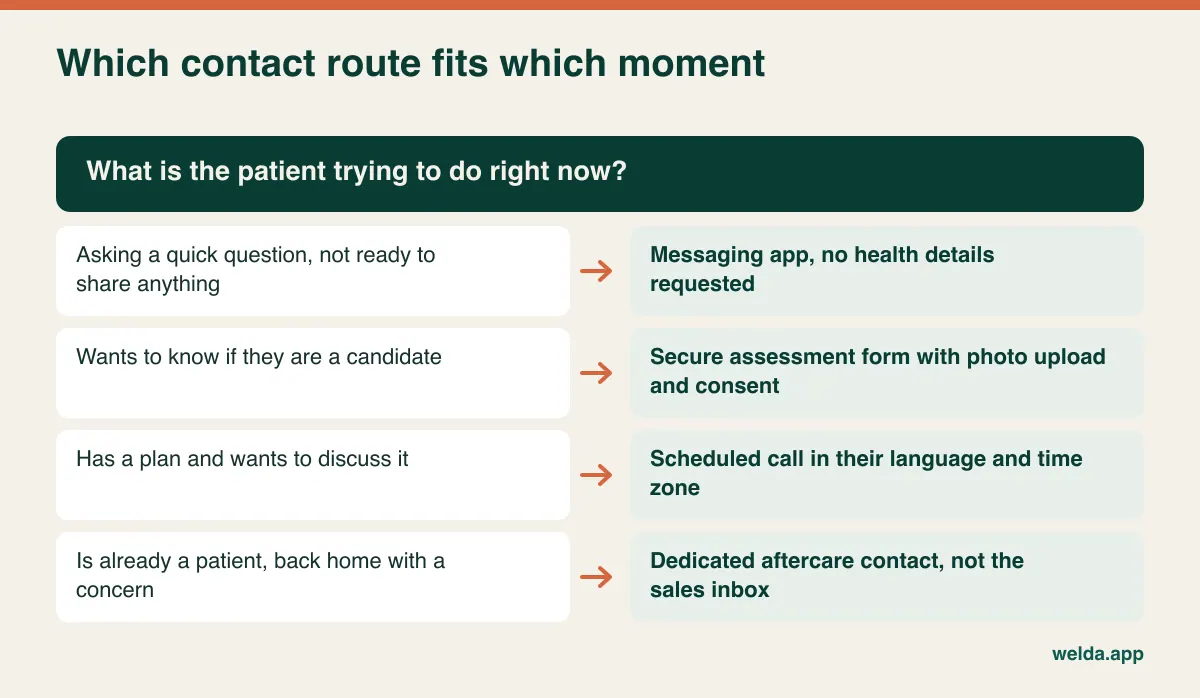
The assessment itself works best in stages, with the commitment rising gradually. The first stage should feel almost trivial. Treatment comes pre-filled from the page the patient was on, and once they leave a name and channel, you have an enquiry worth following up even if they stop there.
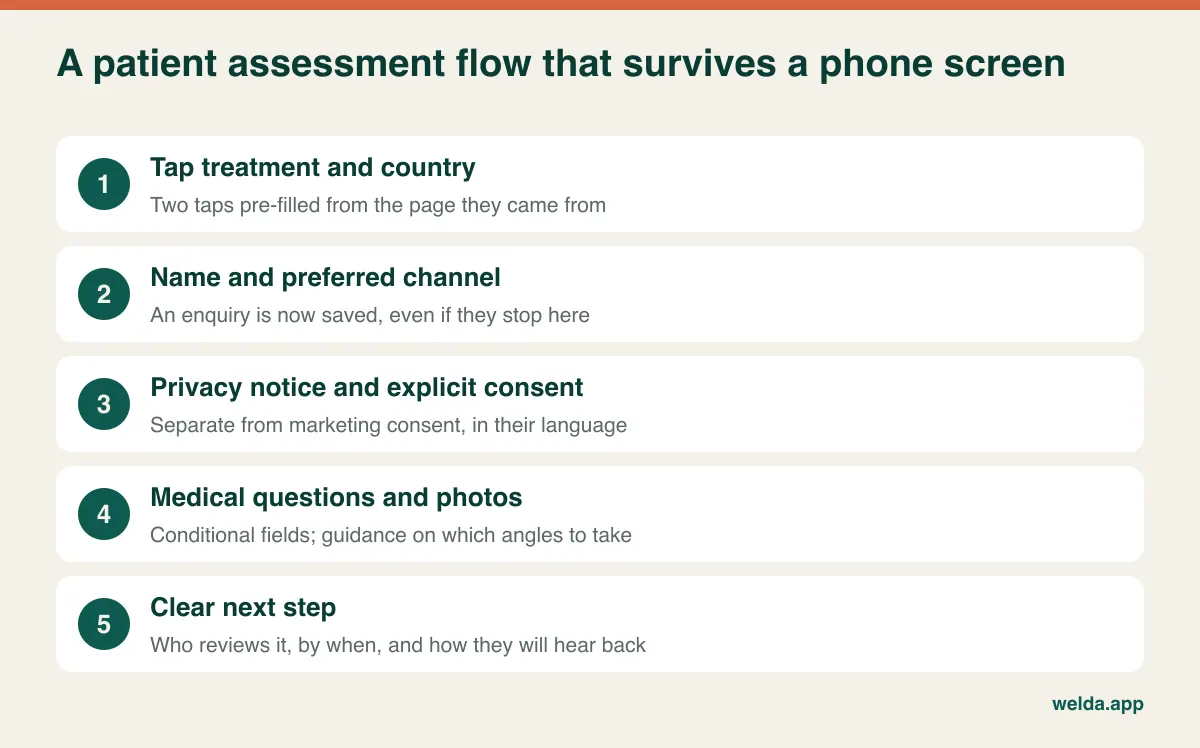
The details decide whether this works in practice. Show which photo angles you need with small illustrations, specific to the treatment, so a hair patient isn't guessing and a dental patient knows whether a panoramic X-ray helps. Handle large phone images properly, with a visible progress bar and error messages in the patient's own language. Save partial progress. Send a confirmation that says who will review the file and when, in a time zone the patient can understand. For example, if your coordinators start at nine in Istanbul, an enquiry submitted in the evening in London should get an automatic reply saying when the first human response will arrive, and that promise should be kept.
What happens behind the form deserves equal attention. Each enquiry should carry its source page, campaign, language and country, and go directly to the person who speaks that language. Ask the agency where submissions are stored, who can open them, how long they stay and how they get deleted. Health information is a special category of personal data under the GDPR and the UK GDPR, and those rules can apply to clinics outside Europe when they target people there. Other countries have their own laws, and it shouldn't be assumed that the US HIPAA framework or any other answers every question. Take advice on your own case. Our privacy-compliant website guide covers the general ground. A practical point to raise with any agency is that a marketing site may sit on one kind of hosting while patient files belong somewhere with stricter controls, and an email inbox is rarely the right place for them.
What moves an agency's quote, and how to compare them
Website proposals for this sector can look wildly different because they often price different things. One may include medical copywriting and a secure assessment flow. Another may include a template, a translation plugin and a contact form. Comparing their totals tells you very little. Put them on one sheet using the lines below, and treat every empty cell as a question for the agency. How to evaluate website proposals has the general method; these lines are the ones specific to cross-border care.
| Cost driver | What makes it grow | What to ask |
|---|---|---|
| Markets and languages | Page count, right-to-left layouts, keyword research per market | Is SEO and testing done separately for each language? |
| Medical content | Who writes it, translation depth, rounds of clinical review | Is copy in scope, and how many review rounds? |
| Enquiry flow | Staged forms, secure uploads, routing by language | Where is patient data stored, and who has access? |
| Evidence production | Facility and clinician photography, video, credentials layout | Is a shoot included, or are we using stock? |
| Integrations | CRM, appointment tools, ad platforms, analytics | Which conversion events will be tracked? |
| After launch | Maintenance, content updates, new languages | How is a new treatment or language priced later? |
Hidden costs in this category usually surface after launch. Rebuilding the design for Arabic, commissioning photography because stock images looked wrong, moving patient data out of email, adding landing pages when paid campaigns start, and updating a clinician's details in every language all land on someone's invoice. Ownership belongs on the list too. Ask in writing who keeps the source code, domain, analytics and ad accounts, because that answer decides how expensive it would be to leave. Costs become concrete only when scope is on the table, which is why we discuss them in a free call rather than publishing a range.
When a full site is the wrong purchase
Some buyers should spend less. If you have no coordinator yet, no idea which market will respond, or treatments that can't legally be advertised in your target country, a full multilingual build is premature. A focused set of pages for one treatment in one language, with solid proof and a properly measured enquiry flow, can answer the commercial question first. Equally, if most of your international patients come through referral and only need to confirm you are real, a modest, accurate site may be all you need. An agency that tells you this is worth listening to.
After launch: read the chain, not the traffic
Treatment decisions can take weeks or months, and the last steps happen outside the website. Visits and form fills will mislead you if you stop there. The chain to watch runs from qualified visit to first contact, to completed assessment, to plan sent, to treatment carried out, split by country and language. It takes a CRM, or at least a disciplined spreadsheet, and a coordinator who records outcomes. Each break suggests a different fix. Few enquiries point at the page or the targeting. Many enquiries and few completed assessments point at the form or reply speed. Many plans and few treatments often have nothing to do with the site.
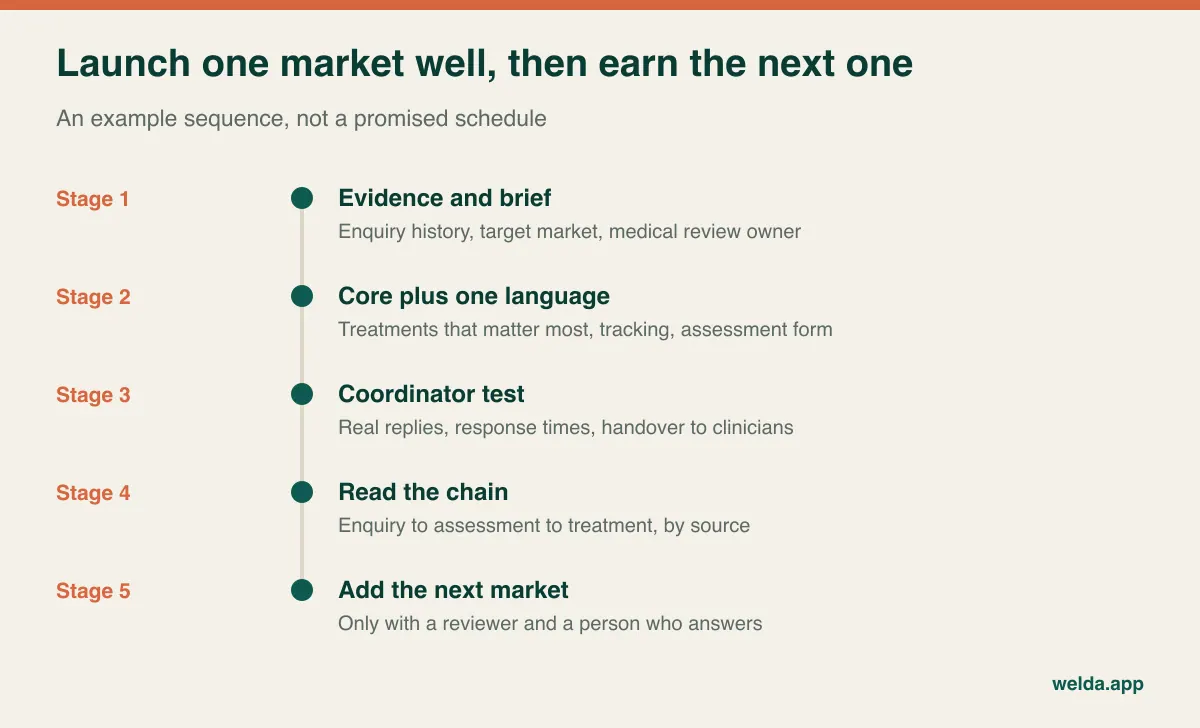
Build the same discipline into how you expand. Launch one market properly, read the chain with real conversations behind it, and add the next language only when you have a reviewer and someone to answer. Health advertising also has its own restrictions on the major ad platforms, so a campaign may need wording changes that affect the landing page as well. The team running ads and the person approving copy need to be looking at the same schedule.
Where Welda fits, and where it doesn't
Welda's web work is done by the Istanbul team that builds and runs our own software, Welda Stock and Welda CRM. If you are looking for medical tourism website design, we scope with you first, design in Figma, and build in Next.js/React or WordPress. We tune against Lighthouse and Core Web Vitals, set up technical SEO with Search Console and GA4, give you a CMS so your team can edit content, and hand over source code with documentation. We work in Turkish, English and German, and this site runs in all three.
Some things we should be upfront about. Clinical approval stays with your clinicians. We don't give legal advice, so licensing, advertising and privacy wording need your own counsel. Languages outside our three, Arabic and Russian among them, need a separate medical translation source, and right-to-left requirements should come up at the start of the conversation. We don't claim a medical tourism reference list, so ask us your sector-specific questions directly and judge the answers.
After the form, our appointment and client management software may be relevant. Welda CRM includes a lead funnel and quotes, encrypted health records, a before-and-after photo archive, message templates in Turkish, English and German, and KVKK/GDPR consent management with an audit log, with a 7-day free trial. How a particular site's form would connect to it is something to confirm during scoping, not to assume. Bring your market list and a rough treatment list to a free call about your medical tourism website design project, or get in touch, and we will work out the scope and the price with you.
Frequently asked questions
How many languages should a medical tourism website launch with?
As many as you can answer in, the same day, with a person. For most clinics that means one strong market beyond the home language, with its priority treatments done well. Add the next language when the first one has a working reply routine and a medical reviewer.
Can I add languages to my existing clinic website?
Sometimes. If the platform supports proper language structures and the templates are flexible, adding languages is reasonable. But a site built for local patients usually falls short on treatment depth, proof and enquiry flow, so have those three audited against your target market before you pay for translation.
Should a facilitator name its partner clinics?
Patients want to know who will treat them, and few will fly without knowing. If commercial reasons make you delay naming a clinic, say at which stage the name will be shared, and explain your role and how you are paid. Check any contractual and licensing requirements with your adviser.
Is AI translation good enough for treatment pages?
It can produce a useful draft. It can't take responsibility for clinical accuracy, natural phrasing or the terms a given market actually searches for. Have someone fluent in the target language edit it, and have a clinician approve it before publication.
Do we need online payments on the site?
Often not at first. Deposits raise questions about foreign cards, currency, refund terms and invoicing, and those need your accountant as much as your developer. Many clinics can take payment through a separate channel after the written plan is agreed, then revisit it once volumes justify the work.
Is WhatsApp enough instead of a form?
It is a strong first-contact channel where patients already use it, but it's a weak system of record. Sources get lost, consent is hard to evidence and photos end up on staff phones. Keep it for the first conversation, then move medical information into a controlled channel.