Landing page design service cost is set by the work behind the page, not by the fact that it is one page. The main drivers are who writes the copy, how custom the design is, what the form must connect to, how much tracking is included, how many variants you need, and who looks after the page once it is live. That is why two quotes for "one landing page" can sit far apart without either being unfair: they often describe different jobs under the same name. Because scope varies so widely, a credible number comes from a short scoping conversation, and for Welda that conversation is free. What follows helps you judge any quote, ours included, and decide whether you need a new page in the first place.
This guide is written for business owners and marketers who are paying for clicks and suspect those clicks are landing somewhere that does not help. Maybe the ads send people to a homepage. Maybe there is a page, but nobody can say what it produces. Either way, the buying decision is easier if you separate what the page has to do from what it is going to cost.
Why "one page" is a misleading unit
Nobody would price a contract by counting its pages. The same logic applies here. A landing page has a single URL, yet it bundles several distinct kinds of work, and most of the effort happens where a visitor never looks. A page for a local roofing contractor might have a short phone-first layout and take little design time, but the offer still has to be pinned down, the phone tap has to be measured, and someone has to decide what happens when a call comes in at 9 p.m. A B2B software demo page might need a CRM connection, a scheduling tool, a security statement and three rounds of legal review. Both are "one page."
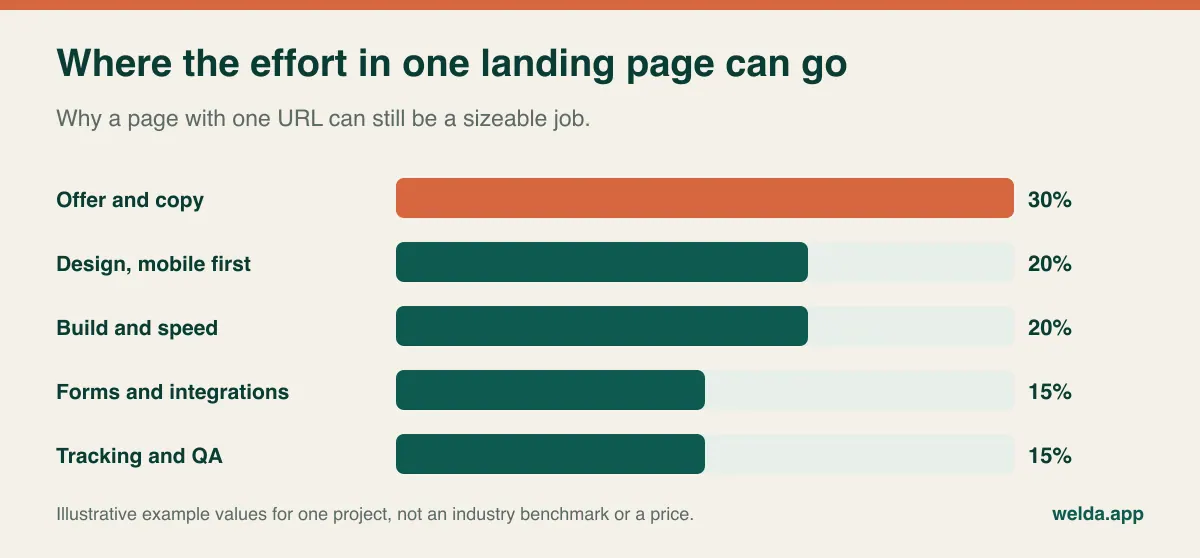
The split above is an illustration, not a benchmark, but the point holds in most projects: if a quote prices only design and build, you may still be on the hook for the parts that decide whether it works. Read every quote by asking which of these jobs it covers, and which it assumes you are doing yourself.
Copy deserves special attention because it is the line buyers most often treat as an afterthought. A designer can make weak copy look finished, which is exactly the danger. If your offer is "quality service at competitive rates," no layout will rescue it. Someone needs to talk to whoever handles your sales calls and find out what prospects actually object to. That conversation costs time, and it is usually worth more than an extra design concept.
Before you buy anything, audit the click you are already paying for
Open your ad on your phone, on mobile data, the way a real prospect will. Read the headline, tap through, and answer five questions. Does the first screen repeat the promise in the ad? Can you tell what to do without scrolling? Does anything jump around while the page loads? Is the form asking for details you do not actually use? Does the page say what happens after you submit it?
Then go to your numbers. How many clicks reached the page, how many used the form or tapped the phone number, and how many of those turned into a real conversation? Each gap points to a different owner. Clicks that never convert point at the page or at the match between ad and page. Leads that never become conversations point at your reply process, and a new page will do nothing for that. Knowing which problem you have can save you the entire project, or justify it.
A dedicated page is usually a poor buy in three situations. If you only run ads on your own brand name, the visitor already knows you, and your homepage may do the job. If you already have a good page for that one service, making it faster and giving it a clearer call to action is often cheaper and just as effective. And if no conversion tracking exists, you cannot tell whether any page works, so fix that first. If you are weighing the wider structural question instead, our guide on one-page versus multi-page websites covers it.
The real question is how many promises you are making
"We need a landing page" is usually an incomplete brief. List the distinct promises in your live ads, multiply by the audiences who would need a different argument, and multiply again by languages or markets. Then decide which differences justify a new page and which can be handled by swapping a headline and a photo.
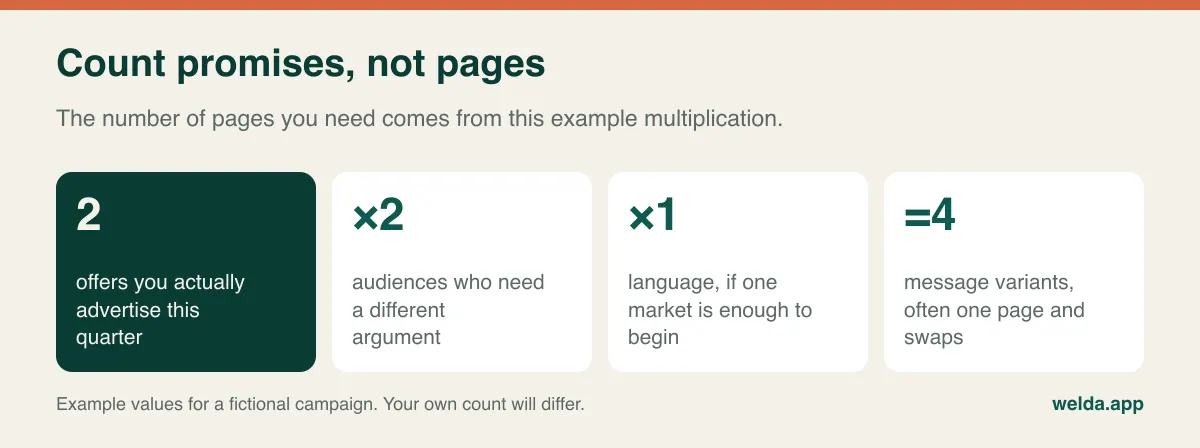
Consider a fictional training provider. Its "weekend coding bootcamp for career changers" ad and its "upskilling for engineering teams" ad need separate pages, because the first reader worries about job prospects and payment plans while the second worries about invoicing, reporting and scheduling across a team. Now take a dental group advertising the same whitening offer in two cities. The address, phone number and photos change, and nothing else really does. That is one template with two versions.
This distinction changes your quote more than almost anything else, because a second design from scratch and a variant of an approved template are very different amounts of work. Ask how a provider prices each. Then start with the single promise taking the largest share of your ad budget. Ordering five variants of a structure nobody has validated just multiplies the risk.
Traffic source sets the job the page has to do
A person who searched "emergency boiler repair near me" wants confirmation and a phone number. A person scrolling through social media who saw your ad was not looking for anything; they need to recognize the problem before they care about your solution. Generic advice like "keep it short" ignores this difference. Search traffic often rewards a short, direct page. Cold social traffic usually needs more explanation and a lower-commitment action. Retargeting visitors already know you, so the page can focus on the one objection that stopped them.
Tell every provider where the traffic will come from before they quote. If you run Google Ads, the fit between keyword, ad and page also has a technical side, because landing page experience is one of the components of Google Ads Quality Score. A provider who designs before asking about traffic is designing for nobody in particular.
Where the page lives changes the bill for years
This decision is often made by default, yet it affects both the first invoice and every year afterward. You have three realistic options.
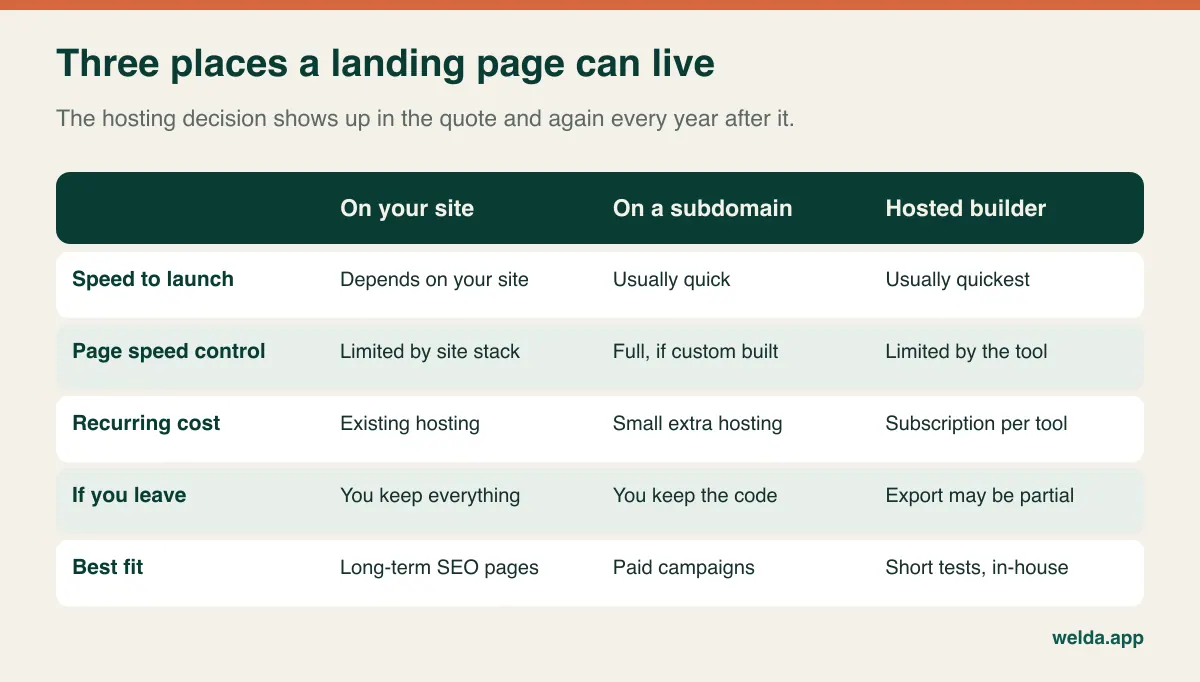
Building inside your existing site keeps everything in one place and suits pages you also want to rank in organic search. The catch is that the page inherits whatever is slowing that site down, and changes may have to wait for its release process. A subdomain such as offers.yourcompany.com gives a campaign independence and full control over speed, at the price of a small extra hosting and setup job. A hosted landing page builder is often fastest, and a sensible choice for short tests by a team with time to run them, but you are paying a recurring subscription, speed depends on the tool, and export options may be limited. If you stop paying, ask what happens to the page.
We lean toward owned code for pages meant to run for a long time, and we would not argue with a builder for a two-week test run by someone in-house. The wrong outcome is choosing a builder for cost reasons and then discovering, a year later, that the subscription plus the agency time to operate it exceeded what a built page would have cost. Do that sum before you sign.
Reading a quote line by line
Open a single spreadsheet. Put the items below in the rows and each provider in a column. Mark each cell as included, excluded or unclear, and send the unclear ones back as questions. Only then look at the totals. Many apparent price gaps disappear at this point, and a few get wider for good reason.
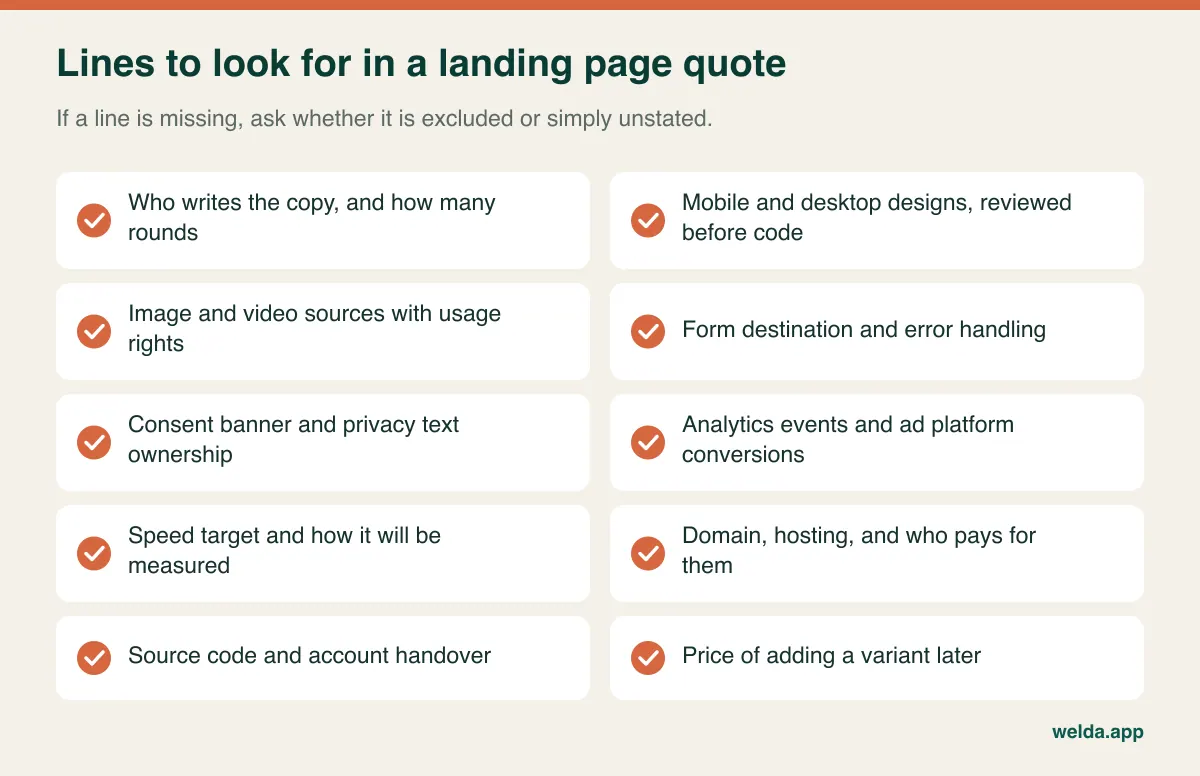
Next, calculate cost across twelve months rather than comparing launch fees. Add hosting, any tool subscriptions, maintenance, and what you will pay for routine edits such as a new headline when the campaign changes. Ask what a second page costs if it reuses the approved template. For a broader method, see our guide to evaluating website proposals.
The hidden costs tend to appear after launch rather than in the quote. Revisions beyond the included rounds. Stock image licenses that were assumed to be yours. Paid tools the page quietly depends on. A form that emails one person and fails silently when their inbox changes. And the expensive one: analytics, tag manager, ad and domain accounts created under the provider's login. Have those opened in your company's name from the start. Separating them after a disagreement is slow and sometimes costs you your historical data. Check too whether quoted figures include sales tax or VAT, and in which currency, particularly when you hire across borders.
Fixed fee, hourly or retainer
The billing model is part of the cost, because it shapes behavior once work starts. A fixed project fee forces both sides to write down a scope, which is why it suits a single defined page. Its weakness is that it tends to stop at launch unless you agreed otherwise, and that anything outside the scope becomes a change request. Hourly billing is fair for small edits and hard to forecast for anything larger. A monthly retainer makes sense when you are really buying ongoing testing and new variants, but only if you can see what got done and can exit cleanly.
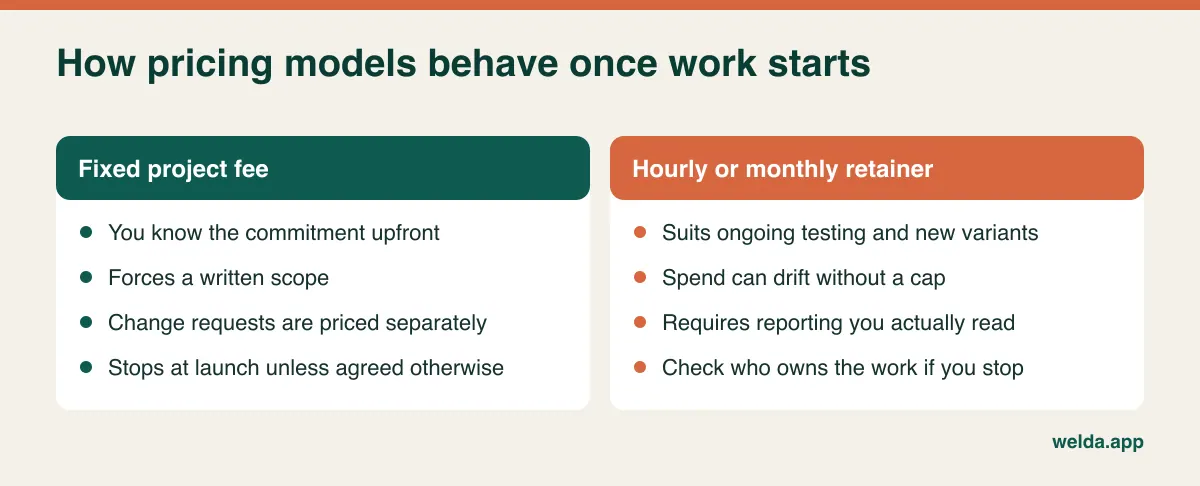
A common pairing is a fixed fee for the first page, followed by agreed rates for changes. Be wary of a low setup fee tied to a long minimum contract, and check who owns the page if you end that contract. Ask what happens to the design files and code on the day the agreement ends, and get the answer in writing.
Measure before you spend
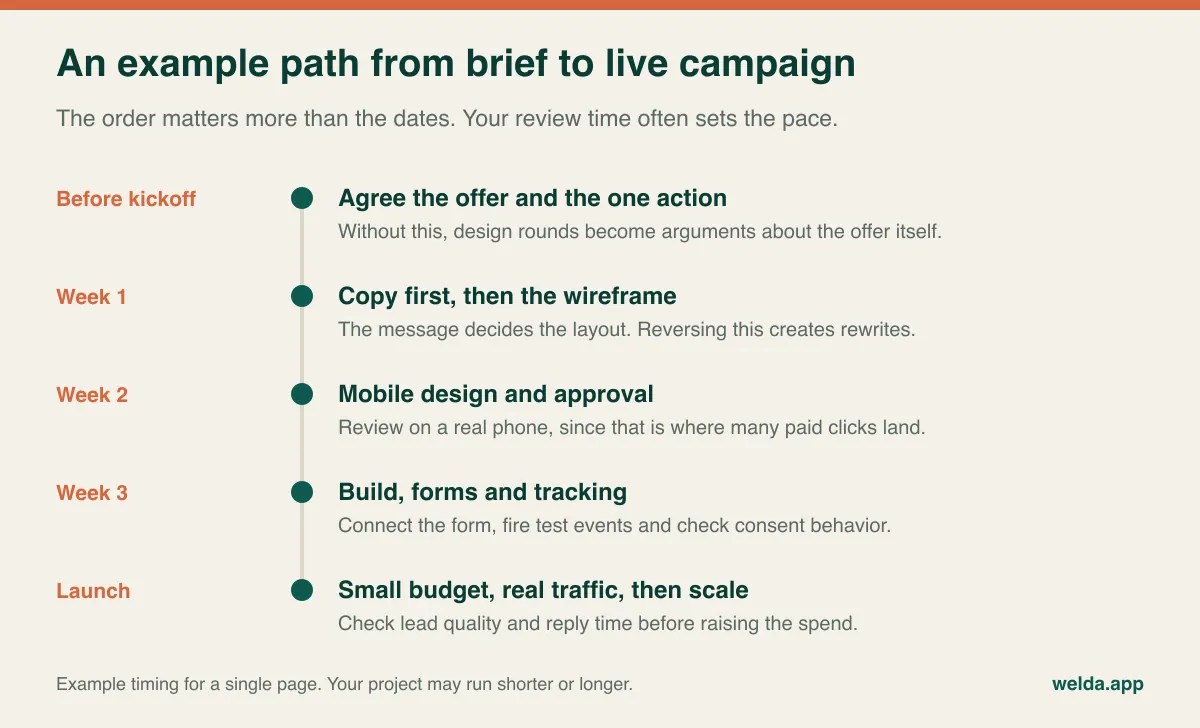
Launch day is a poor time to learn that your tracking does not work. A page goes live, ads start, and two weeks later somebody notices that the conversions in the ad platform do not match the leads in the inbox. That spend is now hard to learn from. Treat a tracking test as the last acceptance step, not as an extra. Submit a real test lead from a real phone. Confirm it arrives in the right inbox. Check that the event appears in Google Analytics 4 and in each ad platform, once and not twice. Try rejecting cookies and see whether tags actually stop.
Be careful with click-based events too. A tap on a WhatsApp or phone button means somebody started; it does not prove a message was sent or a call was connected. In the first few weeks, count real conversations by hand and compare them with what the dashboards report. Once the numbers can be trusted, our landing page conversion optimization guide covers what to test next.
On speed, ask for targets rather than adjectives. Google's published "good" thresholds for Core Web Vitals (2.5 seconds for LCP, 200 milliseconds for INP and 0.1 for CLS) can go into a brief, along with how they will be measured. "Fast" cannot be verified at handover. These thresholds can.
Selling across borders adds its own line items
Many businesses reading this advertise beyond one country, and that affects scope in ways a local page never would. Translation is the obvious cost, but a page translated without adapting its proof and objections often underperforms. A German buyer and a US buyer may want different kinds of reassurance, different levels of detail, and different ways of making contact. Decide whether you need a translation or a separate page for that market, and price them differently.
Privacy rules vary too. If you collect leads from people in the EU or UK, GDPR and related cookie rules are relevant wherever your company is based. Ad and analytics tags generally need thought before consent is given. Parts of the US have state privacy laws of their own, and Canada, Australia and others have their own expectations around marketing messages. We are not giving legal advice here, and a brief scoping note cannot replace it, but it is reasonable to ask a provider how consent works on the page and who supplies the privacy text. In most arrangements your company remains responsible for that text. Regulated sectors such as health, finance and legal services often have extra advertising restrictions, and ad platforms enforce policies of their own. Raise this before design begins, because it can change the claims the page is allowed to make.
Hiring across borders is common as well, so ask about working hours overlap, language of communication, contract jurisdiction and how invoices are handled. Our team, for example, is based in Istanbul. For some clients that is entirely fine; for others, local presence or a specific data-processing arrangement matters. It is better to raise that at the outset than to discover it at contract stage.
Does a dedicated page pay for itself?
You do not need an elaborate model. Divide the total first-year cost of the page by the gross profit from one sale. The answer is how many additional sales the page has to generate to cover itself.
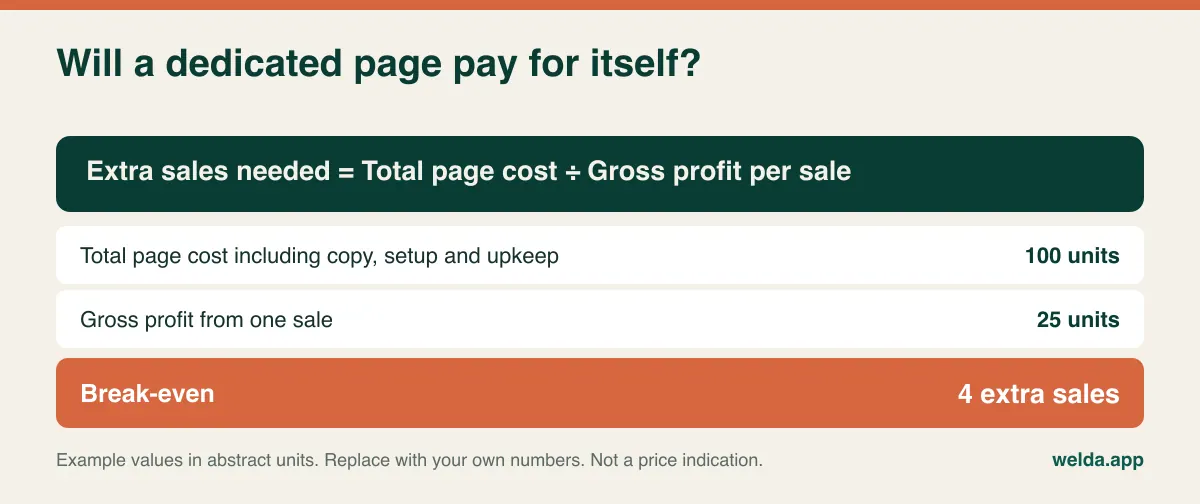
For high-value, infrequent sales such as equipment, renovation or B2B services, the threshold is often small, and a handful of qualified conversations can justify the work. For low-margin, high-frequency products the threshold climbs, and fixing an existing product page or using a simple template may be the sensible choice. The calculation will not give you a guarantee. It will quickly tell you whether a custom build is out of proportion to the campaign.
Be skeptical of anyone who answers this question for you with a promised uplift. No provider can honestly promise a percentage without knowing your traffic quality, your offer and your competition. A reasonable commitment is about deliverables: a speed target, working tracking, an agreed number of revision rounds, and handover of code and accounts.
The hour after the lead arrives
Few landing page proposals mention this, yet it can decide the return on the whole project. Somebody who fills in your form has often contacted other businesses too. Whose screen does the lead appear on? Who covers Saturdays? What does the first reply say? If nobody can answer, even a great page turns into an expensive notification.
Three small items are worth adding to the scope. A thank-you page that says when you will reply and what to prepare, rather than just "message received." A notification that goes to a shared destination rather than one person's inbox. And a stored source field recording which campaign the lead came from, so that months later you can answer "which ads produced customers?" using conversations rather than clicks.
How Welda handles this kind of project
Landing pages sit inside our web design and development service, and our landing page design service is built for campaigns, launches and paid traffic: fast-loading, focused pages with clear calls to action and conversion tracking. We begin by agreeing goals and scope, design in Figma with you, then build in Next.js/React or WordPress and tune performance against Lighthouse. Search Console and GA4 are set up as part of the work. The source code belongs to you, you get a CMS for editing content, and you can host where you like. The same Istanbul team also builds Welda Stock and Welda CRM.
We do not sell fixed packages, so a number follows a scoping conversation. If your team can run a builder for a short test, or if your existing page only needs a small fix, you may not need a project at all, and we would rather say so on the call.
Questions buyers ask
How much does a landing page design service cost?
It depends on copy, level of design, integrations, tracking and number of variants, which is why a single figure would mislead you. Compare quotes line by line, and over twelve months rather than at launch. For your own project, the number becomes clear in a free consultation once the scope is known.
Is it worth paying for a custom design over a template?
A template can be enough if your offer is clear, your brand is simple and you are testing a campaign. Custom work makes more sense when the sale depends heavily on trust, when the purchase is high-value, or when you need full control over speed. Judge by what the page must persuade someone of, not by how a template looks in a demo.
Can a landing page rank on Google as well as take ad traffic?
It can, but the two goals pull in different directions. An ads-only page may be thin on content and deliberately free of navigation, while a page meant to rank needs depth and a place in your site structure. Say upfront if you expect organic traffic, because it changes where the page lives and what goes on it.
How many form fields should I use?
As few as your next step requires. For many service enquiries a name, a phone number or email and a short description may be enough. If your sales team truly needs more to qualify a lead, add fields deliberately and watch what happens to both volume and lead quality.
What should I prepare before asking for a quote?
Six things: the promise in the ad, where the traffic comes from, the one action you want, who will handle the leads, what copy and images already exist, and who approves the work. With those answers a provider can scope accurately, and you can compare their responses fairly.
What happens to the page when the campaign ends?
Do not leave an expired offer online. Redirect it to a relevant current page or update it. If you will run the campaign again, keep the page as a reusable template, because the next one will then be faster and usually cheaper to produce.
How soon can I judge whether the page works?
Traffic volume decides that, not the calendar. A week of low traffic can mislead you. Check at first that tracking works and that the leads are relevant, and make decisions about variants only after a meaningful number of conversions has built up.
Getting a number you can compare
You do not need a finished brief for a first conversation. Your ad, your recent numbers and a sentence describing the promise are enough to discuss whether a new page is justified, or whether a fix will do. To talk through scope and get a landing page design service cost for your own project, start with our landing page design service cost and scope page or book a free consultation.