Free veterinary practice software can be enough for a single-vet clinic in its first months, while the patient list is short and one person books and treats everyone. It tends to stop being enough around the first anniversary of opening, not on opening day. That is when annual boosters for your earliest patients land on top of routine follow-ups, and a reminder routine that relies on someone remembering starts to slip. So the useful question is not whether the software costs nothing. It is who will know, twelve months from now, which pet is due back and which owner to contact. This guide sets out where free options run into limits on data, support and reminders, how to find the switching point for your own clinic, and how to leave free software without losing your records.
Wanting to keep costs down is sensible. A new clinic has already paid for the lease, the table, the autoclave, the imaging equipment and the first drug order before the first patient walks in. We should declare an interest: we sell clinic software. Even so, telling every new practice owner to subscribe in week one would be poor advice. For some clinics, free really is the right place to start. What matters is knowing in advance when and how you will leave it.
Follow the money before you compare features
Search for free vet software and you will see very different things sharing one label. Each has a cost. It has just moved somewhere you may not be looking.
- The spreadsheet stack. A spreadsheet, a shared online calendar and a messaging app. There is no licence fee and no system either. You design the structure and your staff are the automation.
- A free-forever tier. A vendor gives away a limited package and earns from paid tiers. Limits usually sit on patient count, users, storage or messaging, and you pay on the day you hit one.
- Open source. The code is free. Hosting, installation, backups, updates and security are yours. Unless a partner or relative enjoys running servers, the real bill is a contractor.
- A trial labelled as free. Useful for deciding, but not something to build a clinic on.
- Human-practice or general booking tools. These can be adapted, but on day one you will have to decide whether the "patient" field holds Mrs Patel or her spaniel, and that compromise follows you for years.
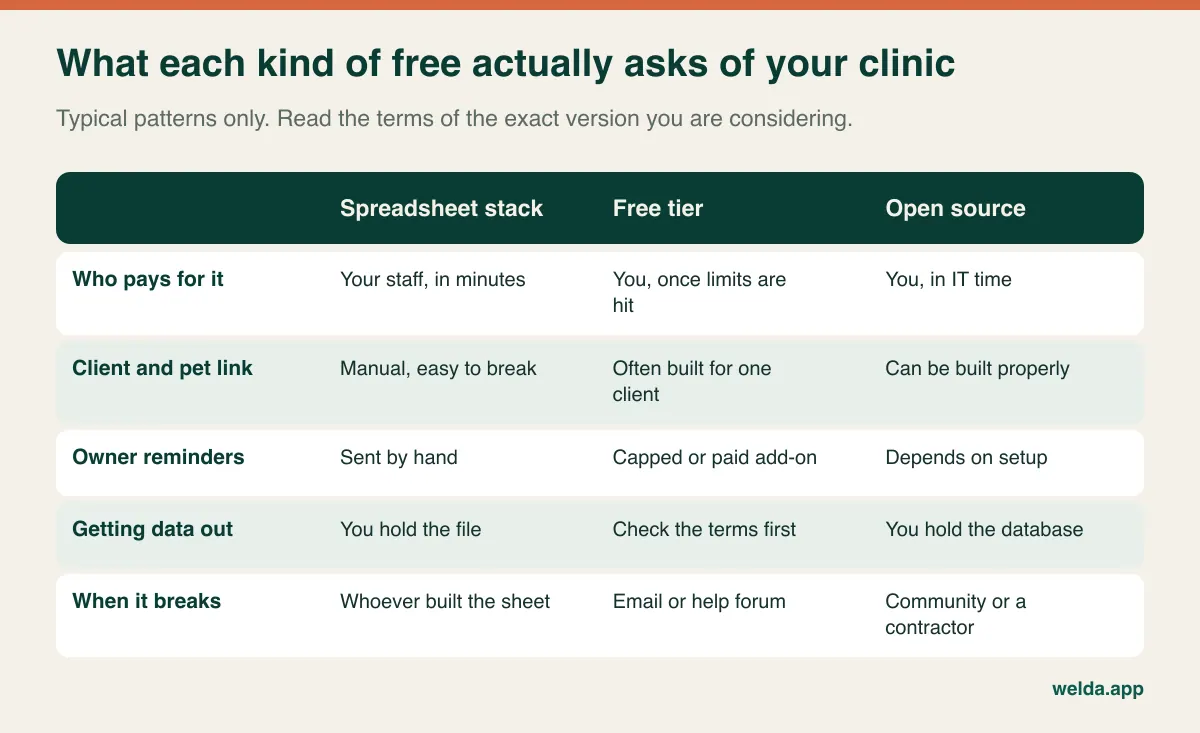
None of these is a bad choice in itself. Each suits a clinic of a certain size and a certain kind of owner. Trouble usually comes from not noticing that the clinic has outgrown the choice it made.
The recall problem shows up a year late
In a hair salon, a weak free tool reveals itself on the busiest Saturday. In a veterinary clinic the failure is delayed, because a large part of your work is scheduled for the future. Every vaccination you give in month one is effectively a work order for around month thirteen, depending on the product and your protocol. Those orders are invisible while they build up, so a calendar and a spreadsheet look completely adequate for most of the first year.
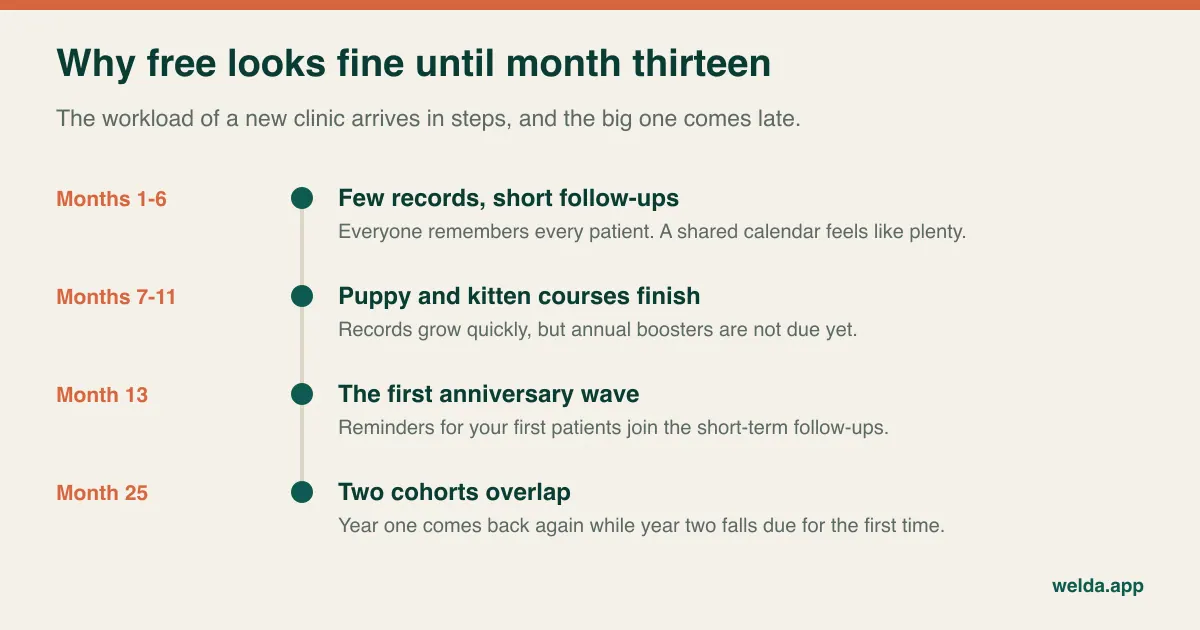
Try the arithmetic with invented but plausible numbers. Say you register 40 new patients a month, send about 20 short-term follow-up reminders a month, and recall each patient once a year. For the first twelve months you handle roughly 20 reminders monthly. In month thirteen the first 40 patients come due and the monthly total becomes 60. In month twenty-five, the first cohort comes round again while the cohort from month thirteen falls due for the first time, and you are at 100. Real clinics lose patients to house moves and competitors, and intervals vary by vaccine, species and risk. Still, the shape holds: the load climbs in steps, not gradually.
This is why the most misleading moment to assess free software is month six. Everything is working, and the evidence looks good, but the demanding part of the system has not been tested. Base the decision on your registration dates instead. Find the month your first patients come due, go back three months and put that date in your diary. That is your real decision date. Our guide to the patient recall system covers the wider logic of bringing patients back.
Where a manual recall leaks
A recall is not one action but a chain, and a free setup relies on a person at each link. Somebody must filter the list, notice who is due, send the message, chase non-replies, book the slot and then see whether the pet came in. Each step can slip without anyone knowing.
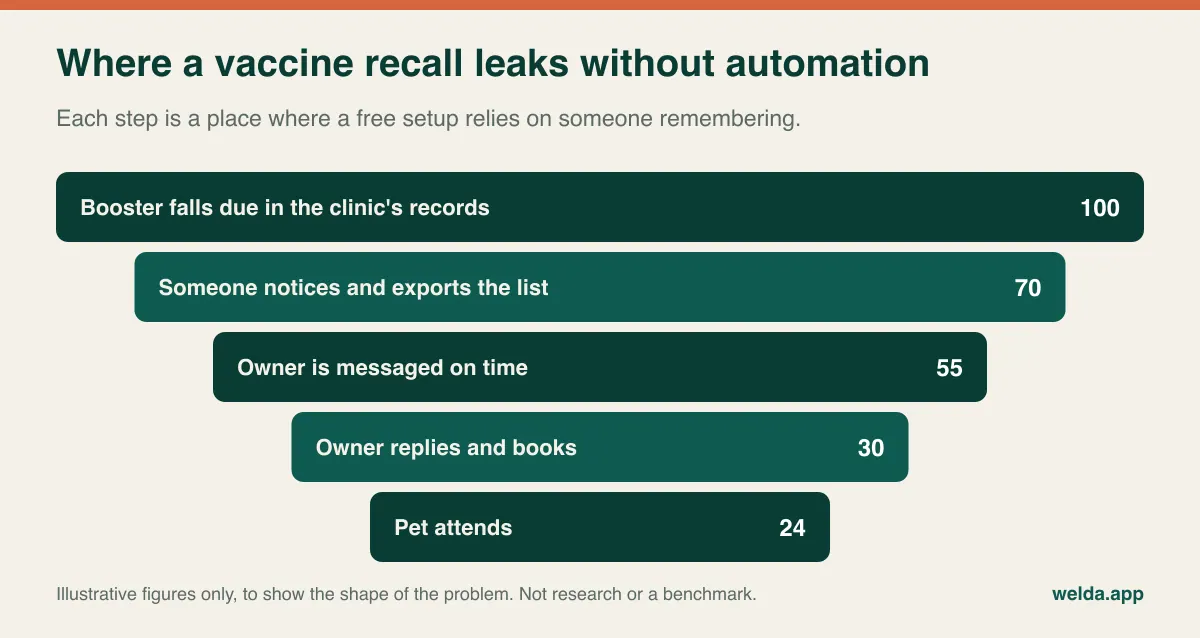
The numbers in that funnel are illustrative and not a benchmark. The point is to look for the widest drop in your own clinic. Measure it for a month. If nobody can say how many patients were due last month and how many came in, your first problem is not software but visibility, and that alone is a reason to change something.
One owner, three pets, and a very common name
Your patient cannot read a text or pay an invoice. The person who books, pays and answers messages is someone else, and may be different people in one family. Many free tools are built around a single customer record, and that mismatch appears with the first multi-pet household.
Picture a client with a cat, a Labrador and a rabbit that officially belongs to her teenage son. As three spreadsheet rows, the phone number lives in three places. When it changes, one gets updated and two go stale, and the next reminder for the rabbit goes nowhere. As one row, vaccine dates pile up in one cell and your date filter stops working. Then there is the naming problem. Every vet has too many patients called Bella, Max or Luna. If typing a name returns six results with nothing to separate them, a note about a drug reaction will eventually land on the wrong animal. That single error can do far more damage than the software saving was ever worth, and it is much harder to fix.
A ten-minute test tells you more than a features page. In any product, attach three pets to one owner, change the owner's phone number and see how many places you had to touch, then try to tell two patients with the same name apart in the search results.
Here is how Welda CRM handles this. Each animal has its own patient record, the owner's phone number is entered as the contact, and species and breed go into the notes. Histories stay separate, and reminders go to the owner's number. We do not advertise a dedicated household view, so ask to see the phone-number scenario on screen and judge whether that structure works for you.
Your calendar reminds you. It does not remind the owner.
"Includes reminders" is one of the more misleading phrases in free software. Very often the notification goes to the account holder. The person who needs the nudge is the owner, and the gap between those two is filled by your receptionist, who must see the alert, open the record, find the number, type the message, get the pet's name right and press send.
On a quiet Tuesday this works. On a Saturday morning with a vaccine queue at the door, a painful cat in the consulting room and the phone ringing, it is the first job to go. Nothing appears to break. Months later it shows up as an overdue dog and an owner who has drifted to the clinic nearer the school. That is what makes the free approach hard to judge: its failures make no noise when they happen.
Free tiers that do message owners tend to limit it, reasonably enough, because sending has a real cost. Ask how many messages you get a month, what happens when they run out, whether the system warns you or quietly stops, and which channel and sender number are used. Channel matters more than most buyers expect. Owners in some countries live on WhatsApp, and in others they expect SMS or email. Welda CRM's automatic reminders go via WhatsApp, as our guide to WhatsApp appointment automation describes, so if your clients do not use it, that is a real limitation and you should raise it with us before going further.
The message nobody wants to send
There is one risk you will not find in any general booking software review. Sending "Time for Max's annual booster!" to a family who said goodbye to Max three weeks ago can undo years of goodwill in a sentence. With a bulk list, the person who prepares it may not have heard the news. With automation, nobody looks at the message at all, which makes this question more important, not less. Whatever you use, decide in advance exactly how a deceased patient's future reminders are stopped, and make it part of how euthanasia appointments are closed. In any demo, ask: "This pet has died. Show me what we switch off."
What you leave behind matters more than what you pay
A clinic's most valuable long-term asset is its records: what each animal was given, how it reacted, what is due and how to reach the owner. If you ever sell the practice or bring in a partner, this is much of what is being valued. Putting years of it into a free product means trusting that the product, its free tier and its terms will still be there. No bad intent is needed for that to go wrong. Free tiers get withdrawn and small products close.
Look at these four limits in particular.
- Export. Can you get everything out, including clinical notes and attached files, or only names and phone numbers? Is export reserved for paid plans? The only real test is to run one and open the result.
- Storage. A patient file is more than text. Lab PDFs, radiographs, ultrasound stills and consent forms add up fast. When free storage runs out, files migrate to phones and desktops, and the record quietly falls apart.
- Ownership. Whose personal email is the account on? If an associate leaves, does the calendar go too? This is an easy tangle to fall into with free tools, and it is awkward to raise after a falling out.
- Fragility. Spreadsheets have their own failure: sort one column and save, and you can separate pets from their owners in a second. Version history helps only if someone notices in time.
For a broader framework on protecting this information, see our article on patient data security in clinics.
Support, emergencies and the 11 p.m. phone call
Downtime hurts a veterinary clinic differently from most appointment businesses. If a salon cannot open today's list, it apologises. If a dog arrives with suspected poisoning and you cannot reach last month's bloods or a note about a previous drug reaction, it is another matter entirely.
Support on a free product usually means a forum, documentation or a queue. That is fair, as nobody giving software away owes you a response time. Your question is practical: if I cannot log in today, how do I reach patient information another way? If you stay on free, have an answer prepared: regular backups, where they are kept and who can open them. With open source you are the support desk. If an update breaks something on Friday night, Saturday's waiting room is your problem.
Out-of-hours work raises the stakes further. A vet on call at 11 p.m. cannot open a spreadsheet saved on the front-desk computer. Mobile access to history in a small clinic is a question of clinical safety as much as of convenience.
Price the free setup in hours
You do not need to attach a currency to this. For one normal week, time three jobs: sending reminders by hand, finding records and matching owners, and tidying lists or running backups. Multiply to a month.
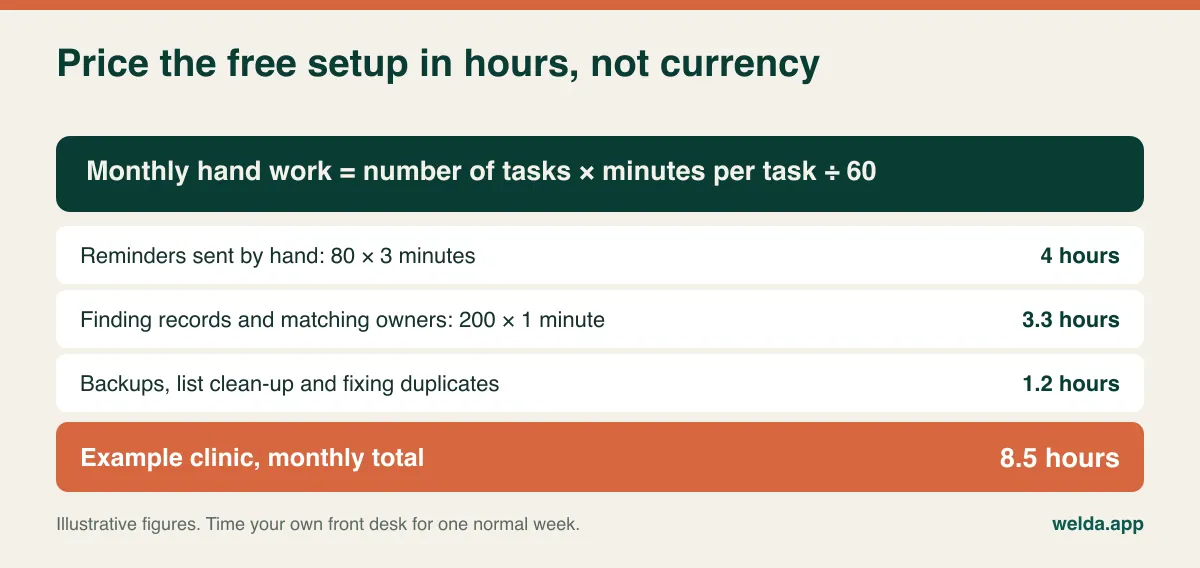
The example comes to 8.5 hours a month. Who spends those hours matters more than the total. In a new clinic it is often the vet, between consults or at home in the evening. With a receptionist, those are hours when the desk is not looking after the people in front of it. Then ask two more questions. What would those hours bring in as consulting time? And how many missed boosters and rechecks a month does your current routine let slip? Set those answers beside a written quote, and "free or paid" becomes a much more honest comparison.
When you compare quotes, do not stop at the monthly figure. Ask each vendor in writing what is included: number of users and locations, monthly message allowance, storage for documents, whether modules such as stock cost extra, whether data migration and training are charged, whether invoicing needs a third-party connection, and how you get your data when you cancel. Hidden costs rarely appear on the day you buy. They arrive when you pass a limit, or when you try to leave.
Rules that do not get cheaper with the software
This is general information, not legal advice, and requirements differ by country and sometimes by state or province. Check with your regulator, professional body or adviser.
Client privacy. An animal has no privacy rights, but its owner does. Names, addresses, phone numbers and payment details attached to the record are personal data in most jurisdictions, including under GDPR and UK GDPR. A free tool does not reduce your responsibility, so ask where data is hosted, who can access it and on what terms it is processed. In the United States, HIPAA is generally not the framework for veterinary records, but state rules on record confidentiality may apply.
Record retention. Many veterinary regulators expect medical records to be kept for a set period, and that period varies. If a free tool disappears or deletes inactive accounts, the obligation stays with you. This is a further reason to hold your own regular export.
Medicines. Controlled drugs and prescription medicines usually come with their own logging rules. A practice management tool, free or paid, does not automatically satisfy them. Welda CRM's published features do not include a controlled-drug register, so plan on keeping one separately and ask us about your exact case.
Marketing consent. A reminder about an animal's care and a promotional offer may fall under different rules, depending on the country. Separate the two and record consent where needed.
Finding your own switching point
A universal patient count would be false precision. A single-vet clinic with 500 tidy records is in better shape than a two-vet clinic with 200 messy ones. Watch for behaviour instead.
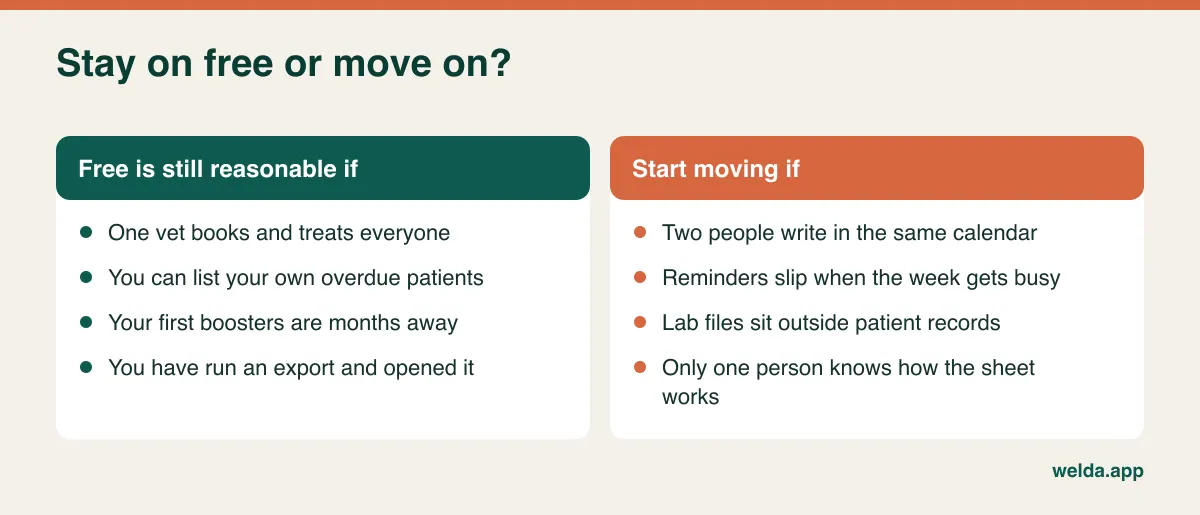
One sign on the right means keep an eye on it. Two at once means start planning. The opposite is equally true: if none applies, you work alone and your backups are real, there is no hurry. Equipment or the other costs of opening a new clinic may well be a better use of early money.
A note on practice type. This article mainly has appointment-based companion animal clinics in mind. If most of your work is farm or equine, with herd records and routes between visits, an appointment-centred product may not be the right tool, and Welda CRM's published features do not cover those needs.
If you start free, build the exit first
Choosing free on purpose is a respectable decision, provided you bring some discipline. In a spreadsheet, a few habits make a later move far easier. Give every animal its own row and a unique ID. Keep owners on a second sheet and link them by ID. Enter dates as real dates, not text. Use dropdowns for species and status so that "cat", "Cat" and "cta" do not become three species. Add a "next recall date" column from day one and do not leave it blank. Save a dated copy somewhere separate every Friday.
Then run an exit drill each quarter. Export everything, open the file and check the history of three random patients. It takes twenty minutes and can save you days on switching day. Vaccine and consumable stock deserves the same simple discipline: count on a fixed day and note expiry dates, so a vaccine nearing its date shows up on a list before it shows up at the back of the fridge.
What a demo must show, whichever vendor you pick
Sales demos tend to run on tidy sample data. Bring your awkward cases, and put them to free and paid vendors alike.
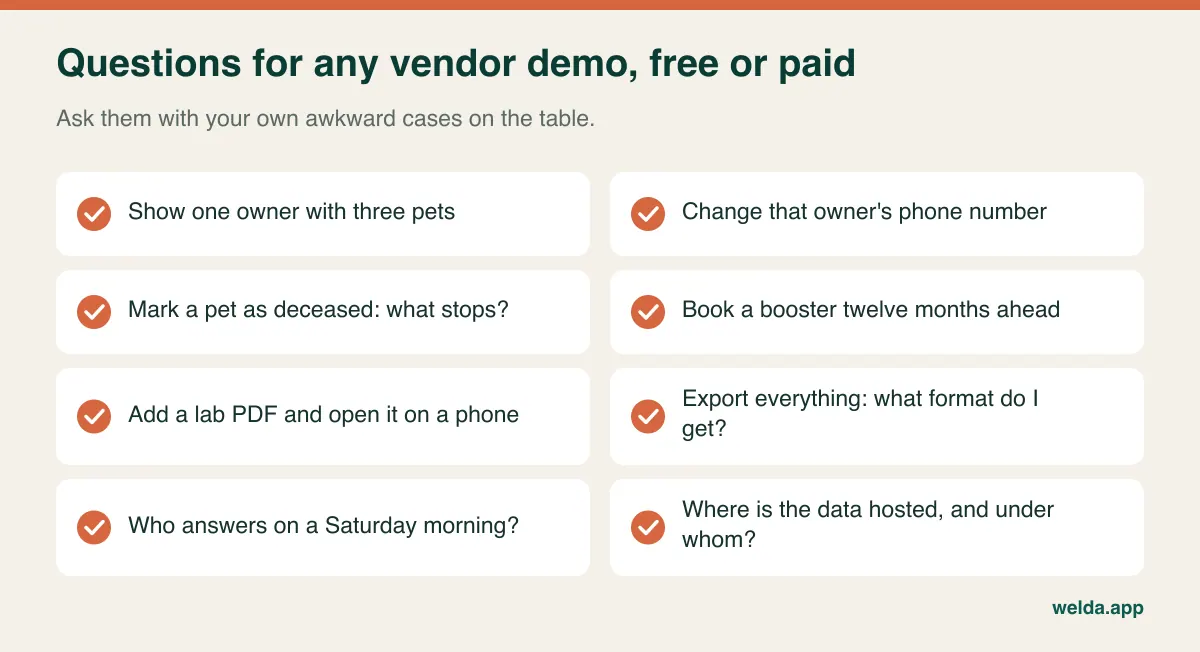
Now the same test applied to us. Welda CRM has no separate vaccination schedule module. You record vaccines on the animal's record as notes and documents, and when you book the next appointment, the WhatsApp reminder goes out automatically. So the habit you need is booking the next visit on vaccination day, rather than expecting the system to calculate it. There is no direct integration with imaging devices either, so radiographs are attached as files. It runs in a browser, so if your internet drops, access pauses, though records are safe when you reconnect. If any of these is a dealbreaker, look elsewhere.
What it does cover: calendars per vet with conflict prevention, automatic owner reminders, invoices and balances linked to the record, role-based access, encrypted records with an audit log and consent management, and access from a computer, tablet or phone. The interface works in English, Turkish and German. You can see how this fits together on our page for clinics that have outgrown free veterinary practice software.
There is no permanent free plan, but there is a 7-day free trial with all modules open. A week cannot naturally show you a recall from a year ago, so stage one: enter yourself as the owner, book a check-up for two days later and see what arrives on your phone. Then try double-booking a slot, squeezing in an emergency, attaching a lab PDF and opening it on your phone, and logging in with a front-desk role.
Moving without stopping the front desk
Switching is rarely as bad as people fear, but the order matters.
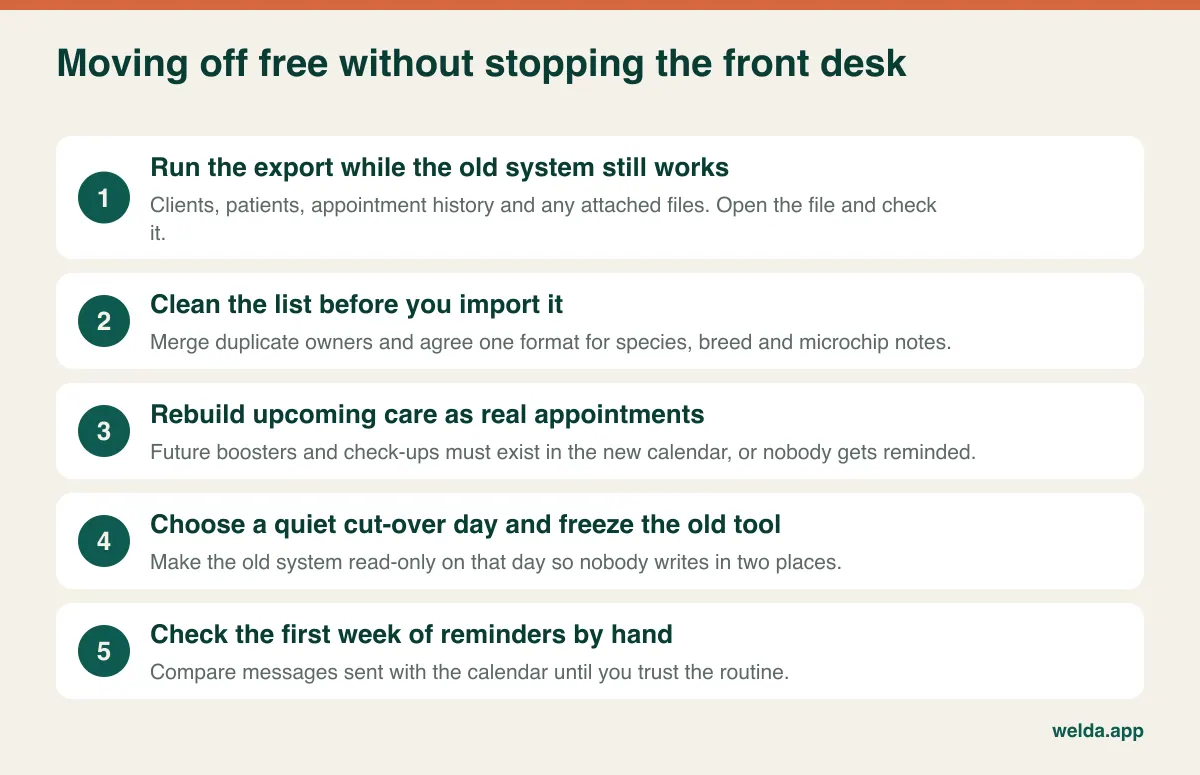
Step three is the one that is easiest to miss. Recall dates sitting in an old spreadsheet column do nothing in a new system. If the booster does not exist as an appointment in the new calendar, nobody gets reminded. So build a list of everything due in the coming months and enter it before you switch off the old routine.
Pick a relatively quiet week and avoid any vaccine campaign or holiday rush. Do not try to digitise every paper file at once; scanning each one when the animal next comes in is much more realistic. With Welda CRM, moving existing patient and appointment data and training your team are included in setup, and scanned paper records can be attached to the relevant patient. For the rest of how a clinic runs day to day, see our veterinary clinic management guide.
Frequently asked questions
Is there truly free veterinary software?
Yes, but it is typically either limited in features, patients or users, or open source software whose hosting and maintenance fall to you. Plenty of "free" results are time-limited trials. Read the terms and work out how the vendor makes money before you enter a single patient.
Should a brand-new clinic pay for software from day one?
Not necessarily. A tidy single-vet clinic with few records can start free. Structure your data so it can be moved, and review the decision at least three months before your first patients' anniversary. If you can afford it, starting with clean records is also less work than cleaning them later, so weigh both sides.
Can I track vaccinations in a spreadsheet?
With a small number of patients, yes. One row per animal, a next recall date and a weekly filter will work. Someone must still send every message, so the routine depends on a person and tends to fail in your busiest week.
Is free software a privacy risk?
Being free does not make a product non-compliant, and paying does not make one compliant. What matters is where data sits, who can access it, how it is deleted and what your agreement with the provider says. A provider who cannot answer those questions in writing is the real risk.
Will I lose my data when I leave a free tool?
That depends on its export. Test it in week one rather than on the day you leave. With Welda CRM, moving existing patient and appointment data is part of setup; how much carries over cleanly depends on the state of your file, so bring it to the conversation.
Does Welda CRM have a free version, and what does it cost?
There is no permanent free version, but there is a 7-day free trial. When it ends your data is not deleted; the account becomes read-only until you choose a plan. Pricing depends on your locations, users, message volume and modules, and is settled in a free consultation. You can see what plans vary by on the Welda CRM pricing page and book a free consultation to talk through your clinic. If you are still deciding whether free veterinary practice software is enough for you, bring your numbers from the hours exercise and we will look at them together.