Beauty salon package tracking software records what a client bought, every session they have used and what they have paid, as dated entries on one client record, so that “how many do I have left?” has a provable answer. Most salon systems can show a remaining-session number. Choose the one that can also explain that number when a client disputes it, and that handles the awkward cases without staff inventing workarounds: the missed appointment, the half-finished treatment, the paused course, the sister who wants to use up the last three sessions.
If you are shortlisting right now, the fastest route is this: pick your most complicated current client, and make every vendor enter that client live. The rest of this guide tells you what to look for while they do.
A counter tells you a number; a ledger tells you why
Picture a hypothetical front desk on a Saturday. A client on a course of eight laser sessions says she has four left. Your paper card says three. She remembers one appointment being cut short when the machine overheated; the therapist who did it left in the spring. Nobody is lying and nobody can prove anything, so the conversation ends with you giving away a session to keep the peace, and with a client who now quietly wonders what else your records get wrong.
That argument is not really about arithmetic. A simple counter stores the result and throws away the history. A ledger keeps each event: sold, used, reversed, paused, paid, refunded. The remaining figure is then simply the sum of those events, and you can read it back line by line with the client beside you.
This is the difference to test for. Plenty of tools describe “package management” in their feature list, and the phrase can mean anything from a true session history to a number someone edits by hand. Ask to see the history behind a balance, not the balance. Then ask what happens when somebody corrects it. If the old value simply disappears, you have a tidier notebook, not a record that settles anything.
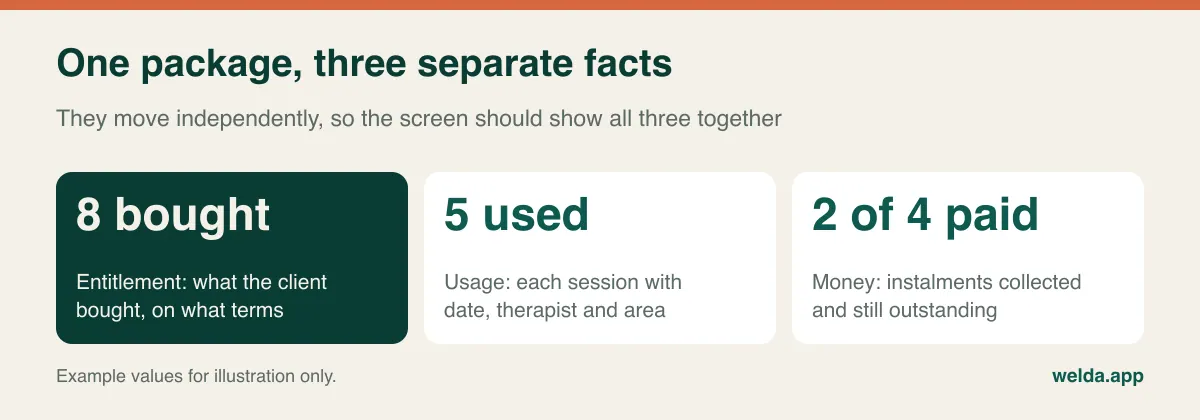
It also helps to accept that one package carries three separate facts. Entitlement is what the client bought and on what terms. Usage is what actually happened, and when. Money is what has been collected. A good screen shows all three together because they move independently, and most front-desk confusion comes from reading one as though it were another.
Four families of dispute your software has to survive
Sales demos show the well-behaved client who books, turns up and finishes the course. She never causes a problem, so she tells you nothing. The cases below are the ones that produce refund requests and bad reviews. They fall into four groups, and it is worth checking each group separately because tools tend to be strong in one and weak in another.
Attendance: did this session count?
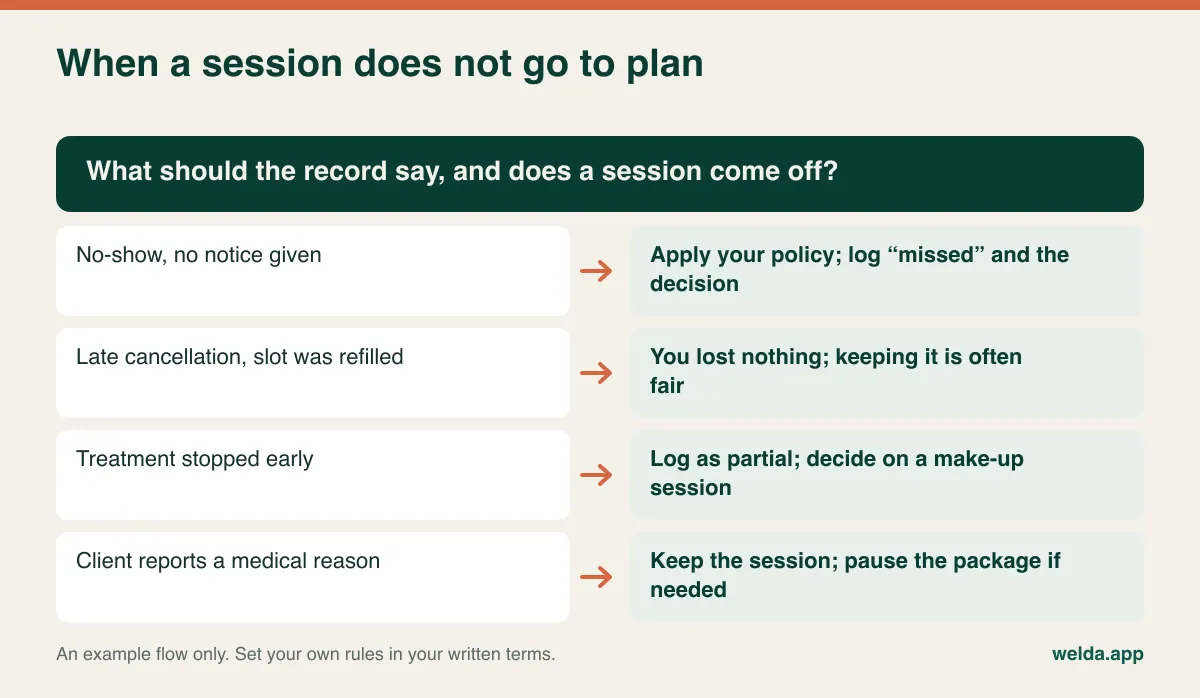
A no-show, a cancellation made an hour before, and a treatment abandoned halfway are three different events, and your policy may treat each one differently. Perhaps the first no-show is forgiven and the second forfeits a session. The software should not impose that policy, but it should record the decision: “missed, session kept” and “missed, session deducted” need to look different in the history a year later. Watch out for systems where the only options are “complete” or “delete the booking”. Those push staff towards silently not recording anything. The reminder side of this problem has its own playbook, which we cover in reducing no-shows.
Partial sessions deserve their own test. The machine fails, the skin reacts, the client has to leave. If the record can only say “used” or “not used”, the therapist will leave it unrecorded and write a note, and that note will not be on screen when it matters months later.
Time: how long is this package good for?
Expiry dates are where salons discover how little they wrote down. If your packages expire, the software should surface those approaching the date while there is still time to book, rather than leaving reception to deliver bad news at the counter. If you do not use expiry, you still want a list of old open packages, because a client can reappear after two years expecting her sessions to be honoured.
Pauses are the other half. Pregnancy, a medical reason, a summer of sun exposure before laser, a long stay abroad: these are ordinary events in this trade. A proper pause has a start and an end, moves any expiry date with it, and takes the client out of the “overdue, please call” list. Otherwise someone will ring a pregnant client to rebook her laser course, which is an avoidable and rather awkward phone call.
Ownership: whose sessions are these?
“My daughter will use the rest.” Whether you allow this is a business decision, and laser or skin plans are often personal to the client. If you do allow it, the transfer should leave a trace on both profiles. The workaround of treating the daughter under her mother's record is worse than it looks, because treatment notes and any allergy information end up attached to the wrong person.
Gift sessions belong here too. A “buy eight, get two free” offer and a goodwill session after a complaint are not worth the same as paid sessions, and that matters the day someone asks for a refund. Ask whether paid and free sessions can be told apart. For groups, ask what happens when a client who bought at one branch visits another: the balance must be visible in both places at once, or the same entitlement can be spent twice.
Money: what is still owed, and by whom?
The dangerous combination is “sessions finished, balance unpaid”. It tends to happen because payments live in one place and session counts in another, so the final session gets delivered and nobody glances at the instalment plan. You want the money position to appear at the moment reception opens the appointment. That is not about embarrassing anyone at the door; it is about raising the subject before the last session rather than chasing it afterwards.
Prepaid sessions are a promise, not yet income
Packages feel wonderful in the month you sell them. The cash arrives up front, while the work arrives over the following year. Owners who read their bank balance as profit tend to have a strong January after a holiday promotion and a confusing spring. Two questions should be answerable separately in your reports: how much did we sell this month, and how much treatment did we actually deliver?
How prepaid services and gift vouchers are treated for tax and in your accounts varies by country, so take that part to your accountant. The management point holds everywhere: you are carrying an obligation to deliver every unused session, and you should be able to see roughly how large that obligation is. A spreadsheet can technically do it, though few are kept up to date enough to trust.
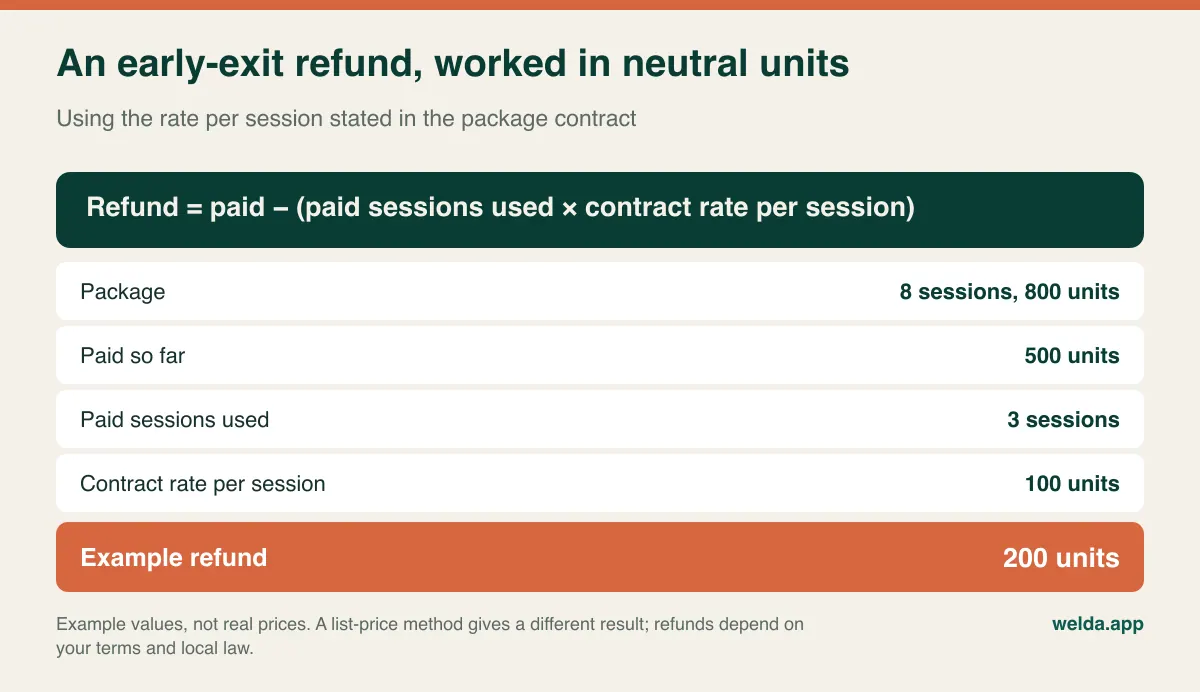
Refunds are where the method matters. Say a client leaves early. You could value the sessions she has used at the discounted package rate, or at your single-session list price, and the two give different refunds. Neither is automatically right, and consumer rules in your jurisdiction may limit what you can do, especially for prepaid contracts. What the software owes you is clean inputs: sessions used, paid sessions versus free ones, and money received. The method itself belongs in your written terms. The example below uses neutral units so it reads as a calculation rather than as a price. Pricing packages sensibly in the first place heads off a lot of this; our guide to package pricing goes into the trade-offs.
Laser courses, facials and brows break in different places
“Package” covers very different work, so build your test around whatever earns you the most.
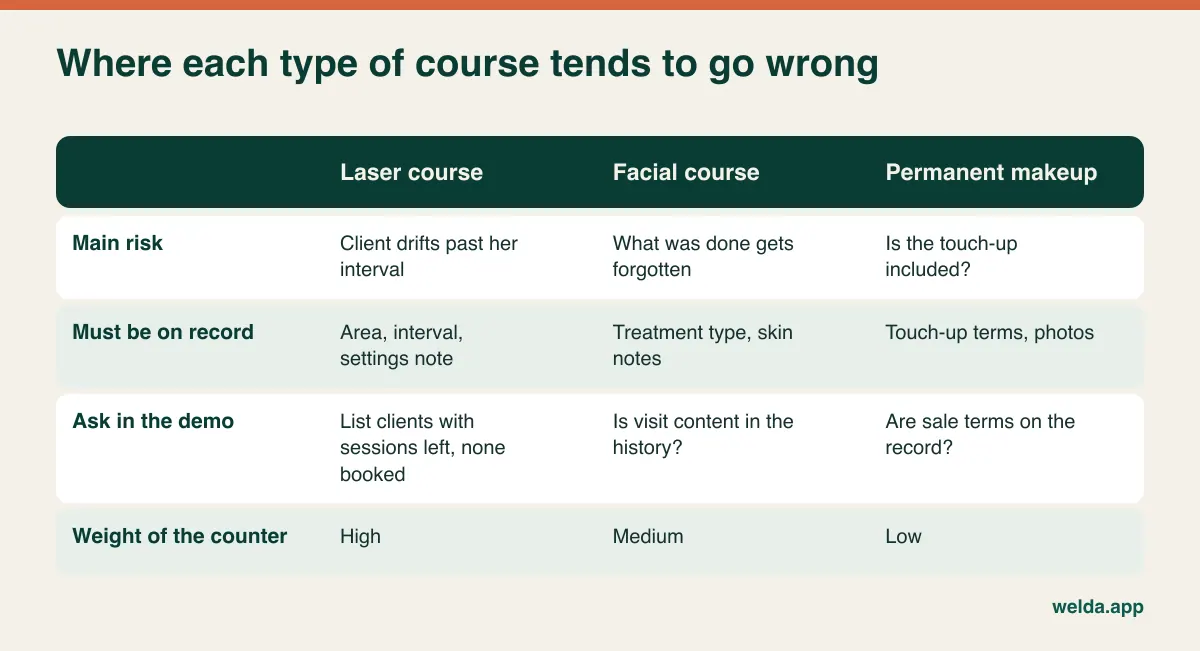
Laser hair removal is a slow process with intervals that depend on the area and the person. Its main risk is drift rather than miscounting: the client leaves without rebooking, and six months later the course has quietly died. Your system should answer “who has sessions left, is past their usual interval, and has nothing booked?” This is also where the area question bites. A “full body” course can mean eight sessions per area to the client and eight visits to you. If a visit covers legs only, what comes off? A single package-level number forces that into a free-text note, so anyone who sells by area should push hard on this in the demo.
Facial courses have shorter gaps and often vary from visit to visit, so what was done matters as much as how many remain. Body-contouring courses tend to need measurements and before-and-after records, since the common complaint is “nothing has changed”, and a dated record helps both sides. Permanent makeup is a different animal again: one procedure plus one or two touch-ups, where arguments concern whether a touch-up is included and by when. Here the terms recorded at the point of sale and the photo history count for more than any session counter.
Spreadsheet, booking app or package-aware CRM?
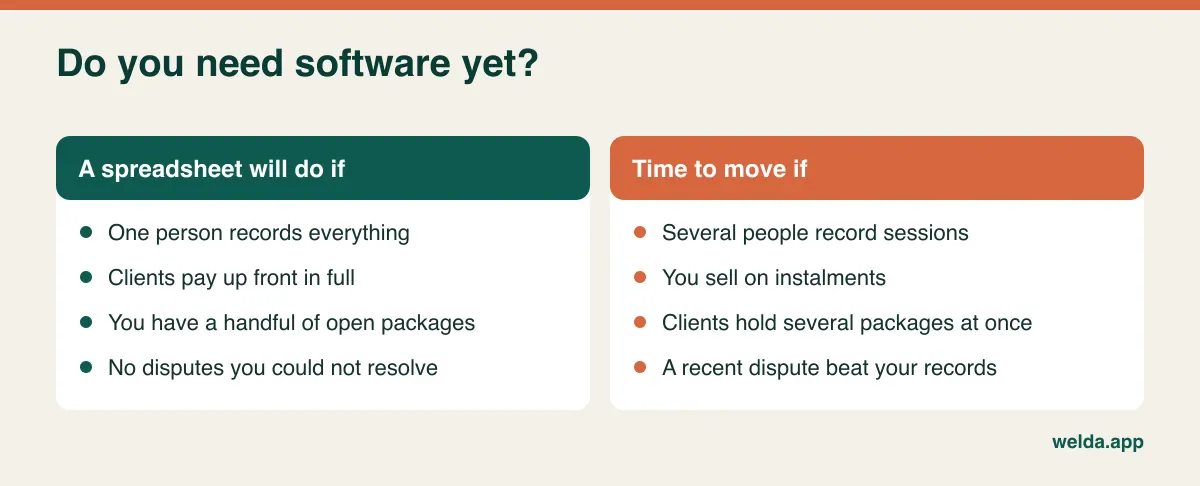
Software is not automatically the answer. A solo therapist who sells a handful of courses, takes payment in full and is the only person touching the file can run a clean spreadsheet for a while. With few open packages, mistakes are easy to spot, and writing down your package terms will do more good than any tool.
Many salons sit in the middle with a booking app that handles the diary beautifully and treats packages as an afterthought, or not at all. That is fine until the appointment and the entitlement stop talking to each other. A completed booking should be the natural source of a session, so linking them removes a whole category of “we forgot to mark it”.
A package-aware CRM makes sense once several of these are true: more than one person records sessions, you sell on instalments, clients hold more than one package at a time, or you have had a real dispute in the past few months that your records could not resolve. If a second location is on the horizon, moving before you open is much easier than moving afterwards.
On cost, look first at what drives the bill rather than the headline figure: locations, people who need logins, monthly message volume and the modules you actually need. When comparing quotes, ask whether data migration and training are included, what happens if you exceed a message allowance, which modules cost extra later, and how you get your data back if you leave. Those are the usual places a quote stops matching the invoice.
Who is allowed to change the count?
This is the part few vendors bring up, and it has little to do with distrusting your team. A kind-hearted therapist who does not log a session “as a favour” costs you money you will never see. A therapist wrongly accused of the same thing is an even worse outcome. A clear trail protects honest staff first.
Three checks. Can you restrict who may reverse a session by role, rather than leaving it open to anyone on the front desk? Can completed appointments be compared against recorded sessions, so a mismatch shows up? And if you pay commission per treatment, does commission draw on the same record? A separately maintained commission list will drift away from the session history, and the end-of-month conversation that follows is one nobody enjoys.
The client's own view is the other side of that coin. Many disputes happen because the client sees the number for the first time on the day she disagrees with it. Saying the count aloud at the end of each visit is free and effective: “That's five done, three to go.” An automatic message after the visit, or a portal where clients can see their appointments and packages, goes further. Whichever you pick, only one source counts as the truth; a paper card running alongside the system recreates the argument you were trying to end.
Privacy and paperwork the software will not settle for you
This is general information rather than legal or tax advice, and rules differ by country. Treatment records often hold more than you would expect: allergies, medication, pregnancy, skin conditions, before-and-after photos. Under the GDPR and UK GDPR this kind of information may count as health data, which carries stricter conditions, and many other jurisdictions have comparable privacy laws. In practice, ask: where is consent recorded and which version did the client agree to, who can see these notes, is access logged, and how is a deletion request handled? Therapists keeping client photos in a personal phone gallery is a habit to end regardless of which system you buy. The checks in our piece on data security in clinics apply just as well to salons doing skin and laser work.
Messaging has a similar line: an appointment reminder and a promotional blast are generally not treated alike, and marketing often needs its own consent. Finally, put your package terms in writing, covering expiry, missed visits, pauses, transfers and refunds, and have them checked against local consumer rules, because software can apply your policy but cannot defend one that was never written down. If you need invoices or tax documents in a specific format, ask the vendor how that works in your country, and do not assume.
Moving open packages without starting a fight
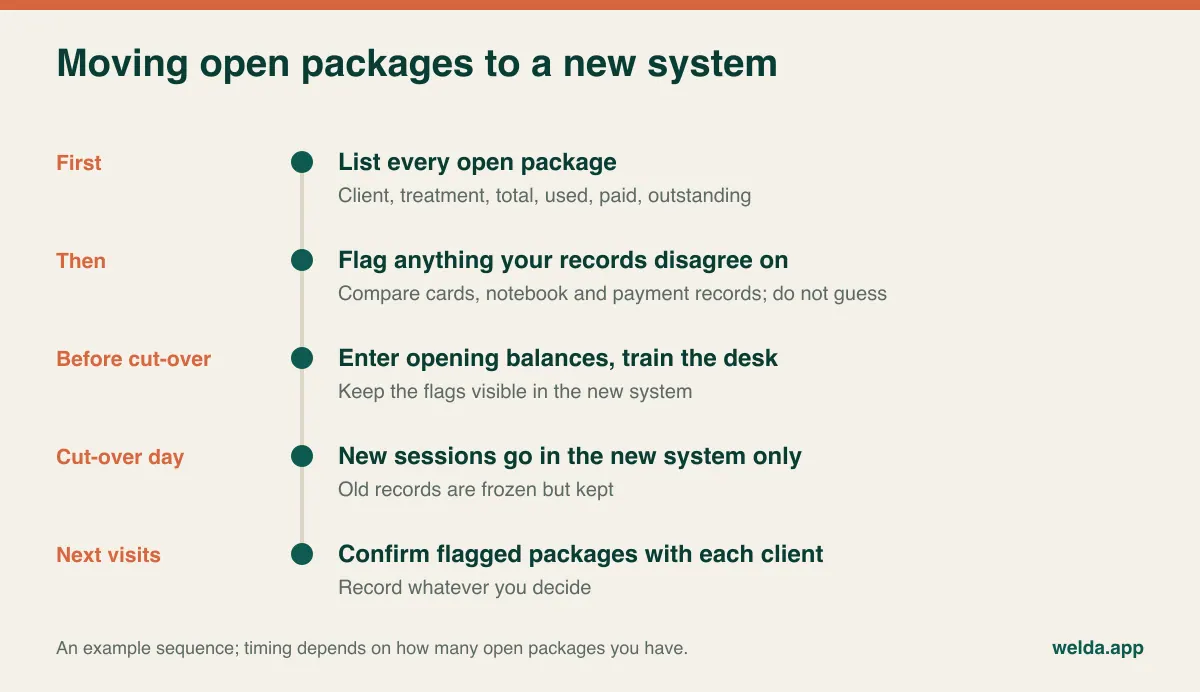
Importing a client list is the easy part. The hard part is the opening balance of every package still in progress, because one wrong figure in week one convinces your team and your clients that the new system is unreliable. Treat this as a reconciliation project.
List every open package: client, treatment, total sessions, used, paid, outstanding. Flag anything your records disagree about, and do not guess. Confirm the flagged ones with the client at her next visit. Where the gap is small and your own records are at fault, conceding is often cheaper than arguing, though that is your call to make, and the decision should be recorded either way. Then pick a cut-over date: from that morning, sessions go into the new system only and the old records are frozen but kept. Running both side by side for long is how two sets of numbers come back. Closed packages from years ago can come later, if at all.
A demo script that exposes the gaps
Bring the real case and run it in this order, asking after each step who will be able to see this later, and from where. You are testing two people's experience. Your receptionist cares how many clicks it takes to record a session at a busy moment. You care whether month-end questions have answers. A system that pleases only one of you tends not to last: either the team stops using it or the reports let you down.
- Sell a course with an instalment plan, and include two free sessions from a promotion.
- Record a normal session, then one that ended early, then a no-show under your own policy.
- Reverse a session entered by mistake, then ask to see the history of that correction.
- Pause the package for three months and look at what happens to any expiry date and the follow-up list.
- Find every client with unused sessions and nothing booked.
- Work out an early-exit figure from what is on screen, without a calculator or a separate file.
- Export the client's history, then ask how you would get all your data out if you left.
If the vendor says “you can put that in the notes” more than once or twice, count it as a no. Notes are where disputes go to hide.
Where Welda CRM fits, and what to check with us
Welda CRM is our appointment and client management system for businesses that run on bookings; you select your sector and the screens and modules adjust. As beauty salon package tracking software, it keeps package sales, total and remaining sessions and usage history on the client profile. Each session used is deducted automatically and payment status sits alongside it. Around that you get specialist calendars with conflict detection, a waiting list, automatic WhatsApp reminders, invoices and instalments, a client portal for appointments and packages, role-based permissions with an audit log, GDPR consent management, and encrypted health records with allergy and contraindication alerts plus before-and-after photos.
We would rather be straightforward about the edges. Our product pages do not spell out how every scenario in this guide behaves. Please test these with us before you decide:
- Counting sessions per body area within one package
- Pausing, expiring and transferring a package
- Telling paid sessions apart from free ones
- How your own policy on no-shows and partial sessions is recorded
- How a corrected session appears in the history
- Using a package across branches, and the numbers behind an early exit
Client and appointment data migration, setup and hands-on team training are part of the service; how your open package balances should move is something to go through together, because it depends on the state of your current records. If you are outside Turkey and have country-specific invoicing or till requirements, raise them early so we can tell you plainly whether they are covered.
Welda CRM is a monthly subscription with no separate setup fee, and the price is agreed in a free consultation based on your locations, users, message volume and modules. Bring your most complicated client and the list above. If you would like to test with your own data first, the 7-day free trial has every module open. You can start from the beauty salon package tracking software page. For the wider operational picture, including how packages fit alongside staffing and retention, our beauty salon management guide is a useful companion.
Frequently asked questions
What is the difference between booking software and package tracking software?
Booking software answers who is coming and when. Package tracking answers what the client is entitled to, how much of it has been used and how much has been paid. If you sell courses you need both, linked, because the completed appointment is where a used session comes from.
Can I track beauty packages in a spreadsheet?
With few packages, one person editing and payment taken up front, yes. It tends to fail when several people use the file, because changes leave no trace, nothing connects to the diary and no reminders go out. It can hold a number, though it cannot tell you who changed it.
Should a no-show lose the client a session?
That is your policy to set and it should be in your written terms, subject to local consumer rules. Many salons distinguish between first offences, late cancellations and repeat no-shows. Whatever you decide, the software should record the decision so nobody has to rely on memory later.
How do I handle a client who disagrees with the count?
Go through the session history together, date by date; a specific date often jogs a memory and settles it. If your record really is incomplete, say so and record whatever you decide. Then start telling every client the count at each visit, so that the same gap cannot quietly build again.
What should happen to unused sessions if a client moves away?
Your terms should say. Typically you have a choice between a refund using a stated method, a transfer if you permit one, or credit at another branch. The system's job is to give you accurate figures for sessions used and money received, so the conversation is about the policy rather than the facts.
Do small salons really need this?
Not always. Choose the three or four cases you run into most and test only those. Branch handling can wait if you have one branch. Missed visits, partial sessions and instalments, though, turn up at any size.
How long does switching take?
The technical setup is usually the short part. The time goes on reconciling open packages, so how long it takes depends mainly on how many you have and how reliable your current records are. Schedule the cut-over for a quieter week if you can, and give reception time to practise beforehand.