Social media management pricing comes down to scope: how many platforms are covered, how many pieces of content go out each month, how much of that is video and who films it, whether paid ads are part of the job, and who answers the comments and DMs. No honest agency can quote you a sensible figure until those answers are on the table, which is also why two proposals for the same business can look wildly different without either agency overcharging.
If you are about to hire someone on a monthly basis, the useful question is not "what does this usually cost?" but "what exactly am I buying, and how does it compare to the other quote on my desk?" A market average would tell you very little, because it blends freelancers posting templates with teams running shoots in three languages. So this guide works the other way round. It explains the billing models you will come across, shows how each scope decision pushes the fee up or down, and gives you a way to compare proposals like for like. The worked examples use neutral "units" rather than a currency, so you can drop in your own numbers.
Start with how you are being charged
Before reading the quantity on a proposal, look at the billing logic behind it. The same work can be sold in four ways, and each one rewards different behaviour on both sides.
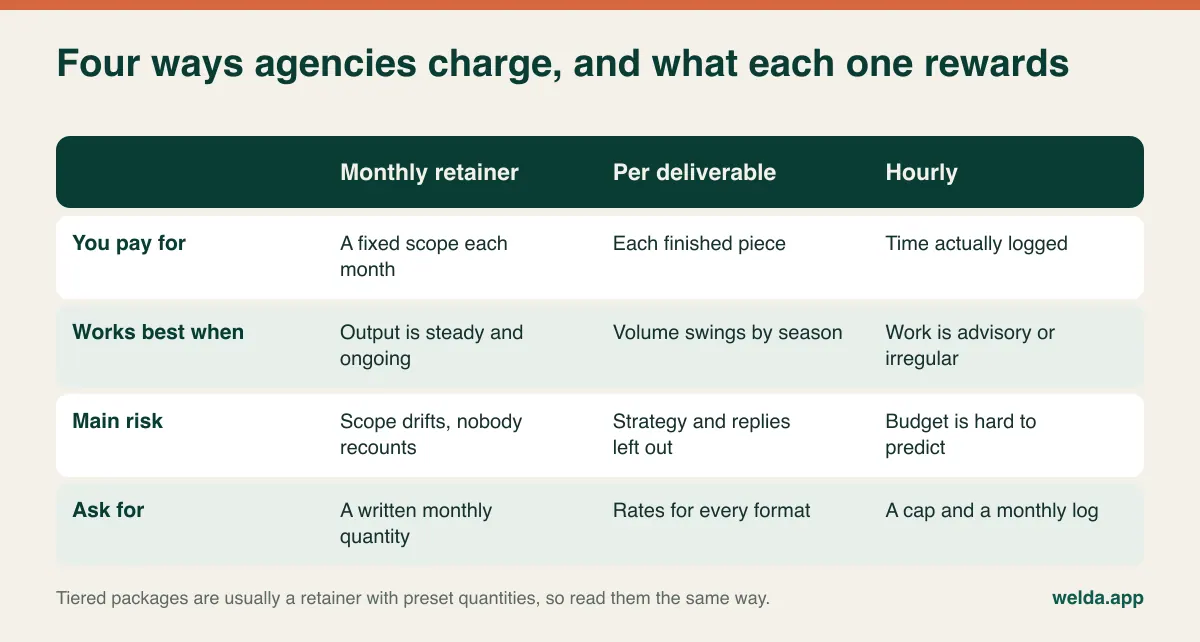
A monthly retainer is the most common arrangement and it suits work that genuinely happens every month: planning, publishing, replies, reporting. Its weakness is drift. The retainer agreed in spring still bills the same in autumn, even though you may have quietly added a platform, or the agency may have quietly dropped the weekly stories. Ask for a monthly delivery record so that both sides can see the drift when it happens.
Per-deliverable pricing is clear and attractive for seasonal businesses. A ski rental shop or a wedding venue does not need the same output in every month. The catch is that strategy, community management and reporting do not fit neatly into a per-post price, so check where they went. They have either been loaded into the rate or left out altogether.
Hourly billing makes sense for consulting, audits or training an in-house person. It is harder to budget for routine work, so ask for a monthly cap and a time log. Tiered packages ("Starter, Growth, Pro") are simply retainers with preset quantities. They are quick to compare but rarely fit exactly; you can end up paying for a platform you do not use because the tier you need happens to include it.
There is a simple check for whether a retainer is the right shape for you. Divide it by the agency's per-piece rate, if they will give you one.
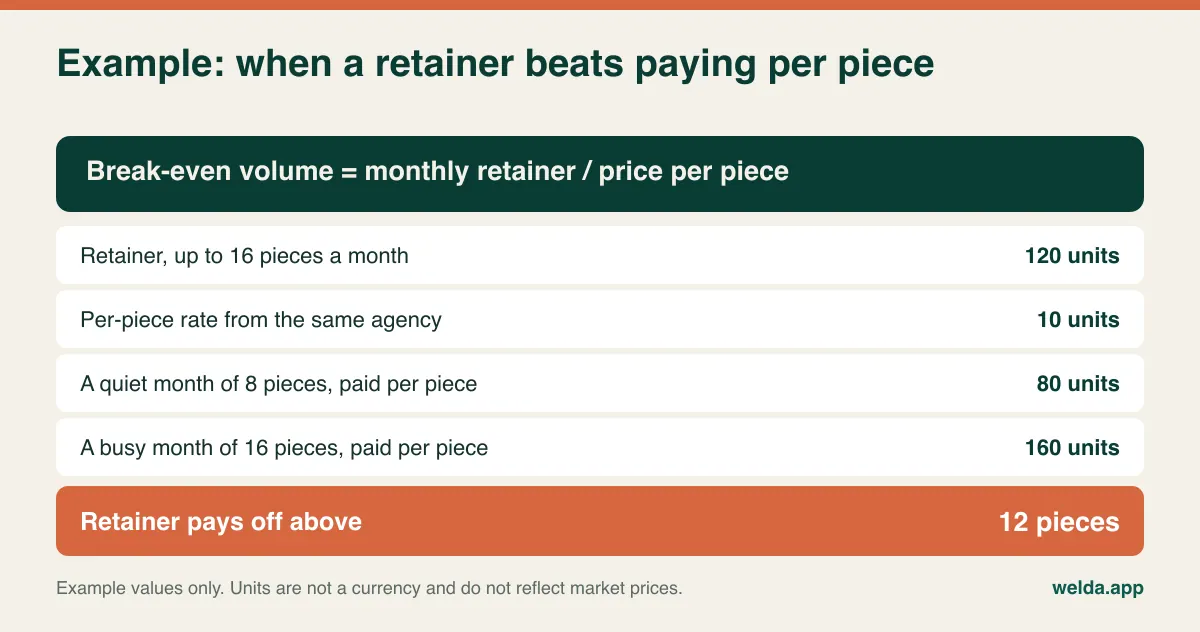
If your real requirement is around eight pieces and it rarely changes, you have just found the first thing to renegotiate. Be fair about what the comparison leaves out, though: if the retainer also covers replies and reporting, the per-piece price needs those costs added before you can call it cheaper.
The four dials that move the fee
Whichever model you end up on, the same drivers decide the size of the bill. Think of them as dials rather than a checklist, since every one of them can be turned down as well as up.
Platforms
The number of platforms matters less than how much each one demands. Sharing a resized Instagram post to Facebook is modest work. LinkedIn usually isn't: a useful post for a B2B audience starts with an interview with someone in your company, then a draft in their voice, then their approval. TikTok rewards faster cuts and a person on camera, so a repurposed Reel may underperform even if it costs almost nothing to publish. A proposal that says "management of three platforms" should tell you which of these it means.
Content volume and mix
Monthly quantity is the most visible figure and the easiest to misread. Twenty pieces could be ten stories and ten templated posts; twelve could be four researched carousels and eight videos. Always ask for the mix by format, and what counts as one unit. Volume should follow what you actually have to say. A restaurant with a changing menu, or a retailer with weekly arrivals, has material for frequent posting. A consulting firm with a long sales cycle may do better with fewer, stronger pieces. Sketch a realistic month on paper before you commit to a number: if you struggle to fill it, the agency will struggle too.
Video
Video is the widest dial on the list, because "four videos" can describe anything from editing clips you filmed on your phone to a half-day shoot with a crew. We return to it below, because it deserves its own section.
Paid ads
Running ads adds a separate skill set, a separate monthly budget, and in many cases separate creative. It also changes who is accountable for results, which is why it should be priced on its own line, never buried in "full service".
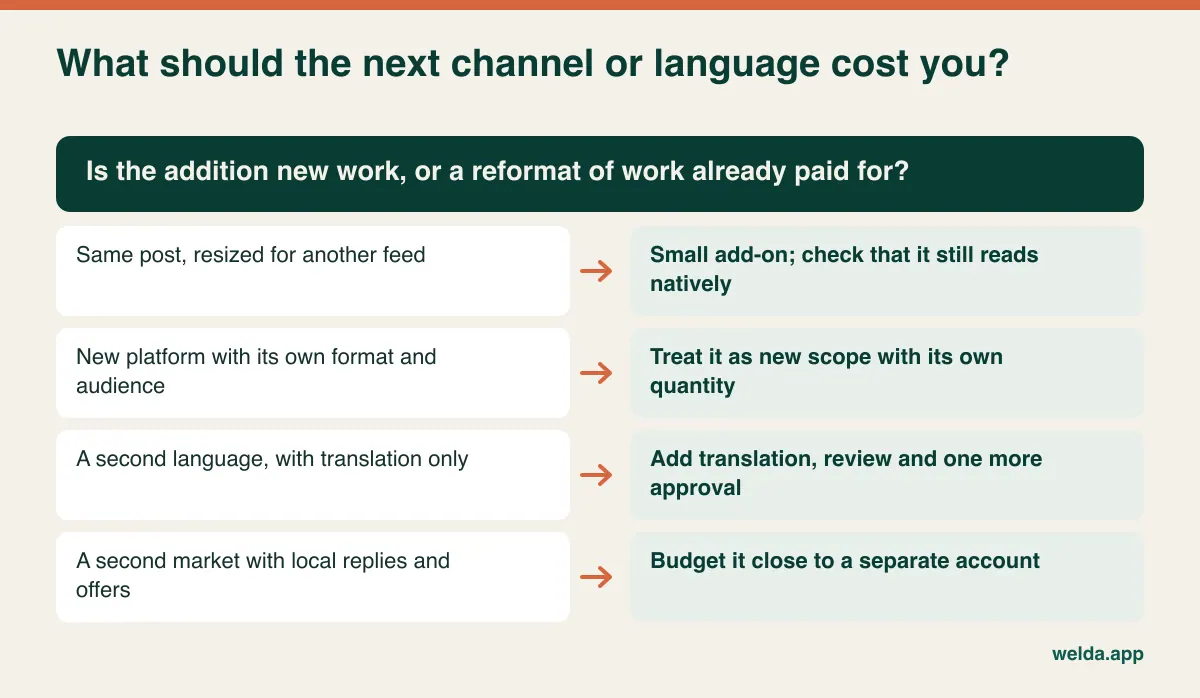
Before picking any dial settings, it helps to be clear about whether a new channel or language is actual new work or just a reformat of work you have already paid for. This matters a great deal once a business grows beyond one market.
Languages, markets and time zones: where international scope gets expensive
Businesses selling across borders often underestimate this part of their social media management pricing. Adding a language looks like a translation job. In practice it adds a translator or native copywriter, another round of review, and usually one more person who has to approve. A pun in your English caption may not survive into German or Spanish, and on-screen text in a Reel means re-editing the video, not just rewriting the caption.
Three scenarios tend to come up, and they cost very different amounts to serve:
- One global account, one language. Often the cheapest and most underrated option. An English-language account can serve many B2B audiences well, with no local customer service to staff.
- One account with translated captions. A moderate addition, though the audience will soon notice if comments in their language only get answered in English.
- A separate account per market. Each has its own calendar, local holidays, offers, replies and sometimes its own ad account. Budget for this close to a separate engagement rather than an add-on.
Time zones raise a further question that rarely shows up on the first proposal. If your customers are messaging you from Sydney and your agency works European hours, what does "timely reply" mean? For a tourism business or an online retailer, that gap may be worth paying to close. For a manufacturer it probably isn't. Decide this before comparing quotes, because an agency that includes extended reply coverage is not selling the same service as one that doesn't. Rules also differ by market. Data protection law such as the GDPR and UK GDPR, consumer protection rules, and advertising disclosure rules enforced by bodies such as the FTC in the US or the ASA in the UK can all shape what gets published and how. None of this is legal advice, but a proposal for several markets should at least show who checks what.
Why one video can cost as much as a month of posts
Most of the cost of video sits before and after the camera. Scripting, booking people, travelling, lighting, sorting takes and editing are all time, and the sixty seconds you see at the end says little about how much went in. When you read "video included" on a proposal, get answers to these:
- Who films it? Your staff on a phone, the agency's videographer, or a production crew?
- Who is on camera? The owner, an employee, a paid presenter or a creator? What happens to the footage when an employee leaves? Written consent from anyone identifiable is a sensible baseline.
- Where is the shoot, and how often? Travel may be billed separately, and a factory or a remote site changes the arithmetic.
- Is the music cleared for commercial use? Business accounts often have limited access to popular tracks, and a licensed library may be a further subscription.
- How many versions come out? Vertical, square, with and without subtitles, each language.
The best legitimate way to lower video costs is batching: one well-planned shoot day to supply the whole month, rather than four visits for four clips.
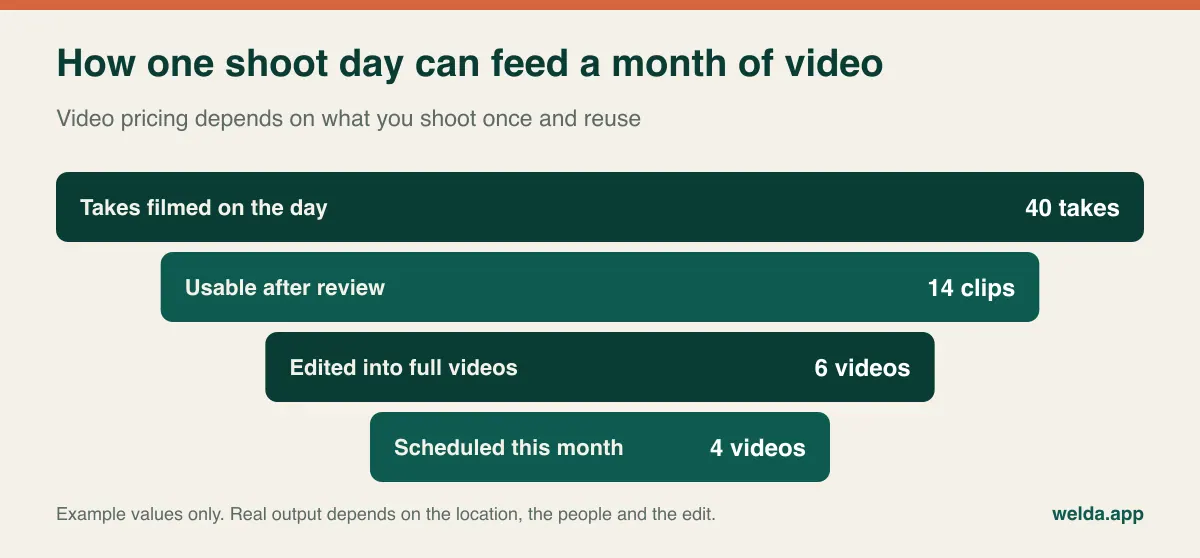
Batching only works if someone plans ahead, and that means your team knowing a month in advance what is on the menu, what is launching, or who is available. A dental practice can usually plan a day of patient questions answered by a dentist. A fashion retailer with weekly stock changes may be better off training a store employee to film simple clips while the agency handles the editing and thinking. That split lowers the fee, but only as long as the clips really do arrive on time, so be honest with yourself about that. Ask for the quote that matches the split you can really sustain.
The cost nobody quotes: your own approval chain
Here is a price driver that sits entirely on your side of the table. An agency that has to chase comments from a founder, a marketing manager and a partner, each with different opinions and none with the last word, spends hours on coordination rather than content. Experienced agencies price this in once they have seen how you work, and some will build it in after the first awkward month.
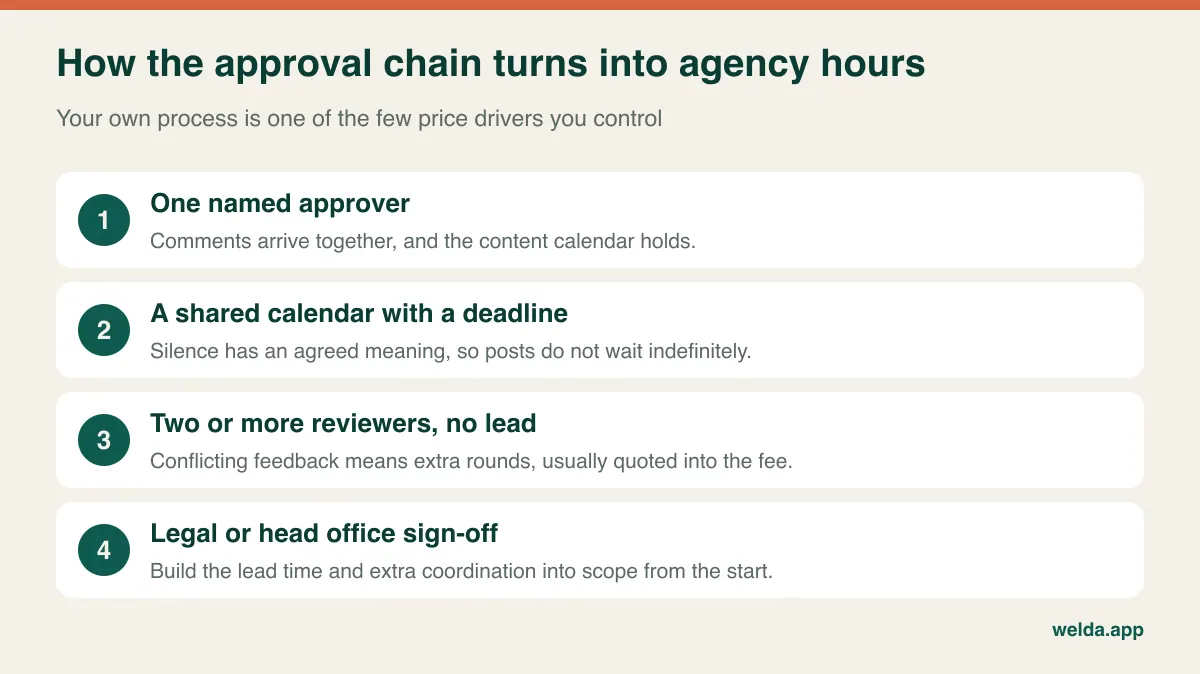
You can act on this before asking for a quote. Name one person who approves content. Agree on a turnaround (for example, two working days) and on what happens if that deadline passes. Group feedback into a single comment thread instead of a string of messages. Tell the agency up front if legal, compliance or head office must see the content; in regulated sectors this cannot be avoided, and our guide on social media for clinics shows how much additional care healthcare accounts can require. It should simply be visible in the scope and the schedule.
The same reasoning applies to raw material. An agency that gets photos of new products, customer questions from your sales team and a heads-up on the next promotion has less to invent. An agency that hears nothing will produce content that could belong to any business in your sector. No fee level fixes that.
Paid social is three payments, not one
"Ads included" can mean any of three things: the media spend paid to Meta, TikTok or LinkedIn, the management fee for building and running campaigns, and the creative made for those campaigns. Ask for each on a separate line. If a single bundled price covers all three, you cannot tell how much of your money reaches the platform.
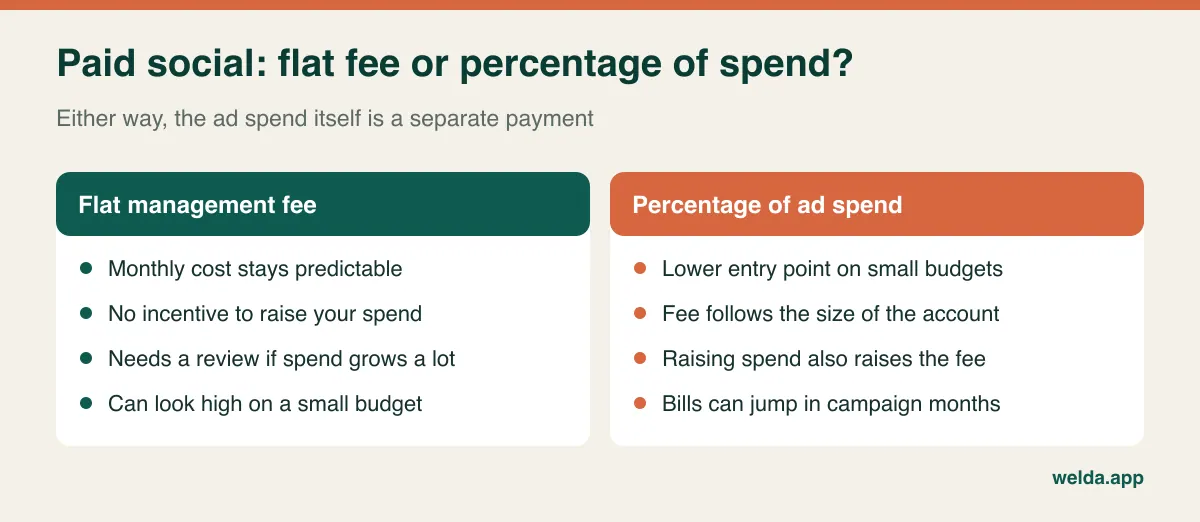
Whichever fee model you choose, the cleanest setup is an ad account in your company's name, billed to your card, with the agency added as a partner. That way the history, audiences and pixel data stay with you if you part ways. Watch for foreign currency too. If your ads bill in dollars and your revenue is in another currency, your real cost moves when exchange rates do, and on a percentage model the fee can follow.
Not every account needs paid support on day one. If you have nothing on your profile that would convince a visitor, ads simply send more people to an empty room. If you need bookings or sales in the near term, organic alone is unlikely to deliver in time. Our comparison of paid and organic social media walks through that choice.
Agency, freelancer or in-house: compare the whole cost
A fee only means something next to its alternative, and the honest alternative may be less obvious than the next agency on your list.
| Option | What the price really includes | Works best when | Where it breaks |
|---|---|---|---|
| Freelancer | One person's time, often with a narrower skill set | Scope is small and clear; you need one strong skill | Holidays, illness and work that needs both design and video |
| Agency | A team plus coordination and overhead | You need strategy, design, video and reporting together | You may get a junior account handler; ask who actually does the work |
| In-house hire | Salary, taxes, equipment, tools and management time | Volume is high and being on site every day is a real advantage | One person rarely covers strategy, video, design and ads equally well |
| Hybrid | Agency plan and shoots, plus in-house daily posts and replies | Someone internal has a few reliable hours a week | Quietly collapses if that person gets too busy |
When you work out the in-house number, include what is easy to forget: payroll costs, software, a phone or camera, cover for leave, and the manager's time spent directing the work. And count your own hours if you are thinking of doing it yourself. Three evenings a month are not free, particularly if they are three evenings you could have spent on sales.
Putting three proposals on the same footing
Comparison starts before the quotes arrive. Send every provider the same one-page brief: goal, platforms, quantity and mix, who films, reply hours, paid ads or not, and who approves. Good agencies may push back on your plan, and you should welcome that, but the differences will now be visible instead of hidden.
When the proposals come in, list what you need in the left-hand column and mark each quote against it. For anything missing, ask that same agency what it would cost to add. Don't estimate that yourself. Here is an example, using units, for a business that wants two platforms, ten posts, four videos including filming, and weekday replies.
| Example | Proposal A | Proposal B | Proposal C |
|---|---|---|---|
| Stated monthly fee | 90 units | 130 units | 150 units |
| Add filming and video editing if missing | +50 | +25 | 0 |
| Add weekday replies if missing | +25 | 0 | 0 |
| Set-up fee spread over 12 months | 0 | +5 | +10 |
| Like-for-like monthly cost | 165 units | 160 units | 160 units |
In this example, a gap that looked large on the first page shrinks to almost nothing. Once costs are this close, base your decision on other things. Do they have relevant work to show? Who will actually run your account? Does their sample report explain why things happened, or just list the numbers? Our guide to choosing a social media agency goes deeper on that side of the decision.
What to pin down before you sign
Most disputes do not come from bad faith. They come from a sentence that both sides read differently in month one and argue about in month four. These are the items most often left vague, and the ones that tend to turn into extra invoices.
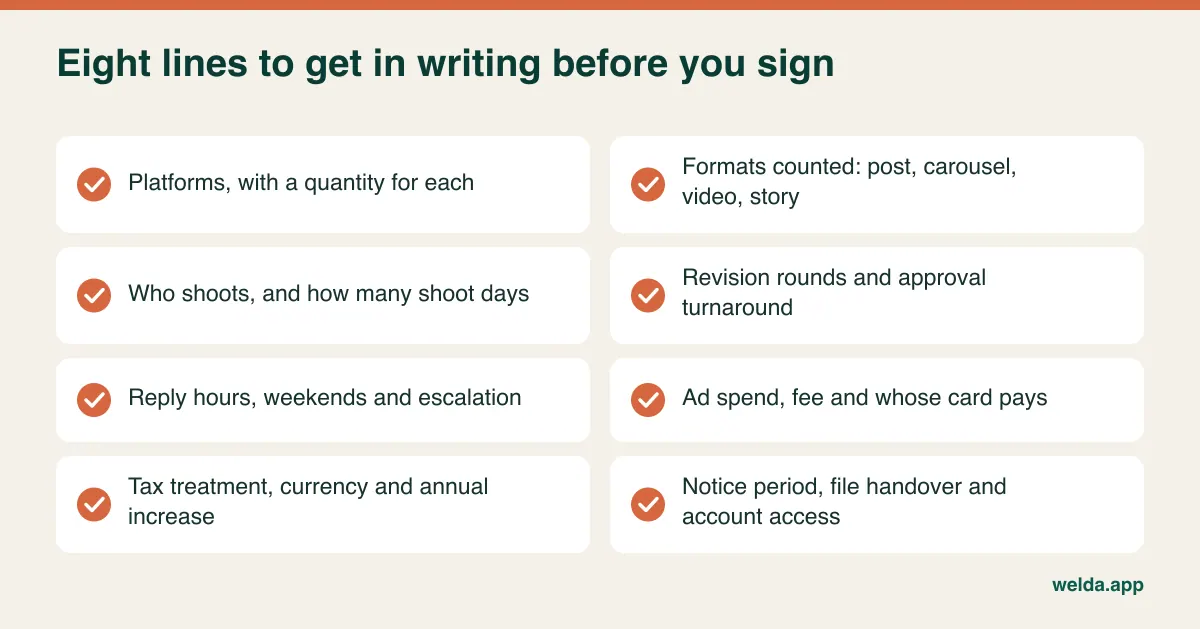
Three of them deserve a closer look. Account ownership first: profiles, the business portfolio and the ad account should be in your company's name, with the agency added as a user. Never let an agency register them under its own email. Exit terms next: how much notice do you need to give, is there a fee for leaving early, and do you keep source design files and raw footage afterwards? And price changes: when can the fee be increased, and by what method? A contract that says nothing about this tends to be settled in an unwelcome email. Ask about tools as well. Scheduling software, stock libraries and music licences are real costs, and you should know whether they are covered or passed on.
When hiring out is the wrong call
It is not always the right moment, and a good provider should say so. You may want to wait if you can't currently serve more customers, if there is nowhere clear to send interested people, or if you can't give even an hour or two a month to approvals and raw material. Monthly management is also a poor fit if you expect it to deliver sales within the next few weeks without any ad spend. Organic social builds over time, and any promise of quick guaranteed sales from it deserves suspicion.
Smaller options exist. You can buy a strategy and three months of calendar, then publish it yourself. You can pay for design only, or for one shoot day each quarter and handle the daily posting in-house. These lower the bill without pretending the work has disappeared. Someone still needs to do it, on a schedule, for months.
How Welda scopes this work
We don't publish a fixed price list. Our social media management pricing depends on the platforms covered, the monthly content volume and the scope, the same factors described in this article. Standard scope covers strategy and positioning, a monthly content calendar, design and production of posts, reels and stories, copywriting, community management across comments and DMs, and a monthly performance report. We manage Instagram, Facebook, TikTok, LinkedIn and YouTube, with one dedicated contact, and ownership of and access to your accounts always stay with you.
A couple of things sit alongside that scope. Ad management belongs to our digital advertising service, and the ad spend itself is paid directly to the platforms, separately from our fee. Larger photo and video production falls under content production. How filming fits your plan is worth raising in the first conversation, as are reply hours and any languages you need beyond your main one, since these all change the scope and we would rather settle them with you than assume.
Frequently asked questions
Why does social media management pricing vary so much between agencies?
Mostly because the proposals describe different work. Video production, platform-specific content, reply coverage and ad management can each change the workload substantially. Team size and seniority also matter. Compare on the same scope first, and much of the gap usually becomes explainable.
Is ad spend included in the monthly fee?
Usually not, and it is generally cleaner if it isn't. Keep the media spend on a separate line, ideally billed directly to your own ad account. If a bundled price is the only option on offer, ask in writing how much of it will go to the platforms.
Should I sign a long contract to get a better rate?
Only if the exit terms are reasonable. A minimum term of a few months is common, since the first weeks go into setting up. Look at the notice period, early exit fees and what is handed over when you leave before weighing up any discount.
How many platforms should a small business start with?
Usually one or two: the ones where your customers already look for businesses like yours and where someone can answer them. It is easier to add a channel once your first one runs reliably than to rescue five half-empty accounts.
What should I prepare before asking for a quote?
Your goal, your priority platforms, links to current accounts, a rough count of monthly messages, the photos and video you already own, who will approve content, and any ad plans. An upper budget limit helps too, even if it is rough, because it lets the provider propose a realistic scope.
How will I know if the fee is worth it?
Record a baseline before you start: profile visits, link clicks, inbound messages and how many of those become enquiries or sales. Follower counts alone will not tell you much. Our social media analytics guide explains what to track. If by month three the report still can't explain what worked and why, raise it.
Once you have your rough scope, a short call is the quickest way to turn it into real numbers. Talk to us about social media management pricing in a free consultation: we will go through your platforms, content mix and filming needs, and the quote will follow that scope.