Small business website design cost is decided by scope far more than by the agency's rate card, and the honest way to bring it down is to buy less, not to buy cheaper. For most small firms the smallest site that can win customers is four or five pages: a home page, a page for each main service, some real proof of your work, a contact path that takes one tap, and measurement from day one. On the first invoice you usually do not need a blog package, a second language, an online shop, a custom booking system, a monthly SEO retainer or a logo redesign.
Search for this topic and you will mostly find tables of figures. They are of limited use, because a five-page site for a mobile dog groomer and a five-page site for a joinery business with a quote form and a project gallery are not the same job. What follows is the part those tables skip: what actually moves the cost, how small you can safely go, how to make quotes comparable, and which bills show up after launch. Your own figure then comes from a written quote against a scope you control.
What actually moves the cost of a small site
Page count is the thing everyone asks about, and it is a poor predictor. Five pages built from the same layout can be less work than one page with a custom quote calculator. These are the variables that usually matter more:
| Cost driver | It goes up when | How to keep it down |
|---|---|---|
| Variety of page types | Every page has its own layout | Reuse one strong service-page layout across services |
| Design depth | Bespoke illustration, motion, several concept rounds | Clean type, your real photos, one agreed direction |
| Content readiness | Nothing is written and nobody owns the task | Supply raw notes and photos before design starts |
| Integrations | Booking, payments, CRM, or inventory sync | Link to a ready-made tool first |
| Languages | Each language needs copy, upkeep and its own SEO | Add one only when real demand appears |
| Decision-making | Three partners approve everything, in turns | Name one person with the final say |
| After-launch support | You cannot edit anything yourself | Ask for a CMS and a short handover session |
Notice that half of that list is in your hands rather than the supplier's. That is good news on a limited budget. A web team prices uncertainty as well as work: if the brief is vague and the content is "coming soon", a sensible supplier builds a cushion into the quote, because that is where projects tend to overrun. Remove the uncertainty and you often remove the cushion.
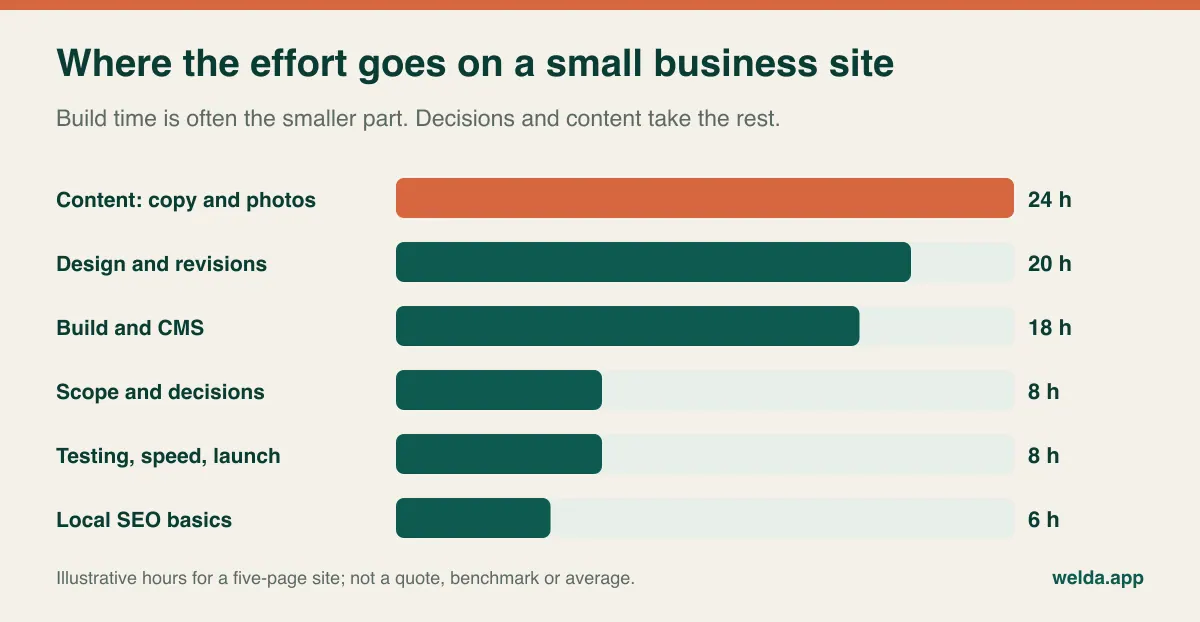
The chart is an illustration rather than a benchmark, but the shape is one to take seriously. Owners tend to imagine they are paying mainly for code. Often they are paying for someone to chase, shape and rewrite what the business could have supplied in rough form.
How small can the site be and still win customers?
Start with a single sentence: "When someone lands on this site, I want them to ___." For a locksmith, the blank is "call me now". For a wedding florist, it is "look at my work, then ask about my date". For a bookkeeper, it is "trust me enough to book a short call". Write one verb, because that verb decides what the site needs and exposes everything it does not.
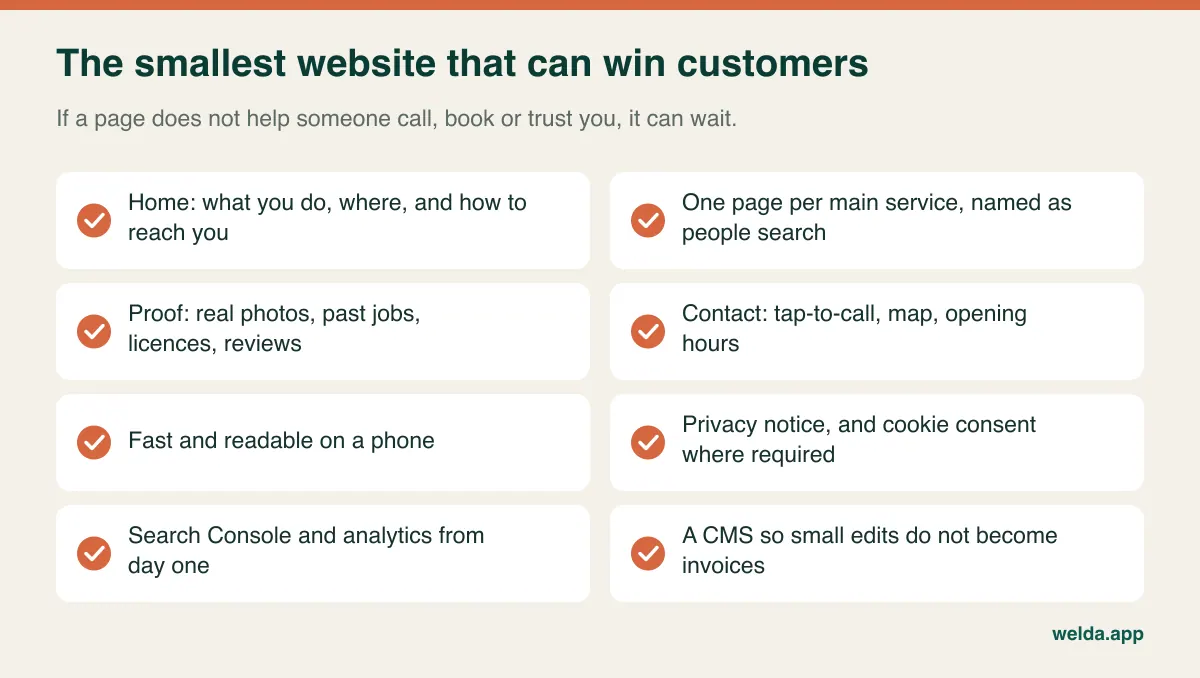
Take a mobile dog groomer working across a few postcodes. She needs a home page that says what she does and where, one page on full grooms and one on nervous dogs, a gallery of actual dogs she has groomed, tap-to-call and a WhatsApp link, and a clear area list. That is the whole site. She has no use for a "Meet the Team" page with one person on it, a news section, or a mission statement.
Now take an independent bookkeeper in a mid-sized American town. Her clients are not in a hurry; they compare two or three people and worry about trust. She needs fewer photos and more explanation: who she works with, what a typical month looks like, what software she uses, what she needs from a new client, and a calendar link for a short intro call. The page count is similar to the groomer's. Almost nothing else is.
Whatever the trade, a few rules hold. Give each main service its own page, named the way customers would say it, because a single "Services" page with six paragraphs cannot answer six different searches. Put your service area and contact route where they can be seen immediately on a phone. Use real photographs. Install Search Console and analytics at launch, since nothing else you do later can be judged without them. Anything beyond this list should have to earn its place with a reason you can say out loud.
What to leave off the first invoice
Everything below can be valuable later. The mistake is buying it before there is a reason. Each item has a trigger: a concrete thing that happens in your business and tells you the time has come.
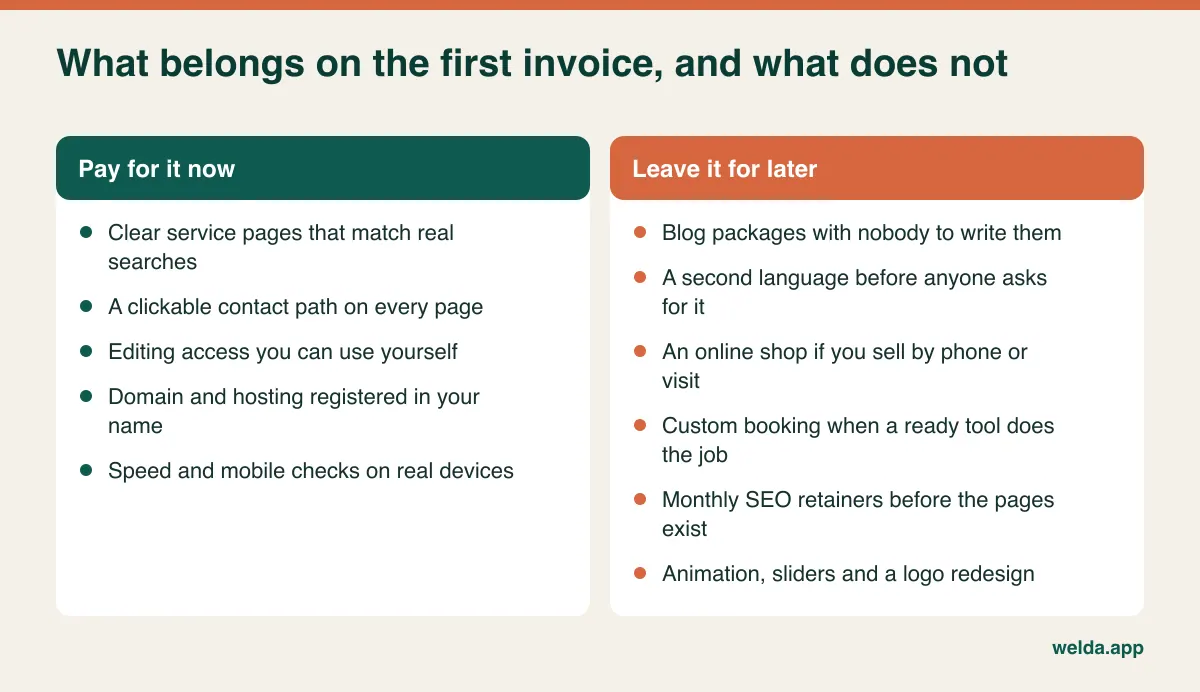
- A blog package. A blog with three posts from two years ago makes a business look closed. Put answers to common questions on your service pages first. Trigger: you hear the same questions every week and somebody has actually agreed to write.
- A second language. Copy, updates and search work all double. A tour operator in a tourist town may need one on day one; a roofer rarely does. Trigger: real enquiries are arriving in that language.
- An online shop. A shop is not a feature. It brings product data, stock, shipping, returns, payments, tax treatment and consumer rules with it. Trigger: people are asking to buy remotely and your margin can absorb delivery.
- Custom booking. A ready-made booking tool linked from your site does the job for most salons, tutors and consultants. Trigger: the ready-made tool is demonstrably blocking how you work.
- A monthly SEO retainer before pages exist. Technical foundations belong in the build. Ongoing work makes sense once there are service pages live and data accumulating. Be wary of anybody promising a specific position; no one can guarantee one.
- Animation, sliders and video backgrounds. They add build time and page weight, and a visitor on a phone with poor signal pays for them. Trigger: you have a genuinely useful video to show.
- A logo redesign. Customers rarely reject a plumber over a logo. If you have no logo at all, that need not hold the site up either: your business name set in a clean typeface will do for launch, and a logo can be added later.
A useful test in any supplier meeting: ask "Which of the items in your proposal would you drop if this were your own money?" A confident team will answer without much hesitation. The reply tells you as much about the supplier as the proposal does.
A cheap site nobody finds is the expensive one
Design cost gets all the attention, yet a new site has no traffic of its own. For a small local firm, first contact often comes through a Google Business Profile, a map listing, a referral or social media. The website's role is usually to close the deal, by reassuring someone who has already half-found you.
That changes how to split the money. Rather than spending the whole budget by launch day, keep some time and some funds for what comes straight after: completing your Google Business Profile (which is free), matching your name, address and phone number everywhere they appear, asking real customers for reviews, and adding photos regularly. A modest site backed by that work will usually do more for a neighbourhood business than a beautiful one nobody sees.
There is also a question of whether you need the site yet. A baker booked solid through Instagram and word of mouth can reasonably wait. A business that wants to be found by strangers searching "emergency electrician near me", or that would be stuck if its account were suspended, has a stronger case. If you are on the fence, try searching for your own trade and town on your phone, and look at what a stranger would actually find about you.
Three routes, and whose time each one spends
The route you pick changes the small business website design cost more than most individual features do, partly because some of the cost is your own time. That is a real cost, though it never shows up on an invoice. An owner who spends six weekends fighting a website builder has not obtained a free website; they have paid in weekends that could have been billable or spent with family.
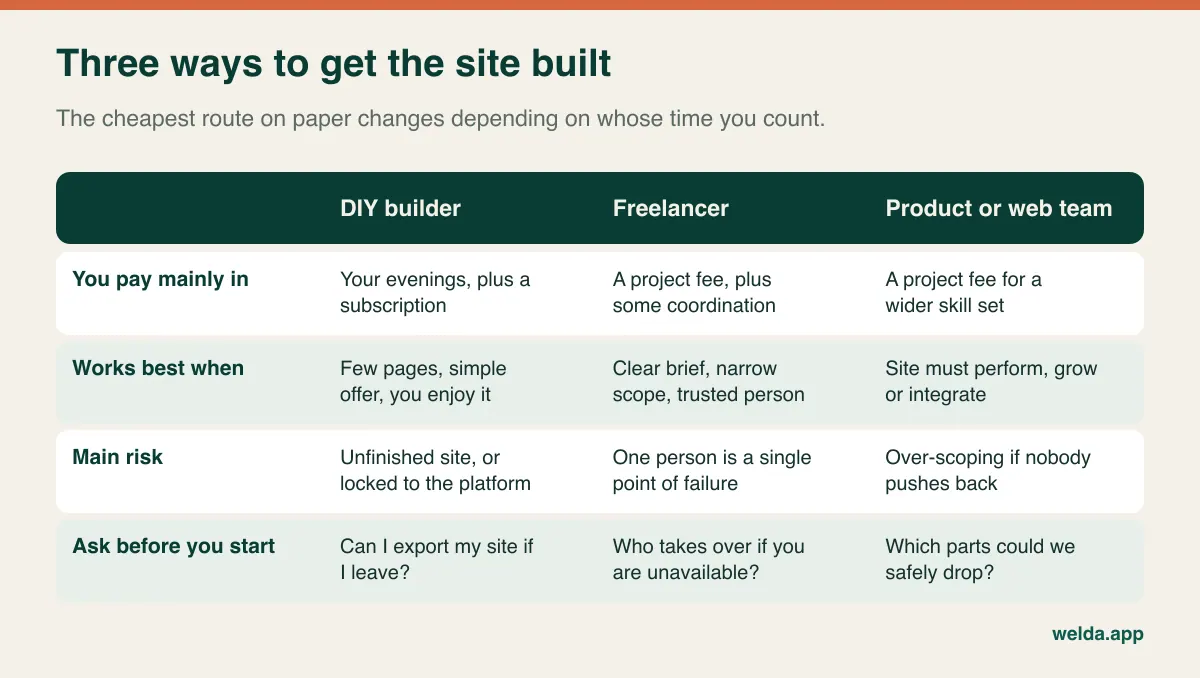
A DIY builder can be the right call, and it is worth saying so plainly. If you have few services, a simple offer and an owner who actually enjoys this kind of thing, start there. Check whether you can export your content if you leave. The usual failure is not a poor website but an unfinished one. Our comparison of a DIY website builder vs hiring an agency goes deeper.
A freelancer suits a tight brief and a person you have reason to trust, ideally one whose earlier sites you can look at and whose clients you can speak to. Agree where the files live and what happens if they are unavailable for a month.
A team makes sense when the site has to perform measurably, is likely to grow, or has to connect to other systems. The risk here runs the other way: a team has more skills to sell, so you need someone willing to push back on scope. That applies to us too.
Welda builds sites from scratch rather than selling template packages, so if your need is a simple online business card and your budget is very tight, a builder may genuinely serve you better for now. We would rather say that in the first call than sell you a site you do not need.
How to make three quotes comparable
Three suppliers will usually quote three different jobs. One includes content upload, another does not. One offers "unlimited revisions" with no definition of a revision. One registers the domain under its own account. If you compare the totals at this stage, you are comparing noise.
The fix takes an hour. Write a one-page scope and send the identical text to everyone:
- The one job of the site, using your sentence from earlier.
- A page list, including which services each page covers.
- Who supplies content. State what you will write, what you need help with, and how many photos you have.
- Forms and connections: contact form, booking link, map, analytics, anything else.
- Things you want to edit yourself, such as hours, prices, staff and photos.
- A required answer to each of these: how many revision rounds are included, what happens to the domain, whether source files or code are handed over, what support looks like after launch, and what happens to the site if you stop paying.
Quotes that come back are now readable side by side. A low one might be efficient, or it might be missing something you will be billed for later, and you can now ask which it is. Our guide to evaluating website proposals covers the fine print in more detail, and once your one-pager is ready you are welcome to send it to us too. To see your own small business website design cost in writing, tell us the scope and we will prepare a quote after a free discovery call.
The bills that arrive after launch
A quote describes the build. The site's cost also depends on the three years after it. Before you sign, ask about each of the following and write down the answers:
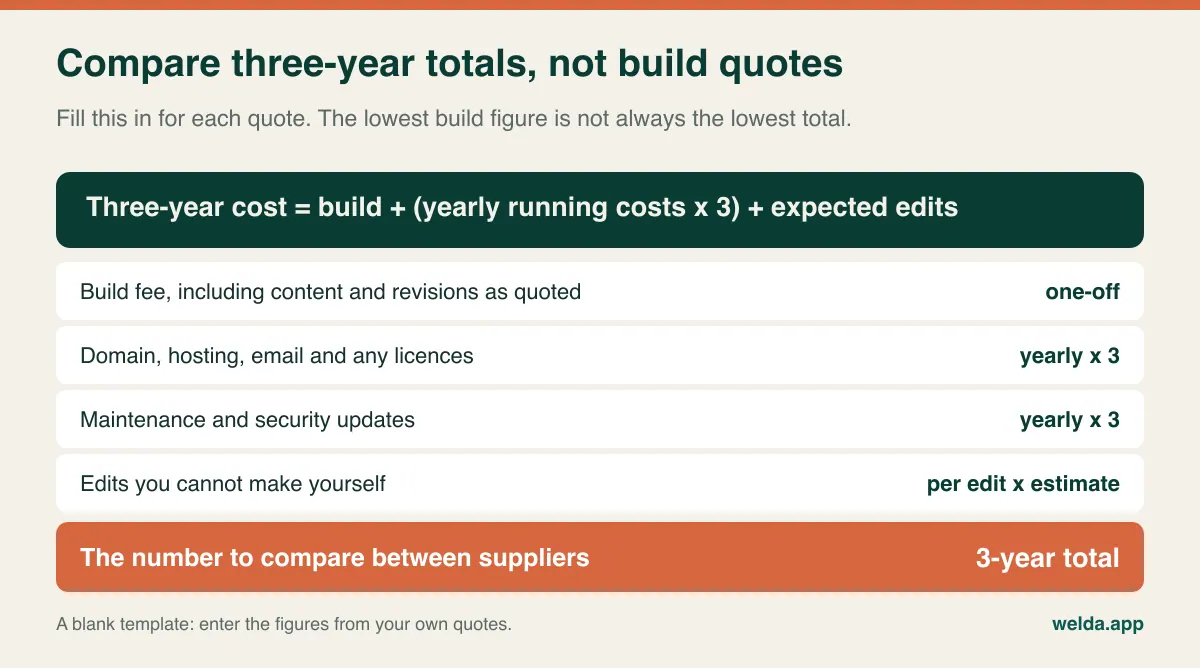
- Renewals. Is the domain, hosting or email included only for the first year? What is the renewal rate, and who holds the account?
- Licences. Are premium themes, plugins or font licences paid annually, and in whose name?
- Security and updates. Software platforms need patching. Who does it, how often, and is restoring from a backup part of that?
- Small edits. If you cannot change your own opening hours, every small update becomes a ticket and possibly a charge.
- Exit cost. If you stop paying a monthly fee, does the site go dark? A rented site can look cheap in month one and be the largest total by year three. Moving to a new supplier without the files can come close to starting over.
Our article on the hidden costs of cheap websites goes through these one by one. The takeaway is simple: three-year total against three-year total, with ownership listed beside it. That comparison beats any published price list, including one with a tempting headline number.
Privacy, cookies and access: the small-site version
Being small does not make you exempt from data rules. The specifics depend on where you and your customers are, so treat this as a general map rather than legal advice. A contact form collects personal data, which generally means you need a clear privacy notice. Analytics and advertising tags can trigger consent requirements in some places, notably under the GDPR in the EU and the UK's equivalent rules, while various US states have their own privacy laws that may or may not reach a business your size.
The cheapest compliance strategy is to collect less. Ask only for what you need to answer the enquiry. Do not add tracking tools you will not look at. Do not put form submissions on a marketing list without proper permission. Accessibility is similar: legibility, sensible contrast, alt text and keyboard-friendly forms cost little when they are built in, and more to retrofit, and rules in several countries are moving in that direction. If you handle health or financial data, or sell online, take specific advice. Our privacy-compliant website guide is a practical starting checklist.
Is it paying back? Use your own numbers
You can test the investment without anyone else's averages. Take your three-year total from above and divide it by the profit you keep from a typical new customer. The result is the number of extra customers the site must bring in across three years. For an electrician with solid margins per job, that number may be comfortably small. For someone selling low-margin, one-off items, it may be large enough to change the scope, or the decision altogether.
Then, after launch, track the steps rather than a page view total:
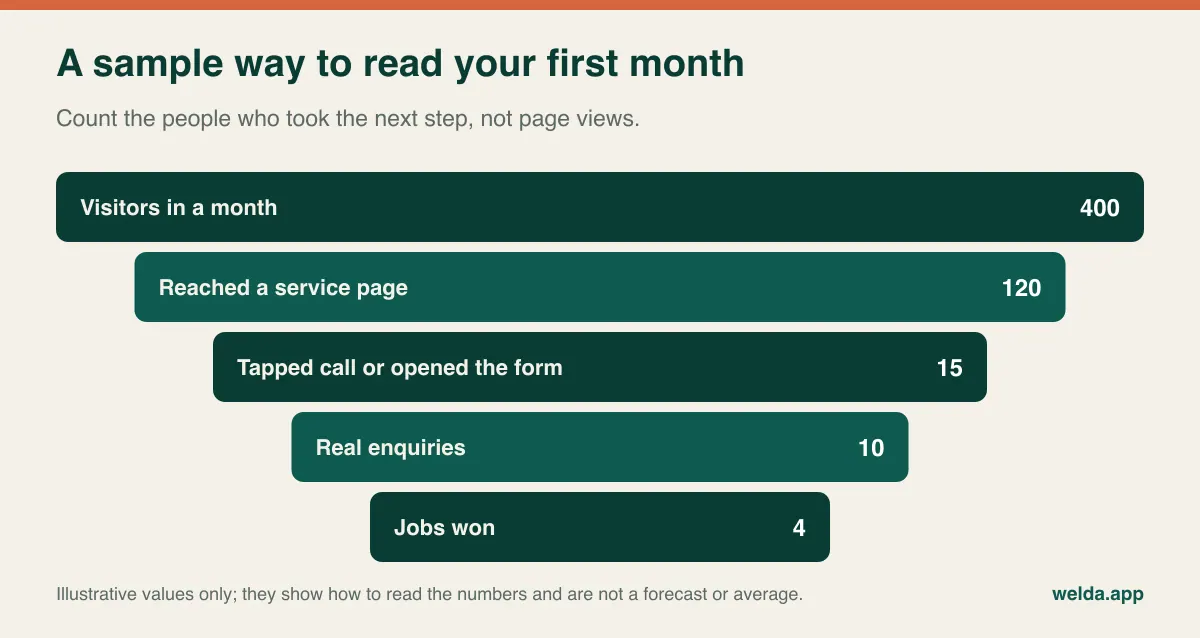
Read that funnel as a diagnostic. It tells you which problem you have, and each one has a different remedy, most of which are not "a bigger website".
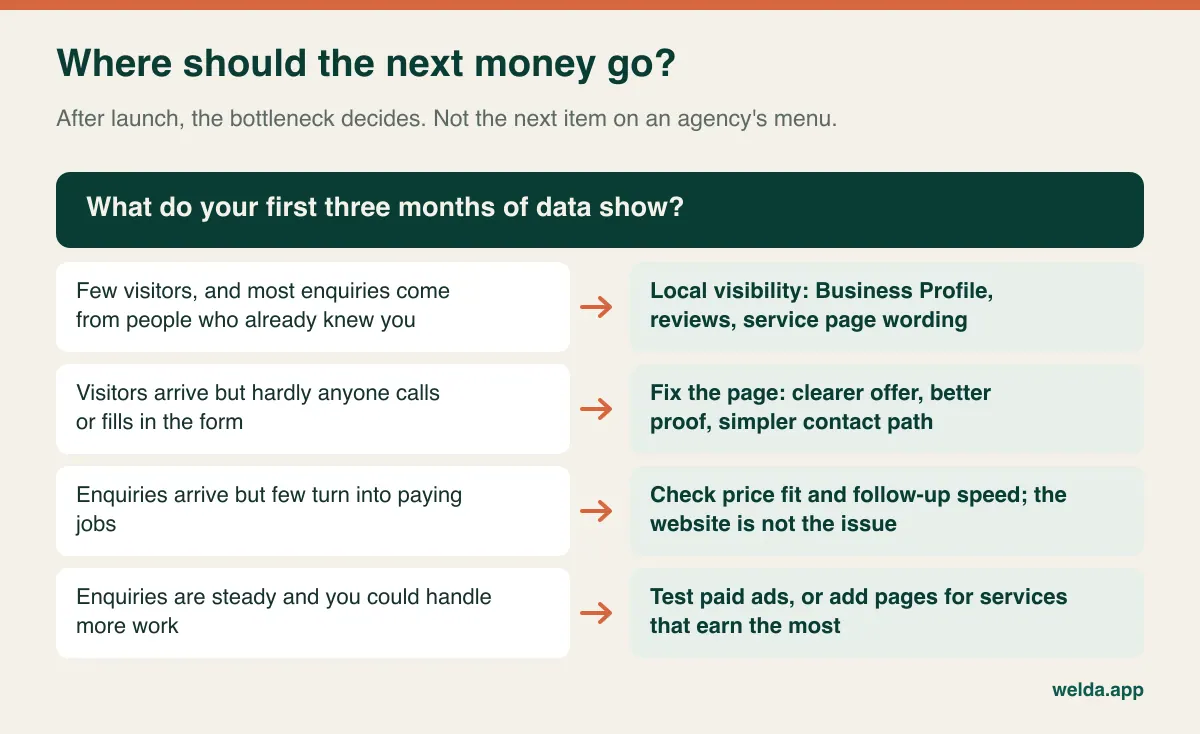
Make one change per quarter. If you redo the home page, launch ads and add five pages in the same month, you will not know which one mattered. This is also where the small-first approach pays for itself: every later addition is a decision with a reason behind it, rather than an item on a package list that seemed sensible in a meeting.
What working with Welda looks like on a small scope
We do not sell fixed packages, so the first conversation is about the job the site has to do and the pages it needs. You get a written quote that lists what is included. The interface is designed in Figma and no code gets written until you approve it. The site is then built on Next.js/React or WordPress, with Search Console and GA4 set up and speed measured with Lighthouse and PageSpeed. You also get a CMS so that you can change text, images and pages yourself, along with a walkthrough for your team. Source code and documentation are handed to you, and you can host wherever you like; optional maintenance packages are available if you would rather not manage updates. Our team is based in Istanbul and also builds our own products, Welda Stock and Welda CRM.
There are also things we will not do. We do not promise rankings, we do not offer legal advice on your policies, and we are not the lowest-budget template option. If that still sounds like a fit, ask about your small business website design cost and describe your business in a few lines. The figure gets settled in a free call, and a good part of that call is often spent working out what can come out of the scope. For the full list of what the service covers, see web design and development.
Frequently asked questions
Why won't you just give a number for small business website design?
Because any number without a scope behind it would be close to meaningless. The same five pages can involve wildly different content, design and integration work. A written quote against a clear scope tells you more than a headline figure, and it is the figure you can hold someone to.
Is a one-page website enough for a small business?
It can be, particularly for a café, a single-service trade or a small local venue. If you offer several distinct services and want to be found for each one, separate pages usually serve you better. A sensible middle path is to launch with one strong page and split out your best-earning service first.
Should I pay for design or for SEO first?
Treat the technical basics of SEO as part of the build: fast pages, clean markup, clear titles and proper setup. Hold off on a monthly retainer until service pages are live and data has started to collect. At that point you can see what is worth paying for.
Who should own the domain and hosting?
You should own the domain, in your name, with your own login. Someone else can manage the technical side, but the account should stay yours. Make sure you can also get your files out, because that is what keeps your options open later.
Can a small site grow later without being rebuilt?
Generally yes, if the foundation is sound and you own it. New service pages, a blog or another language can be added when there is a reason. What tends to force a rebuild is a locked platform or undocumented work, so ask early what adding a page would involve.
How long does a small business website take?
A single landing page can go live within days; a typical small site often takes a few weeks. Content is the usual cause of delay, so having your notes and photos ready is the most effective way to shorten the timeline.