Brand identity design cost depends less on the logo than on how many decisions, deliverables and rights the project covers. Five things move a quote the most: how much strategy is included, how wide the logo system is, how many real-world applications get designed, what rights transfer to you, and how many people must approve the work. That is why any single market figure you find online tells you very little, and why two proposals with the same title can be pricing entirely different jobs.
If you already have a logo but your deck, website, packaging and social posts look like four different companies, you are the reader this guide was written for. It walks through what you are actually paying for, how to tell a thin package from a complete one, what tends to surface after sign-off, and how to put competing proposals on one scale. Your own number comes from scope, and the free consultation is where that scope gets pinned down.
What you are really paying for: decisions, assets and rights
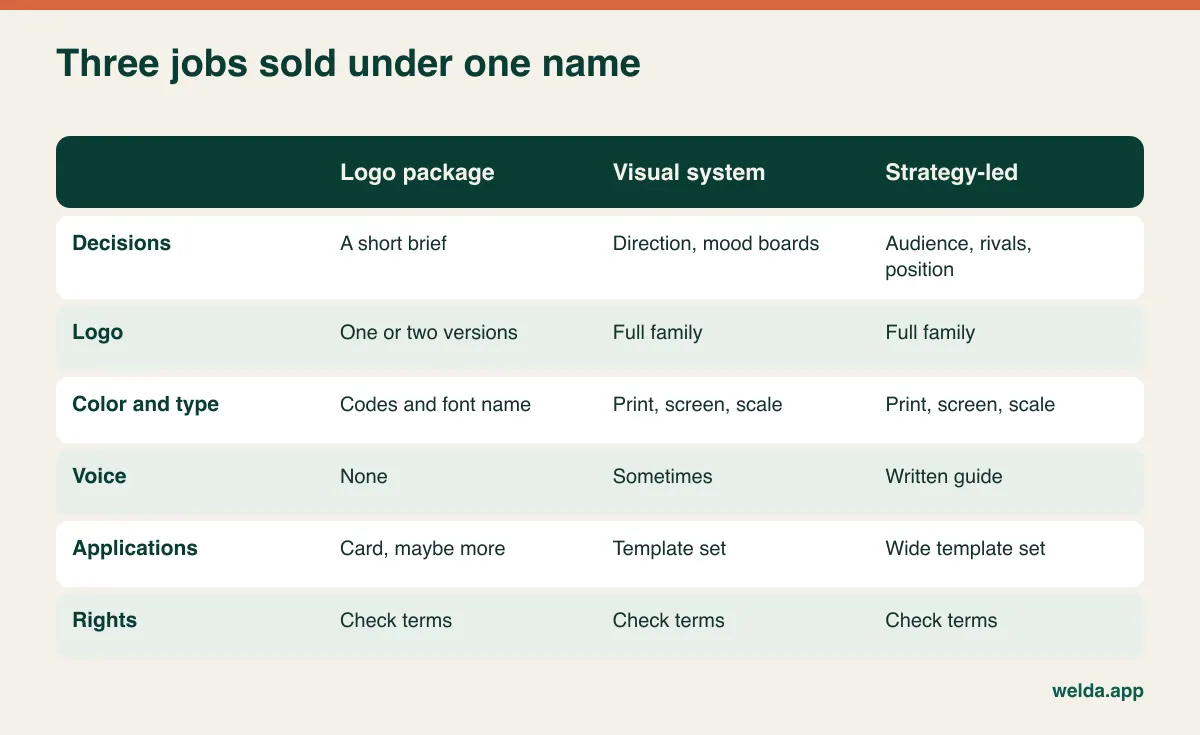
It helps to stop thinking of an identity as a design object and start thinking of it as three separate purchases bundled together. Most confusion about price comes from not seeing the bundle.
Decisions. Who is this brand for, what does it stand against, how should it sound, and how far should it sit from competitors? Someone has to do that thinking. When a proposal includes discovery, audience and competitor review, and mood boards, you are paying for structured decision-making. When it does not, those decisions still get made, only informally, by whoever happens to be in the room when the logo is presented.
Assets. The files you will use: logo versions, palette values, type standards, templates and a guideline. This is the most visible part of the bundle and the easiest to compare, which is why so many buyers compare only this.
Rights. Permission to use, change and pass on everything above. It is invisible on a mockup, and it can matter more than any of the visuals if you ever sell the company or switch designers.
A cheap quote and an expensive quote are often not a low and high price for the same thing. They are different mixes of these three. Before you ask why one costs more, ask which of the three it contains more of.
Five kinds of provider, five cost structures
Provider type shapes a quote before the scope does, because each has a different cost base and a different way of working. None of these is right for everyone, and the honest question is how much coordination your project requires.
Logo generators and template tools. You pay for access to software. These are useful for testing an idea or getting something presentable on a landing page in the first weeks of a business. They do no thinking about your market, uniqueness is limited, and terms vary from tool to tool. Read the license carefully if you plan to register a trademark.
Design marketplaces and contests. You pay for volume and speed, and you get many options with little context. It can work for a low-stakes side project. It rarely produces a system, and the risk of look-alike work falls on you.
Independent designers. You pay for one person's senior attention. This can be an excellent fit when scope is clear, one person decides, and the list of applications is modest. The thing to plan for is continuity: what happens in eighteen months when you need a new template and that person is booked or has moved on?
Boutique studios. You pay for a small team with a defined process, usually including strategy and application design. This tends to suit growing companies with several channels and more than one stakeholder.
Full-service agencies. You pay for coordination across brand, web, content and advertising. If your website and campaigns are being rebuilt at the same time, one team carrying the visual language can prevent a lot of rework. For a narrow project, that same structure can be more process than you need.
A useful test: list what happens the week after handover. If the answer is "our office manager will use a few templates," you do not need the machinery of a large agency. If the answer is "three vendors must apply this across a website relaunch, a trade show and new packaging," a lone freelancer without support may be stretched.
The scope drivers that move a quote the most
Once you know the kind of partner you are looking at, these are the variables that explain most of the remaining spread. A good provider will ask about them early. If nobody asks, treat that as a warning, because the number you were given cannot be based on much.
| Driver | Lighter end | Heavier end |
|---|---|---|
| Strategy | A short brief you write yourself | Interviews, competitor review, positioning and voice work |
| Logo system | One lockup and a mono version | Full family with primary, horizontal, vertical, symbol and single-color versions |
| Applications | Business card and email signature | Decks, proposals, social kits, signage, packaging, vehicle and event work |
| Brand architecture | One company, one name | Sub-brands, product lines, partner or franchise rules |
| Languages and scripts | One language in Latin script | Several markets, including non-Latin lettering |
| Stakeholders | Founder decides | Partners, board or regional leads all sign off |
| Legacy | New business with nothing to protect | Known brand where recognition must survive the change |
| Timeline | Flexible | Fixed launch or trade show date |
Some things should not inflate a number. A long list of initial concepts does not automatically add value; three considered directions usually give you a better decision than ten quick ones. Guideline page count is also a poor proxy. Fifteen pages your team opens are worth more than a hundred they do not. And a simple-looking mark is not a sign of little work, because simplicity that holds up at favicon size and on the side of a building takes the most testing. Our logo design guide explains what to look for in that testing.
Going international changes the brief
Companies that sell across borders often discover late that an identity approved in one market is only a draft in another. If you plan to expand within the next few years, say so in the first conversation, because several of these items are far cheaper to handle during design than after.
Script coverage. A typeface you love may have no Cyrillic, Arabic or Greek, or may treat Turkish, Polish or Vietnamese characters as an afterthought. If your lettering must exist in another script, that adaptation is design work in its own right, with its own review cycle by someone who reads the language.
Name and meaning checks. A word that sounds clean at home can read awkwardly elsewhere. Color associations also shift by culture and category. A quick local review catches the embarrassing cases, and it costs little compared with reprinting anything.
Trademark footprint. Rights are territorial. A clearance search in your home market says nothing about the markets you want to enter next. Depending on where you sell, you may be looking at national offices such as the USPTO or UKIPO, the EUIPO for the European Union, or an international filing route under the Madrid System. Fees and legal counsel belong in a separate budget from design, and our trademark registration guide outlines the process. Ask for professional advice on your specific situation.
Font licensing by territory and domain. Commercial web fonts are often licensed per domain or by traffic, and desktop and app use may be priced separately. A brand running sites on several country domains should check the license terms before the typeface is locked in.
Accessibility expectations. Color choices that fall short of common contrast guidelines such as WCAG can cause problems for readers and, in some markets, for compliance. It is easier to adjust a palette before it appears on everything. The specifics vary by country and sector, so treat this as something to check and not as legal advice.
Local print and production. Paper stocks, standard sizes and color processes vary. US Letter and A4 alone can break a template set that was only tested in one. Ask for both if you operate in both.
Who owns the work when the invoice is paid?
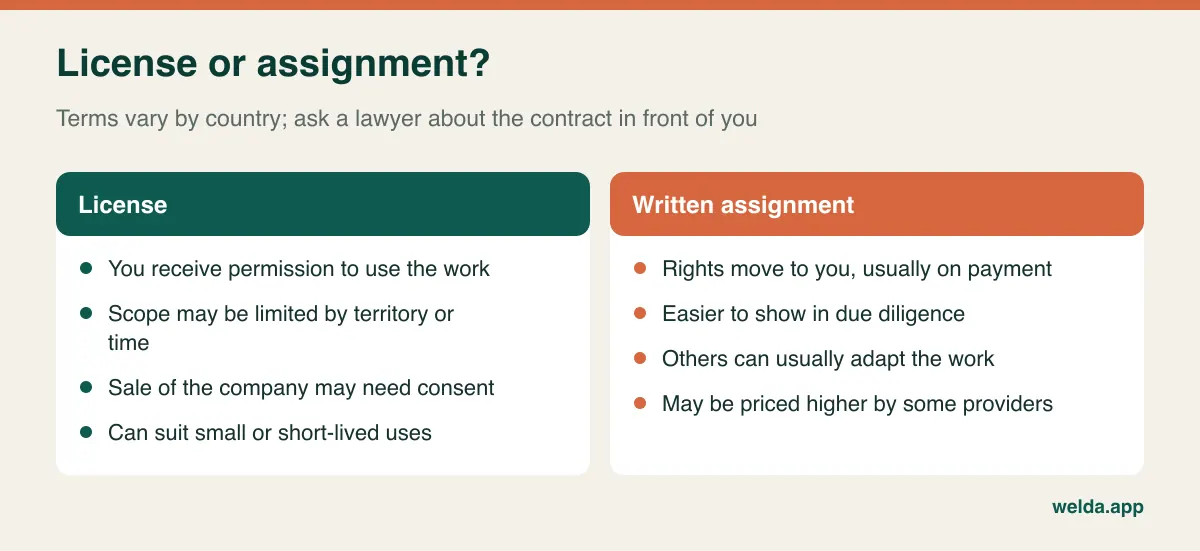
This is the part most buyers skip, and it is the one that can hurt the most. Paying for a design does not automatically mean you own it everywhere, in every form. Copyright rules differ by country. In many jurisdictions the creator holds the rights until they are transferred in writing, and in the US the "work made for hire" doctrine applies to independent contractors only in limited situations. Do not assume that a phrase in an email settles it. Have a qualified lawyer look at anything that matters, but know what you are looking for.
Ask these questions while it is still easy to ask them:
- Is this an assignment of rights or a license? If it is a license, is it exclusive, and is it limited by territory, medium or time?
- Does the transfer take effect on full payment, and does the contract say so?
- Can the rights pass to a buyer if the company is sold or merged?
- Can another designer or your in-house team modify the work later?
- What happens to rejected concepts? Can they be reused for another client?
- May the designer show the work in a portfolio, and from what date?
- Are stock images, icons or fonts in the work licensed separately, and in whose name?
Rights are a real cost driver, which is why you should not treat them as a technicality. Broad transfer may legitimately cost more with some providers, and it is better to see that on the proposal than to negotiate it three years from now, when you have an acquirer asking for the paperwork.
A proposal comparison you can do in an afternoon
Comparing bottom lines first is the classic mistake. Instead, normalize. Start with your own use list before you reread any proposal: which items will you really use in the coming twelve months? A consultancy might list slide decks, proposals, email signatures, LinkedIn templates and a website. A food brand might list packaging, shelf material, trade show graphics and social. That list is your ruler.
Then make one sheet with a row for each item and a column for each provider, and mark every cell as "written," "unclear" or "missing." Each unclear cell becomes a question to send back. Each missing cell becomes a request for a separate figure, so the totals end up describing the same scope. This one step usually changes the ranking, because a low quote that leaves out the presentation template, editable files and rights may stop looking low.
After that, score what remains. A simple weighted score keeps the conversation away from who has the nicest pitch deck. Weight the things that matter to you, and only look at normalized totals after you have scored.
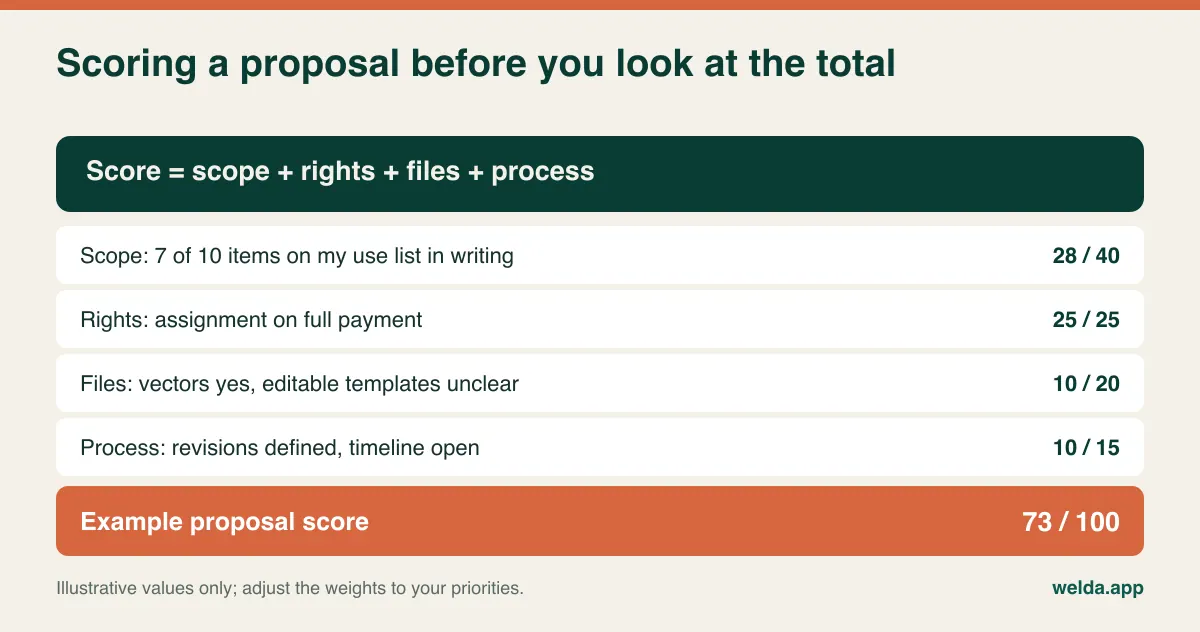
Consider a hypothetical example. A twelve-person software consultancy gets three proposals. The first is a tidy package with a logo and business cards, the second a full system with templates but a limited license, and the third a full system with assignment on payment and editable files. By total alone, the first wins. Against the consultancy's own list, which is heavy on decks and proposals, the first needs several add-ons, the second needs a rights conversation, and the third is complete. Which one they should sign still depends on budget and fit, but now they are comparing real options.
Also put tax treatment, payment schedule, cancellation terms and post-launch support on the same sheet. If you buy from abroad, note the currency and how VAT or sales tax applies, and ask your accountant if you are unsure. When you look at portfolios, check for more than logo mockups. A business card floating on a gray background proves very little; a real deck, a live website and a printed piece prove more.
Costs that appear after sign-off
Most budget surprises come from rollout. Design fees get debated line by line, and then the invoices for everything that the identity touches arrive. It is worth building a rough rollout list before you commit, so the identity you pick is one you can afford to implement.
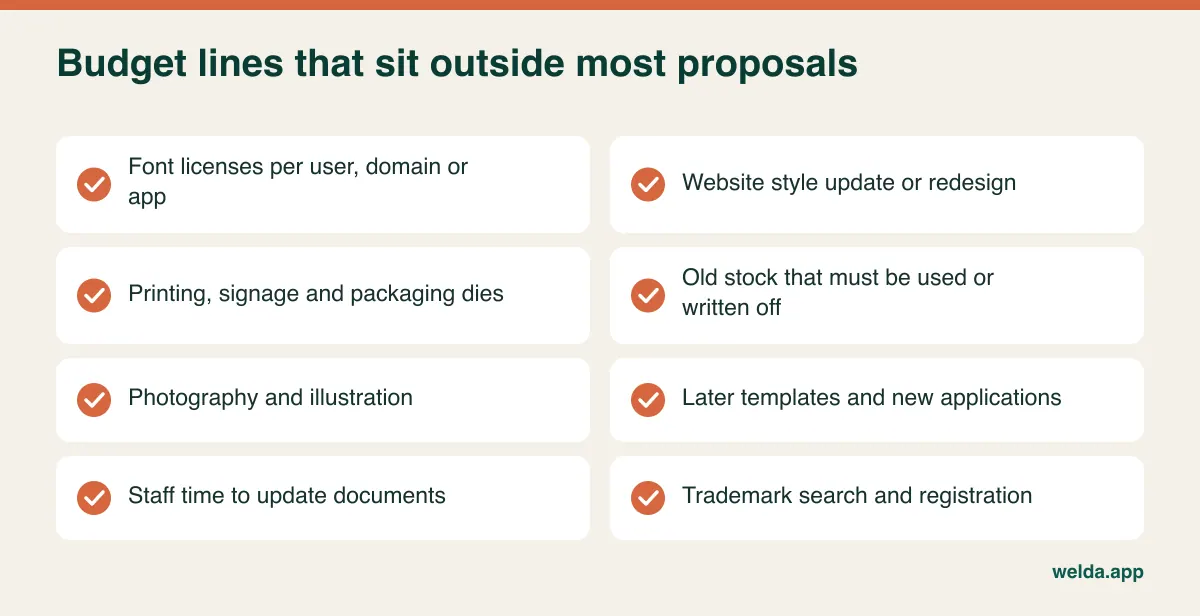
- Font licenses for desktop, web and apps, sometimes per user or per domain.
- Website updates, from a style pass to a redesign, depending on how tightly the old look is built in.
- Print and production, including signage, packaging plates and dies, uniforms and vehicles. Identity proposals rarely include production.
- Existing stock of boxes, labels and brochures that you must either use up or write off.
- Photography and illustration, if the new look depends on a style your current library does not match.
- New applications later. Agree now whether follow-up work is hourly, per item or on retainer.
- Internal time. Updating templates, CRM footers, slide libraries and sales material consumes staff hours, even if no vendor sends a bill.
- Legal and registration fees for trademark work, in each territory you care about.
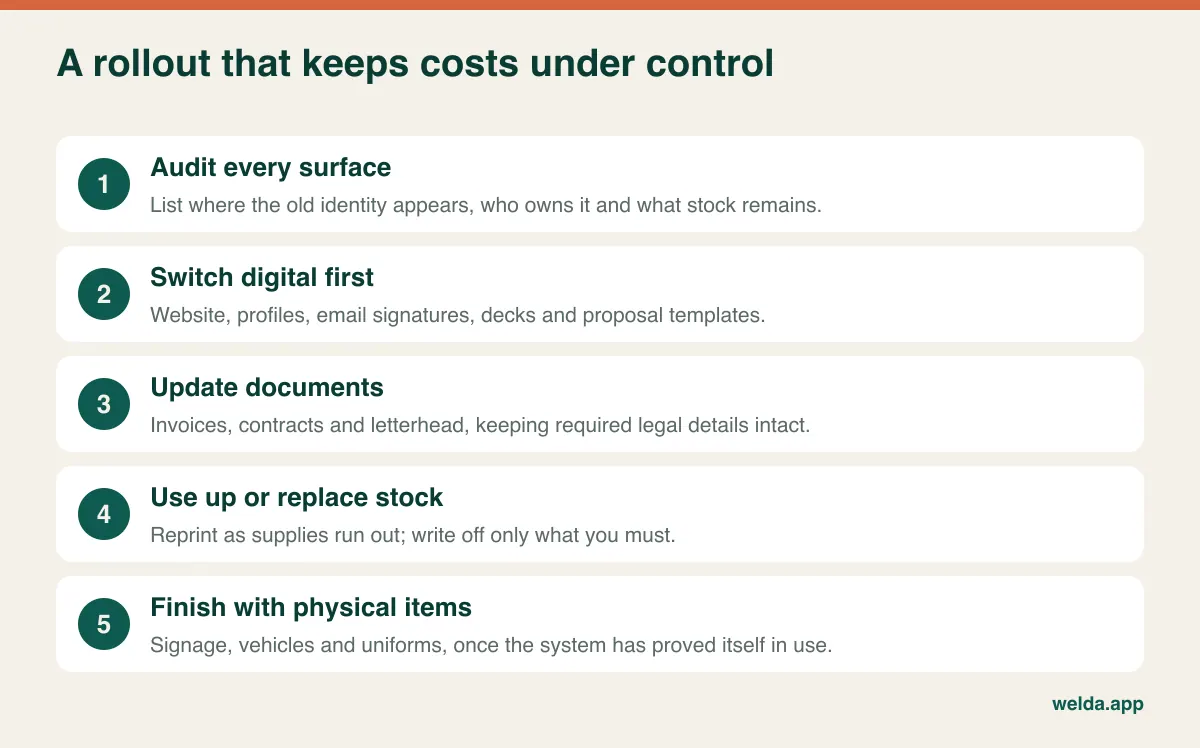
A phased rollout usually saves money. Digital surfaces come first because they are fast to change and quick to correct. Let the identity live for a few weeks in real decks and social posts, because small flaws show up quickly. Only then order the sign that is expensive to change. If you want to go deeper on managing a change of this kind, read our guide to what rebranding involves.
When a smaller project is the smarter purchase
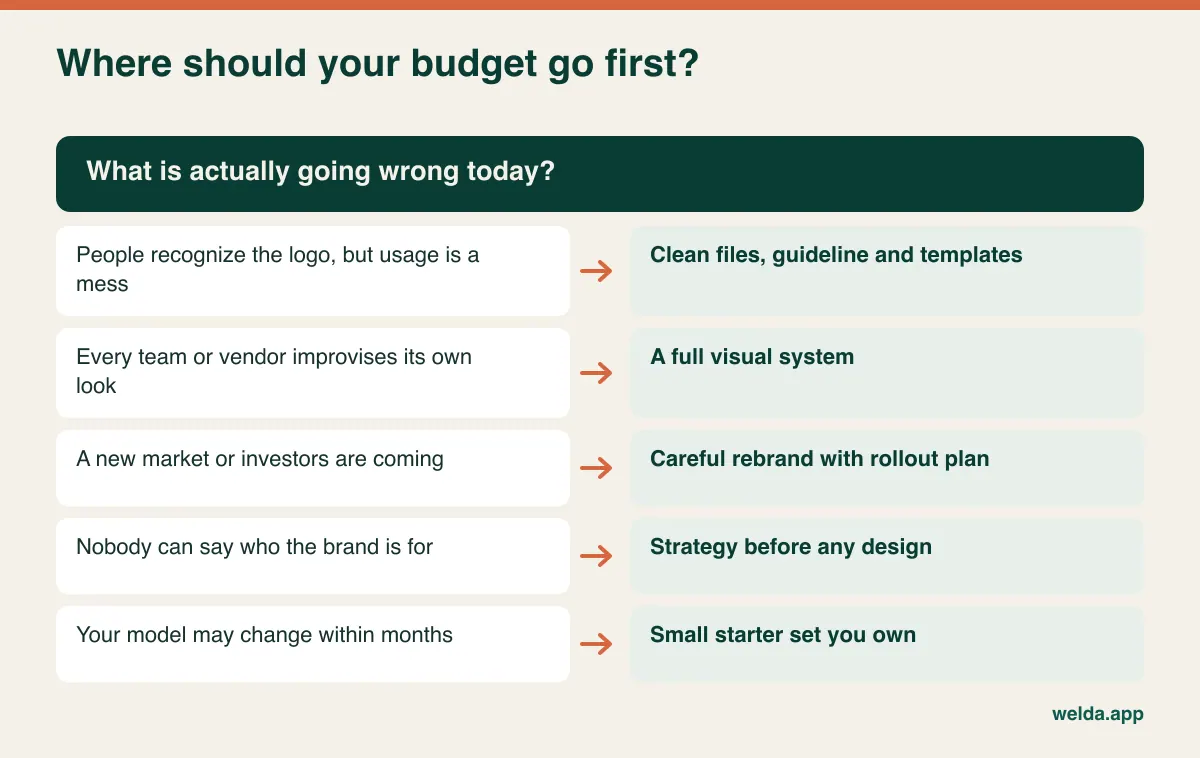
A full identity is not always the right call, and a good provider will tell you so. Here are situations where you should buy less.
Your logo works; your rules do not. If people recognize the mark and the real issue is inconsistent use, you may need only cleaned-up vector files, a defined palette and type, a short guideline and a handful of templates. Our article on what a brand guideline contains can help you see whether that is enough.
Your business model is still moving. If your target customer or even your name could change in six months, a large investment now is premature. A small starter set, with vector files that you own, buys you time.
Nobody will apply it. If you have no one in-house and no recurring design partner, the guideline will sit in a shared drive. Solve who applies the identity first, or include ongoing support in the plan.
You have a narrow, urgent problem. If the trade show is next month, the sensible move may be to fix the booth and the sales deck now and start a proper identity project afterward. Rushing discovery to hit a date is the worst place to save time.
And the opposite case: if you are preparing to raise money, enter a new market, or open locations, or if every new piece of collateral currently starts from zero, then a system usually pays back in less rework and fewer "which logo file is the right one?" emails. That payback is real but hard to quantify in advance, so be wary of anyone who promises a specific return from a new identity.
Questions for your first call
Come prepared with your current logo files, a few recent materials, three brands you like and three you do not, your use list, the names of decision-makers and any hard dates. It also helps to put a few plain counts on one page, because they answer most of what a provider needs to know.
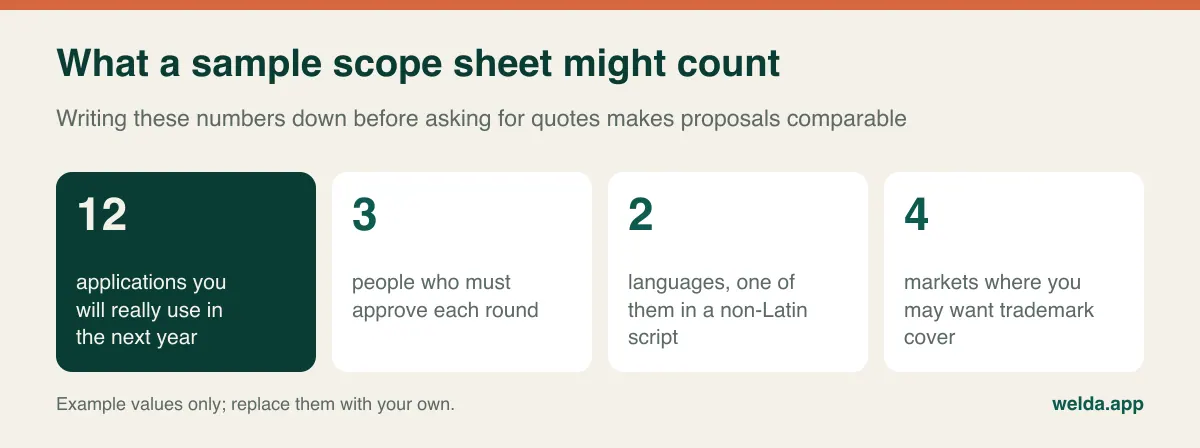
Then ask:
- What exactly counts as a revision round, how many are included, and what happens after that?
- Which files will I receive, including editable templates, and in which formats?
- How is the transfer of rights written, and when does it take effect?
- Who holds the font licenses, and is there a cost on my side?
- How do you test the logo at small sizes and in print?
- Do you run any check for similar marks, and what do you recommend on trademarks?
- Who will actually do the work, and who is my day-to-day contact?
- How do you price requests that fall outside the agreed scope?
The way someone responds tells you as much as the answers. A partner who can explain what is not included, without being asked twice, is usually easier to work with than one who says yes to everything before scoping it.
How Welda scopes an identity project
Welda has no fixed price list for branding. Brand identity design cost depends on scope, the number of variations and applications, and your strategy needs, so we start with a discovery conversation. The work moves through four stages: discovery and brief, concept and direction, design and refinement, then handover with a brand guideline.
The standard deliverables are a logo system with primary, horizontal, vertical, symbol and single-color versions; a palette with HEX and CMYK values; primary and secondary type standards; a brand voice and tone guide; a PDF brand guideline with vector logo files in AI, SVG, PNG and PDF; and applications including a business card, social media templates, email signature, letterhead and presentation template. Revision rounds and scope are set in writing in the proposal, and the full usage rights to the delivered identity are yours. If you want the same visual language carried across your website, social channels and ad materials, that can run from one place too.
Some things are not on that standard list, including trademark filing, packaging, signage production, and non-Latin lettering. If your project needs those, raise them on the call and we will tell you plainly what we can and cannot take on, so you can bring in a specialist where needed. You are welcome to bring competing proposals; the method above works just as well with ours on the sheet.
Frequently asked questions
Why does brand identity design cost vary so much?
Because the phrase covers very different scopes. One quote may include a logo and a business card, while another includes strategy, a full logo family, templates, a guideline and transfer of rights. Only compare totals once the items and rights are aligned.
Should I buy a logo now and a full identity later?
That is a reasonable path if your business is still taking shape. Make sure you receive vector files and color values and that your rights are clear. A system can be built around an existing logo later, as long as the logo holds up at small and large sizes.
What should I prepare to get an accurate quote?
A list of real applications, the number of markets, languages and locations, your current logo files, the decision-makers involved and any deadlines. The more specific you are, the less a provider must pad for uncertainty.
Are unlimited revisions a good sign?
Not necessarily. Unlimited rounds often mean undefined scope and can stretch a project without improving it. A clear number of rounds, a definition of what each round covers and known terms for extras tend to serve you better.
How long does a brand identity project take?
That depends on scope and on your approval chain. A logo alone is faster than a full identity with applications and a guideline. In practice, delayed feedback often extends a timeline more than the design itself does.
Do I need to register a trademark before the design starts?
Not before design starts, but it makes sense to check for conflicts before you commit to a name or mark. Registration is a separate legal process, so ask a trademark professional about the territories that matter to you.
How do I find out what my project would cost?
Share your use list and current materials, and we can define scope and prepare a tailored proposal. You can request a free consultation about brand identity design cost through the service page or get in touch directly. Bring any proposals you already have; going through them line by line makes the conversation faster.